A Heavier White T-Shirt Can Still Turn Sheer in Daylight
Two white tees can feel equally substantial and provide very different coverage. A black-camisole test reveals what an unverified fabric-weight claim cannot.
August 27, 2026 · 7 min read
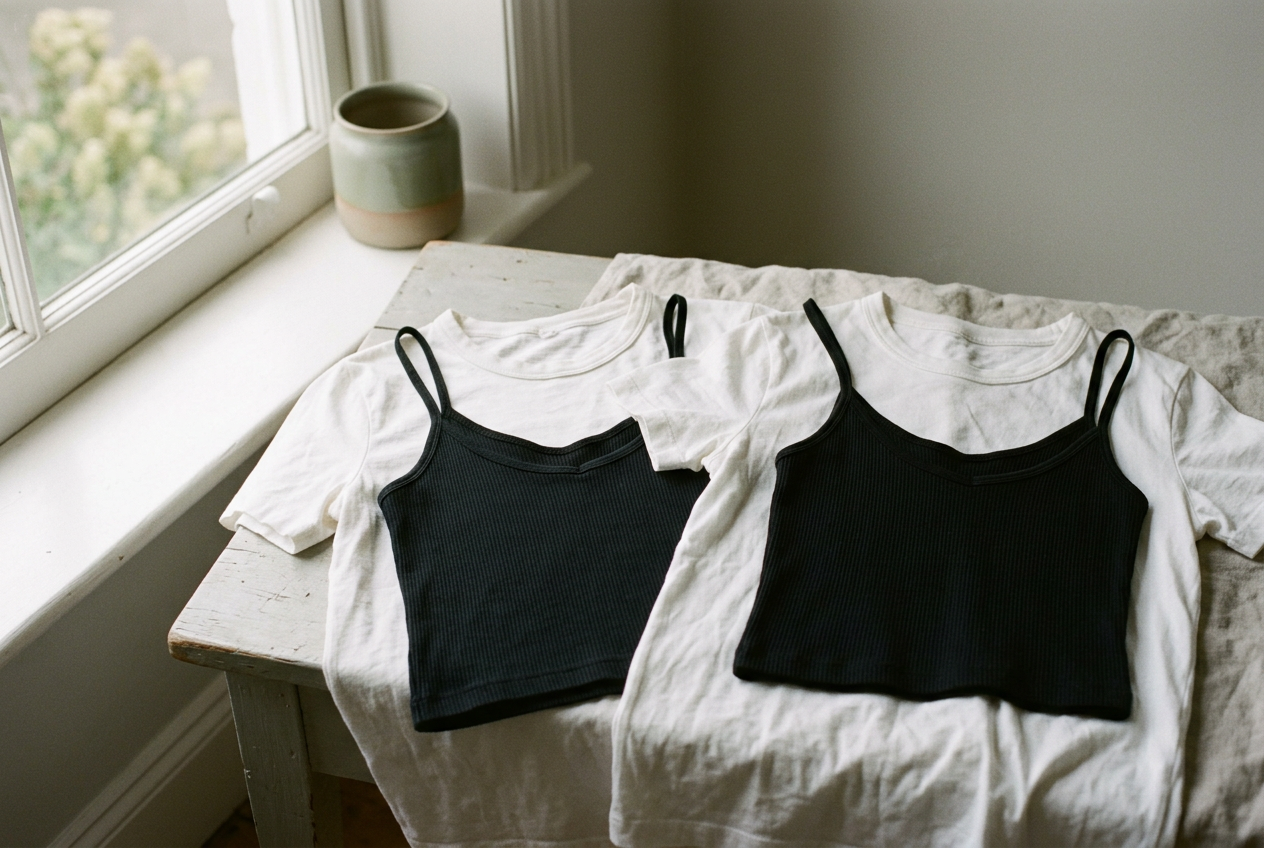
The comparison that changed my shopping method involved two white crewneck T-shirts and one black camisole. Both tees felt substantial in the hand, neither was tissue-thin, and their folded stacks took up about the same space. In a softly lit room, each looked like a dependable everyday basic.
The window told a different story. The all-cotton shirt had a compact, smooth surface and kept the black camisole muted underneath. The softer cotton-modal shirt contained elastane, draped closer to the body and showed a much clearer dark rectangle, especially when I pulled the fabric across the chest and raised an arm.
No verified fabric-weight figure was available for either shirt, which made this a useful real-life case rather than a comparison built around grams per square meter. Grams per square meter, often shortened to GSM, measures how much a square meter of fabric weighs. It can help describe a textile, but it cannot tell you how that material distributes its mass or what happens when the shirt stretches over a body.
Why similar heft can give different coverage
Knit density, meaning how closely the loops of knitted fabric sit together, is the first thing to examine. A dense jersey can use relatively fine yarns while leaving little open space between loops. Another jersey may get its soft, weighty hand from bulkier yarns or a lofted finish, yet contain more room for light to pass through.
That distinction was visible in the two-shirt test. Held loosely against the black camisole, the smooth cotton tee showed a small, regular loop pattern. The cotton-modal blend looked plush from the outside, but its loops became easier to distinguish when the fabric was held near the window. Pulling it sideways made the dark layer noticeably sharper.
Fiber content also changes how a shirt behaves, although a care label cannot predict opacity by itself. Cotton can produce a crisp, compact jersey or a loose, slubby one. Modal, a regenerated cellulose fiber made from plant-derived pulp, often gives a shirt softness and fluid drape, which can make it settle closely around the chest, shoulder blades and waistband. Polyester can be knitted tightly or loosely.
Elastane adds recovery and stretch rather than automatic sheerness, but that stretch may allow a close-fitting shirt to open between its loops.
The yarn matters too. A smooth, tightly spun yarn can create an even field of coverage, while an intentionally irregular yarn may produce thin and thick areas that become apparent against skin. Slub jersey, meaning fabric knitted with yarn that varies in thickness, often has the casual texture shoppers want, though its thinner streaks may transmit more light.
Surface finish can mislead the hand. Brushing lifts fine fibers from the cloth, creating softness and a hazy appearance under store lighting; those raised fibers may scatter reflected light without closing the spaces inside the knit. A polished surface can feel thinner because it lacks fuzz, even when the underlying loops sit more closely together.
White intensifies the issue. Bright fitting-room lights bounce from the fabric’s surface, while daylight coming from behind the wearer travels through the knit and reveals contrast underneath. The shirt has not changed. The direction and strength of the light have.
Start with the dressing-room test
Use the same dark object for every shirt. A black camisole works well because it covers a broad area, but a dark scarf or the unlit screen of a phone can provide a quick comparison. Place it inside the front of the shirt, smooth only one layer of fabric over it and look for the edges of the dark shape. A vague gray shadow suggests more coverage than a crisp rectangle.
Do this with the fabric resting naturally first. Then pull it sideways only as much as it would stretch when worn. The useful result is the change between those two states: if the dark shape becomes sharply defined with a light tug, the shirt may look fine on a hanger but turn translucent across the fullest part of the torso.
Next, try the shirt in the size and underlayer you expect to wear. This advice is unisex because the fabric mechanics are the same across wardrobes, though the points of tension will differ by body and cut. Move rather than posing straight on. Reach forward, lift both arms, sit down if the fitting room permits it and turn far enough to inspect the upper back.
Return to the same black-camisole comparison while the shirt is on. In the softer blended tee, the main failure was not at the relaxed front panel. It appeared across the chest during movement and over the shoulder blades when the arms reached forward, where the knit had to cover more distance.
Look at the side seams as well. A body-skimming shirt can seem opaque from the front while becoming clearer where it pulls diagonally from bust or chest toward the waist. If the hem catches at the hips, the lower front may stretch enough to reveal a waistband or pocket lining. Sizing up can reduce those pressure points, provided the shoulders and neckline still sit where you want them.
Store lighting is only a first pass. Overhead illumination tends to emphasize surface texture and may hide the backlit contrast that appears outdoors, so keep the receipt and check the return policy before removing tags when opacity is a deciding factor.
Finish at a window before committing
At home, wear the undergarment you normally use with a white tee. Start facing a bright window in indirect daylight, then turn so the window is behind you and inspect the shirt in a mirror. A side-on position is useful because it shows where the fabric pulls across the torso rather than hanging freely.
Repeat the movements from the fitting room. The cotton-modal shirt still looked soft and substantial while relaxed, but the black camisole became clearer when daylight sat behind the shoulder and the fabric stretched during a forward reach. The compact cotton tee changed less. That difference was more useful than trying to estimate weight by pinching each hem.
A phone photograph can record the comparison, but do not let it overrule your eyes. Cameras automatically brighten or darken a scene, and two images taken seconds apart may expose the white fabric differently. If you photograph both shirts, stand in the same spot, use the same background and avoid tapping the screen to alter brightness between shots.
Run one final test without the black layer. A nude-to-you undergarment reduces contrast and may make a moderately translucent shirt workable, while white, black and saturated colors are more likely to show. This is a styling decision, not proof that the fabric itself is opaque. If you want to wear the tee without planning an underlayer every morning, judge it against the highest-contrast option you realistically use.
Read the shirt before reading the claim
A product description that says heavyweight may be accurate without promising coverage. Weight can come from dense construction, thick yarn, surface bulk or some combination of them, and the label rarely explains which one you are getting. Treat the word as a starting point.
Hold the body panel near a light source without stretching it. An even field with small, closely spaced loops is a stronger sign than softness alone. Then make the same modest sideways pull used in the dressing room. Wide gaps, distinct vertical channels or isolated thin streaks deserve attention, particularly if the cut is fitted.
Check separate areas rather than assuming the whole garment matches. The front may be doubled only at a pocket, while the back uses the same single layer as the body. Ribbed neckbands look dense because their structure differs from jersey, so a substantial collar says little about torso coverage. Printed graphics can block contrast locally and leave the surrounding white fabric exposed.
Fit belongs in the construction assessment. A dense tee in the wrong size can become less opaque once it is pulled tight, while a lighter shirt with an easy cut may cover better because its loops remain relaxed. If you fall between sizes, compare the shoulder placement and torso tension rather than buying the smaller option for a cleaner outline.
Where budget and investment matter
Paying more can buy better yarn, steadier knitting and a cut that has been tested across sizes, but price does not guarantee daylight coverage. A costly tee with a fluid, close fit may be intended for layering. A budget shirt with a compact jersey and straighter body can pass the black-camisole test.
The investment case becomes stronger when the dense knit also recovers after stretching, the side seams hang straight and the neckline returns to shape. Those are qualities you can inspect. An unsupported weight claim is not worth paying extra for when the seller provides no construction detail and makes returns difficult.
Opacity also carries a comfort tradeoff. The most tightly knitted option may feel warmer and stiffer, while the softer blended shirt can be more comfortable under a jacket even though it needs a low-contrast underlayer. Choose for the way the shirt will be worn, then let the window make the final call.
Questions people ask
Is GSM useful when buying a white T-shirt?
GSM can help distinguish broadly light and heavy fabrics when the figure is verified, but it does not describe loop spacing, surface finish or stretch under tension. Use it alongside fiber content, fit and a light test rather than treating a higher number as an opacity guarantee.
Is a 100 percent cotton white T-shirt always less sheer?
No. Cotton can be knitted into a compact, even jersey or a loose fabric with visible gaps and slubbed areas. An all-cotton label identifies the fiber, not the density, so hold the body panel over a dark layer and repeat the test while gently stretching it.
Should I size up for better coverage?
Sizing up may improve coverage if the current size pulls across the chest, upper back, stomach or hips. It will not fix a loosely knitted fabric that is translucent while relaxed, and the larger size may create unwanted shoulder drop or a wide neckline. Compare both sizes in motion.
Can the right bra or undershirt fix a sheer white tee?
A nude-to-you underlayer lowers contrast and can make moderate translucency less noticeable. It cannot turn an open knit opaque, particularly in strong backlight. Test the shirt with your usual undergarment, then repeat with the black camisole if you want to separate styling help from the fabric’s coverage.
One update a day
Today's fashion update, in your inbox
One fashion update each morning — no hype, no filler, just pieces worth wearing.