A White T-Shirt Can Pass the Light Test Before You Try It On
A dense knit matters more than a premium claim. Four quick checks reveal whether a white T-shirt will turn sheer, lose shape or look worse when sized up.
October 5, 2026 · 8 min read
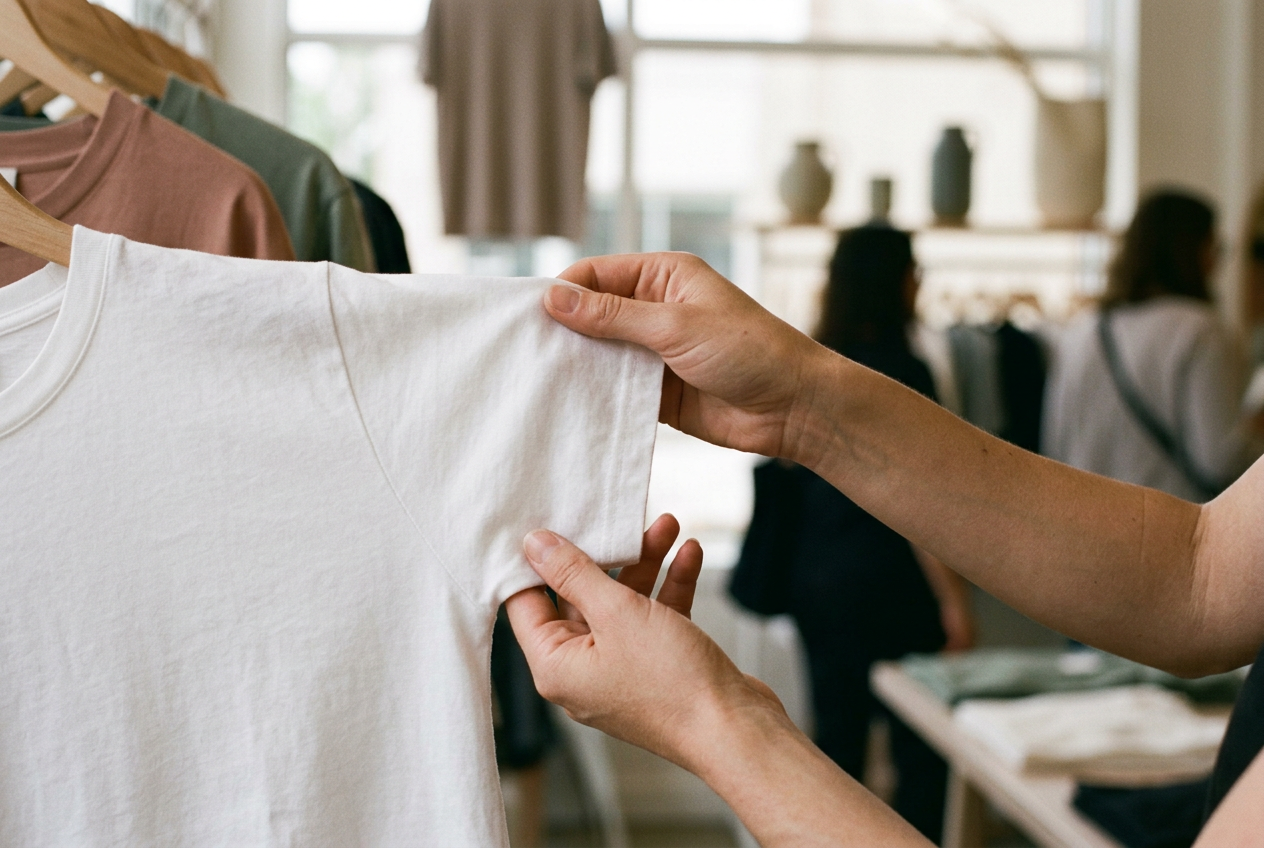
My test case was a plain white 100 percent cotton crew neck, cut from fine single jersey, meaning the face shows tidy knit stitches while the reverse has small horizontal loops. I compared my regular size with the same shirt one size larger, first on the hanger and then over a matte, skin-tone base layer with dark trousers. The regular size pulled slightly across the upper chest; the larger one removed that tension but created a loose fold beside the waistband that looked more transparent under side lighting.
That result is useful beyond one tee. This is unisex advice: the store tests work in women’s and men’s departments, though bust, shoulder and stomach tension can change which size keeps the knit most closed.
Start with density, not softness
Fabric weight is useful, but most shoppers will not have a grams-per-square-meter figure on the care label. Use your hand instead. Lift the shirt by a shoulder seam and gather a section of the body loosely into your palm, without crushing it. A denser jersey feels compact for its thickness, with enough substance that the bundle settles rather than floating or collapsing into a slippery handful.
Compare it with another white tee from the same rack or department. This relative check is more reliable than deciding whether one shirt feels “heavy,” because a brushed finish can make lightweight cotton feel plush while a smooth, tightly knitted surface may feel cooler and less impressive. Softness tells you about the finish. It does not confirm opacity.
Return to a single layer at the lower front, away from the hem. Rub it lightly between finger and thumb. If your fingertips can map each other clearly through the fabric, the knit is thin or open enough to deserve a light test. The cotton crew neck in my comparison felt smooth rather than fluffy, but the cloth resisted that fingertip definition; its density was easier to notice at the body than at the doubled hem.
Do not judge from the hem alone. Hems contain folded fabric, so almost every white tee looks reassuringly solid there, including shirts whose single-layer body turns translucent over a waistband or bra edge.
Stretch the knit and watch it return
Hold a small section near the side of the lower body, where pulling will not distort the neckline. Ease it gently across the width, then let go. Stretch recovery, the fabric’s ability to return toward its original shape, matters because loops that stay spread apart admit more light and may remain visibly strained after sitting, reaching or tucking.
Watch the spaces between stitches while the fabric is under mild tension. A dense cotton jersey can become more transparent when pulled, yet its surface should still look even, without obvious pinpoints of light or long gaps forming between rows. After release, the edge should settle without rippling. Cotton blended with a little elastane may snap back faster, but fiber content alone is no guarantee; an open knit with stretch can still be sheer.
The regular-size test shirt lightened across the upper chest because tension opened the knit. Once released, it recovered cleanly. That suggested the fabric itself was stable and the issue belonged to fit, which is a better reason to try another size than a vague impression that the cotton feels expensive.
Read the ribs separately
A rib knit has alternating raised and recessed columns that let fabric expand across the body. If the entire tee is ribbed, separate two columns gently with your fingers and inspect the valley between them. A substantial rib can look opaque while relaxed, then expose pale channels when stretched across the chest or stomach. In that case, the fitting room still matters.
On a jersey tee, the ribbed crew neck offers a different clue. Fold the collar lightly and release it. A firm collar should regain its curve rather than holding a crease or flaring outward, although this says more about shape retention than body opacity. The narrow collar on my cotton test shirt recovered well, while its body remained softer and more fluid.
Treat those two fabrics as separate evidence, even when they are both listed as cotton.
A chunky collar also cannot rescue a weak body. Some low-cost tees put their most substantial fabric where shoppers touch first, then use a lighter jersey through the torso. Pinch the body and collar in turn. The difference need not be small, but it should make sense for the design rather than conceal how little cloth sits below the neckline.
Use store light without turning it into a flashlight test
Hold one layer of the shirt between your eyes and a broad ceiling light, keeping the fabric about a hand’s width from your face. You are looking for an even glow. Tiny bright points suggest an open or irregular knit, while large cloudy patches can reveal uneven density or areas stretched by the hanger.
Next, place your hand behind the body at normal reading distance. A workable everyday white tee may show a soft shadow because white cotton is rarely a blackout material. Clear finger edges, visible nail color or strong contrast between skin and the dark care label indicate that underwear and waistbands will probably show as distinct shapes.
Skip the phone flashlight. Its concentrated beam is harsher than most daylight or indoor wear conditions and can make a perfectly serviceable shirt fail. Diffuse store lighting gives a more useful comparison, especially when you test two tees in the same position. If one shows your fingers sharply and the other reduces them to a muted shadow, the second is the safer choice even if both carry the same “premium cotton” wording.
The cotton crew neck passed this test through the flat center front. At the side seam, where the larger size hung away from the body, the fabric caught more backlight and the dark waistband became easier to read. The cloth had not become thinner. Its position changed the contrast.
Sizing up can trade stretch for shadow
A larger size often improves opacity when the original fit pulls hard enough to spread the knit. It does not improve every white tee. Drape, the way fabric hangs and folds under its own weight, changes with added width and length, and loose cloth can move away from the skin into brighter planes beside darker folds.
That is what happened with the larger cotton tee. The chest looked more even because the stitches were no longer under tension, but surplus fabric collapsed above the trouser waistband, making alternating bright and dark areas that drew attention to the layer underneath. From the front it was acceptable. Under side lighting, it looked less opaque than the regular size, despite having the same fabric and more room.
Dropped armholes can add another problem. Extra width may expose the side of an undershirt or bra rather than cover it, while a deep fold behind the arm can place a dark shadow directly beside a brightly lit section of white cloth. If your regular size only strains at one point, a different cut with more chest room or straighter side seams may work better than scaling up the whole garment.
Judge the fit in motion once you reach the fitting room. Raise your arms, sit, and make the tuck you would wear outside the store. Look at the shirt from the side as well as straight on. The useful size is the one that keeps the knit from stretching without producing enough loose fabric to create high-contrast folds.
Spend for construction you can verify
At the budget end, a white tee that passes the density, recovery and light checks can be a sound buy, particularly if you expect stains or collar discoloration to limit its life. Paying more makes sense when the body knit is consistently dense, the collar returns cleanly and the cut gives you room where you need it without adding loose fabric everywhere else.
Premium language by itself is not worth the difference. “Long-staple,” “combed” and “luxury” may describe fiber or processing, but none tells you how tightly the final cloth was knitted. A higher price can buy better cotton and cleaner sewing while still leaving you with a light, intentionally airy shirt. That may be desirable for layering.
It is the wrong investment if your goal is one white tee worn on its own.
For online orders, inspect close-up fabric photos and look for garment weight or knit details, then keep the return window in mind. A retailer’s opacity claim is less useful than a clear image of the unstretched body against skin, and sizing reviews cannot predict how folds will sit on your torso.
Questions people ask
Is a heavier white T-shirt always less sheer?
No. Weight helps when it comes from a dense, even knit, but thick yarn arranged loosely can still admit light. Compare a single layer at the body, then stretch it gently. A compact tee should blur your hand behind it and return without leaving widened gaps.
Should
I size up in a white T-shirt to stop it looking transparent?
Size up when tension is opening the stitches across the chest, shoulders or stomach. Stop if the larger size creates dropped armholes or deep folds around a dark waistband, since those changes can make the underlying contrast more visible. A roomier cut in your usual size may work better.
What should I wear under a white T-shirt?
A matte base close to your skin tone usually creates less contrast than bright white or black underwear. Smooth edges also show less clearly through fine jersey. The shirt should still pass the hand-and-light test on its own; the base layer reduces visible outlines, but it cannot make an open knit dense.
One update a day
Today's fashion update, in your inbox
One fashion update each morning — no hype, no filler, just pieces worth wearing.