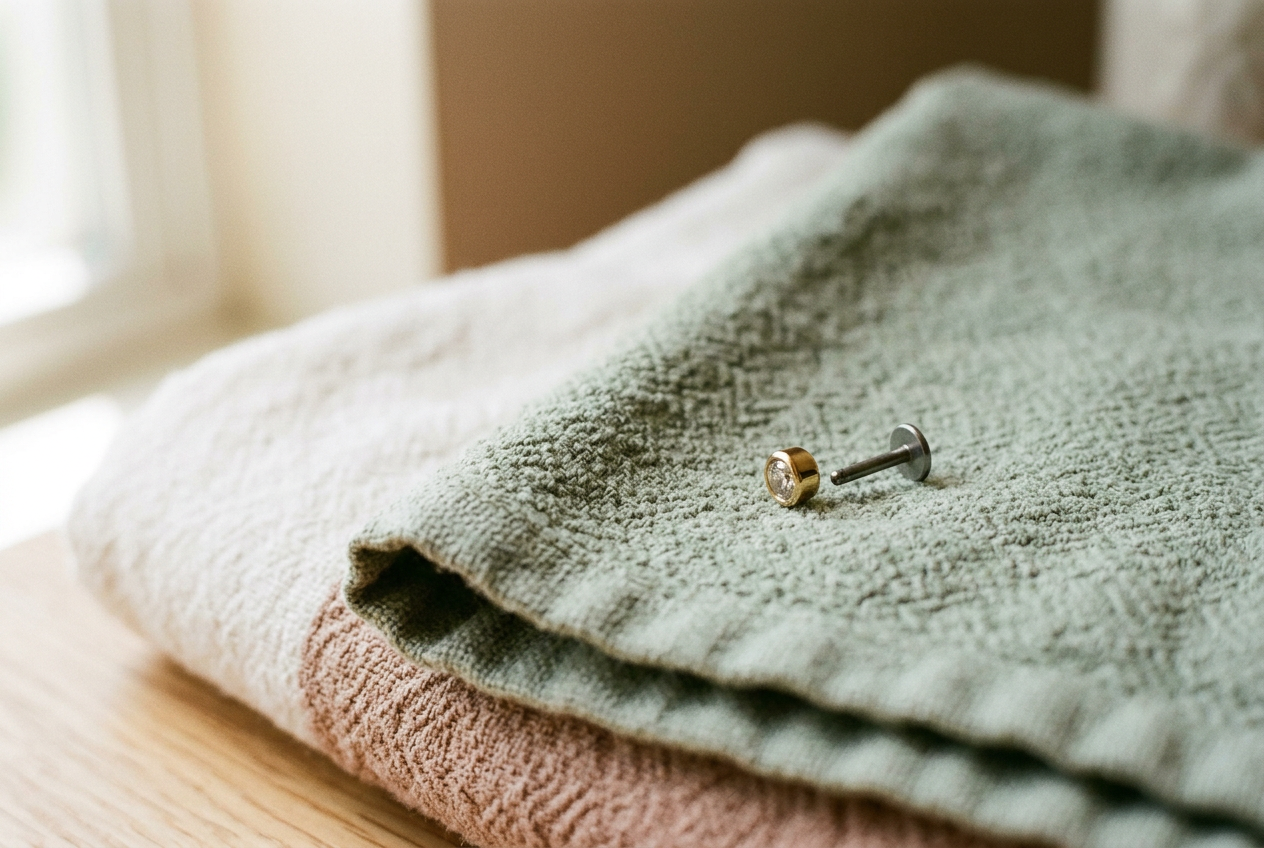
Your Threadless Earring Pin Needs Less Bend Than You Think
A shallow midpoint bend creates the tension that holds a threadless labret together. Here is how to set it, test it off the ear, and spot a weakened pin.
August 27, 2026 · 7 min read
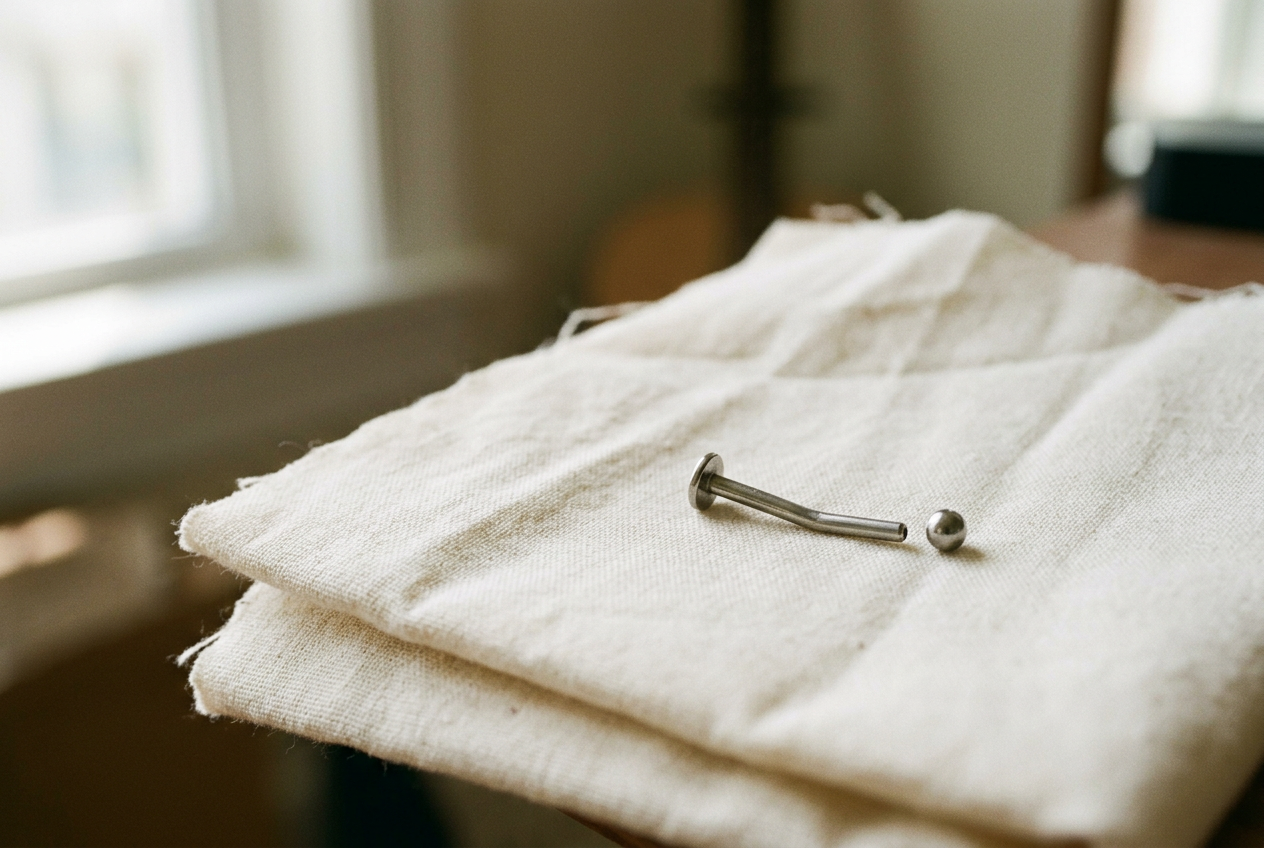
The important detail is almost too small to see. On the implant-grade titanium flat-back labret on my desk, the narrow pin beneath the decorative ball is not straight. It has a slight, smooth offset around its middle. That bend presses against the inside wall of the post, creating the friction that keeps the two pieces together.
A threadless labret, meaning a straight hollow post that accepts a pressure-fit decorative end, has no screw threads to tighten. The flat back sits flush against the ear, while the pin attached to the front end slides into the post. This advice is unisex because the mechanism does not change with styling, placement, or wardrobe.
The bend should be subtle. A pin folded into a visible angle is already too far gone.
Start with the post, not the ear
Remove the jewelry before adjusting it. Working while the post is in your piercing puts pressure on the channel, and it gives you no clear view of whether the pin is bending smoothly or developing a kink. For a fresh or irritated piercing, leave the fitting to a professional piercer rather than repeatedly removing and reinserting the jewelry.
Wash and dry your hands, then clean the jewelry according to its maker’s instructions. Work over a folded towel or tray. Threadless ends are tiny, and a polished ball or stone setting can bounce from a hard counter before you register that it has slipped.
Check that the post is intended for the pin. Threadless systems are widely used, but fit can vary among manufacturers, and mixing an end with an unfamiliar post may produce a connection that is loose even after adjustment. A bend cannot correct a damaged, oversized, or incompatible opening.
Inspect the pin under bright light. It should look smooth from the base of the decorative end to its tip, without a sharp elbow, flattened patch, split, or rough edge. The hollow post should also remain round at its opening. If either component is visibly damaged, stop there.
The titanium labret on my desk gives a useful baseline: its post stays straight, its opening stays circular, and only the narrow pin receives the bend. Bending the labret post itself can make the flat back sit crooked and may prevent compatible ends from fitting later.
Put the bend near the middle
Slide the pin into the post until roughly half of its length remains exposed. The post now supports the lower section of the pin and places the adjustment around the midpoint, rather than directly beside the decorative setting or at the delicate tip.
Hold the post firmly. Apply light sideways pressure to the decorative end, using the post as the support point, then remove the pin and inspect it. The goal is a shallow, continuous bend. It may register more as a change in line than as an obvious angle.
Do not fold the pin against the rim of the post. A hard crease concentrates stress in one spot, while a gentle bend creates spring tension across a broader section as the pin travels down the hollow shaft. Avoid grabbing the pin with ordinary pliers, which can score or flatten such a small component unless the jewelry maker specifically calls for a suitable tool.
Placement matters. A bend very close to the tip can catch at the post opening instead of sliding inside, and a bend directly beneath the decorative end puts repeated strain at the pin’s fixed base. The supported halfway method keeps the curve in the working portion of the pin.
For the small ball end on my desk, the first adjustment is barely visible. That is enough to begin testing. Adding tension in tiny increments takes another minute; correcting an aggressive kink may require replacing the entire end.
Test retention before wearing it
Insert the pin into the empty post while holding both pieces over the towel. Pressure should increase as the bent section enters. Push the end fully home so there is no visible gap between the decoration and the post.
Some combinations give a faint click or a distinct final seat. Others do not. Sound is less useful than resistance: a secure end should not fall out when the assembled labret is turned downward, and it should stay together under a light, straight pull with your fingertips.
Keep that pull modest. This is a retention check, not an attempt to prove the jewelry cannot be separated. You should still be able to remove the end intentionally by gripping the post and front, then pulling them straight apart with controlled pressure. Excessive force can bend the post, strain the pin, or send the decorative end across the room when it releases.
If the end slips out with almost no resistance, separate the pieces and add another very slight bend at the same midpoint area. Reassemble and test again. Do not keep bending different sections of the pin, because several small angles can create a wavy profile that drags through the post without giving predictable tension.
If the pin stops partway, do not force it. Remove it and look for too much curvature, a kink, or a mismatch between components. A correctly adjusted pin should feel snug, but it should travel all the way into its intended post.
Once the labret passes the off-body test, insert the post into a healed piercing and press the front into place. Check that the decorative end sits flush against the post rather than hovering above it. The back disc should rest according to the post length; pin tension cannot fix a post that is too short and pressing into tissue, or one so long that it catches and tilts.
Know when another adjustment is one too many
Metal tolerates some reshaping, but it does not welcome endless back-and-forth movement. Repeated bending can cause work-hardening, meaning the metal becomes less able to flex in the adjusted area, and the pin may eventually crack rather than spring against the post wall.
Replace the end if the pin has a sharp kink, a visible crack, a rough stress mark, or a section that no longer returns to a smooth curve. Retire it as well if it repeatedly loosens after having held securely in the same compatible post. More bend is not a sensible answer when the pin’s shape keeps changing during ordinary insertion and removal.
Pay attention to the base beneath the decorative ball or setting. Any movement there is more concerning than a controlled curve through the middle, because the pin is attached at that point. A loose or leaning pin can place uneven force on the setting and should be assessed by the seller, manufacturer, or a piercer who stocks compatible parts.
The desk labret is still serviceable because its pin has one shallow midpoint bend and retains the same shape after assembly. If I had to adjust it every time I changed the front, I would replace that decorative end rather than keep coaxing tension from weakened metal.
The tradeoff against threaded jewelry
Threadless jewelry is quick to assemble once the tension is right, and there are no tiny screw threads to align behind the ear. It also asks the wearer to judge a mechanical fit. Too little bend lets the end escape. Too much makes removal difficult and stresses the pin.
An internally threaded labret, whose screw threads sit inside the post rather than on its exterior, is the practical alternative for someone who prefers a front that twists into place. It still needs compatible parts and periodic checking, but retention depends on engaged threads instead of a flexed pin. Neither system compensates for poor post length, damaged jewelry, or an irritated piercing.
For an everyday flat back earring, meaning the post’s backing sits flush against the earlobe, the threadless system earns its convenience only when the connection can be tested without drama. One smooth bend. Firm insertion. A controlled release.
Questions people ask
How much should a threadless earring pin bend?
Use the smallest bend that creates firm resistance inside the post. It should be a shallow curve near the midpoint, not a sharp angle. Start by inserting the pin halfway into the post, applying light sideways pressure, and testing the connection before adding more.
Should a threadless earring click into place?
It may click or feel as though it settles at the end, but not every compatible combination makes a sound. Judge the fit by resistance instead: the front should sit flush, remain attached when turned downward, and withstand a light straight pull while still allowing controlled removal.
Can
I adjust a threadless pin while the earring is in my ear?
Remove it first if the piercing is healed. Off-body adjustment protects the piercing channel and lets you inspect the pin for a smooth bend. For fresh, swollen, painful, or irritated piercings, ask a professional piercer to check the jewelry and post length.
When should I replace a bent threadless end?
Replace it when the pin has a kink, crack, rough stress mark, movement at its base, or a curve that changes after normal use. An end that keeps loosening in the same compatible post has moved beyond routine adjustment, even if another bend briefly restores tension.
One update a day
Today's fashion update, in your inbox
One fashion update each morning — no hype, no filler, just pieces worth wearing.