A Green Earring Post Does Not Mean the Whole Earring Failed
Green at the post usually points to exposed copper alloy where friction and moisture have worn the plating. Cleaning removes residue, but it cannot replace missing metal.
October 31, 2026 · 7 min read
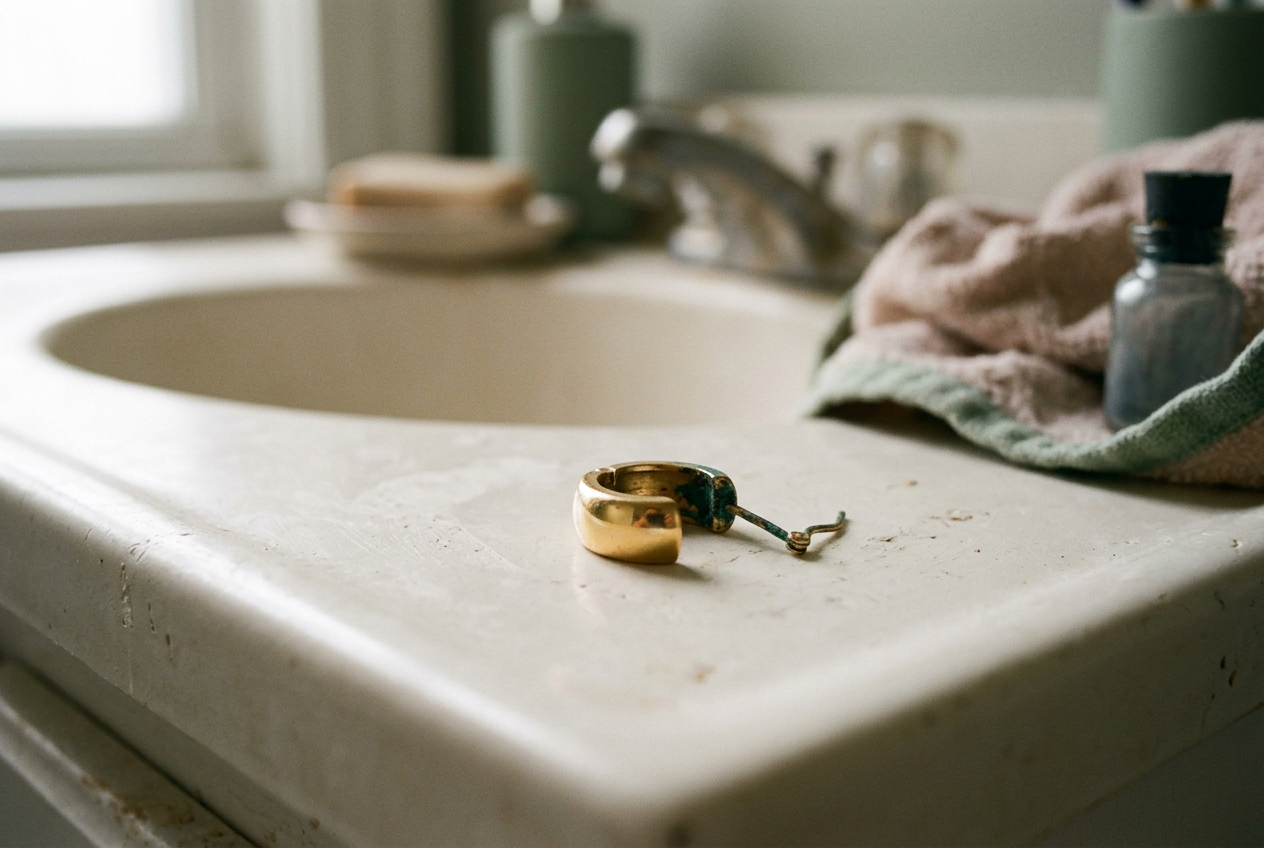
The useful clue is the border. Picture a slim gold-tone huggie marked gold-plated brass: its curved front still looks bright, while the straight post has developed a dull green cast and leaves a narrow green mark at the piercing. That localized change does not automatically condemn every visible surface. It points to the part under the most friction, moisture and skin contact.
This advice is unisex. The same mechanics apply to a tiny stud, a men’s hoop or a decorative drop earring, although the repair options change with the construction.
Why the post changes first
A post slides through skin, rubs against the piercing channel and meets pressure from a butterfly back or hinged closure. Sweat, water, skin oil and hair products can collect there. The decorative face has an easier life, especially when it sits away from the skin and gets wiped after wear.
Many gold-tone earrings are made from brass or another copper-bearing alloy, then covered with a thin layer of gold or a gold-colored finish. Oxidation, meaning a chemical reaction between metal and its surroundings, can produce green copper compounds once that base metal is exposed. Those compounds may transfer to skin without spreading across the whole earring.
The huggie’s intact front and green post therefore make sense together. The plating may still cover the curve, while repeated opening, closing and insertion have thinned it at the post. A soldered joint can also expose a different alloy, and some earrings use one metal for the decorative body and another for the post. A product described only as “gold-plated” may not tell you what sits underneath each component.
A green mark is not proof of copper on its own, but it is a strong practical signal when the earring contains brass, bronze or an unspecified base metal. Tarnish can also look dark brown or nearly black depending on the alloy and residue present.
Clean residue before judging the finish
Start gently, and only after removing the earring. Wash the green mark from intact skin with mild soap and water, then dry the area without scrubbing. Do not put the earring back into a sore piercing to test whether the color returns.
For the huggie, use a soft cloth slightly dampened with water and a small amount of mild soap, working around the post and hinge rather than soaking the entire piece. Follow with a clean damp cloth and dry it fully. A soft toothbrush can reach a plain metal hinge, but it can also catch delicate settings or lift a loose finish, so pressure should stay light.
Material matters. Pearls, opals, porous stones and glued components may not tolerate soaking or standard jewelry cleaners. Plated jewelry also loses finish faster under abrasive polishing cloths, stiff brushes and repeated chemical cleaning. If the maker provides care instructions, those take priority over a general method because the maker should know the coating, stones and adhesives used.
Skip vinegar, bleach and improvised abrasive pastes. They may remove surface residue while attacking the remaining plating. Alcohol and hydrogen peroxide are also poor routine choices for irritated skin, where they can add dryness without fixing the metal problem.
Cleaning answers one useful point. If the green was mostly product buildup or loose tarnish, the post may look normal after a gentle wipe. If the metal beneath remains pinkish, coppery, rough or patchy, the finish has probably worn through. No cleaning method can put that plating back.
A quick return means the plating is done
Leave the cleaned earring unworn for a moment and inspect it in daylight. On our gold-tone huggie, the decisive detail is not a perfect shine. It is a change in color between the post and the protected inside curve, particularly where the post passes through the ear or meets the closure.
If green residue reappears after another wear, exposed base metal is still reacting with moisture. Repeated polishing may make the post look better for an afternoon, yet every abrasive pass can remove more of the surrounding finish. At that point, maintenance has become a loop rather than a repair.
Clear nail polish is often suggested as a barrier. It is not a durable post coating. It can chip, create an uneven surface and introduce ingredients that were not designed for prolonged contact inside a piercing. A removable plastic sleeve can also increase the post’s diameter, alter the fit and trap debris, which makes it a poor improvisation for an already snug piercing.
Professional replating may be possible for a valued piece, but construction decides whether it is sensible. A jeweler may be able to refinish a simple earring or replace the post on a conventional stud. A hinged huggie is harder: the post, hinge and hoop work as one fitted mechanism, and added plating can affect movement or closure. For inexpensive fashion jewelry, replacement often costs less effort than chasing a temporary finish.
Skin irritation changes the decision
Green transfer alone can be a surface stain. It should wipe or wash away, and it does not necessarily mean the wearer has a metal allergy. Burning, persistent itching, swelling, tenderness, cracking or a wet rash is different. Remove the jewelry from an established piercing and stop experimenting with cleaners or barrier coatings.
Nickel may be part of the problem even when copper caused the visible green. Nickel contact allergy can produce an itchy rash, and terms such as “alloy” or “surgical steel” do not tell a sensitive wearer how much nickel is present or how readily it may reach the skin. The front of the huggie can remain photogenic while the post causes trouble where the skin is warm and enclosed.
A fresh piercing needs more caution because removing jewelry at the wrong time can affect the channel and its drainage. Marked pain, spreading redness, heat, swelling, pus or feeling unwell calls for prompt guidance from a qualified health professional; an experienced piercer can also assess jewelry fit and material, but should not replace medical care when infection is suspected. Green discharge from the piercing is not the same thing as a green metal stain.
Buy the post, not just the front
For daily wear, check the material of the post and backing rather than accepting a description of the decorative body. “Gold-plated brass earrings” may still place plated brass through the ear. “Titanium post” is more useful, although a sensitive shopper should look for a specified implant-grade titanium standard rather than an unqualified use of the word titanium.
Implant-grade titanium, meaning titanium produced to a recognized specification for long-term body contact, avoids nickel and does not rely on gold plating for its basic skin-facing surface. Niobium is another nickel-free option used in body jewelry. Both have a cooler gray base color, though titanium can be anodized, a process that changes its surface color without adding a flaky decorative layer.
Solid yellow gold removes the plating-loss problem, but “solid” does not mean pure. Jewelry gold is alloyed for strength, and its recipe can include copper or other metals. Look for a clearly stated karat and nickel-free composition if sensitivity is the reason for upgrading. White gold deserves particular scrutiny because some alloys contain nickel.
Platinum is another durable option, with a price that usually places it well above everyday costume jewelry.
The tradeoff is straightforward. Implant-grade titanium usually prioritizes skin compatibility and low weight over an exact rich-gold appearance, while solid gold preserves the traditional color and can suit long-term wear but requires a much larger spend. For the green-post huggie, replacing the whole pair with verified titanium or solid nickel-free gold is more dependable than buying another plated pair whose post material remains undisclosed.
Fit still matters after the metal improves. A post that is too short can press the earlobe and trap moisture; one that is too long can shift, snag and rub the channel. The best replacement leaves enough room for the tissue without allowing the earring to swing freely. Good metal cannot rescue persistent pressure.
Questions people ask
Can
I keep wearing earrings if only the posts turn green?
If the piercing is calm and the color washes away, brief wear is unlikely to mean every part of the earring has failed. A recurring green mark shows that the post’s surface is still reacting, however, so daily wear is a poor bargain. Replace the post or earring before irritation begins.
Does a green earring post mean I have a metal allergy?
Not by itself. Copper oxidation can leave a green stain without causing an allergic reaction. Itching, burning, swelling or a persistent rash suggests irritation or contact allergy, which may involve nickel or another metal in the alloy. Remove the earring and seek appropriate assessment if symptoms continue.
Can green tarnish be cleaned off permanently?
Loose residue can be cleaned off, but exposed base metal will oxidize again whenever moisture and skin contact return. If gentle cleaning reveals a coppery patch or the green comes back after wear, the lasting options are professional replating, post replacement or a new earring made from a suitable solid metal.
What earring post material is better for sensitive ears?
Verified implant-grade titanium and niobium are strong starting points because they do not depend on decorative plating and are generally nickel-free. Solid nickel-free gold can also work, though it costs more and its alloy should be disclosed. Avoid relying on vague labels such as “hypoallergenic” when the seller does not name the post material.
One update a day
Today's fashion update, in your inbox
One fashion update each morning — no hype, no filler, just pieces worth wearing.