Magnetic Necklace Clasps Are Easier, but Weight Changes the Call
A magnetic converter removes the tiny lever from fastening a necklace, but it can also release under a heavy pendant. Here is how three clasp types compare for limited hand dexterity.
November 1, 2026 · 8 min read
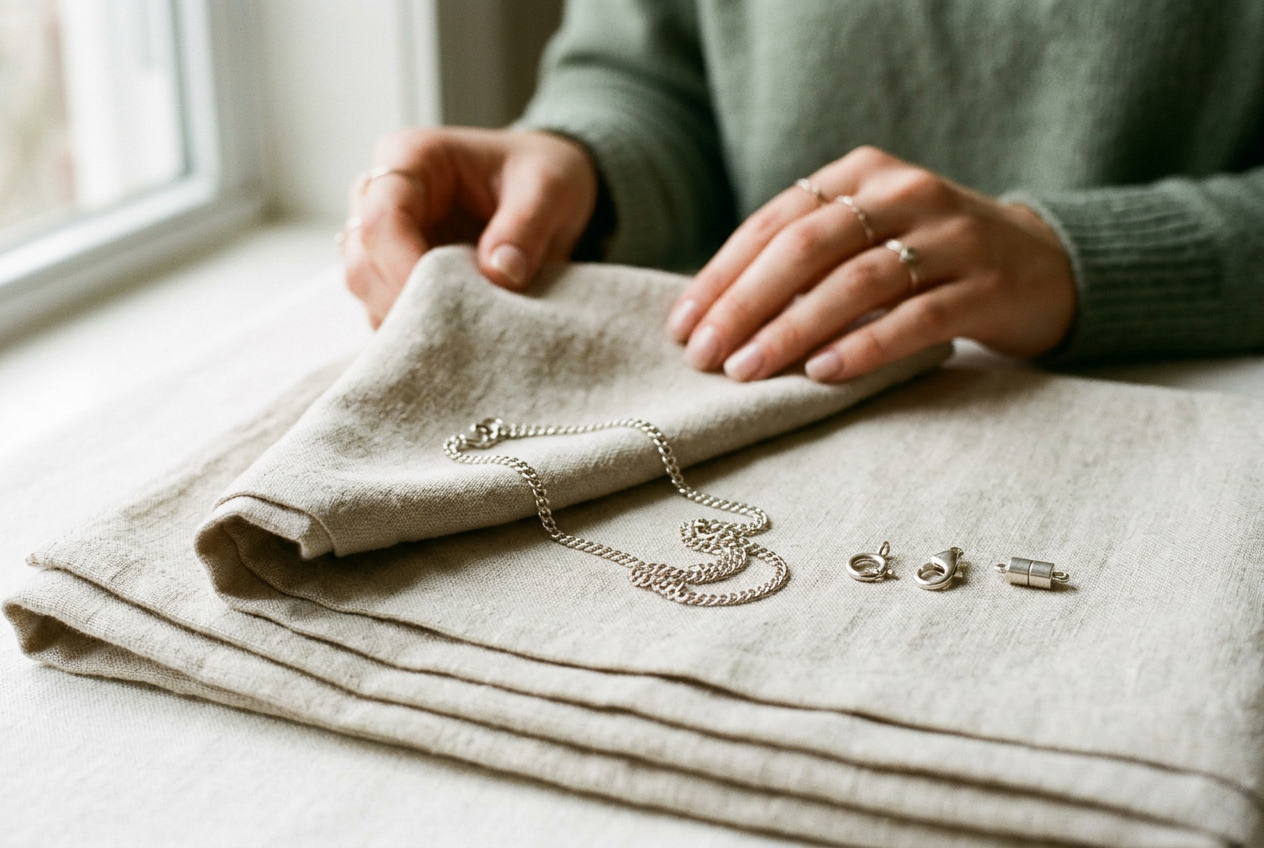
The revealing test is an 18-inch fine curb-chain necklace, meaning its flattened links interlock closely, with a small pendant and a spring-ring clasp barely wider than a shirt button. The necklace itself is easy to wear. Fastening it requires one hand to hold a narrow lever open while the other finds a tiny oval loop behind the neck.
That combination exposes what clasp comparisons often miss. Grip is only one demand. The wearer must also align two moving parts without seeing them, maintain tension on a fine chain and confirm that the clasp has closed rather than caught against the edge of the loop.
This is unisex advice. Clasp mechanics do not change by wardrobe, although necklace scale does: a light pendant on a fine chain places very different demands on a retrofit than a substantial curb chain or beaded strand.
Spring rings are small for a reason
A spring ring is a hollow circular clasp with an internal spring that closes its opening when the lever is released. Its neat scale works visually with delicate chains, and a sound spring ring can hold a light necklace securely once fully closed. It does not add much bulk beside the neck.
The problem is the lever. On the fine curb chain, a thumbnail could catch it, but the finger had to move through a short, controlled arc while the opposite hand kept the receiving loop in place. Reduced pinch strength makes that tiring. Tremor, joint pain, numb fingertips or limited reach can turn the same movement into repeated misses.
A larger receiving loop helps more than it appears. The jump ring, which is the small wire loop at the opposite end of the chain, should be large enough for the clasp opening to enter without exact positioning. An oval loop is often easier to stabilize than a tiny round one because it offers a longer target, provided its wire still fits through the clasp opening.
That makes a modest jewelry repair worth considering before replacing the clasp. A jeweler can fit a larger end ring, inspect the spring and close or solder connecting rings where the construction allows. This usually preserves the necklace’s visual balance. It also avoids the extra length and visible hardware of a converter.
A spring ring remains the least convincing choice when the lever itself is the barrier. Buying a larger version may improve leverage, but it can look out of scale on the 18-inch chain, and the wearer still has to pinch and hold it. Size reduces difficulty. It does not remove the motion.
Lobster clasps give the fingers more to hold
A lobster clasp uses a hinged arm that opens when its external lever is pulled back. Its body is easier to locate by touch than a small spring ring, especially in a medium size with a broad lever, and the tapered opening can guide a receiving loop into place.
In handling, the larger body was the important improvement. The clasp could rest against the side of a finger instead of floating between two fingertips, which reduced the amount of fine pinching needed. Alignment still mattered. The lever had to remain open until the oval ring passed the gate.
Security is generally the lobster clasp’s strength, assuming the spring returns briskly and the gate closes flush. The solid body also suits somewhat heavier chains better than a tiny spring ring, although there is no universal weight limit based on clasp type alone. Clasp size, alloy, spring condition, connecting rings and pendant movement all affect the result.
Look closely at the lever before paying for a retrofit. Some decorative lobster clasps are larger overall but retain a narrow, stiff trigger, so they add visual bulk without making the action much easier. A swivel lobster clasp, which allows the clasp body to rotate at its connection, can reduce chain twisting, yet the extra joint creates another wear point and may be unnecessary on a fine necklace.
For the curb-chain test case, replacing the spring ring with a proportionate lobster clasp would improve the grip without changing how the necklace releases under load. It would not solve limited shoulder reach or the need to coordinate both hands behind the neck. A wearer who can pinch a lever but cannot maintain the position may gain little.
Magnetic converters remove the lever
A magnetic converter consists of two magnetized halves that attach to the necklace ends and pull together when brought close. This is the clearest mechanical change of the three options: there is no spring lever to hold, and the magnets assist with final alignment.
On the fine curb chain, that assistance makes fastening possible in front of the body before rotating the clasp to the back. The halves find each other within a short distance, which can help when finger sensation is limited. A barrel-shaped converter gives the fingers a broad surface to separate later.
Opening it creates the main tradeoff. Magnets resist a straight pull, but they may separate more readily under peel or shear force, meaning pressure that tips or slides one half away from the other rather than pulling both halves directly apart. A pendant that catches on a scarf, bag strap or sweater can apply exactly that uneven force.
Chain weight matters here. Product documentation should state the intended necklace type or load, and the converter should be tested with the complete necklace rather than judged by how strongly its empty halves snap together. A substantial pendant adds momentum. Long chains also snag more easily.
If the seller gives no compatibility guidance, that converter is a poor match for valuable or weighty jewelry.
The 18-inch necklace stays in the plausible range for a small converter because both chain and pendant are light, but the adapter changes two details. It lengthens the necklace, often by a noticeable fraction of an inch, and its cylindrical body looks heavier than the original spring ring. On a short necklace, that added length can shift the pendant’s resting point. On fine chain, the converter may rotate toward the front because it outweighs the pendant.
Attachment deserves equal attention. Clip-on converters that hook onto the existing clasp and end ring are easy to try, but they can preserve the original accessibility problem during installation and introduce extra connections. A jeweler can remove the old clasp and install the converter directly, using closed or soldered rings where suitable. That is the cleaner everyday retrofit.
Magnetic clasps are not appropriate for every wearer. Manufacturers commonly warn that magnets may interfere with pacemakers or other implanted medical devices; follow the medical-device maker’s guidance and skip the magnetic option when advised. Magnetic jewelry must also be removed before procedures or equipment use when the relevant facility or manufacturer requires it.
Match the metal as well as the mechanism
Low-cost converters are often plated base metal. The plating can wear where the halves rub, exposing a different color or a metal that irritates sensitive skin. Sterling silver, stainless steel, gold-filled findings, which have a mechanically bonded layer of gold over a base metal, and solid gold versions occupy higher price bands, but material labels still need scrutiny.
Match color in daylight. A bright yellow converter beside a muted gold chain will read as an add-on, particularly if the clasp rolls forward. More important, match construction: a solid-gold necklace does not automatically need a solid-gold magnetic clasp, but the connecting rings should not abrade the chain or create a weak point that costs more to repair than the converter saved.
The basic price hierarchy is predictable without treating cost as proof of quality. Plated adapters sit at the inexpensive end, sterling silver and better-finished steel occupy the middle, and solid precious-metal clasps cost far more. Jewelry labor adds another charge when the original clasp is removed, rings are soldered or the chain needs reinforcement.
For an inexpensive necklace, a clip-on converter can be a sensible trial. For an heirloom, the correct first purchase is an inspection by a jeweler, not a packet of generic adapters, because the smallest existing component may be the one that fails.
A practical way to choose
Start with the movement your hand can repeat comfortably. If a firm pinch is manageable and visual alignment is the main obstacle, a lobster clasp paired with a larger oval end ring is the strongest candidate. If holding any lever open is the failure point, magnetic closure changes the task more meaningfully.
Then assess the necklace on a table. Check the pendant weight relative to the chain, inspect every connecting ring and note whether the clasp already pulls toward the front. A magnetic converter adds both length and weight, so it can exaggerate that rotation even when it holds securely.
Test a retrofit over a folded towel before wearing it outside. Fasten and release it several times, tug the necklace straight, then apply gentle sideways pressure near the clasp to mimic a snag. Stop if a ring gaps, the magnetic halves peel apart too easily or the clasp gate fails to return flush. The point is not to prove the finding indestructible.
It is to expose a mismatch before the necklace reaches a sidewalk.
The fine curb chain lands between two answers. A proportionate lobster clasp is the better permanent alteration when pinch strength remains adequate. A directly installed magnetic converter is easier to close when the lever motion is no longer workable, but the necklace should stay light and the wearer must accept visible hardware plus a less forgiving response to snags.
Questions people ask
Are magnetic necklace clasps secure enough for daily wear?
They can suit a light chain and small pendant when the converter is intended for that construction and stays closed during straight and sideways handling checks. They are a weaker bet for heavy, valuable or frequently snagged necklaces because uneven pressure can peel the magnetic halves apart.
Can a jeweler replace a spring ring with a lobster clasp?
Usually, provided the chain ends and connecting rings can support the new finding. Ask for a clasp that is large enough to grip but proportionate to the chain, plus an oval receiving ring that fits fully through the open gate without forcing it.
Does a magnetic converter make a necklace longer?
Yes. The two-part converter sits between the existing ends, so a clip-on version adds its full closed length plus any hooks or rings. That small change can lower a pendant, loosen a short necklace or make a heavy converter rotate toward the front.
Which clasp is easiest with arthritis or numb fingers?
There is no universal winner. A magnetic clasp removes the sustained pinch and assists alignment, while a broad lobster clasp may feel more controllable to someone who can operate a lever but wants a larger grip. Try the movement over a towel with the complete necklace, not the clasp alone.
One update a day
Today's fashion update, in your inbox
One fashion update each morning — no hype, no filler, just pieces worth wearing.