Tiny Spring Rings Are the Hardest Fine-Chain Clasps to Close
Magnetic converters need the least finger force, but oversized trigger clasps give fine chains a better balance of grip and security. Here is what each mechanism asks of your hands.
October 22, 2026 · 8 min read
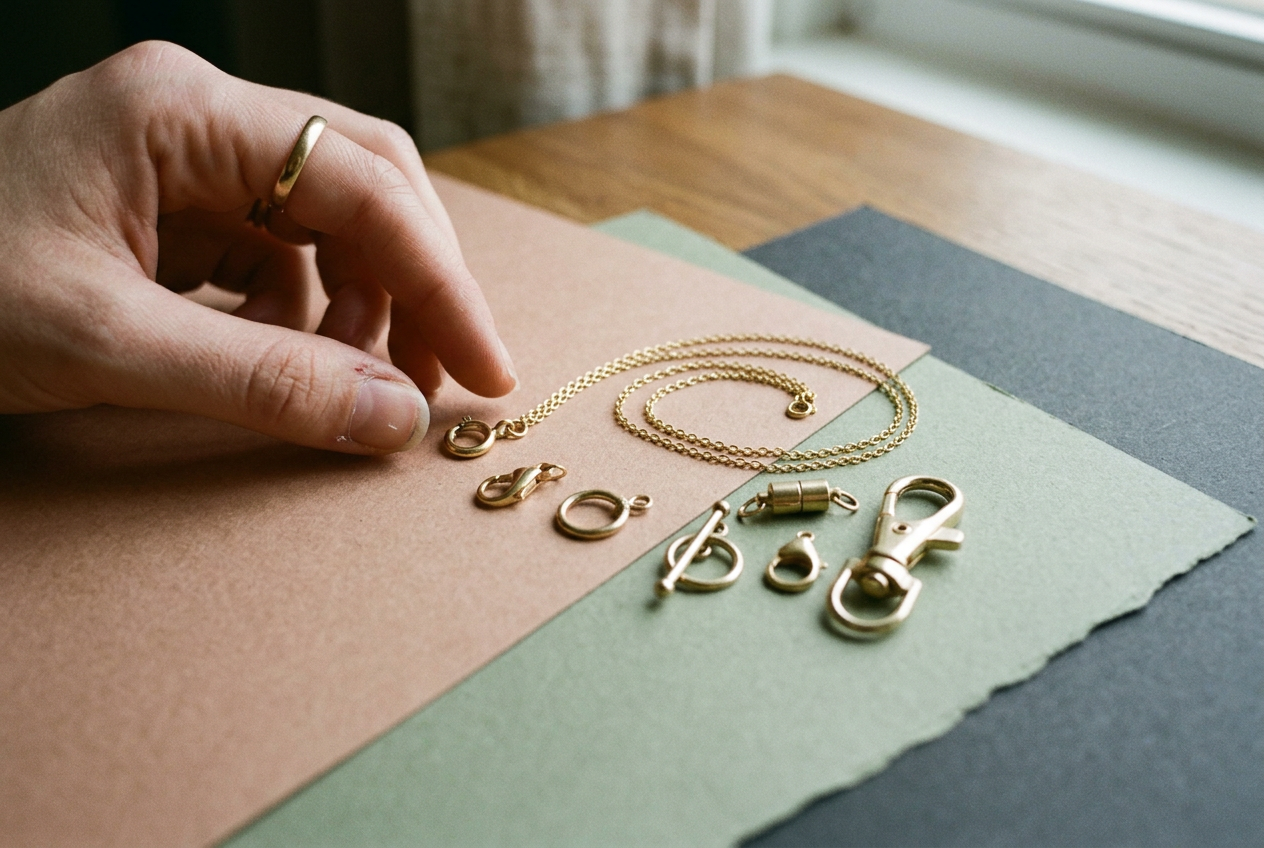
The problem is visible on a slim 14k yellow-gold cable chain I use for this comparison: a small flat pendant, a fine link, and a spring-ring clasp that nearly disappears between two fingertips. The chain itself sits lightly. Closing it takes more effort than wearing it.
That mismatch matters. Fine jewelry is often designed to look delicate from every angle, so brands keep the fastening hardware small, yet the reduced grip area, meaning the surface available to hold and control, can make an otherwise wearable necklace frustrating. This unisex guidance applies across wardrobes because the mechanics do not change with styling, although chain length affects whether the clasp can be brought around to the front.
I handled each mechanism at the back of the neck, at the front of the body, and on a tabletop, checking how much finger curl it required, whether one hand could complete the closure, and how readily the parts separated under a gentle pull. That cannot reproduce every form of stiffness, tremor, weakness, pain, or limited sensation. It does reveal which designs demand a precise pinch and which leave room for the hand to work.
Spring rings ask the most of the fingers
A spring ring, meaning a hollow circular clasp opened by pulling back a tiny tab, is common on fine chains because it is light, discreet, and relatively secure when the internal spring works cleanly. It is also the least forgiving mechanism here.
The hand must stabilize the ring, pull the tab against spring tension, guide a small receiving loop into the opening, then release the tab without letting that loop slip out. On the 14k cable chain, the tab gives less purchase than the ring itself. A stiff thumb cannot press straight into it comfortably. An unsteady hand may bring the two ends together and still miss the narrow opening.
One-handed use is poor unless the necklace can be turned to the front and laid against the chest for support. Even then, the clasp rotates as pressure reaches the tab. Spring rings make sense when minimum weight and a nearly invisible finish matter most. They are a bad default for anyone who already avoids a necklace because closing it costs several attempts.
Standard lobster clasps improve the grip, not the whole task
A lobster clasp, meaning a teardrop-shaped fastener with a spring-loaded side lever, usually gives the fingers more metal to hold than a spring ring. Its longer body can rest against the side of the index finger while the thumb moves the lever, which reduces the need to pinch a tiny circle from both sides.
That is an improvement, but scale matters more than the name. A miniature lobster clasp can be almost as demanding as the spring ring on the cable chain, particularly when its lever sits close to the body or has a polished surface that slides under the thumb. The receiving loop may still be very small.
Security is generally good when the lever closes fully and the spring remains responsive. Weight stays modest. Behind the neck, however, one-handed fastening still requires a controlled sequence: hold the clasp steady, open it, locate the loop, and release. A standard lobster is better than a spring ring, though it is not the easiest answer for pronounced stiffness or shaking.
Oversized trigger clasps give the best overall balance
An oversized trigger clasp is a larger spring-loaded clasp with a broad body and a more substantial lever. Some are rounded, while others have an elongated shape that can lie flat against the fingers. The useful change is not decorative. More surface area lets the palm and finger pads share the work instead of concentrating it at the thumb tip.
In handling, this was the strongest compromise between access and retention. The lever still requires pressure, but the clasp body stays put rather than spinning away, and a larger receiving ring is easier to locate without exact alignment. With the necklace turned to the front, one-handed closure is realistic for many hands. Behind the neck remains harder because the lever and loop must still meet by touch.
The tradeoff appears on the chain. An oversized solid-gold clasp adds visible hardware and can pull a very light necklace backward, especially when the pendant is flatter and lighter than the fastener. On the slim 14k cable chain, that imbalance would matter more than it would on a heavier rope or curb chain. A clasp upgrade should therefore include a proportionally larger receiving loop, but not hardware so heavy that it becomes the necklace’s counterweight.
This is usually a jeweler alteration rather than a cheap add-on. Plated hardware sits in the fashion-jewelry price band, sterling silver costs more, and a solid-gold clasp plus bench labor is the investment option. For a valuable chain worn often, that expense can be more sensible than replacing the necklace.
Toggles need little force but enough slack
A toggle clasp, meaning a straight bar passed through a larger ring, removes the spring entirely. The bar offers a generous grip, and closure needs coordination rather than thumb strength. Bring the necklace to the front, turn the bar lengthwise, pass it through the ring, then let it settle across the opening.
One-handed use can be very good when the chain has enough slack to pull the full bar through. A short necklace worn close to the throat is more awkward because the hand must create room that the fit does not provide. A bracelet creates another problem: the loose end can fall away before the bar reaches its ring.
Toggles are less secure than closed spring clasps when the necklace goes slack. If the bar is short, the ring is large, or a coat collar pushes the chain forward, the bar can line up with the opening and pass back through. They also read as a design feature. Adding one to the fine cable chain would change its quiet back fastening into visible jewelry hardware, which may be welcome at the front and clumsy at the nape.
Magnetic converters are easiest, with clear limits
A magnetic converter is a two-part magnetic closure attached to the necklace’s existing clasp and receiving loop. Bring the ends close and they pull together. No lever. No tiny tab.
Of the five mechanisms, it demands the least finger force and the least precise alignment, and it is the clearest choice when independent one-handed closure outranks every other consideration.
Converters also avoid permanent alteration. That makes an inexpensive plated version useful as a trial before paying a jeweler to replace a solid-gold clasp. Check the attachment style, however. Some converters use small lobster clasps that recreate part of the original problem during installation, although they only need to be fitted once and can remain on the chain.
Convenience reduces security. A sharp tug, a caught scarf, or the weight of a substantial pendant can separate magnets that would stay closed during ordinary movement. Stronger magnets resist separation but add weight, and a round converter can roll toward the front if it outweighs the necklace’s pendant. On the slim 14k chain, the converter was easy to manage yet visually and physically larger than the original spring ring.
A converter also lengthens the necklace and introduces another metal surface against the skin. Match solid gold with compatible solid-gold hardware when long-term wear and metal sensitivity matter; inexpensive plated converters may wear through at contact points. Magnets can conflict with some implanted medical devices, so follow the device manufacturer’s guidance and seek medical guidance before wearing one near the chest.
Match the clasp to the chain, not just the hand
For the best grip-to-security balance, start with an oversized trigger clasp and a larger receiving loop. Choose a toggle when low finger force matters and the necklace has enough length to create slack. Choose a magnetic converter when the closure must work with minimal pinch and you can accept lower resistance to snags.
Before ordering a chain online, look for photographs of the actual clasp rather than relying on “lobster” or “spring ring” in the description. Ask for the clasp’s dimensions, the receiving loop’s size, and the total hardware weight. A large clasp paired with a tiny loop only solves half the task.
For an existing necklace, take the piece to a jeweler and handle sample clasps before authorizing the work. The attachment should be closed securely, often with a soldered jump ring, meaning the small connecting ring is fused shut rather than left with a narrow seam. That detail matters on valuable chains because an accessible clasp is no improvement if its connector pulls open.
The original spring ring on the 14k cable chain wins on visual discretion and low weight. It loses at the moment the necklace needs to be worn. For daily use, the oversized trigger is the better permanent alteration; the magnetic converter is the practical trial.
Questions people ask
Can a jeweler replace a spring ring with a larger clasp?
Usually, provided the chain links or end fittings can support the new hardware. Ask to handle the clasp first and request a larger receiving loop as part of the alteration. The jeweler should also assess whether the added weight will pull a fine chain backward or distort its end links.
Are magnetic necklace clasps secure enough for fine jewelry?
They can be adequate for light necklaces in low-snag situations, but they release more readily than a sound lobster or trigger clasp. Avoid treating a magnetic converter as maximum security for an irreplaceable pendant. Test the complete necklace over a soft surface, including the pendant’s pull on the closure, before wearing it outside.
Which clasp is easiest to close with one hand?
A magnetic converter requires the least force and alignment. A toggle follows when the necklace can be brought to the front and has enough slack for the bar to clear its ring. An oversized trigger clasp needs more thumb movement, but it offers a stronger balance of manageable grip and secure closure.
Will a larger clasp damage a delicate chain?
Size alone is not the problem. Excess weight, a poorly matched connector, or a stiff clasp attached to a very fine link can concentrate stress at the chain end. A jeweler should match the clasp and receiving loop to the chain’s construction, then close the connecting rings securely.
One update a day
Today's fashion update, in your inbox
One fashion update each morning — no hype, no filler, just pieces worth wearing.