Your Earring Posts Match by Eye. The Gauge May Not.
A 20-gauge stud and a 16-gauge flat back can look nearly identical. Measure the post, length and threadless system before ordering a replacement.
October 17, 2026 · 8 min read
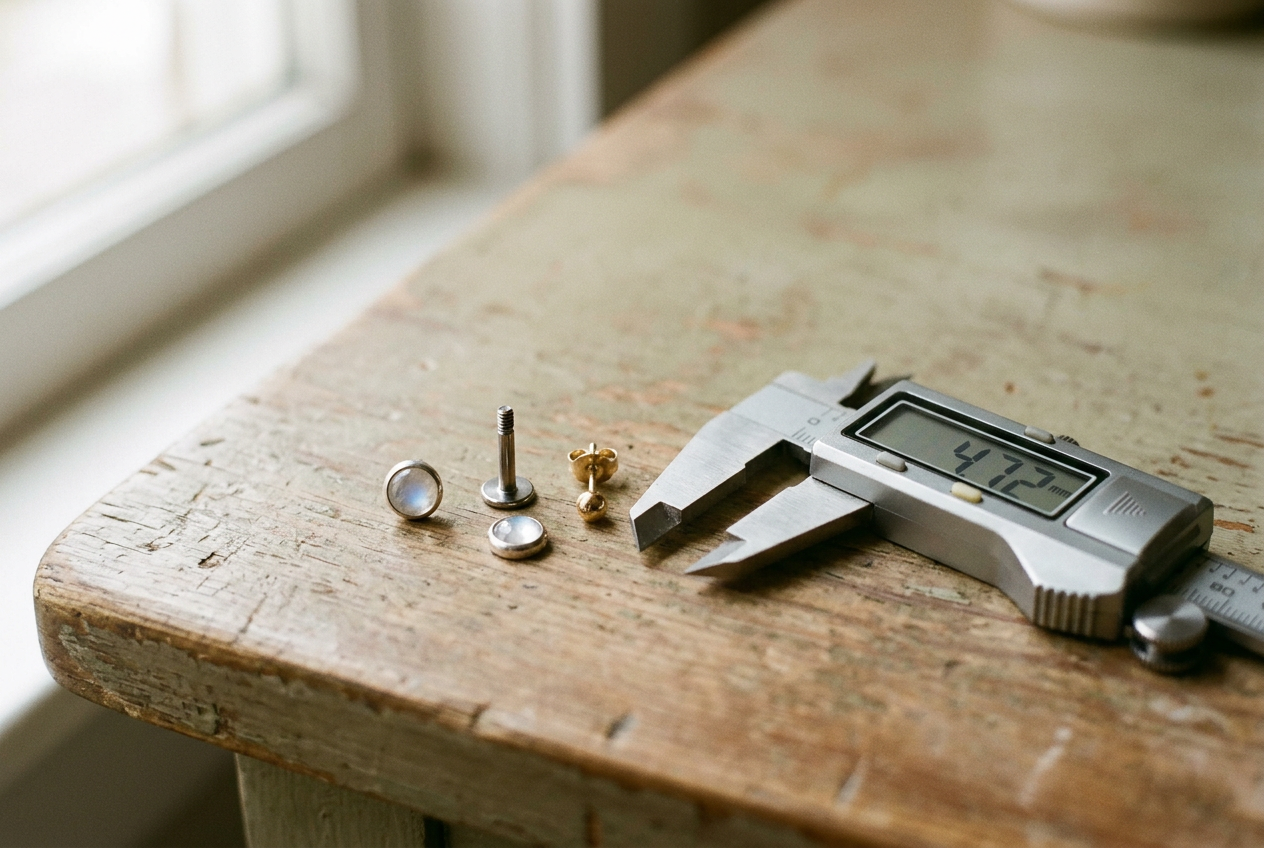
The useful comparison is a slim bezel stud on a 16-gauge implant-grade titanium flat-back post beside a conventional 20-gauge stud with a butterfly backing. From the front, both can present as the same small gold dot. Turn them sideways and the difference still looks slight. Put the thinner stud into a piercing accustomed to the thicker post, however, and the front may tilt, travel forward or feel less stable.
That mismatch explains a common replacement-order failure. The decorative end is the right color. The post length sounds familiar. The listing says “flat back.
” Yet the parts do not connect, or the assembled earring does not sit like the one already in the ear.
This is unisex guidance. Post fit depends on the jewelry and piercing channel, not the wardrobe around it.
Start with the number that is easy to miss
Gauge describes post thickness, and the numbering runs backward: a lower gauge number means a thicker post. Common body-jewelry sizes include 20 gauge at about 0.8 millimeter, 18 gauge at about 1.0 millimeter, 16 gauge at about 1.
2 millimeters and 14 gauge at about 1.6 millimeters.
Those fractions of a millimeter matter. The reference 16-gauge flat back is about 0.4 millimeter thicker than the 20-gauge conventional stud, yet that difference can disappear in a product photograph, especially when the image emphasizes the decorative end rather than the shaft.
Conventional fashion studs are often thin, but there is no single mandatory gauge shared by every brand. Do not infer thickness from “standard post,” the size of the stone or the type of backing. A butterfly clutch can sit on a relatively fine post, while a flat-back earring, meaning the post’s backing sits flush against the earlobe, may use a thicker body-jewelry gauge.
A healed piercing that comfortably holds the 16-gauge reference post may not grip a 20-gauge stud in the same way. The hole does not need to look dramatically larger for the lighter post to shift. A loose butterfly backing adds more movement, and a heavy front magnifies the tilt.
This does not mean a thinner stud is automatically unsafe or unusable in a healed lobe. It means the fit has changed. If the front droops, catches or pulls through more readily than expected, the visual similarity between the two earrings is irrelevant.
Gauge is only one part of compatibility
A threadless earring uses a narrow pin on the decorative end that bends slightly inside a hollow post, creating tension that holds the pieces together. The outside diameter of that post is its gauge. The tiny pin entering it is a separate measurement.
This distinction matters when replacing only the gold bezel end on the reference titanium post. A shopper may correctly identify the post as 16 gauge and still buy an end whose pin does not suit that manufacturer’s post. Some established threadless systems are designed so one end works with more than one common post gauge, but “threadless” does not promise that every end from every seller interchanges.
A pin that is too thick may stop at the opening. A pin that is too fine may slide in without enough tension, even after a modest bend. Do not force the first or keep bending the second until the metal fatigues. Match the maker’s stated compatibility whenever possible, particularly if the listing specifies a pin diameter or names a proprietary system.
Threaded jewelry creates a different problem. Internal threading means the screw threads sit inside the hollow post; external threading puts them on the end of the post. Thread pitch and diameter must match. Two 16-gauge pieces can therefore share the same outside post thickness and still refuse to screw together cleanly.
The practical rule is blunt: gauge describes the shaft, not the whole connection.
Make a record before taking the stack apart
Photograph the reference earring while it is assembled. Include the front, the side profile and the back disc, then place it beside a ruler with millimeter markings. A ruler will not resolve every gauge accurately, but the image preserves proportions and shows which component belonged where.
Next, write down four separate facts rather than one vague size: outside post gauge or diameter; wearable length; back-disc diameter; and connection type. Wearable length is the section that passes through the piercing, excluding the decorative front and, depending on the construction, the fixed back.
For the reference earring, “16 gauge, 6-millimeter wearable length, threadless, titanium flat back” is useful documentation. “Small labret” is not. A labret post is a body-jewelry post with a fixed flat disc on one end and a removable end on the other, but retailers may offer several gauges and lengths under that same product name.
Use a digital caliper if the original order confirmation and packaging are gone. An inexpensive model generally costs less than replacing several incompatible ends, and it can read the shaft in millimeters without asking you to judge the narrow gap between gauge marks on a card.
Close the jaws gently around the straight, widest part of the post. Do not measure over screw threads, a taper or the bent portion of a threadless pin. Zero the caliper first, take the reading more than once and compare the result with the seller’s conversion chart, since a small measuring error can put an 18-gauge post unhelpfully close to its neighbor.
Clean the caliper jaws before they touch jewelry. If the earring is in an unhealed or irritated piercing, leave it in place and ask a reputable piercer to identify and measure the setup instead of removing it for a home sizing session.
Read the product page in the right order
Start with construction. “Threadless end,” “internally threaded post” and “complete earring” describe different purchases. A photograph may show a finished piece even when the listing includes only the decorative top, while another listing may bundle the end and post but require the buyer to select each measurement.
Then check gauge in both systems. A listing that gives only millimeters is not missing information: 1.2 millimeters corresponds to 16 gauge, while 1.0 millimeter corresponds to 18 gauge.
Keep the seller’s chart open rather than relying on memory.
Move to wearable length only after gauge and connection match. A correctly gauged post can still pinch if it is too short, while excess length lets the front tip and leaves a section of shaft exposed. Swelling, anatomy and piercing placement affect the required room, so copying the length from another person’s ear is a poor substitute for recording the post that already fits yours.
Finally, check the back disc and material. A larger disc can feel steadier but may crowd a neighboring piercing in a close stack. Implant-grade titanium is a practical choice for many everyday flat backs because it is light and widely used in body jewelry, while solid gold offers a different color and price band; plated mystery metal is not an equivalent replacement merely because the front looks right.
The cheapest path is usually replacing only the missing component. It stops being economical when the connection is undocumented. If the brand or system cannot be identified, buying a complete compatible end-and-post set may cost more upfront but removes the guess about pin fit, threading and nominal sizing.
Test the fit without forcing it
For threadless jewelry, insert the pin partway into the post, add a slight bend according to the maker’s instructions, then press the pieces together. The bend supplies tension. If the end drops out with almost no resistance, stop and verify compatibility rather than creating an extreme bend.
For threaded pieces, the end should engage smoothly. Resistance at an angle can mean crossed threads, which damages the small connection quickly. Back it out. Realign it.
Once assembled, compare the earring with the original photographs. The reference bezel should sit flat without the 16-gauge post projecting noticeably between the lobe and front, and the back disc should rest without pressing a sharp outline into the skin. Check it again after normal wear, because a post that seemed acceptable for five minutes may reveal extra travel once hair, headphones or sleep puts pressure on it.
The conventional 20-gauge stud remains useful when its own post and butterfly clutch fit the wearer well. It is not a drop-in substitute for the documented 16-gauge threadless setup, even though both fronts look like the same small gold dot.
Questions people ask
Can
I wear a 20-gauge stud in a piercing that held 16-gauge jewelry?
A thinner stud may pass through a healed channel, but it can sit loosely, tilt under a heavier front or allow the piercing to tighten around the smaller post over time. Do not treat it as an equivalent fit. Ask a piercer before changing gauge if the piercing is fresh, irritated or difficult to reinsert.
Are all threadless earring ends interchangeable?
No. Some threadless systems support ends across common post gauges, but pin diameter, tolerances and manufacturer specifications still matter. Match the documentation for both parts. An end that feels loose without a pronounced bend, or one that will not enter the post, should not be forced into service.
Can I identify earring gauge with a ruler?
A ruler can provide a rough check and works well for photographing wearable length, but the difference between common post gauges is too small for dependable visual judgment. A clean digital caliper gives a more useful millimeter reading. Measure the straight shaft, not threads, tapers or a threadless pin.
Does post length tell me the gauge?
No. Length measures how far the wearable shaft extends through the piercing, while gauge measures its thickness. A 6-millimeter post may be sold in several gauges, and two posts of equal thickness may have different wearable lengths. Record both numbers before ordering.
One update a day
Today's fashion update, in your inbox
One fashion update each morning — no hype, no filler, just pieces worth wearing.