Why Your Straight Stud Points Down or Sideways
A stud’s visible angle comes from the piercing channel, the top’s weight and where its post attaches. A smaller top may fix the lean. Sometimes only a piercer can assess it.
October 14, 2026 · 7 min read
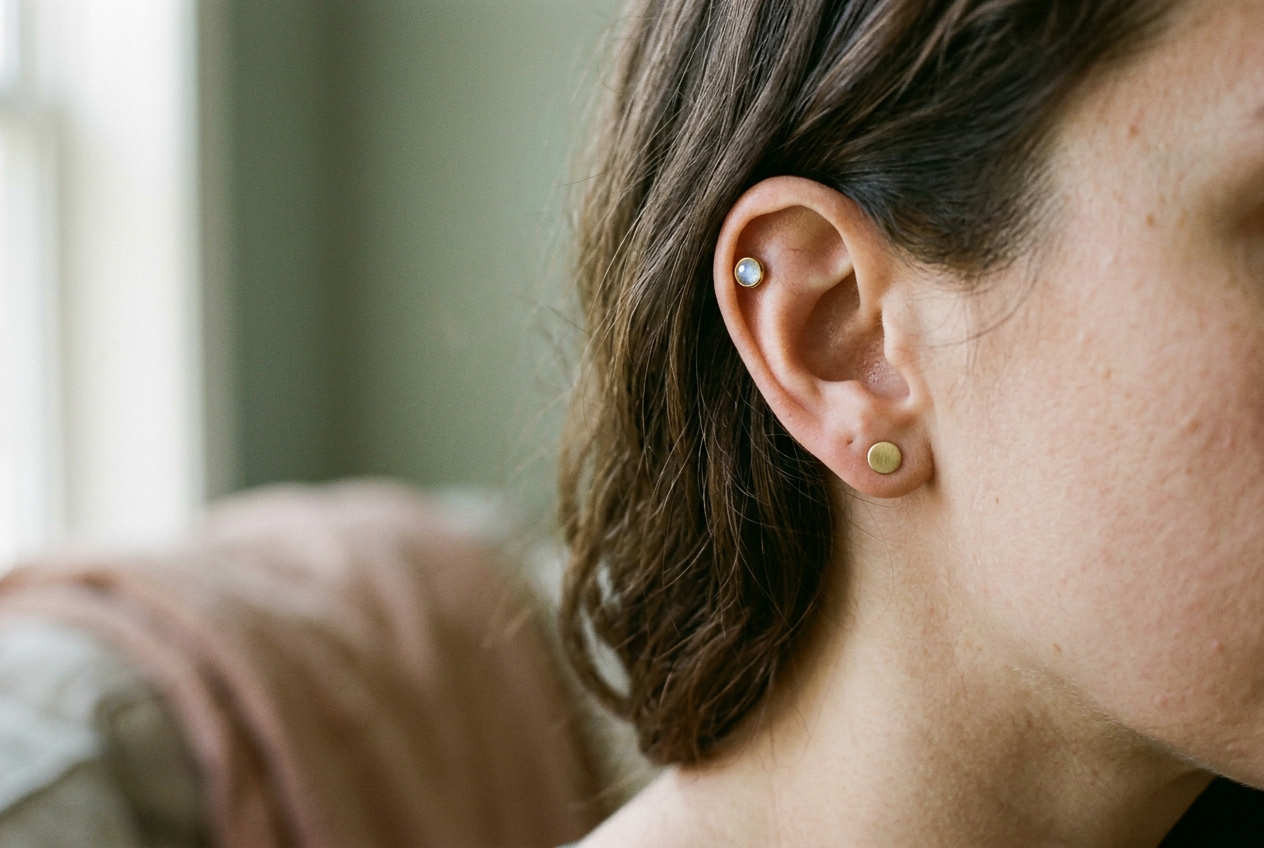
The test pair looked straightforward: 4 mm round cubic zirconia ends, prong-set in 14k yellow gold and fitted to implant-grade titanium flat-back posts. A flat back earring, meaning the post’s backing sits flush against the earlobe, should feel stable and look tidy. On my ears, one stone pointed slightly down. The other turned toward the outside edge of the ear.
Changing the backing did not make both studs face forward. Changing the decorative ends did more.
For one week, I alternated the stones with smaller, low-profile gold disks on the same posts. The downward lean became much less visible under the lighter disk, while the sideways angle remained. That difference matters: weight and scale can exaggerate a marginal fit, but they cannot redirect a piercing channel that already travels through the lobe at an angle.
This is unisex fit advice. Earlobe shape and piercing geometry determine the result, regardless of which jewelry department supplied the studs.
The post follows the piercing channel
A piercing channel is the healed passage through the tissue. The earring post has to follow it. If that passage rises, drops or travels sideways between the front and back of the lobe, the decorative top will sit at the corresponding angle even when the post itself is perfectly straight.
The front view can be misleading. A stud that appears centered may exit higher on the back of the lobe, which directs its front downward; a channel that exits closer to the side can make a round stone face inward or outward. Earlobes are also curved rather than flat, so two piercings made at matching heights can present jewelry differently.
Post length changes how clearly the angle shows. Too much empty post leaves room for the top to tip away from the skin, particularly when the decorative end projects forward. A closely fitted post reduces that movement, but shortening is not a correction for every lean. If the post presses into the tissue or the backing leaves a mark, the fit is too tight rather than more supportive.
The titanium posts in the test pair had little visible extra length. That ruled out obvious looseness. The gold disks still followed the sideways path on one ear, which was the useful result: buying an even shorter post would have added pressure without changing the direction of the channel.
The decorative top can amplify a small lean
A larger stud has more visual area below and beside the post, while a raised setting places more weight farther from the lobe. That forward projection gives gravity more leverage. The effect is easy to see with halo studs, substantial pearls and clusters that sit proud of the skin, even when none of them feels especially heavy in the hand.
Post placement within the decorative top matters too. On a conventional stud, the post may be soldered or cast into the back of the setting. When that attachment sits above the visual center, more of the top hangs below it and the stud is more likely to point down. An attachment offset to one side can encourage turning, especially on a smooth round post.
Threadless jewelry makes comparison easier. A threadless end, meaning a decorative top held in a hollow post by a slightly bent pressure-fit pin, can be changed without replacing the entire backing when the components are compatible. The 4 mm stones and small gold disks used here shared the same posts, so the piercing angle and post length stayed constant during the comparison.
The smaller disk helped the downward-facing side because it sat closer to the lobe and placed less material below the attachment point. It did not make the piercing straighter. It made the existing angle less conspicuous.
That is a worthwhile styling fix for a healed piercing that feels comfortable. A plain implant-grade titanium end is usually the lowest-cost way to test the idea, while solid gold and genuine stones raise the price quickly. There is little reason to buy an expensive replacement top before confirming whether scale and weight are the problem.
A controlled swap reveals the real fit issue
Start with the jewelry out of the ear only if the piercing is fully healed and normally tolerates changes. Place the stud face-down on a clean, flat surface and look at where the post joins the back. An obviously high or sideways attachment can explain why the top hangs unevenly, although a centered post may still look crooked once it follows the ear’s channel.
Next, compare the original end with a flatter, lighter shape on the same correctly fitted post. Keep the visual footprint smaller. A polished disk or low bezel setting gives a clearer test than another projecting cluster, and using the same backing avoids confusing a new top with a different post length.
Then look at the stud from the front and side while the ear is relaxed. Do not push the top flat with a tight backing. That can disguise the angle for a photograph while placing continuous pressure on the lobe, and it is a poor trade for jewelry intended to stay in through work, sleep or exercise.
The test pair produced two distinct answers. The left stud’s downward tilt softened enough under the small disk that I would choose a low-profile end rather than pay for another pair of gemstone studs. The right stud still pointed sideways after a week of normal wear, with no meaningful change between the stone and disk. That behavior points back to the channel or local anatomy, not the decoration.
Butterfly-back earrings can sometimes look more upright when a broad backing supports the lobe, but tightening one until the stud faces forward risks pressure and trapping debris. It also gives up the sleep-friendly advantage of a smooth flat back. For daily wear, a correctly sized flat-back post with a suitable top is the cleaner comparison.
Placement problems need an in-person view
A professional piercer can inspect the front and back exits, check whether the post length suits the tissue and compare the jewelry’s attachment point with the direction of the channel. That assessment is more useful than ordering several posts by guesswork, because a shorter post cannot turn a diagonal channel into a perpendicular one.
Leave fresh, irritated or swollen piercings alone rather than running this experiment. Jewelry changes during healing can disturb the channel, and unexplained pain, heat or discharge belongs outside a fashion fit test. A qualified piercer can advise on jewelry fit and refer medical concerns when appropriate.
For a healed piercing, the likely outcomes are concrete. A smaller end may sit convincingly straight. A properly measured post may remove excess tipping. If neither works, the choices narrow to accepting the angle, selecting shapes that cooperate with it or discussing whether different placement is practical.
Re-piercing costs time as well as money because the old site may need to settle before another placement can be considered.
Use the angle in an earring stack
A slight angle is not automatically a failed piercing. In an earring stack, a small disk or bezel-set stone can make it visually quiet, while a marquise or curved end can follow the ear’s edge deliberately. The useful distinction is comfort: styling can absorb an odd direction, but it should not require a backing tightened against the skin.
On the test ear, the low gold disk worked beside a small hoop because its surface did not advertise the downward pitch. The sideways-facing stud remained noticeable next to aligned round tops, so an elongated end following the outer ear would be the better styling move if the piercing itself stayed unchanged.
Questions people ask
Can a heavy earring make a straight post look crooked?
Yes. A heavy or projecting top pulls farther from the lobe, making a small downward angle more visible. Try a lighter, flatter end on the same properly fitted post. If the direction does not change, the piercing channel or the placement of the post within the top is the more likely cause.
Will a shorter flat-back post make my stud sit straight?
A shorter post can reduce tipping when excess length leaves a gap behind the decorative end. It cannot redirect an angled piercing channel, and a post that is too short may press into the tissue. Have a piercer measure the fit rather than choosing the tightest post that can be fastened.
Can
I straighten a crooked stud by tightening the backing?
Tightening may hold the top flatter for a short time, but continuous pressure is not a sound fit correction. The backing should secure the jewelry without compressing the lobe. On a healed piercing, compare a lower-profile top or have the post length checked instead of forcing the original stud into position.
Why does the same stud sit differently in each ear?
The piercing channels may travel at different angles, and the lobes themselves can differ in thickness or curvature. Test the same small, low-profile top on both sides. If one stud still points consistently sideways or down while the other faces forward, a piercer can assess the placement from both exits.
One update a day
Today's fashion update, in your inbox
One fashion update each morning — no hype, no filler, just pieces worth wearing.