Long Hair Catches Prong-Set Flat Backs. Discs Stay Put.
Four fronts on the same titanium post behaved very differently around long hair. Prongs pulled hardest; a smooth disc needed the least attention.
October 12, 2026 · 7 min read
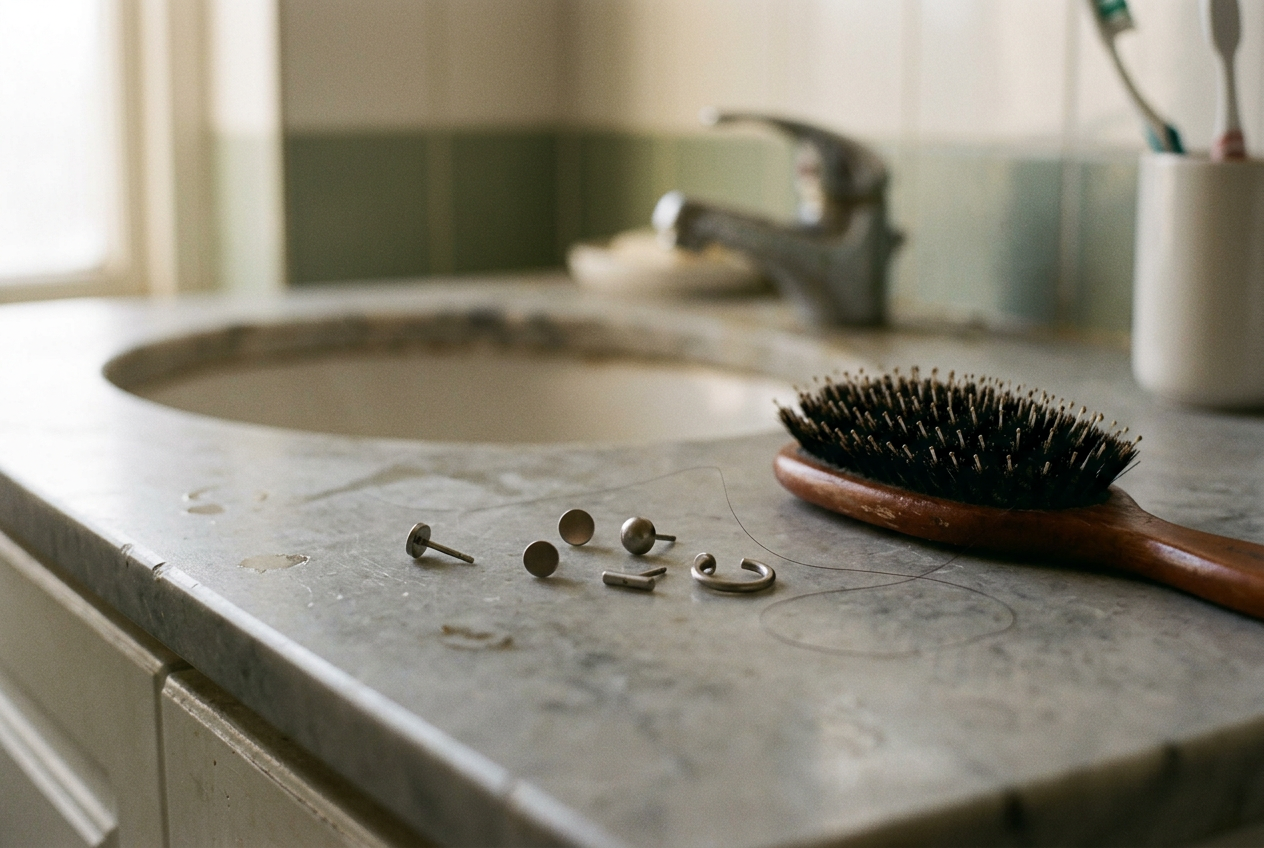
The same post, four fronts
The anchor for this comparison was one implant-grade titanium labret, a straight earring post with a flat backing, worn in a healed upper-lobe piercing under hair that falls past the shoulders. Implant-grade titanium means the metal meets a recognized standard for long-term contact with the body. The post stayed in place while four compatible fronts from the same threadless system were swapped: a prong-set stone, a bezel-set stone, a polished ball and a low-profile disc.
That sameness matters. Changing the post length along with the front would muddy the result, because extra post showing behind the ear gives the jewelry room to tilt and turns even a smooth front into a lever. A post that is too short causes a different problem: pressure, indentation and no allowance for ordinary tissue changes. The useful fit sits close without pinching, with the back resting flat and the front not sinking into the skin.
Across brushing, shampooing and all-day wear, the front’s outer edge mattered more than its overall visual size. Hair found every exposed claw and narrow ledge. It mostly slid over broad, polished surfaces. This is unisex coverage; the mechanics follow hair length, texture and placement rather than a particular wardrobe.
Dry brushing reveals every edge
The prong-set stone caught first. Prongs are small metal claws that hold a stone above its base, and each claw creates a point where one or two hairs can lodge. With a brush moving downward, those few trapped hairs transferred the full pull of the stroke to the earring. The front rotated on some passes and tugged the post sideways on others.
Neither movement felt dramatic, but repeated tension is exactly what makes an end worth checking later.
A prong setting with rounded, well-finished claws performed better than one with a lifted or rough claw would, yet the basic geometry remained unchanged. Long hair can enter from several angles. If sparkle is the priority, inspect the setting under bright light and run a clean fingertip around its perimeter before wearing it beneath loose hair. A claw that catches skin can catch hair.
The bezel came next. A bezel is a metal rim that surrounds the stone’s edge, leaving no separate claws. The smooth rim let the brush release more easily, though a tall bezel still presented a shoulder where it met the post. That shoulder occasionally collected a strand when the brush passed close to the ear.
The pull was shorter and less sharp than with the prong-set front.
The polished ball behaved differently. Hair tended to move around its curved surface, but the sphere stood farther from the lobe than the disc, creating a narrow space beneath it. A loose strand could wrap once around that neck. Brushing then turned the ball rather than releasing it immediately, which matters if the jewelry uses a screw fitting; with this threadless sample, the concern was outward movement rather than unscrewing.
The low-profile disc caused the fewest stops. Its broad face sat close to the ear, and the hair had little room to wind underneath. Edge finish still counted. A thin disc with a crisp perimeter can scrape or hook, while a smoothly rounded edge releases strands with less resistance.
Decorative engraving, beading and milgrain would change that result.
Wet hair changes the force
Shampooing exposed a different snag pattern. Wet hair gathers into heavier sections, so the problem was no longer a single strand finding a prong; it was a clump moving around the ear and pushing the whole earring sideways. Scrubbing directly over the titanium labret made every raised front feel larger than it looked in the mirror.
The prong-set stone again demanded the most care. Hair worked between the stone and its setting, then tightened as the section was pulled toward the ends. The safer handling move was slow and unglamorous: hold the hair close to the snag, loosen the loop with wet fingers and move it back over the front. Pulling the full length of hair away from the ear increased leverage on the post.
The bezel did well under running water because its enclosed rim offered fewer entry points, although a high-set stone still made the jewelry easy to bump with fingertips. The ball rolled under a wet section and then trapped several strands at its base. It released without much picking, but only after the hair’s direction changed.
The disc remained the quietest option. Water and conditioner helped hair slide over its face, and its shallow profile gave a wet section less to push against. That does not make every disc equal. A textured sunburst front or a disc with sharp cutouts may look low from the side while offering several small catches from above.
Drying created the hardest accidental pull. A terry towel has loops of its own, so pressing and blotting around the ear was more controlled than rubbing. The same applies to microfiber hair wraps: a smooth-looking fabric can still drive the earring sideways when tightly twisted near the lobe.
All-day wear exposes leverage
Loose hair did not have to snag hard to move the jewelry. Repeated light contact from tucking hair behind the ear, putting on sunglasses and changing a sweater gradually rotated the taller fronts. The prong-set stone showed the most directional change because its facets and claws gave fingers and hair something to push. The ball also moved, though its smooth shape made the movement less obvious.
Rotation alone does not prove that a threadless front is loose. A threadless end uses a slightly bent pin held inside the post by tension, and a secure end may still turn while remaining fully seated. The useful warning signs were different: a new gap between the front and post, a front that rocked instead of rotating evenly, or an end that pulled outward with almost no resistance during a gentle check.
The low-profile disc stayed aligned most consistently on the same titanium labret. It also disappeared best beneath hair and felt least intrusive against a phone. That restraint is its tradeoff. A plain polished disc reads more like deliberate hardware than a bright stone, while a wider disc can dominate a small lobe even if it performs well mechanically.
Placement changes the ranking at the margins. A front near the outer edge of an upper lobe meets more moving hair than one tucked into a protected inner stack, and curly or coily hair can loop around a ball or prong without ever meeting a brush. The smoothest front is still the safer default, but the wearer’s usual hair routine supplies the real stress test.
When a threadless end needs reseating
Brand instructions for threadless jewelry generally rely on pressure between the pin and the post, not a twisting action that tightens the end. On a healed piercing, reseating means washing and drying the hands, stabilizing the flat back, aligning the front with the post and pressing the two ends together until no gap remains. Do not test security by repeatedly yanking the front. That can weaken the fit or irritate the piercing.
After the prong-set front caught during brushing, the titanium labret deserved a visual check even though the pull was brief. The end remained flush, so no adjustment was needed. After any harder snag, compare the front’s position with the other ear or use a mirror from the side. A sliver of exposed pin, persistent rocking or a front that will not stay fully inserted calls for removal from the styling rotation until a reputable piercer checks it.
A threadless pin may need its tension adjusted, but bending it without the maker’s instructions can leave it too tight, too loose or damaged. Components from different brands may also look compatible while fitting poorly, since post and pin dimensions are not universally interchangeable. Keeping the front and labret within one documented system removes that variable.
Fresh or irritated piercings are different. Do not remove or repeatedly press jewelry merely to investigate a snag. Swelling, heat, discharge or worsening pain belongs with a qualified piercer or health professional rather than a home fit experiment.
The buying decision
For hair worn loose most days, a polished low-profile disc is the least demanding choice. Look for a rounded edge, a close fit and enough face area to handle without making the front heavy. A smooth bezel is the better compromise when the ear stack needs color or sparkle. It protects the stone’s perimeter while avoiding exposed claws.
A ball makes sense for a minimal stack, particularly when the sphere is small enough to sit close without creating a deep neck beneath it. Prong-set fronts belong in the higher-maintenance category. They can deliver more visible stone and less surrounding metal, but long hair turns that openness into a practical cost: slower brushing, more checks after washing and a greater chance of a sharp pull.
Plain titanium balls and discs usually occupy the accessible end of a brand’s range. Bezels rise with the stone and metal choice, while solid-gold prong settings and fine gemstones can cost far more without becoming less snag-prone. Paying for precious material changes color, finish and value. It does not change the claws.
The best purchase may be a second compatible front rather than another full earring. Keep the bezel or prong-set stone for tied-back hair and switch to the smooth disc for wash day, travel or stretches of overnight wear. Confirm compatibility first, and have a piercer make the swap if the piercing is difficult to reach or not fully healed.
Questions people ask
Which flat back earring shape is best for long hair?
A polished, low-profile disc caught least in this comparison because it sat close to the lobe and gave strands little room to wrap underneath. Choose one with a rounded perimeter rather than a sharp, stamped edge. A smooth bezel is the next-best option when you want a visible stone.
Do prong-set flat backs always snag?
No, but their exposed claws create more possible catch points than a bezel or plain disc. Rounded, evenly finished prongs reduce the problem without removing it. They suit hair worn up or away from the ear better than daily brushing through loose, shoulder-length or longer hair.
How can
I tell if a threadless end needs reseating?
Look for a visible gap, exposed pin, new rocking or an end that moves outward with very little pressure. Rotation by itself can be normal. With clean hands and a healed piercing, stabilize the back and press the front straight in; recurring looseness needs a piercer’s inspection.
Are flat back earrings suitable for a fresh piercing?
Properly fitted flat back labrets are commonly used for fresh piercings, but the post length and material should be selected by a qualified piercer to allow for swelling. Do not swap decorative fronts for a hair test while the piercing heals, and do not shorten the post until a piercer says the tissue is ready.
One update a day
Today's fashion update, in your inbox
One fashion update each morning — no hype, no filler, just pieces worth wearing.