A Flat Back Won’t Stop Prong-Set Stones From Snagging
The backing may sit flush, but the stone setting still meets your pillowcase, towel, sweater, and hair. A low bezel is the cleaner choice for overnight wear.
October 9, 2026 · 8 min read
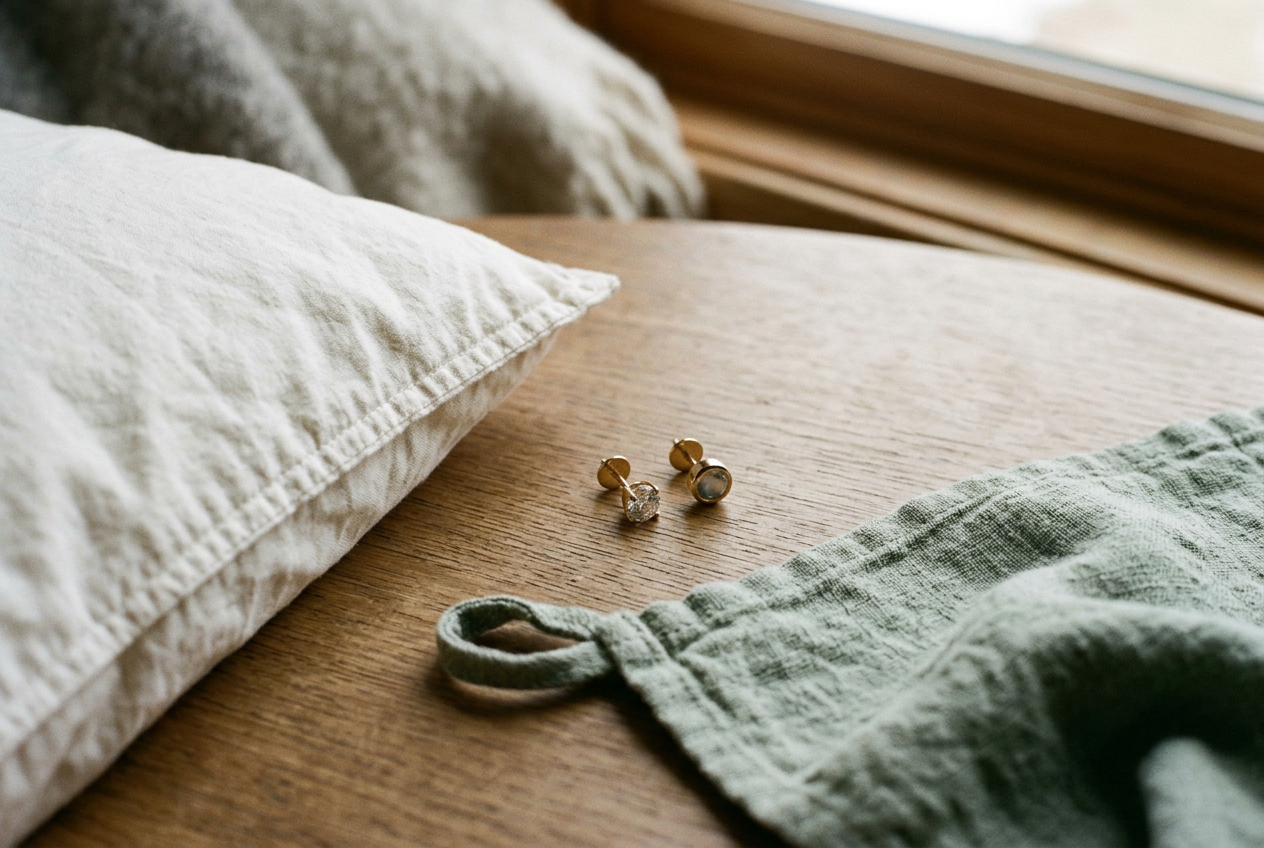
The troublesome detail is tiny: four metal tips rising around a 3 mm round stone. On a flat back earring, meaning the post’s backing sits flush against the earlobe, those tips become the likeliest snag point once the conventional butterfly clutch is gone.
For this comparison, the anchor was a matched pair of clear cubic zirconia fronts. One held its stone with four prongs. The other wrapped a smooth rim of metal around the stone in a full bezel. Both sat on the same style of threadless titanium labret, a post that holds its decorative end by tension rather than a screw, so the front setting was the meaningful variable.
This is unisex advice. Hair length, fabric texture, piercing placement, and sleeping position matter more here than the section of a jewelry counter where the earring is sold.
A flat back only solves the back
Flat backs deserve their comfortable reputation. A small disc rests behind the ear instead of a clutch with projecting loops, reducing the hard point that can press into skin or hook a pillowcase. That change is especially noticeable for side sleepers and for piercings higher on the ear, where a conventional backing can feel disproportionately bulky.
The name, however, describes only one end of the earring.
A prong setting holds a stone with narrow metal claws folded over its edge. It exposes more of the stone, which can admit more light and make a small clear gem look crisp rather than metal-heavy. The same open construction leaves several raised transitions where fabric or hair can enter, particularly if a prong tip sits proud or the stone rides high above the ear.
A bezel setting surrounds the stone with a continuous metal lip. There are no individual claws to meet a towel loop. A well-finished bezel also gives the finger a useful clue: stroked from every direction, the front should feel like one rounded shape rather than a stone interrupted by four hard points.
The matched 3 mm fronts showed why this distinction matters. Their backs felt identical against the ear. Their faces did not behave alike once anything brushed across them.
The pillowcase test is gentler than it sounds
A smooth cotton pillowcase did not make the four-prong stud feel dramatically uncomfortable. Most passes skimmed over its small face, which explains why many people sleep in prong-set flat backs without thinking about the setting at all. The weak point appeared at the folded edge and seam, where a raised prong had enough structure to catch rather than merely push loose cloth aside.
The bezel front offered less resistance. Its metal rim guided the seam over the stone, and there was no gap beside a claw for the fabric to enter. That does not make every bezel sleep-friendly. A tall bezel can still press into the ear, while a poorly finished rim can feel sharp.
Height and polish matter as much as the setting’s name.
Pillow material changes the result. Closely woven cotton and smooth sateen present fewer loose fibers than brushed flannel or open-textured linen, although piping, embroidery, and a damaged weave can create snag points on any case. A side sleeper also loads the front at an angle, so a modest projection that passes a fingertip check may become obvious after several hours against a pillow.
For overnight wear, look at the earring from the side. The 3 mm bezel front formed a low, rounded rise from the post. The four-prong version placed the stone slightly above its supporting metal. That extra exposure was attractive in daylight.
It was not useful in bed.
Towels expose the setting fastest
Looped terry cloth is the hardest surface in this comparison. Its pile can slide around a prong and tighten when the towel moves, turning a minor catch into a sharp pull on the piercing. Even the small four-prong front found loops more readily than it found the pillowcase seam.
The practical response is not to grind either earring against a towel as a durability challenge. Pat around the ear after washing, and avoid dragging a bath towel across a pierced lobe or cartilage placement. For a shopping check, an unworn earring can be moved lightly over a clean towel without pressure. Stop at the first catch.
Pulling harder tests the fabric and your grip, not normal wear.
The bezel was calmer on terry cloth because its continuous edge gave the loops less to encircle. It was not frictionless. The join between the decorative front and post remained a possible contact point, and any decorative beading or open basket beneath a so-called bezel can defeat the purpose. A full, low bezel is the relevant construction here, not merely a stone with some metal around it.
That distinction belongs in product photographs. Front views show color and sparkle; side views reveal whether the stone sits in a smooth cup or on a raised structure. If a listing omits the profile, ask for it or choose a design whose construction is visible.
Knits punish sharp prongs
A compact jersey knit passed over both 3 mm fronts without much resistance. A looser sweater knit was less forgiving. Fine yarn could settle beside the prongs, and the pull became more noticeable when the fabric changed direction, as it would while a crewneck moved over the head.
This is where a tiny earring can damage something more expensive than itself. A pulled wool or cashmere loop may remain visible after the ear feels fine, and repeated catches can loosen a prong even when the stone stays in place. Removing a favorite sweater slowly does not eliminate that mechanical mismatch.
The bezel front is the better default for anyone who regularly wears fuzzy cardigans, open knits, or scarves close to the ear. Check the metal edge first. A smooth bezel protects fabric; a nicked or lifted rim becomes its own hook. Run a clean fingertip around the setting before wearing it with a delicate knit, then inspect it again if the earring has been dropped or knocked.
A prong-set flat back still makes sense with tightly woven collars and open necklines, especially when the stone’s brighter, less obstructed appearance is the point. It just should not be mistaken for the lowest-maintenance option because the backing is flat.
Hair finds spaces fabric misses
Hair does not need a visible hook. A single strand can enter the space below a prong, wrap around the post, and pull during brushing or sleep. Longer hair makes the problem easier to notice, but short curls and fine strands around the ear can do it too.
On the matched fronts, the bezel gave hair fewer routes under the stone. The four-prong setting required more attention around the base, where wrapped strands were not always visible from the front. That matters beyond comfort. Hair and product residue can collect beneath an open setting, making cleaning more involved than a quick wipe across the face.
Neither style should be cleaned while still tangled. Unwrap the strand rather than pulling it through the setting, then follow the maker’s care instructions for the metal and stone. Cubic zirconia, diamond, opal, and glass do not share one universal cleaning routine, even when their settings look alike.
Buy the front and post as separate fit decisions
A bezel cannot correct a post that is too short. The wearable length, meaning the section of post that passes through the tissue, must leave enough room for the ear without allowing so much movement that the front tilts and catches. Piercing placement and tissue thickness vary, so copying another person’s millimeter measurement is unreliable.
Disc size matters as well. A wider flat disc can distribute pressure, but it may crowd a neighboring piercing or become awkward in a tight fold of cartilage. The matched 3 mm stone comparison isolates the front setting; it does not erase those fit questions.
Material labels also deserve separate attention. Implant-grade titanium and solid gold are common fine-jewelry choices, but buyers should check the stated grade or karat and confirm what the post, front, and decorative plating are made from. “Hypoallergenic” alone does not explain the alloy or construction.
At comparable material and stone quality, the setting should be treated as a comfort tradeoff rather than a reason to accept a large unexplained premium. Precious metal and natural stones can move an earring into a much higher price band than plated metal and cubic zirconia, regardless of whether the edge is pronged or bezel-set. Pay for the material you intended to buy. Then choose the front for how it will meet your clothes and hair.
The practical decision is narrow. For an earring expected to stay in through sleep, hair washing, sweaters, and daily dressing, choose a low full bezel with a smooth side profile. For a piercing changed with outfits, where brightness and a more exposed stone matter, the four-prong 3 mm front earns its place. Just take it out before pulling on the cashmere.
Questions people ask
Do all prong-set flat back earrings snag?
No. Small, low settings with rounded, well-finished prongs may pass over smooth fabric without a noticeable catch. Risk rises when the stone sits high, a prong projects beyond its surface, or the earring meets towel loops, loose knits, seams, and hair.
Are bezel-set earrings always better for sleeping?
A low, polished bezel usually presents fewer snag points than exposed prongs, but post length and front height still determine comfort. A tall bezel can press into the ear, and a rough rim can catch fabric. Check the side profile rather than relying on the word “bezel.”
Can
I use the towel test on earrings I already own?
Use an unworn earring and move it lightly across clean terry cloth without pressure. Stop if a loop catches instead of pulling through it. The check can reveal a projecting prong, but it does not prove that an earring is safe for continuous wear or suitable for a healing piercing.
Should
I change a fresh piercing to a bezel setting?
Do not change jewelry in a healing piercing merely to improve the front setting. Swelling, post length, metal, and timing need individual assessment. A qualified piercer can check whether the existing jewelry is causing pressure or snagging and fit an appropriate replacement when the piercing is ready.
One update a day
Today's fashion update, in your inbox
One fashion update each morning — no hype, no filler, just pieces worth wearing.