Your Threadless Earring Pin Needs Less Bend Than You Think
A slight curve creates the grip inside a threadless labret. Add it in small adjustments, or the pin can kink, jam or loosen at the decorative end.
October 10, 2026 · 7 min read
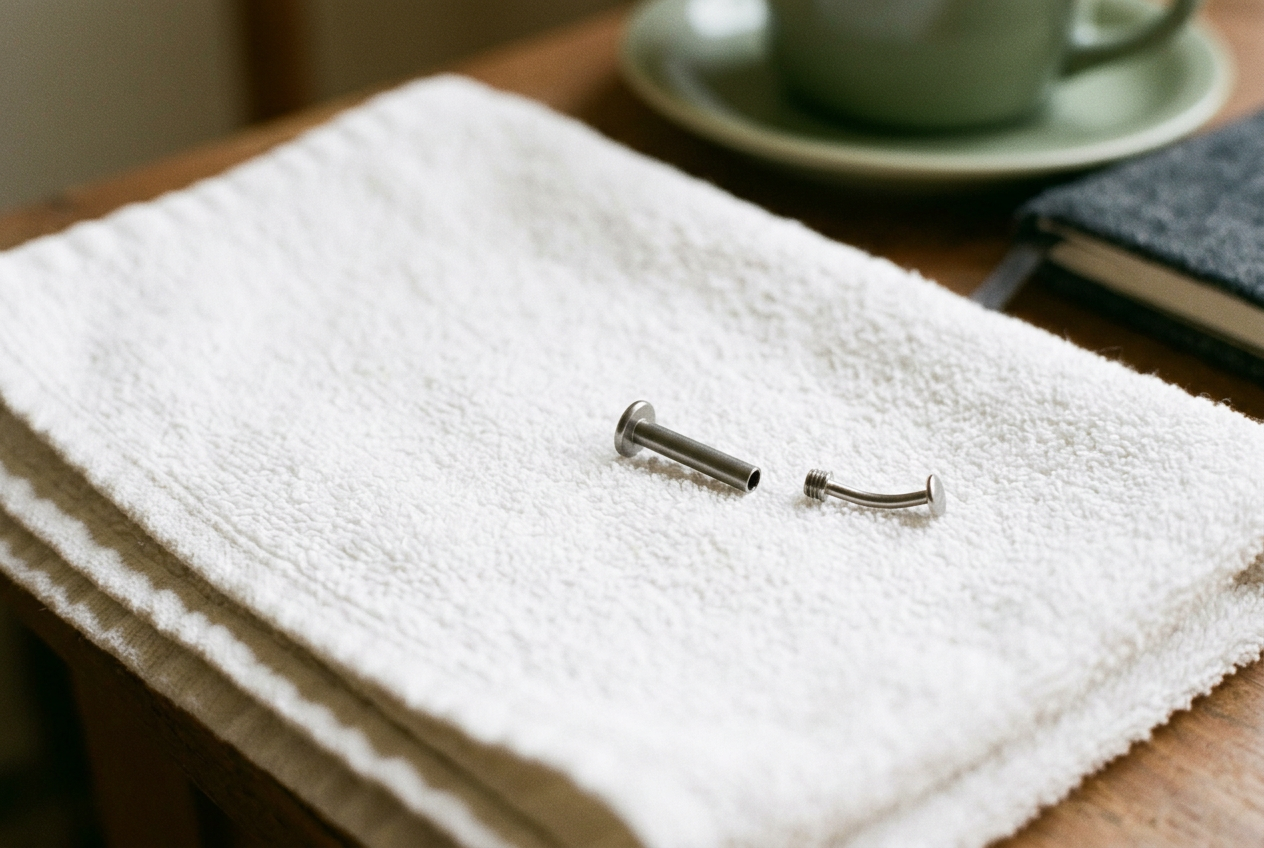
The useful detail is smaller than a fingernail clipping: the slender pin attached to the decorative end should show a shallow curve when viewed from the side. That curve presses against the inside of the hollow post, creating the friction that holds a threadless earring together.
The concrete example here is a NeoMetal implant-grade titanium flat-back labret fitted with a small bezel-set cubic zirconia end. A flat-back earring, meaning the backing sits flush against the skin, is comfortable enough for daily wear because there is no butterfly clutch protruding behind the ear. Its security, however, depends on that tiny pin being adjusted well.
This is unisex jewelry advice. The mechanics do not change with the styling of the ear, whether the labret sits alone in a lobe or alongside several gold hoops.
The curve belongs in the pin, not at its base
A threadless labret has two parts. The hollow post passes through the piercing and ends in a flat disc; the decorative end carries a thin pin that slides into the post. There are no screw threads. Tension between the curved pin and the inner wall keeps the end from pulling free.
Brand fitting instructions commonly show the same basic method: insert part of the pin into the post, angle the decorative end slightly to create a bend, remove it and then press it fully home. Using the post as the bending guide keeps fingers away from the weakest-looking point, the junction where the pin meets the setting.
That location matters. If the bend starts directly under the bezel on the NeoMetal end, repeated adjustment loads the joint rather than the length of the pin. A smooth curve placed farther along the exposed section spreads the movement across more metal. The result should look intentional but modest.
A crease, corner or hook has gone too far.
There is no responsible universal angle to chase. Threadless posts and ends can differ in pin length, internal fit and manufacturer specification, while a pin that already has some curve needs less adjustment than a straight one. Brand compatibility also matters: matching the post and end within the same documented system removes one variable that eyesight cannot resolve.
Set the bend in small increments
Work over a clear tray or folded towel so that the end cannot bounce into a sink or carpet. Wash and dry your hands, then inspect the pin under good light. Stop if it already has a kink, visible crack, rough patch or looseness where it meets the decorative setting. More bending will not repair damaged jewelry.
Hold the flat disc of the post rather than squeezing the hollow tube. Feed the pin partway into the opening, leaving the decorative end outside. Brand instructions vary in how much of the pin they illustrate inserting before adjustment, so use the directions supplied with the jewelry when available; the essential point is to keep enough pin supported inside the post that the pressure produces a gradual curve rather than folding one exposed spot.
Tilt the decorative end a small amount, then bring it back into line and withdraw the pin. Look from the side. On the bezel-set end, the pin should now sweep gently away from a straight path before returning toward it. If the change is hard to see but can be felt during insertion, test it before adding more.
Align the pin with the opening and press the end into the post. Resistance should build as the curved section enters, followed by a firm seat when the decorative end reaches the post. It should not require a hard shove. Titanium is durable jewelry material, but the pin is still narrow, and forcing a severely curved pin into a hollow post can score, kink or lodge it.
Now test the connection off the body. Hold the post and pull the decorative end straight outward with controlled pressure. Do not twist it as though it were threaded. If it slides out with almost no resistance, add another small bend using the same supported method.
If it will not seat fully, or removing it demands enough force that your fingers slip, reduce the curve rather than pushing harder.
Retention should feel firm, not permanent
A good fit has a narrow practical window. The bezel-set end should stay attached through dressing, sleep and ordinary handling, yet remain removable when the jewelry needs changing. Maximum resistance is not the goal.
Too little bend has an obvious failure mode: the end works loose when it catches on a shirt, towel or hair. A fit that seems acceptable during gentle handling can still be poor if the end rotates freely and lifts without a deliberate pull. Retest after the first insertion because the pin may settle slightly as it travels through the post.
Too much bend causes a different problem. The end may stop before the setting meets the post, leaving a visible gap that catches and looks unfinished. It can also become so difficult to remove that the wearer grips the stone or setting with excessive force. On the titanium labret, that defeats the reason for choosing a threadless system, which is a clean front with a removable end rather than a permanently locked assembly.
If the end is too tight, withdraw it straight out and use the post to ease the curve toward straight in a small movement. Avoid repeated back-and-forth flexing. Every correction adds stress, and a pin that has been sharply bent several times is a poor candidate for everyday wear even when it looks straight again.
Fit problems are not always bend problems
A pin can have an appropriate curve and still fail to hold if the end and post were not designed to work together. Threadless does not guarantee universal compatibility. The pin diameter, post opening and expected tension must correspond, which is why the manufacturer’s pairing guidance deserves more weight than a visual match.
Post length creates another false signal. If the labret is too short for the tissue, pressure from the ear can make the front feel fixed even when the pin has weak retention. If it is too long, the decorative end can tip and snag, placing leverage on the connection. Adjusting the pin cannot correct either sizing problem.
Gauge, the thickness of the post that passes through the piercing, also needs to suit the placement and the end being used. It is separate from post length. A professional piercer can check both measurements when the jewelry presses, angles noticeably or leaves excess post visible, especially if the piercing is new or irritated.
For the NeoMetal example, the best stopping point is unremarkable: the bezel sits flush against the post, the end resists a direct pull and removal remains possible without tools. Once it reaches that point, leave the pin alone. Routine rebending is not maintenance.
Handle the jewelry without loading the pin
To remove a threadless end, hold the flat back steady and pull the decorative front straight away from the post. A slight rocking motion may help with a firm connection, but prolonged twisting adds no unscrewing benefit because there are no threads. Grip the setting, not the stone alone.
Check the pin whenever the end has taken a hard snag or no longer feels the same during insertion. A smooth shallow curve can be adjusted. A sharp kink, damaged surface or moving joint calls for replacement of the end, while a distorted post should also be retired rather than used to reshape another pin.
Fresh or healing piercings are a separate case. Do not repeatedly remove an end to practice the fit, and do not shorten a post or change jewelry based on appearance alone. A piercer can fit the connection off the ear and assess whether swelling, post length or placement is creating the problem.
The tradeoff is straightforward. A stronger curve increases retention only until insertion becomes difficult and metal fatigue becomes the larger concern. For an everyday flat back, the right amount of bend is the least that passes the pull test and keeps the front seated flush.
Questions people ask
How visible should the bend in a threadless pin be?
It should appear as a shallow, smooth curve when viewed from the side, without a corner or crease. The pull test matters more than a target angle: the end should resist controlled removal, seat flush against the post and still come out without tools or extreme force.
Can
I bend a threadless earring pin with pliers?
Use the hollow post as the guide when the brand’s instructions call for that method. Bare pliers can mark or sharply crease a narrow pin, while padded tools still make it easy to apply too much pressure. If fingers and the matching post cannot produce a controlled adjustment, take the jewelry to a piercer.
Why does my threadless end keep falling out?
The pin may be too straight, but incompatible parts, a damaged post or excess post length can create the same complaint. Inspect both pieces, confirm that the manufacturer approves the pairing and add only a small curve. Replace an end with a kink, crack or loose pin rather than rebending it.
Can
I adjust a threadless end while it is in my ear?
No. Remove the connection and adjust it off the body so the post supports the pin and you can inspect the curve. For a fresh or irritated piercing, leave the jewelry in place and ask a piercer to handle the fitting; repeated removal can disturb the channel and obscure the real sizing issue.
One update a day
Today's fashion update, in your inbox
One fashion update each morning — no hype, no filler, just pieces worth wearing.