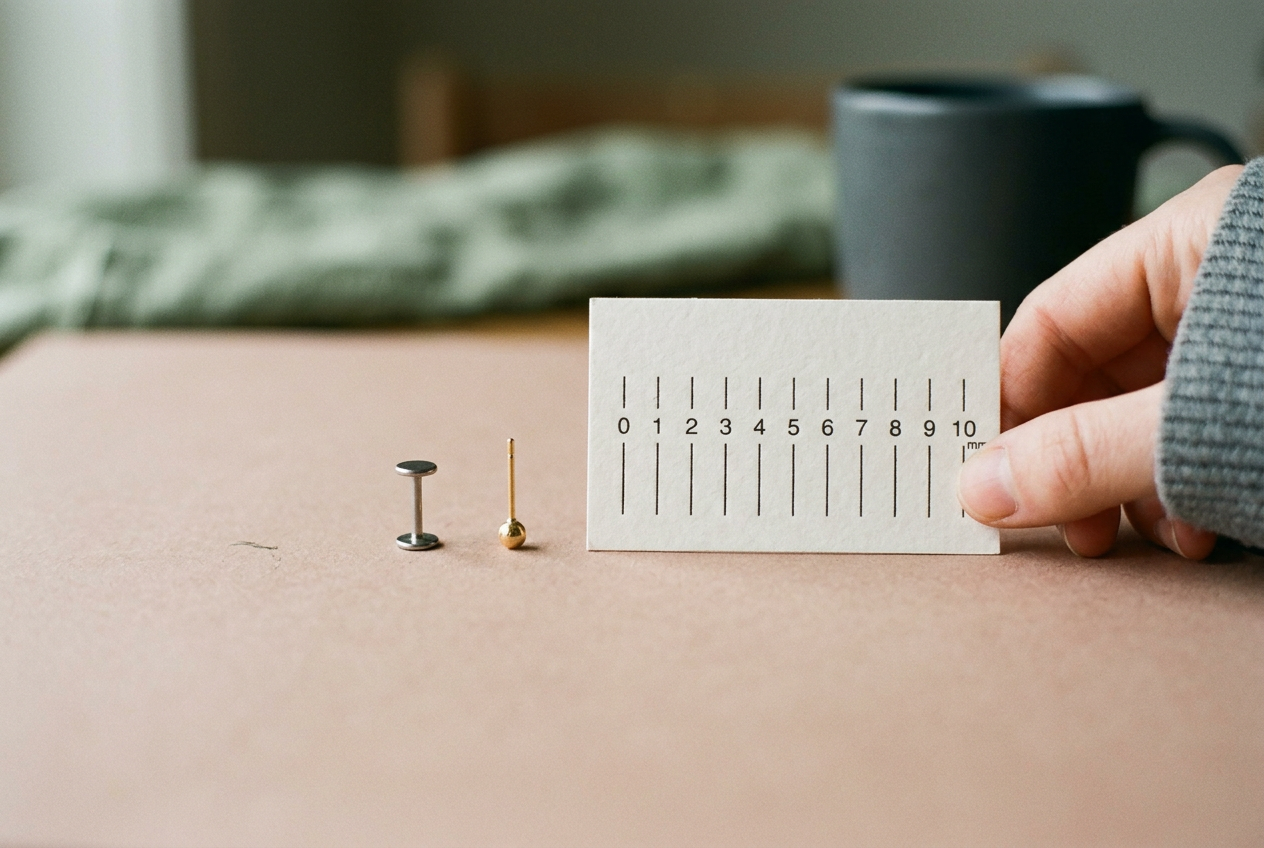
A 0.2 Millimeter Earring Change Can Feel Bigger Than It Looks
An 18g post is only 0.2 millimeter thicker than a 20g post, but it occupies much more space. Check the millimeter size, post system and top before buying.
September 28, 2026 · 7 min read

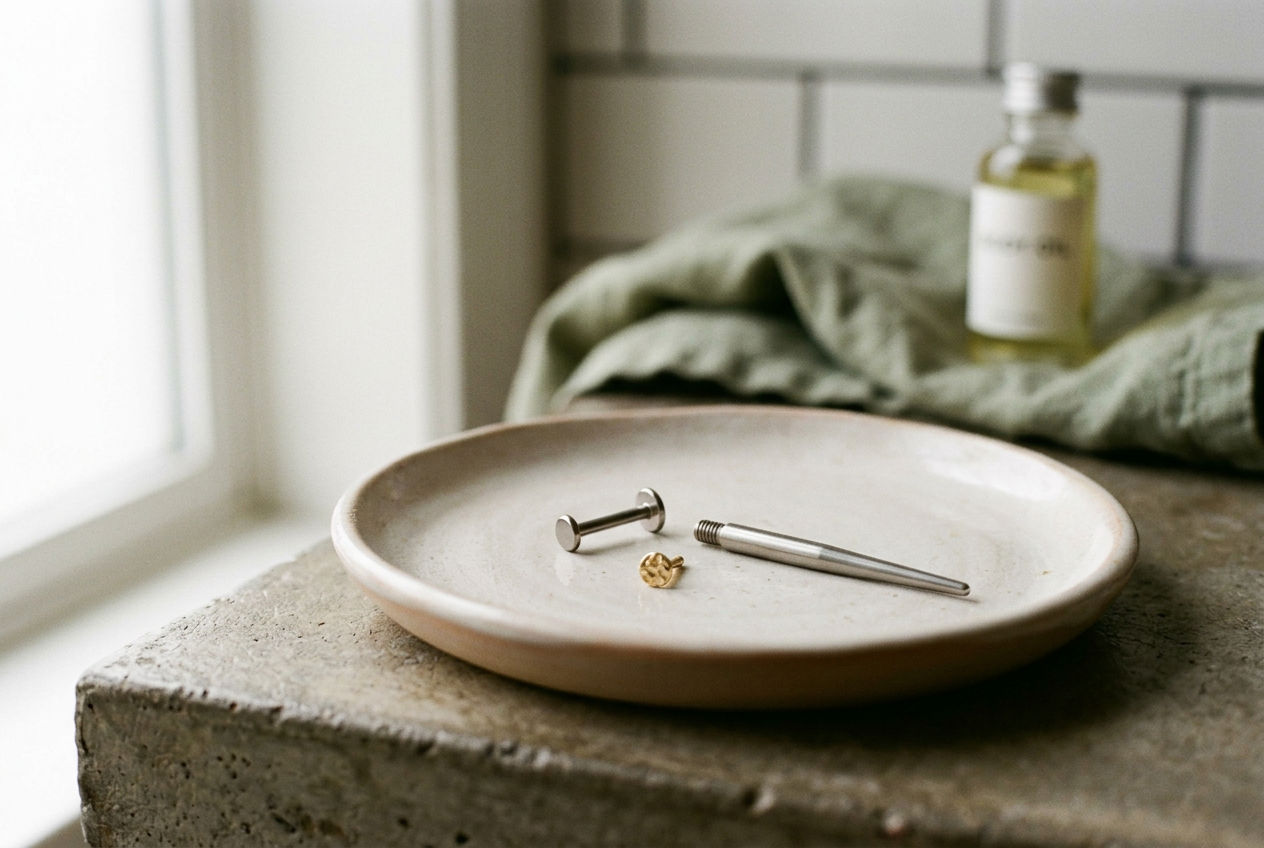
The reference pair for this walkthrough is specific: two 18g implant-grade titanium threadless flat backs with 3 mm bezel-set cubic zirconia tops, intended for first-lobe holes beside slim gold huggies. A flat back earring, meaning the post’s backing sits flush against the earlobe, makes sense in that stack because there is no butterfly clutch to overlap the neighboring earring.
The possible mismatch is less visible. If those holes have been wearing conventional 20g studs, the new 18g posts are about 0.2 mm thicker. That sounds negligible on a product page.
It may not feel negligible during insertion, and a decorative top that fits one post may still be unusable with another.
Gauge is a thickness label in which the number runs backward: a lower gauge number indicates a thicker post. This unisex sizing system applies across earring styles, but brands sometimes round the corresponding millimeter figures, so the measurement printed in millimeters is the cleaner comparison.
The useful gauge conversions
Start with the sizes most likely to appear in lobe jewelry and flat-back listings:
| Gauge label | Common metric listing | |---|---:| | 22g | 0.6 mm or 0.65 mm | | 20g | 0.8 mm | | 18g | 1.0 mm | | 16g | 1.2 mm | | 14g | 1.6 mm |
These are shopping conversions, not promises that every post carrying the same gauge label has an identical measured diameter. Gauge standards can produce more precise figures, while body-jewelry brands commonly sell rounded metric sizes; manufacturing tolerances and coating thickness can add another small variation.
The practical rule is to privilege the brand’s millimeter specification. If one listing says 18g and 1.0 mm while another says only 18g, the first gives you more useful compatibility information. If a product page shows a gauge in the title and a conflicting metric measurement in the specifications, ask the seller which dimension describes the post before ordering.
Return to the titanium reference pair. Its 18g label matters, but the 1.0 mm measurement is what distinguishes it from the 0.8 mm posts already in the jewelry box.
The gauge number is shorthand. The diameter is the fit.
Why 0.2 millimeter can feel substantial
A move from 0.8 mm to 1.0 mm increases the post diameter by 25 percent. Look at the circular cross-section instead, and the thicker post occupies roughly 56 percent more area, which better explains why a small number on a screen can translate into pressure or resistance at the piercing.
A healed piercing may also have settled around the jewelry worn most often. Removing a fine conventional stud does not guarantee that a thicker flat-back post will behave like a direct replacement, even when both products are marketed for lobe wear. Angle matters. Scar tissue matters.
A post that is slightly oversized for the existing channel can feel uncomfortable before the decorative top is anywhere near its final position.
That is the central tradeoff in the reference stack. The 18g titanium post is sturdy and widely used for threadless jewelry, but choosing it solely because the bezel top looks right could leave the wearer with a post that does not suit the existing hole. Resistance, pain, bleeding or swelling is a stop sign, not a fit quirk to push through; a qualified piercer or clinician can assess what is happening.
Three separate fits have to agree
Gauge is only the first fit. The post must suit the healed piercing, the post length must suit the tissue, and the decorative top must connect to that particular post system. Product pages often spread those details across separate menus, which makes one earring look more interchangeable than it is.
For the reference pair, the 18g measurement describes the outside diameter of the post. The wearable length, meaning the section that passes through the tissue, is a separate number measured from the back disc to the base of the decorative end. A correct gauge paired with too little length can press. Too much length leaves the top projecting forward and allows the post to shift or snag.
Next comes the mechanism. A threadless earring uses a slightly bent pin on the decorative end, held by tension inside a hollow post. Some manufacturers make several post gauges that accept the same family of threadless ends, but that does not make every threadless top universal. Pin diameter, bend, post opening and brand tolerances still have to agree.
Internally threaded jewelry places the screw thread inside the post, with a matching screw on the decorative end. Here, gauge alone is even less useful as a compatibility check because the thread pattern must match as well. Externally threaded jewelry puts the screw thread on the outside of the post; if replacing only one component, identify that construction rather than assuming any screw-on top will fit.
The titanium pair therefore needs four confirmations before checkout: 18g or 1.0 mm at the post, a suitable wearable length, a threadless connection, and a top pin approved for that post. The 3 mm bezel measurement tells you how the top will look in the stack. It says nothing about whether the parts connect.
The compatibility checklist
Read the earring currently being worn before reading the new listing. Packaging, order history and the maker’s product page are more dependable than estimating a fraction of a millimeter by eye, particularly when 20g and 18g posts sit side by side.
- Current post: Record its gauge and millimeter diameter. If neither is known, do not infer the size from the decorative front.
- Healed piercing: Compare the current post with the proposed post. A jump from 20g to 18g is a thickness change, not a neutral style swap.
- Wearable length: Match the length to the existing well-fitting jewelry rather than copying the model photo. Disc size also matters if neighboring backs are close together.
- Connection type: Keep threadless, internally threaded and externally threaded parts in their own systems.
- Decorative top: Check the maker’s stated post compatibility, including compatible gauges or thread pattern. Visual similarity is not a specification.
- Material: Look for a named metal standard rather than a vague phrase such as surgical metal. For titanium, ASTM F136 or ASTM F67 are commonly documented implant-grade specifications.
If all six details are present, buying a post and top separately becomes much less uncertain. It can also save money when the decorative end is already owned, because only the compatible post needs replacing. If the listing omits the connection details, a complete matched earring is the lower-friction purchase.
Post length deserves particular attention in an earring stack. The 3 mm bezel top beside a slim huggie may be visually balanced, yet an overly long labret post, a straight post with a fixed disc back, can tilt the stone toward the hoop and create contact between the two pieces. A shorter post may sit neatly but press the tissue. Gauge conversion cannot resolve that dimension.
Material and styling still count
The reference post is implant-grade titanium because it keeps the construction light and gives the listing a verifiable material specification. Titanium can look cooler and grayer than a yellow-gold huggie, although the 3 mm top hides much of the shaft; an anodized finish may alter the color, while plating is a separate surface treatment that can wear.
For a mixed-metal stack, that small exposed difference is often acceptable. For a tightly matched gold stack, a solid-gold post and top may look more consistent but usually represent a larger purchase, so compatibility matters more: an expensive decorative end that cannot connect to the owned posts is not worth buying on appearance alone.
The sizing decision remains the same. A 20g, 0.8 mm flat back is the closer thickness match for a lobe already wearing 20g studs, provided the length and system also work. The 18g, 1.
0 mm titanium pair is not interchangeable merely because the difference fits after the decimal point.
Questions people ask
Can an 18g earring fit a piercing that wears 20g jewelry?
An 18g post is commonly listed at 1.0 mm, while 20g is about 0.8 mm, so it is a thicker piece rather than a direct size match. A healed piercing’s current fit cannot be confirmed from the label alone.
Do not force a post that meets resistance or causes pain, bleeding or swelling.
Are 20g and 0.8 mm the same size?
They are commonly treated as equivalent in earring listings, although gauge standards, brand rounding and manufacturing tolerances can produce slight differences. Use the product’s stated millimeter diameter when comparing two brands, and check the post length separately because 0.8 mm describes thickness, not how far the post travels through the lobe.
Do all threadless decorative tops fit all threadless posts?
No. A threadless top has a pin that sits under tension inside a hollow post, but pin and opening dimensions can vary. Some brands document compatibility across several post gauges or product families. Confirm that documentation before buying a top alone; the word “threadless” does not establish universal fit.
Which gauge is best for an earring stack?
There is no single stack gauge. Use the diameter already fitting each healed piercing, then choose top and disc sizes that leave physical space between neighboring pieces. In the reference stack, the 3 mm bezel can sit beside the huggie only if the post length prevents tilting and the back disc does not overlap the next earring.
One update a day
Today's fashion update, in your inbox
One fashion update each morning — no hype, no filler, just pieces worth wearing.