Use an Insertion Taper Before Forcing a Flat Back Earring
A threadless insertion taper gives a flat back post a smooth path through a healed piercing. The tool must match the post gauge, and resistance means stop.
September 26, 2026 · 8 min read
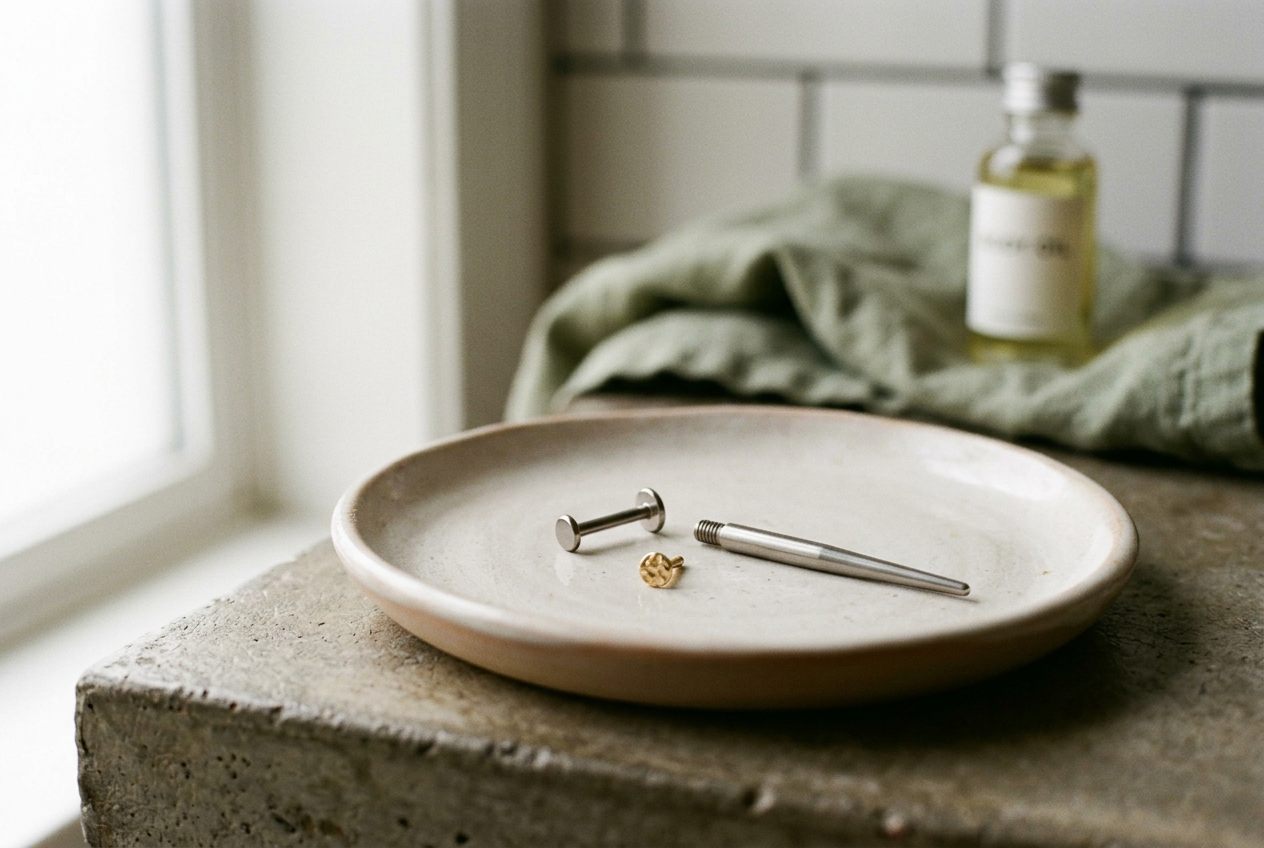
The useful detail is a narrow, polished metal shaft. One end passes through the piercing channel; the other connects to the hollow post, keeping both pieces aligned as the jewelry moves into place. That small bridge matters when the post must enter from behind the ear, where fingers block the view and a slight change in angle can turn an easy swap into a sore one.
Take one specific earring: an 18-gauge implant-grade titanium labret with a 6 mm post, a 3 mm rear disc and a small solid-gold threadless end, worn overnight in a fully healed second-lobe piercing. A flat back earring, meaning the post’s backing sits flush against the earlobe, is comfortable once installed. Getting that little disc through from behind is the awkward part.
This advice is unisex because the mechanics depend on anatomy and jewelry dimensions, not the wardrobe around the earring.
The taper closes the practical gap
A labret is a straight post with a fixed flat disc at the back. With threadless jewelry, the decorative end has a slender pin that presses into the hollow post and stays there through tension rather than screw threads. Remove that end, and the post can slide out through the back of the piercing.
Putting it back is harder. The cut edge of the hollow post is not sharp, but it is blunt enough to catch at the entrance or inside a channel that does not run perfectly straight. Lobes may angle slightly upward or downward. Cartilage channels can be even less forgiving, especially when the piercing sits where the ear folds.
An insertion taper gives the post a continuous route. On the common pull-through style used with threadless labrets, the taper enters from the front, follows the established channel and connects to the post behind the ear; as the taper comes forward again, the post follows from back to front. Designs vary, so the tool maker’s instructions take priority over that sequence.
The taper is a budget accessory, generally costing a small fraction of a solid-gold decorative end. Stainless steel and titanium versions are common. Choose a smooth, well-finished tool from a body-jewelry supplier rather than an unknown rough-edged set, because a visible seam or burr defeats the point.
It is not jewelry. Do not leave it in, and do not use it to stretch a piercing to a larger size.
Match the gauge, not the decoration
Gauge describes the thickness of the post. In the sizing commonly used for body jewelry, 18 gauge is about 1.0 mm, 16 gauge is about 1.2 mm and 20 gauge is about 0.
8 mm. The number gets smaller as the post gets thicker, which is the fit quirk most likely to cause a mistaken order.
The taper should match the labret post’s gauge. For the 18-gauge titanium post in this example, buy an 18-gauge threadless insertion taper that is compatible with the post’s hollow opening. A 16-gauge taper is too thick for that established channel. A 20-gauge tool may pass through, but its narrower body can leave a step where it meets the 18-gauge post, which is exactly where tissue can catch.
Do not choose from the visible size of the gold end. Many threadless ends work with more than one post gauge, while the taper must correspond to the post traveling through the piercing. Post length is separate too. The 6 mm length determines how much room sits between the rear disc and decorative end; it does not determine taper size.
Check the jewelry receipt, packaging or product page before removing anything. If the gauge is unknown, a professional piercer can measure it with the appropriate tools. Guessing is poor value when the whole purpose of the taper is to avoid force.
Compatibility deserves one more check. Threadless systems can differ at the connector, even when the listed post gauge matches, so confirm that the taper is made for the same type of hollow post. If the taper does not seat neatly in the post before either piece goes near the ear, it is the wrong pairing.
Only change a settled piercing
A healed piercing should feel ordinary before an at-home change. There should be no ongoing tenderness, swelling, discharge or recurring crusting, and the jewelry should move only as much as the established channel comfortably allows. Healing time varies by placement and person; an earlobe and a cartilage piercing should not be treated as interchangeable simply because both look calm from the outside.
A taper cannot make an unhealed piercing ready. Home cleaning also does not reproduce the sterilization available in a piercing studio. If the jewelry is an initial post, if a planned downsize is due or if there has been a recent irritation bump, let a reputable professional piercer handle the change.
Set up before removing the existing earring. Wash and dry your hands, use a clean work surface with good light, and clean the jewelry and reusable tool according to their manufacturers’ directions. A mirror helps, but touch matters more than sight behind the ear. Keep the new threadless end within reach so the empty post is not left unsecured while you search for it.
Guide the post without making a new path
Remove the old jewelry gently. If it sticks, do not pull harder just to keep the appointment with a new gold end. A fully healed channel can still tighten after jewelry comes out, and some piercings narrow faster than expected.
For the second-lobe earring in this guide, place the fine end of the compatible 18-gauge taper at the front opening. Follow the angle of the old jewelry. The tool should travel through the existing channel with light, steady pressure; it should not feel as though it is piercing skin. If the maker recommends a lubricant, use only the product and small amount specified for body-jewelry insertion.
Once the connector is accessible behind the ear, fit the hollow front opening of the titanium labret onto it. The join should feel aligned rather than perched at an angle. Support the flat disc between two fingers, then draw the taper toward the front while nudging the post forward from behind, keeping the connection together until the titanium post occupies the channel.
Slow is useful here. Repeated probing is not.
When the post has emerged at the front, detach the taper while holding the rear disc so the labret cannot slip back out. Align the pin of the threadless gold end with the hollow post and press the pieces together. Threadless jewelry pushes in rather than screwing in. Many pins have a slight bend that creates holding tension; do not repeatedly reshape one unless the jewelry maker instructs you to, because too much bend can make insertion difficult and too little can leave the end insecure.
Check the fit from both sides. The 3 mm disc should sit flat rather than digging into the lobe, while the gold end should rest without squeezing tissue between the two. The 6 mm post is only an example, not a universal lobe length. If skin bulges around either end or the post leaves a large amount of spare room that catches on hair, the length needs reassessment.
After the change, leave the earring alone. Mild awareness after handling is different from escalating pain. The finished result should be the same quiet fit that made the flat back appealing in the first place: no exposed backing, no point against the pillow and no pressure ridge from a post that is too short.
Resistance is the stopping point
A taper is a guide, not a lever. Stop if you meet firm resistance, feel sharp pain or see bleeding. The channel may have narrowed, the angle may be wrong or the jewelry may not match the established gauge. Pushing can create a false passage, meaning a new route through tissue rather than the healed channel.
Cartilage deserves less experimentation than a straightforward healed lobe. So do piercings that are difficult to reach from behind, including some forward-helix and inner-ear placements. A piercer can often preserve a narrowing channel with suitable equipment, but repeated attempts at home may leave swelling that makes the job harder.
Seek prompt professional assessment for jewelry that appears embedded or for marked swelling, spreading redness, heat, worsening pain or concerning discharge. Do not make an infected-piercing removal decision from a jewelry tutorial, since removing the post may not be the appropriate first step.
For the settled second-lobe piercing, though, the matched 18-gauge taper solves a plain mechanical problem. It keeps the titanium post connected to the route already through the ear. That is enough to justify one small tool if threadless earrings are changed regularly. For a one-off cartilage swap, the better purchase may be no tool at all and a fitting appointment instead.
Questions people ask
Can
I use any taper for a threadless earring?
No. Choose an insertion taper made for threadless jewelry, matched to the labret post’s gauge and compatible with its hollow opening. A stretching taper or a mismatched connector can leave a ridge between tool and post, increasing the chance that the jewelry catches inside the channel.
Can an insertion taper reopen a piercing that has started closing?
It should not be used at home to force open a narrowed or closed channel. If the taper does not follow the existing route with light pressure, stop. A professional piercer can assess whether the channel remains open and whether jewelry can be reinserted without repiercing tissue.
Do
I need a taper for every flat back earring change?
No. Some accessible, fully healed lobe piercings accept a labret post easily by hand. The taper earns its place when the rear opening is hard to locate, the angle is difficult or the post edge tends to catch. It is particularly useful for people who change threadless ends while keeping the same correctly fitted post.
Can
I use an insertion taper on a fresh piercing?
Leave initial jewelry changes and planned downsizing to a professional piercer. A fresh piercing may look settled before the internal channel is ready, and an at-home taper is not sterile in the way studio equipment can be. The tool is best reserved for established, comfortable piercings with known jewelry dimensions.
One update a day
Today's fashion update, in your inbox
One fashion update each morning — no hype, no filler, just pieces worth wearing.