Magnetic Clasps Beat Lobsters on Grip, Not Security
A magnetic clasp needs the least pinch strength. A lobster clasp is harder to operate one-handed, but it holds a necklace more securely through daily snags and tugs.
November 9, 2026 · 8 min read
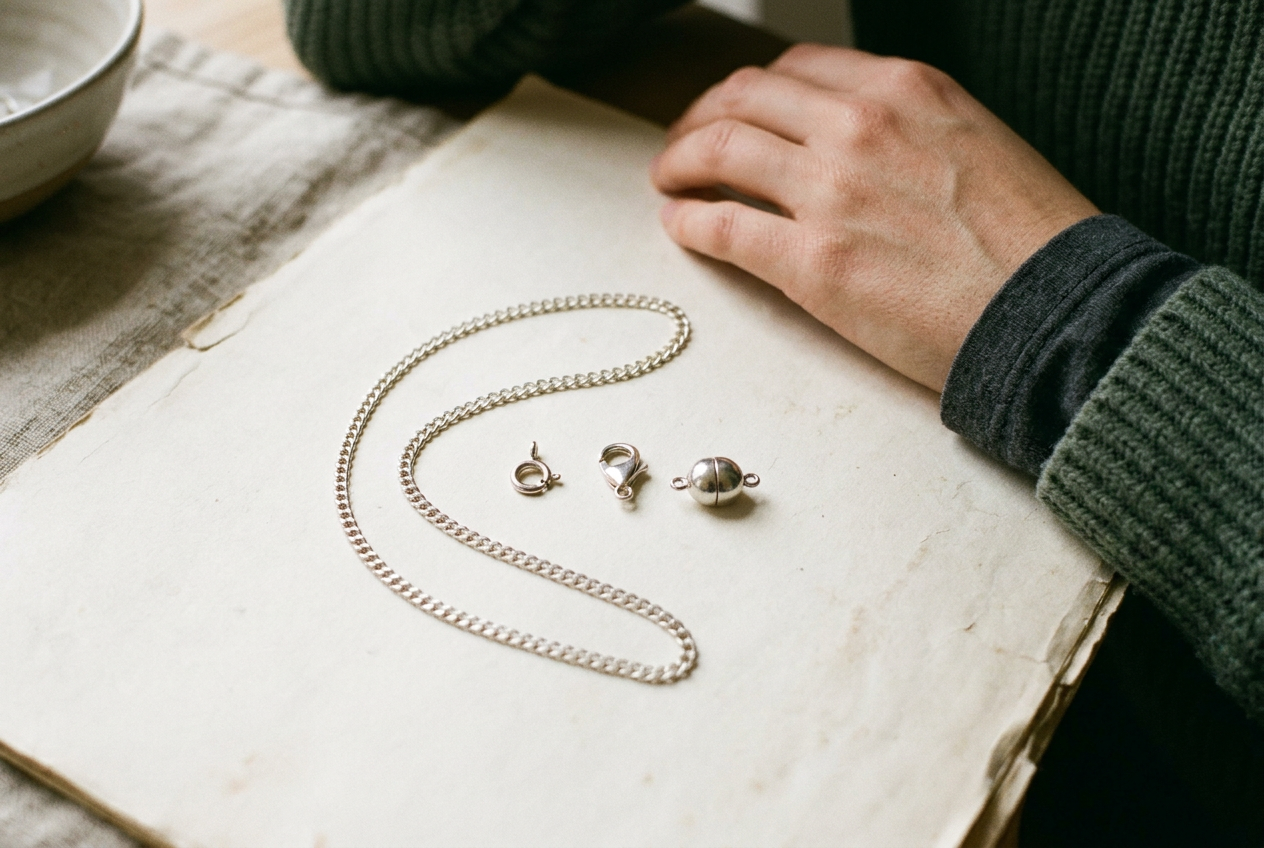
The clasp at the center of this comparison came on an 18-inch fine curb chain: a small spring ring paired with an end ring barely wider than the clasp wire. The chain itself was easy to wear. Closing it at the back of the neck was the problem.
A spring-ring clasp, meaning a hollow circular clasp opened by pulling back a tiny external tab, asks the fingers to do several jobs at once. One hand must stabilize the chain. A fingertip must catch the tab and maintain tension against the internal spring, while the other hand guides a narrow target into an opening that is partly hidden by the fingers holding it.
That sequence explains why a clasp can feel manageable on a table yet fail at the nape. It also gives us a useful way to compare alternatives: opening force, target size, security after fastening and whether one hand can complete the closure. This is unisex coverage. The mechanics apply across wardrobes, whether the necklace is a fine gold chain, a steel pendant chain or a strand of beads.
How the clasps were compared
The same fine curb chain was handled with its original spring ring, a larger lobster-claw clasp and a magnetic converter. A converter is a two-part magnetic fitting that attaches to an existing clasp and end ring, allowing the necklace to close when the halves meet. Each setup was fastened in front of the body, at the nape and with one hand doing most of the work.
This kind of handling check cannot reproduce every form of limited dexterity. Joint range, sensation, tremor, fatigue and grip strength alter the result in different ways. It does reveal where each design places its demands, and whether those demands come from force, precision or the need to hold tension while aiming.
The original spring ring set the baseline. Its spring was not unusually stiff, but its tab offered very little surface for the finger. The matching end ring was the more consequential flaw. It disappeared beneath a fingertip and needed to approach the clasp at a fairly exact angle.
On the fine curb chain, the target caused more failed attempts than the spring itself.
Spring rings demand precision before strength
A spring ring looks tidy on a delicate chain. It is light, compact and unlikely to rotate toward the front under its own weight, which matters when a small pendant should stay centered. Once closed, the continuous circular shape is dependable for ordinary wear.
Opening one requires a concentrated pinch, however, and enlarging the clasp does not always enlarge the tab by the same useful amount. Polished metal adds another problem. A rounded tab gives a short nail or soft fingertip little purchase, especially when hand cream, water or perspiration reduces friction.
The target should decide whether a spring-ring necklace stays on the shopping list. Look past the clasp and inspect the receiving ring. A larger oval ring is easier to locate by touch and offers a longer opening than a small round ring, without adding much visual weight to a fine chain. An extender chain can also help, but only if its links are large enough to catch cleanly; tiny decorative links create several bad targets rather than one good one.
For the test curb chain, replacing only the end ring would improve the fastening task without changing the necklace’s appearance much. It would not make the clasp one-handed. The wearer would still need to retract the tab while presenting the ring with the other hand.
Choose a spring ring when the chain is light, the clasp should remain visually discreet and two-handed fastening is comfortable. Skip it when fingertips struggle to isolate a small tab, when maintaining a pinch causes pain or when the necklace must be put on without help.
Lobster clasps offer more to hold
A lobster clasp, meaning a teardrop-shaped clasp with a lever that retracts a spring-loaded arm, gives the fingers a broader body to stabilize. Its lever is usually easier to distinguish from the surrounding metal than a spring ring’s tiny tab, and the opening can be visibly larger.
That makes the lobster the strongest general-purpose choice of the three tested mechanics, provided the clasp is sized to the chain rather than selected only for delicacy. On the same curb chain, the larger lobster was easier to orient by touch and easier to keep from rolling between the fingers. The wider opening accepted the end ring from a less exact angle.
Force remains part of the equation. Some lobster clasps have short, stiff levers that need a firm fingertip press; others have longer levers with more usable travel. Product photographs rarely communicate spring resistance, so the most useful online clues are close-up images showing the lever’s length and side profile, plus a clearly stated clasp dimension. A return policy matters here.
Size alone does not tell you how stiff the internal spring will feel.
One-handed use is still poor. It is possible to brace the receiving ring against a surface and work the lever with the same hand, but that is a workaround, not reliable necklace fastening at the nape. Worn normally, the lobster expects one hand to open the clasp and another to feed in the target.
Security is where it earns its place. The arm closes behind the end ring, and ordinary movement does not separate the parts. A larger lobster also suits medium-weight pendants better than a tiny spring ring, though an oversized clasp can migrate toward the shoulder or front if it outweighs a very fine chain.
For daily necklaces with sentimental, solid-gold or otherwise costly pendants, a well-proportioned lobster is the safer default. Ask a jeweler to fit a larger end ring at the same time. Increasing only the clasp leaves half the usability problem untouched.
Magnetic clasps remove the aiming problem
The magnetic converter changed the curb chain most dramatically. Instead of holding a spring open, the wearer brings two broad halves near each other. Magnetic pull finishes the alignment. The target feels larger than its visible footprint because the halves begin drawing together before they touch.
That makes a magnetic clasp the clear choice when pinch force is the main barrier or when the necklace must close with one hand. It can also be fastened at the front and rotated to the nape, although a fixed pendant may twist during that move. The converter adds length to the chain, which can shift a pendant lower than intended and change how an 18-inch necklace sits at the collarbone.
Security is the tradeoff. A magnetic clasp resists a gentle straight pull until the force exceeds the magnets’ hold, but sideways leverage, catching the chain on clothing or tugging it while removing a sweater can separate the halves. Magnet strength also varies, and a stronger magnet is not an uncomplicated upgrade: the clasp then takes more pulling force to open and may be harder to separate without yanking the chain.
The connector loops deserve close inspection. A converter attached through the original spring ring preserves that difficult clasp as a potential failure point, even if it only needs to be operated once during setup. A jeweler-installed magnetic clasp removes unnecessary hardware and can match the chain’s metal, while a plated converter is the lower-cost trial before altering a necklace.
Use magnetic closures for inexpensive or replaceable daily pieces, especially necklaces worn under smooth necklines where snagging is unlikely. I would not choose one for an irreplaceable pendant without an added safety chain, which is a short secondary chain that keeps the necklace attached if the main clasp separates. That backup adds another small fastening task unless it is permanently installed.
Magnets may also be unsuitable around some implanted medical devices. Follow the device manufacturer’s guidance before wearing a magnetic clasp near the upper chest or neck.
The buying decision comes down to the hardest motion
If squeezing a small lever is difficult but two hands can meet behind the neck, start with a large lobster clasp and an oval end ring. This combination reduces precision demands without accepting the release risk of a magnet.
If one-handed fastening is essential, the magnetic clasp is the practical answer among these three. Try it first on a necklace that would be disappointing, not devastating, to lose. Wear it through a sweater change at home. Check whether the added hardware pulls the clasp toward the front or drops the pendant below its intended position.
If a fine spring ring is already comfortable, there is no reason to replace it. Its compact shape remains well suited to light chains. On the test curb chain, though, the small receiving ring made the whole closure less usable than its clean appearance suggested. A larger target would be the minimum alteration; a lobster would be the more secure functional upgrade.
Material and finish affect the price band. Basic plated converters are the least expensive way to test magnetic closure, while sterling silver and solid-gold fittings cost more and should match the chain to avoid an obvious color break. A jeweler-installed solid-gold clasp is an alteration worth reserving for a necklace you already wear often, after the mechanism has proved comfortable in a less costly version.
Questions people ask
Which necklace clasp is easiest with limited hand dexterity?
A magnetic clasp asks for the least pinch force and the least precise aim because its two halves draw together. A larger lobster clasp is the better compromise when the necklace needs more security, although it generally requires two hands and enough fingertip pressure to hold the lever open.
Can a lobster clasp be fastened with one hand?
Sometimes, if the end ring can be braced against a tabletop or held steady against the body, but the method is awkward and unreliable at the back of the neck. For consistent one-handed dressing, a magnetic closure or a necklace designed to close visibly at the front is more practical.
Are magnetic necklace clasps secure enough for expensive jewelry?
They can hold through calm daily wear, but a snag, sideways twist or sweater removal may pull the halves apart. For an expensive or irreplaceable pendant, choose a lobster clasp or have a jeweler add a safety chain. Test any magnetic converter on a lower-stakes necklace first.
Can a jeweler make an existing spring-ring clasp easier to use?
Yes. Replacing the tiny receiving ring with a larger oval ring can reduce the aiming difficulty while preserving the original clasp. A jeweler can also install a larger lobster or magnetic clasp, match the metal and check that the new hardware does not outweigh the chain.
One update a day
Today's fashion update, in your inbox
One fashion update each morning — no hype, no filler, just pieces worth wearing.