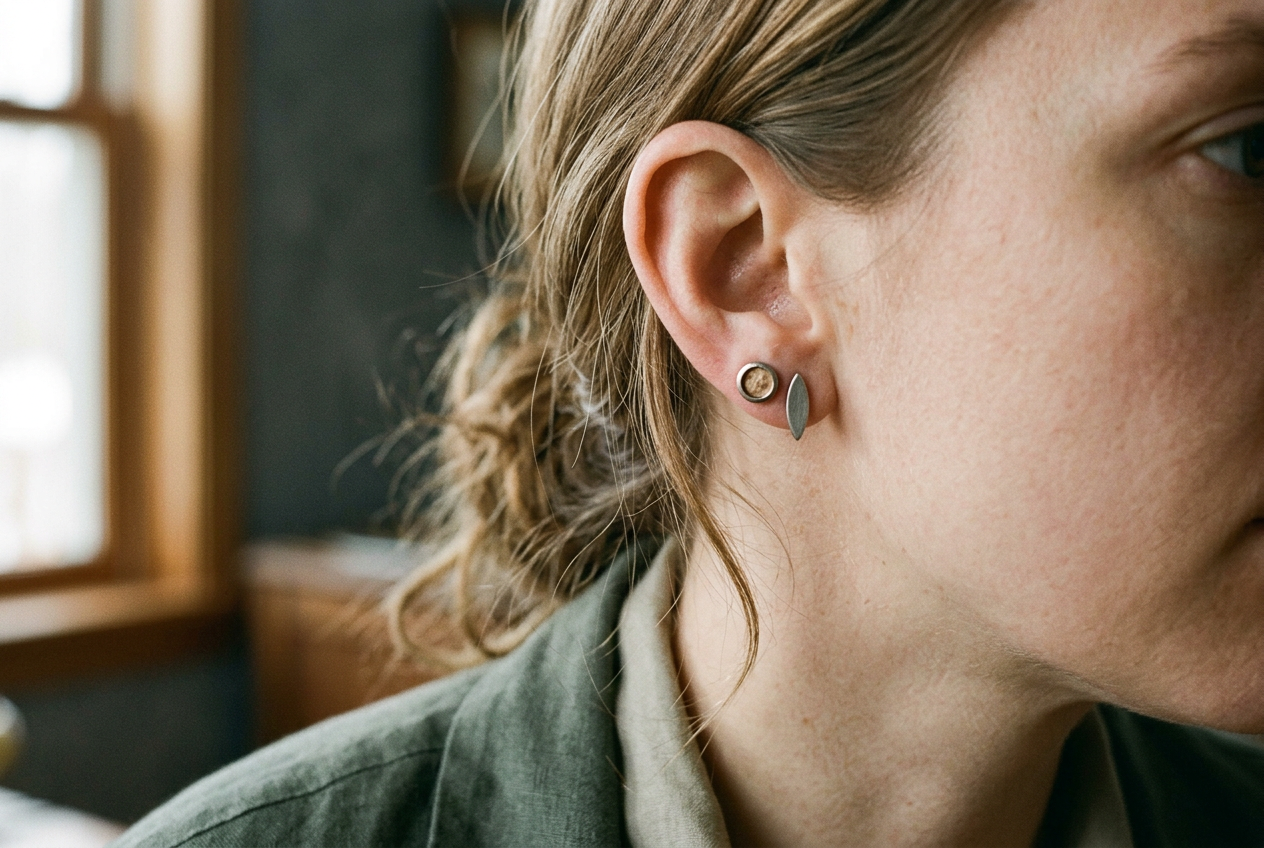
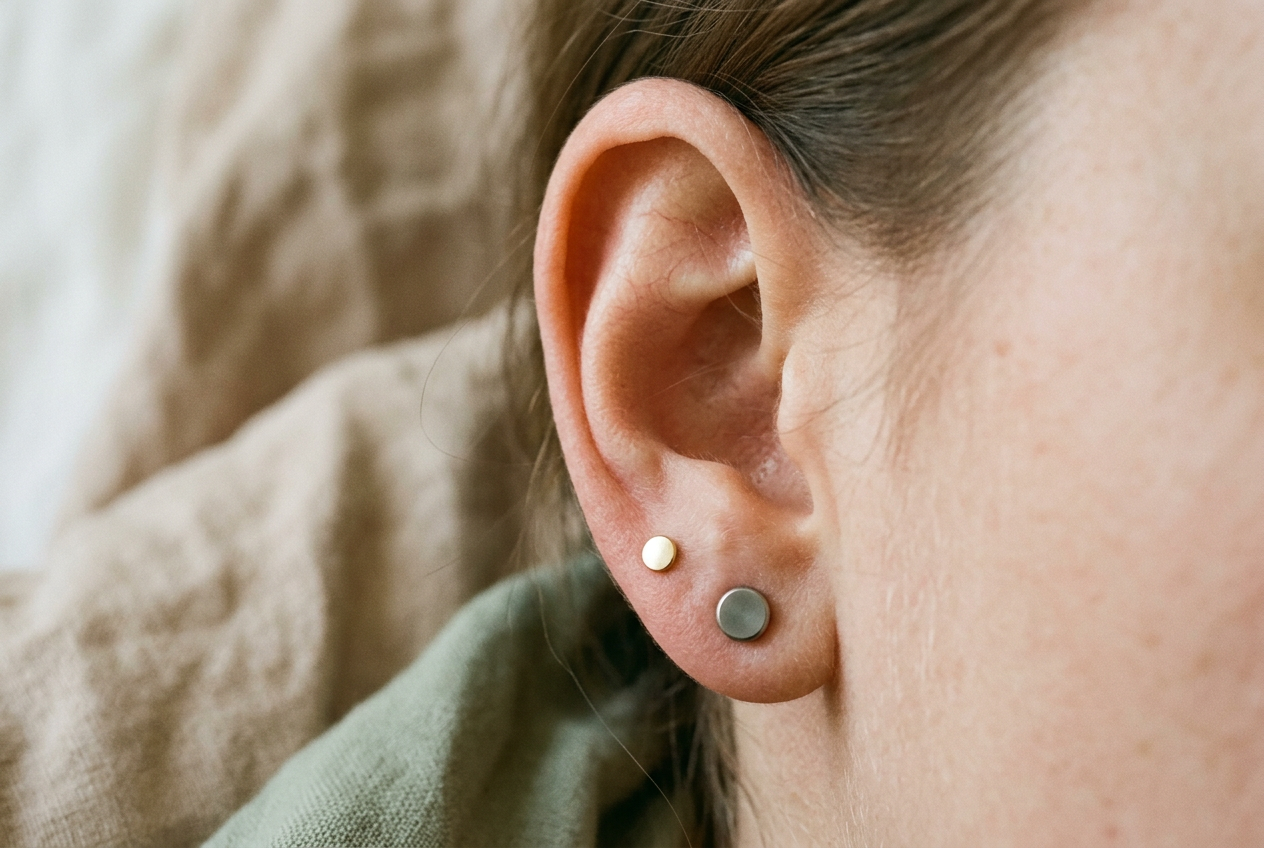
Hollow Gold Hoops Save Weight. The Tradeoff Is Dents.
A large gold hoop can feel almost weightless because it is mostly air. Here is how to tell whether that comfort is worth the thinner walls and harder repair.
November 8, 2026 · 8 min read
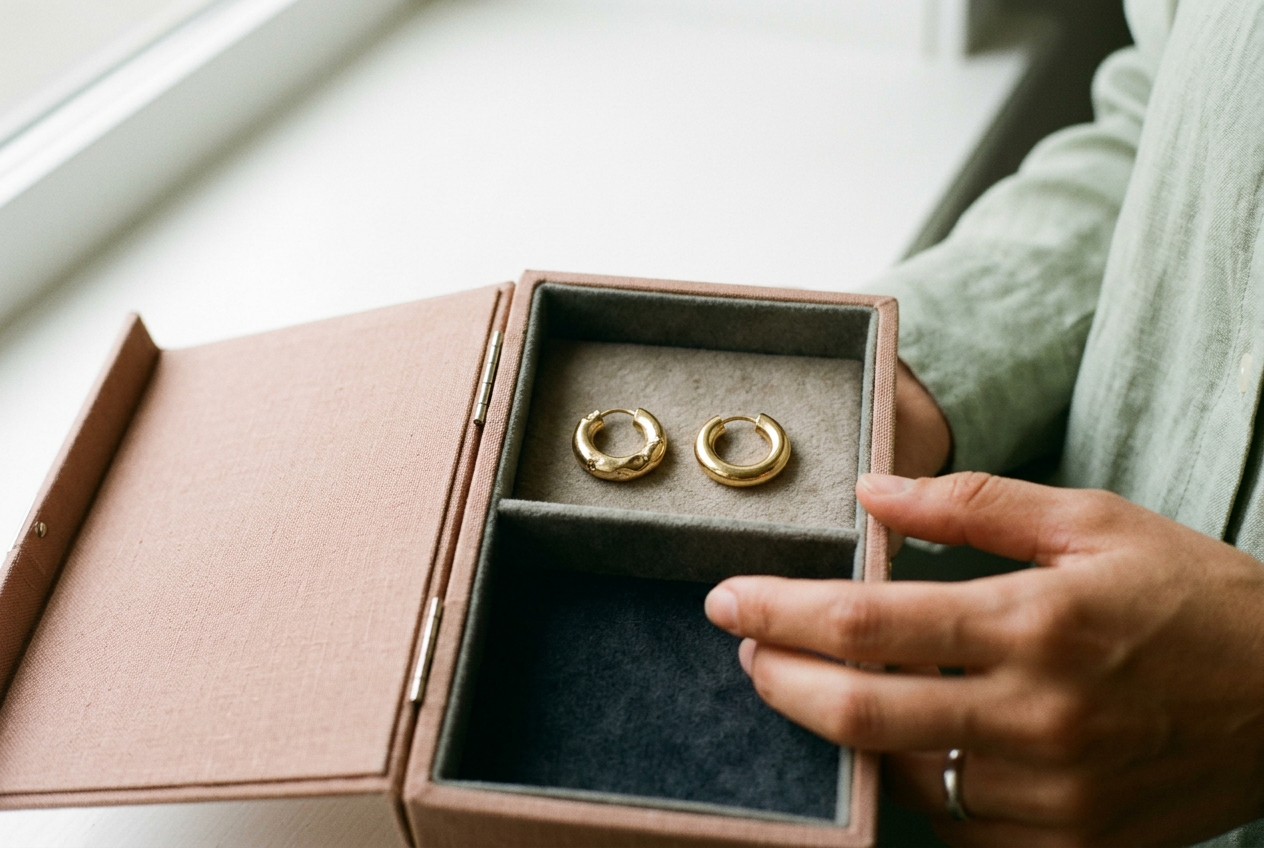
The first sign is often a shallow flat patch, visible when light runs around the curve. It may sit at four o’clock on one hoop while its mate remains round, and it will not wipe away like a smudge.
Keep one buying case in mind: a 30-millimeter hoop made from 14k yellow gold, with a rounded tube about 3 millimeters thick. It is large enough to show beneath the hair, yet restrained enough for daily wear across women’s and men’s wardrobes. Worn from breakfast through a commute, then removed and put into a gym-bag pocket, a hollow version may feel barely present on the lobe. That same light construction makes the pocket the risky part.
Hollow hoops are not badly made by definition. They use less gold to create visible volume, which cuts both weight and material cost. The problem is that their smooth, substantial-looking surface gives little indication of how much metal sits beneath it.
Hollow refers to the tube, not the gold
A hollow hoop starts as tubing or as a thin shell formed around an interior space. The outside can still be genuine 10k, 14k or 18k gold throughout. Hollow describes the construction of the hoop, while karat describes the proportion of gold in its alloy.
That distinction matters because the phrase solid gold is used in two ways. On many jewelry listings, it means the item is made from a gold alloy rather than plated base metal. It does not necessarily promise that the hoop’s rounded cross-section contains metal all the way through. A listing can therefore call an earring solid 14k gold while separately describing its construction as hollow.
A solid-construction hoop has metal through the body of the hoop, apart from spaces required for a hinge or closure. It weighs more at the same diameter and tube thickness, and it generally tolerates an incidental squeeze better because there is material behind the surface.
Semi-hollow sits between those structures, but the term is not standardized across jewelry sellers. It may indicate thicker tube walls, a partly hollow profile or reinforced sections near the clasp. Without a listed weight, a cross-sectional description or a direct answer from the seller, semi-hollow says less than shoppers may assume.
Electroformed gold is another phrase worth noticing. Electroforming deposits metal over a shaped core, which may later be removed, leaving a lightweight shell. It can produce bold, comfortable earrings, though the resulting wall is still vulnerable to concentrated pressure. Gold-filled is unrelated: it describes a bonded outer layer of gold over another metal, not an empty interior.
A dent begins with concentrated pressure
The 30-millimeter hoop in our buying case has a broad visual outline and a narrow wall supporting it. Press that wall between a phone and the side of the head, trap it under a heavy compact in a bag, or pinch it while pulling off a close-neck sweater, and the force lands on a small area. Once the tube buckles inward, it may not spring back.
Diameter also changes the equation. A wider circle gives fingers, clothing and storage clutter more leverage, while a thicker-looking tube can conceal very thin walls. This is why a bold hollow hoop may dent more readily than a fine solid wire hoop, even though the bold pair looks sturdier.
Gold karat does not settle the issue on its own. Higher-karat gold contains more gold, but the hardness of finished jewelry also depends on the other metals in the alloy, how the piece was formed and whether the metal was hardened during manufacturing. Construction and wall thickness are more useful clues than assuming every 14k hoop is tougher than every 18k one.
A small dimple is usually cosmetic. A crease is more serious because the metal has folded sharply, which can lead to a split if that area flexes again. Damage near a hinge, post or soldered join deserves particular attention; those areas already manage movement or connect separate components.
The comfort savings are real
For the 30-millimeter pair, hollow construction can make the difference between forgetting the earrings by lunch and feeling a steady downward pull. Weight matters more as diameter and tube thickness increase, so hollowing is especially useful for oversized hoops that would otherwise be tiring or impractical in solid gold.
The useful number is the weight in grams, preferably stated per earring rather than for the pair. Product pages do not always clarify which measurement they use. Compare hoops with similar outer diameter, tube thickness and closure style, since a tiny hollow sleeper hoop and a large solid wire hoop do not offer a meaningful weight comparison.
Lobe comfort is not only about grams. A thin post concentrates weight over a smaller spot, while a substantial hinge may press against the piercing if the hoop sits tightly. Someone with an elongated or tender piercing may prefer a lighter hollow hoop even at a modest diameter. Someone who dislikes removing jewelry before changing clothes may be better served by a smaller solid hoop that accepts less careful handling.
This advice is unisex because the mechanical tradeoff does not change across wardrobes. Hair length, headphones, scarves and the shape of a shirt neckline affect snagging more than the department in which the earrings are sold.
Read past the material headline
Start with the exact construction language. Hollow, hollow tube and electroformed all signal an interior space. Semi-hollow requires a follow-up. Solid gold confirms the material only if the listing does not also state that the body is solid or provide enough weight information to support that conclusion.
Next, check diameter and tube thickness together. Our 30-by-3-millimeter case has a moderate diameter but a visibly rounded tube, so a surprisingly low listed weight would point toward hollow construction. There is no universal weight cutoff because clasps, alloy and profile vary, yet a gram figure lets you compare two otherwise similar pairs instead of relying on adjectives such as lightweight or substantial.
Look closely at product images of the inner curve and closure. A seam, meaning the line where formed metal edges or components meet, is not automatically a defect. Tubing must be formed and joined somewhere. What matters is whether the line looks even, fully closed and smoothly finished, especially beside the hinge and at the point where a post enters the hoop.
A dark gap, rough solder or visibly flattened section is a reason to ask for another pair. On hinged hoops, reinforced ends can be useful because the clasp takes repeated force, though reinforcement near the ends does not protect the middle of the circle from being crushed.
Also read the care and warranty language before purchase. Instructions to avoid pressure, store the earrings separately or keep them in their original shape signal that the maker expects delicate handling. Find out whether accidental dents are excluded and whether the brand repairs hollow pieces, replaces one earring or only accepts an intact pair. Those answers affect the real price of ownership more than a polishing cloth included in the box.
Repair favors solid construction
A jeweler can often reshape a bent solid hoop, then refinish the surface if enough metal remains. Results depend on the damage and design, but the interior material gives the jeweler something to work against.
Hollow hoops are less cooperative. The jeweler may not be able to reach behind a dent to push it outward, and pulling from the exterior can stretch or mark the thin wall. A sharp crease may crack during reshaping. Laser welding, which joins a small area with concentrated heat, can sometimes close a split, but it does not guarantee that a collapsed tube will become evenly round again.
Traditional soldering also introduces heat near a cavity, seams and moving hardware. For an inexpensive hollow pair, labor can approach the logic of replacement even when repair is technically possible. Ask before leaving the earrings at a counter; some jewelers decline hollow pieces because the likely finish will not meet their standard.
Do not press a dent out with pliers, a pen or another improvised form. Metal can thin where it has already folded, and tool marks create a second repair problem. Stop wearing a hoop if the dent has become a sharp crease or if the clasp no longer aligns.
Choose according to the day, not the display
Hollow is the sensible budget choice when visual scale and low lobe weight matter most. It suits the person who removes hoops before sleeping, stores each one in a divided box and does not carry them loose after the gym. The lower price for a larger silhouette is the point, not a hidden compromise to be discovered later.
Solid construction earns its higher material cost for smaller or medium hoops worn hard and often. It offers better resistance to local pressure, more repair options and more gold by weight, although it can become uncomfortable once the diameter and profile grow. Semi-hollow may offer a useful middle ground, but only when the seller explains what the phrase means for that pair.
Return to the 30-millimeter, 3-millimeter-tube hoop. Buy it hollow if the featherlight feel will keep it in regular rotation and you are willing to give it a rigid compartment at the end of the day. Buy it solid in a slimmer profile if you want an everyday earring that can handle hurried sweater changes without requiring the same level of attention.
Questions people ask
Can a jeweler remove a dent from a hollow gold hoop?
Sometimes, but a smooth result is not assured. The jeweler may have no access to the back of the dent, and a creased wall can split as it is reshaped. Solid hoops are generally easier to straighten and refinish. Ask whether the jeweler has repaired hollow tubing before authorizing work.
Does solid gold mean a hoop is not hollow?
No. Solid gold commonly means the jewelry is made from a gold alloy throughout rather than plated, while the hoop itself may still be a hollow tube. Look for separate construction language, a listed gram weight or written confirmation that the hoop body has a solid cross-section.
Are hollow gold hoops suitable for everyday wear?
They can be, provided everyday wear includes removing them before sleep, exercise, bathing and clothes changes likely to catch the hoop. Store each earring in a rigid, divided space. A hollow pair is less suitable for someone who routinely drops jewelry into a handbag pocket or leaves earrings under other pieces.
Is semi-hollow construction worth paying more for?
Only when the seller supplies useful detail. Thicker walls or reinforced stress points may improve durability without the full weight of a solid hoop, but the label itself makes no measurable promise. Compare gram weight, dimensions, closure construction and repair support rather than treating semi-hollow as a guaranteed quality tier.
One update a day
Today's fashion update, in your inbox
One fashion update each morning — no hype, no filler, just pieces worth wearing.