Uneven Piercing Angles Need Smaller Earrings, Not More Holes
A 3 mm bezel stud became the reference point for balancing mismatched lobe piercings. The useful measurements are front size, orientation and the empty space between earrings.
November 5, 2026 · 7 min read
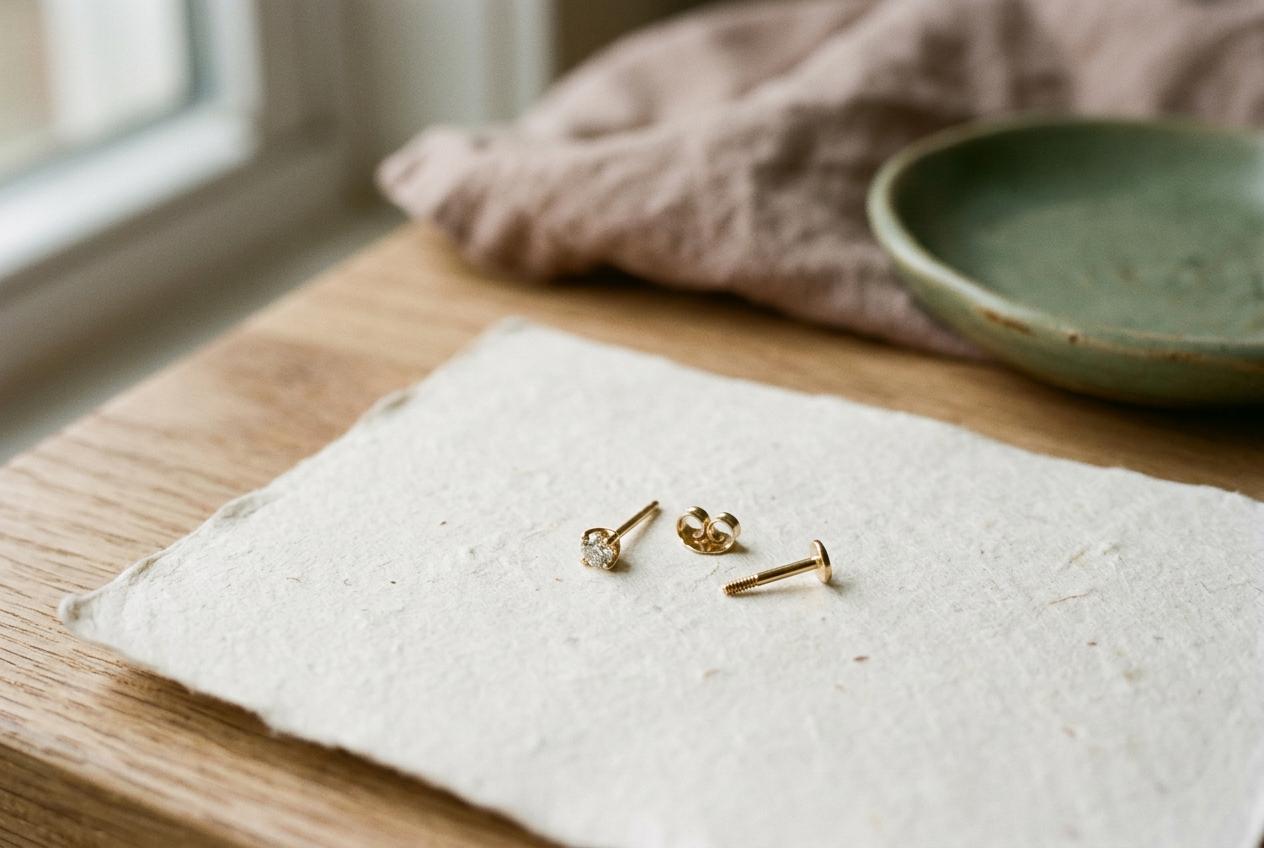
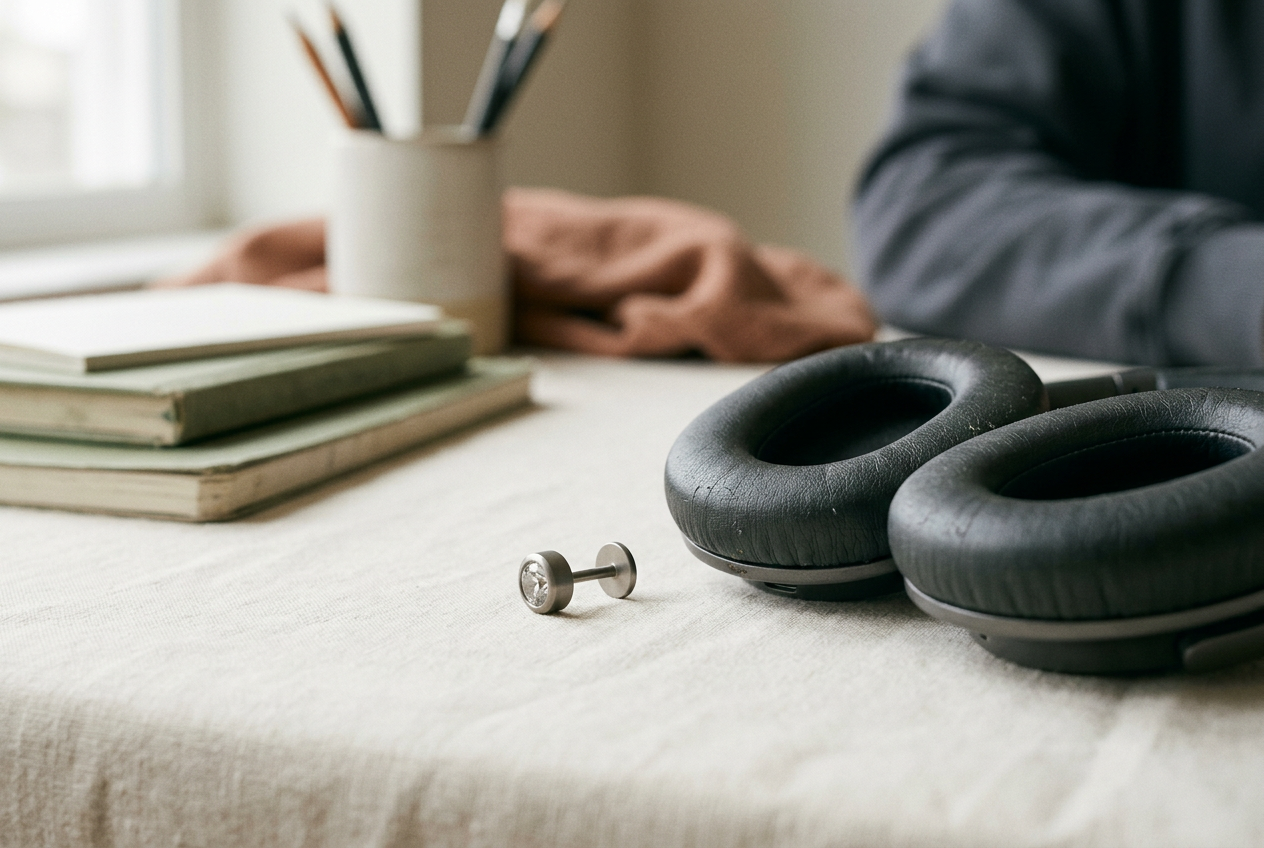
My reference piece is a 3 mm cubic zirconia held in an implant-grade titanium bezel, meaning a slim metal rim surrounds the stone, on an 18-gauge threadless flat-back post. Threadless jewelry uses a bent pin to secure the decorative end without screws. A flat back earring has a backing that sits flush against the ear rather than a butterfly clutch.
I wore that stud for a week in a first-lobe piercing that tilts slightly downward, beside a second piercing that faces more directly forward. The mismatch is small without jewelry. Add two identical stones, though, and the lower one catches light at a different angle while the upper one appears farther away. A matched pair made the spacing look less matched.
The 3 mm bezel worked because its metal edge gave the stone a clear boundary. It did not straighten the piercing. It made the tilt look intentional, then allowed the next earring to be chosen around the visible front rather than the hidden hole.
This method is unisex. The useful variables are the dimensions and geometry of the jewelry, regardless of the clothes or other accessories worn with it.
Read the fronts, not the holes
Piercing holes can appear level while the channels beneath them travel in different directions. A channel is the healed path through the tissue. One post may point straight back while another rises, drops or angles toward the face, which changes how the decorative end rests against the skin.
Judge the stack from arm’s length in diffuse daylight. Phone cameras held close can exaggerate distance, and overhead bathroom lighting makes a tilted stone flash more aggressively. Look at the outline of each front, the direction it appears to point and the negative space, which is the visible skin left between adjacent earrings.
That skin matters more than the measured distance between holes. A 4 mm stone beside another 4 mm stone can consume most of a narrow gap, while a 3 mm bezel next to a 2.5 mm disc may reveal enough skin to separate the shapes. The stack then reads as two decisions rather than one pair that slipped out of alignment.
Take a straight-on photo and cover one earring at a time. If the spacing looks calm with either piece hidden but awkward with both visible, the front dimensions are competing. If one piece seems to point away from the other, orientation is the problem. These call for different corrections.
Use a bezel or disc to quiet the tilted piercing
A prong-set stone exposes more of its edges and usually throws light from several directions. On my downward-facing first piercing, that extra sparkle emphasized the angle. The 3 mm bezel was steadier. Its circular rim remained legible even when the stone’s surface did not face the viewer squarely.
A polished flat disc does the same job with less light. Start around 2 to 3 mm for a crowded lobe, then assess the visible result rather than treating that range as a universal prescription. Thicker lobes, larger ears and wider spacing can carry a broader disc, but increasing the diameter by even a millimeter can erase the narrow strip of skin that makes the arrangement look deliberate.
Finish changes the effect. A high-polish disc reflects a bright spot that can expose tilt, although less sharply than a faceted stone. Brushed gold or matte titanium diffuses the reflection and is the quieter option. A domed disc may lean visibly because its edge lifts from the skin; a thin, truly flat front is better when the goal is to reduce depth.
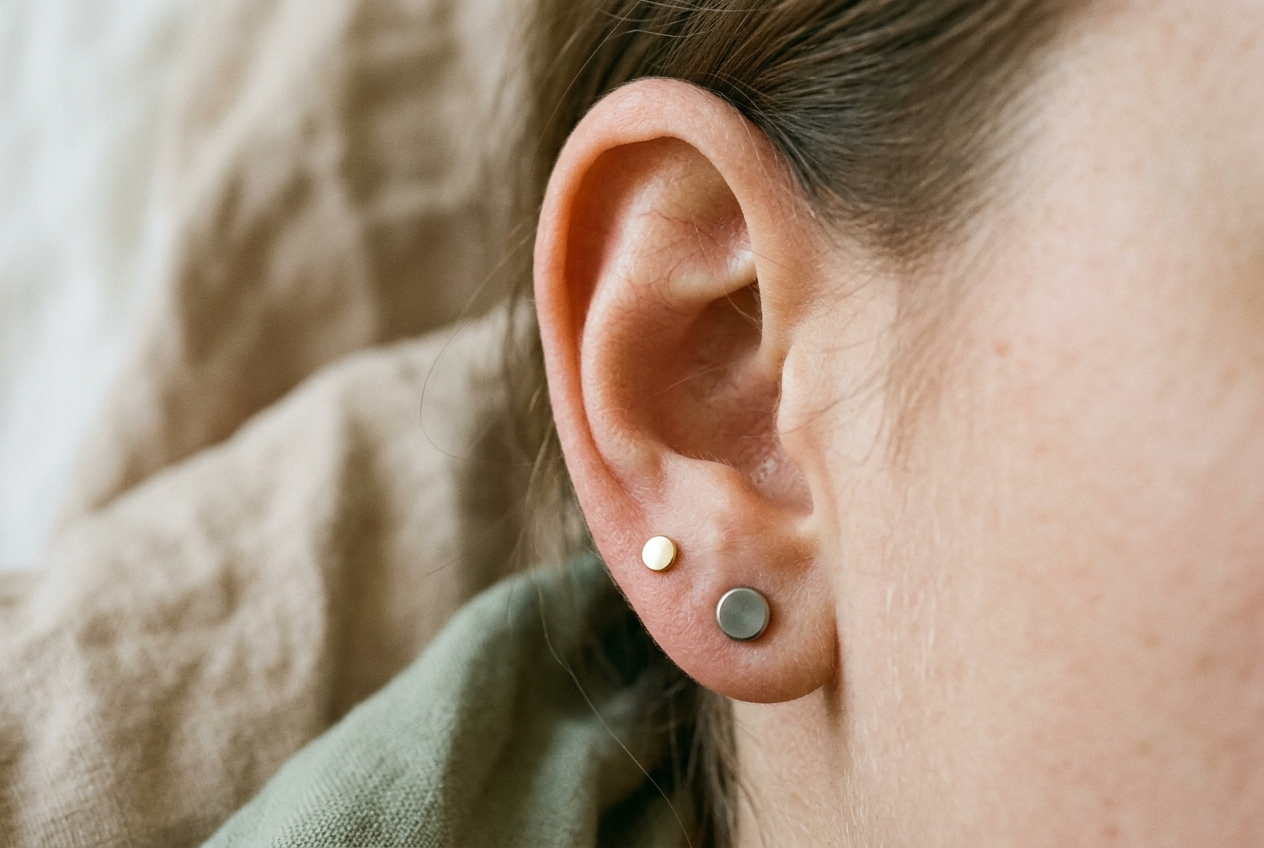
Place the simpler shape in the piercing with the stronger angle. Let the straighter hole carry the more dimensional setting. In my stack, moving the titanium bezel to the lower, downward-facing channel and putting a 2.5 mm flat gold disc above it created a cleaner interval than reversing them, because the disc sat squarely while the bezel contained the uneven flash below.
Short bars can redirect the line
A short bar is useful when the holes are unevenly spaced but their channels face forward. Set vertically, a narrow bar can occupy height without spreading into the gap; turned slightly, it can acknowledge a diagonal arrangement instead of forcing the eye to search for a level line.
Keep it short enough that both ends stay clear of neighboring fronts. A long bar that nearly touches a stud creates a trapped sliver of skin, and that tight gap draws more attention than an obviously generous one. On a compact lobe, the difference between a neat separator and visual congestion can be only a few millimeters.
Rotation is the tradeoff. An elongated end may turn during dressing, sleeping or pulling on a knit, particularly when the post is too long and the front can tip away from the ear. If its orientation needs repeated adjustment, it is not correcting the stack. Replace it with a round disc, or reserve the bar for a piercing whose angle and post fit hold it in place.
I would not pay a solid-gold premium for a bar until its orientation has been tested in an inexpensive but skin-compatible version. Shape is the uncertainty here. Once the length and direction work, upgrading the same dimensions makes more sense.
Tiny hoops need visible clearance
A tiny hoop can soften mismatched stud angles because the eye reads its outer curve rather than a flat face. A huggie is a close-fitting small hoop that usually closes with a hinged segment. It is most helpful in the lowest lobe piercing, where it can establish a rounded baseline for smaller fronts above.
Close-fitting does not mean pressed tight. The inner diameter must clear the lobe without pinching, and the hoop should hang rather than pull the channel downward. Too small, it exposes the angle through tension and may become uncomfortable. Too large, it swings into nearby jewelry and makes a compact stack look accidental.
A plain hoop is more forgiving than one with a fixed charm, which adds weight and a new directional line. Pavé can also advertise a twisted channel when the stones roll toward the side. For uneven piercings, begin with a smooth hoop whose hinge and seam do not occupy the front view.
The tiny hoop was not the best answer for my reference piercing. Its downward channel caused the hoop to project slightly forward, and that depth was clearer from the side than the 3 mm bezel’s tilt. It looked balanced straight on but less settled in profile. The bezel stayed.
Fit the post before judging the design
Post fit can imitate an angle problem. If the wearable length, the section of post that passes through the ear, is too long, the front can droop and the back can slide. Too short, the jewelry may press into the tissue. The correct length leaves room for normal comfort without enough spare post for the front to lever outward.
Gauge describes post thickness. Do not force a thicker post into an established piercing or assume that every decorative end fits every system; threadless components can differ, and threaded jewelry must use matching parts. A reputable piercer can check compatibility and fit, particularly when a post repeatedly leans despite changing the front.
My 6 mm flat-back post sat close enough to prevent the 3 mm bezel from seesawing during daytime wear, though that length is a fit observation rather than a recommendation for every ear. Lobe thickness varies. During the week, the titanium did not discolor or catch on clothing, while the low profile was easier to leave alone than a butterfly-backed stud with spare post extending behind the ear.
Material affects price and wear. Plated brass occupies the lowest price band, but plating can wear and the base alloy may not suit sensitive skin. Documented implant-grade titanium usually sits in the accessible middle and keeps weight low. Solid 14k or 18k gold costs more, with the exact alloy affecting color and potential sensitivity.
Confirm the metal rather than relying on a vague hypoallergenic label.
Build the stack from one fixed point
Remove every earring, then reinstall the piece that behaves best in the most difficult piercing. For me, that remained the 3 mm titanium bezel in the first lobe. Its diameter became the fixed point.
Add one adjacent earring and leave a clear border of skin around both fronts. If the gap collapses, reduce the new front before changing the anchor. A flat disc is the least distracting test piece because it reveals spacing without adding prongs, dangling elements or a second strong reflection.
Next, check the stack from the front and a slight side angle. A bar that looks useful only straight on may be projecting from the lobe. A hoop that balances the lower edge may be pulling. Wear the two-piece arrangement through dressing and removing a sweater before adding anything else, since rotation and catching reveal more than a still photo.
Do not fill every existing hole by default. An empty piercing creates clean negative space at no cost, and it can separate two angles that refuse to cooperate. Buying another earring is worthwhile only after the front size and post fit of the current pieces have been tested; adding another hole does not correct a channel that already points elsewhere.
Questions people ask
Can an earring straighten an angled piercing?
No. Jewelry can change how the angle looks, but it cannot redirect a healed channel. A small bezel, flat disc or plain hoop controls the visible outline and reflection. If a piercing is painful, newly shifting or difficult to fit, leave the visual correction aside and have a reputable piercer assess it.
What earring size works best for uneven spacing?
Start with a front around 2 to 3 mm in the tighter part of the stack, then judge the skin visible around it. The best size depends on lobe shape and hole placement. A one-millimeter increase can consume a narrow gap, so compare actual front measurements rather than product labels such as tiny or mini.
Are flat backs better for an ear stack?
They often help because a well-fitted flat-back post limits drooping and leaves no butterfly clutch behind the lobe. They do not fix every angle. Post length still has to match the tissue, and an oversized decorative end can crowd the stack even when the backing fits well.
Should
I use matching earrings in uneven piercings?
Usually not if matching fronts expose different angles or spacing. Repeat one quality, such as metal color or finish, while varying shape and diameter. In the tested stack, the 3 mm titanium bezel beside a smaller flat gold disc looked more coherent than two identical stones because each front suited its own channel.
One update a day
Today's fashion update, in your inbox
One fashion update each morning — no hype, no filler, just pieces worth wearing.