Flat Back Earrings Still Hurt Under Shallow Headphones
A flush backing prevents snags, but it cannot fix a tall front or a headphone cup that touches the ear. The most comfortable pairing leaves clearance on both sides of the piercing.
November 2, 2026 · 7 min read
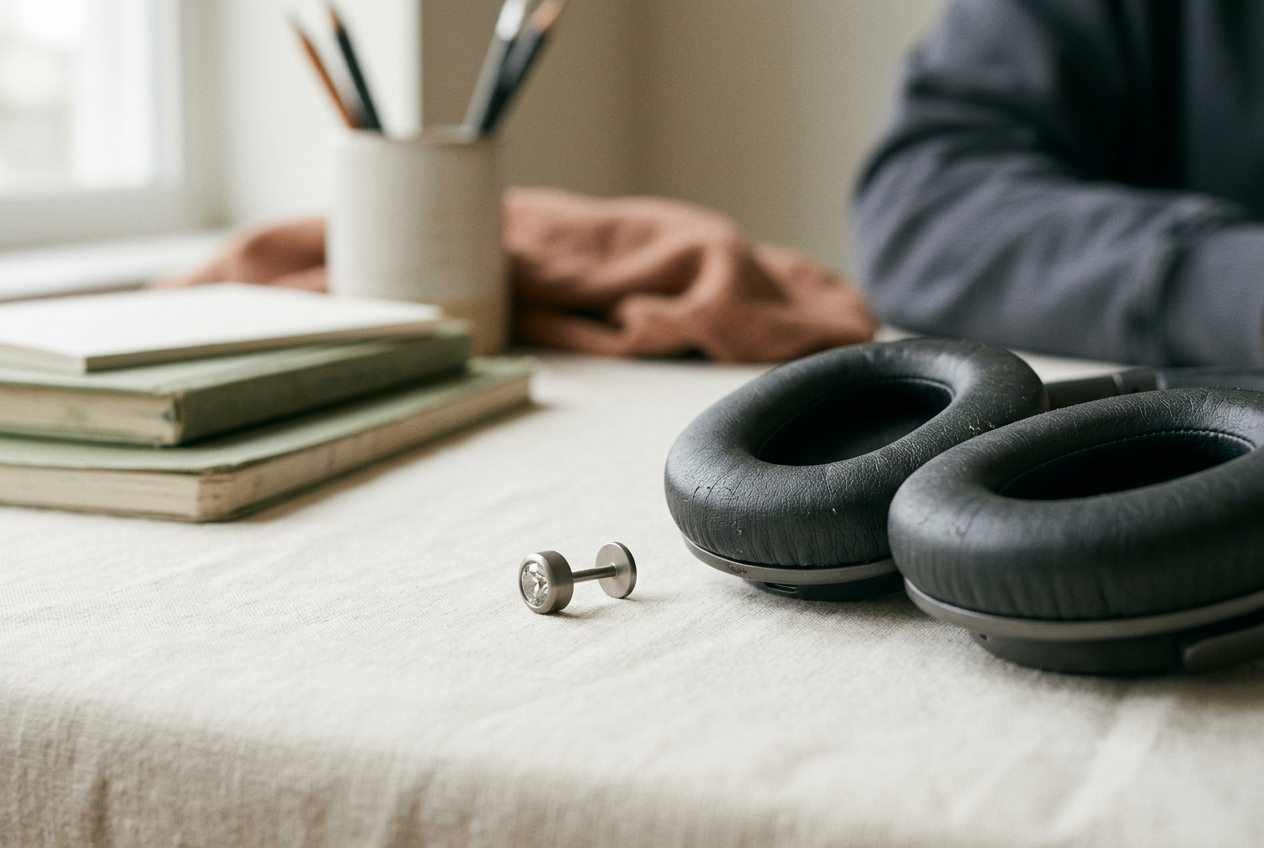
A 6 mm implant-grade titanium post became the useful constant in this test. I wore it in a healed second-lobe piercing with a 4 mm flat disc at the back and a small bezel-set front, then changed one part of the setup at a time through several desk-bound workdays.
That plain earring is a flat back, meaning the post’s backing sits flush against the earlobe. It is also a threadless labret, a hollow post that grips a pressure-fit decorative end. The construction is sold as sleep-friendly because there is no butterfly clutch or exposed post to catch on fabric. Under headphones, though, the front matters as much as the back.
This is unisex fit advice. Ear anatomy and headphone geometry determine the result, regardless of the section of a jewelry store or clothing department in which either item was sold.
The workday pressure test
I compared the 6 mm post with a longer 8 mm version while keeping the same titanium disc and bezel front. I also switched between over-ear headphones with deep oval cushions and a shallower pair whose inner fabric touched the upper ear even without jewelry.
The test was deliberately ordinary: calls, writing, short breaks and repeated removal rather than an uninterrupted listening session. That matters because a setup may feel fine for the first half hour, then become tender after the cup has warmed and the cushion has compressed. Taking headphones off can also catch a projecting front, particularly when the cup opening is narrow.
I checked four contact points: the decorative front against the cup lining, the flat disc against the skin behind the ear, the cushion edge around the lobe and the post inside the piercing channel. This was a fit evaluation, not a test of healing or metal sensitivity, and all jewelry was worn in healed piercings.
The strongest result was uncomplicated. The 6 mm titanium post, low bezel and deep oval cup worked through the day because no single part carried sustained pressure. The longer post failed with the same headphones. The shallow headphones failed with both posts.
Best overall: a close post, low front and deep cup
The 6 mm anchor earring worked when its wearable length, measured from the back of the decorative end to the inside face of the flat disc, left only a narrow margin beyond the lobe. It did not pinch. It also did not slide forward enough to make the bezel lean into the headphone lining.
Post length is easy to misread because extra room can seem safer. Under an ear cup, that room becomes movement. A long post lets the front tip downward or outward, and once the cushion nudges it, the flat disc presses back against the other side of the piercing. The backing remains smooth, but the entire earring behaves like a small lever.
The low bezel helped for a different reason. Its stone was held by a smooth metal rim rather than raised prongs, and the front sat close to the lobe. Front-end height means how far the decorative piece projects from the skin, not how wide it looks from the front. A broad, thin disc can clear a headphone more easily than a narrow gem in a tall setting.
Deep headphone cushions completed the setup. Their opening surrounded the ear, while the inner lining stayed clear after the pads settled. Firm depth proved more useful than pillowy softness: a thick cushion can look generous on a desk yet collapse until the ear meets the driver covering once clamping pressure is applied.
For a healed lobe that suits a 6 mm post, this is the combination I would buy first. Implant-grade titanium keeps the earring light and usually sits in the accessible end of fine piercing jewelry, while solid gold raises the price substantially without changing the pressure mechanics. Gold may be the aesthetic choice. It is not a substitute for correct length.
Better for upper-ear placements: a flat decorative end
Cartilage placements expose a weakness in many over-ear designs. The upper ear often sits closer to the cup lining than the lobe does, so even a small prong-set gem can meet the fabric every time the head turns or the headband shifts.
A flat disc or very low cabochon front gives that area a better chance of clearing the cup. The decorative end still needs rounded edges, since a crisp rim can feel sharp when the headphone presses it sideways. Small clusters were less convincing for this use: their width occupied more of the curved ear surface, while multiple raised points gave the lining more places to catch during removal.
Post length remains personal here. The 6 mm anchor is a useful reference, not a universal prescription, because cartilage thickness varies and some placements swell or change angle. A fitted post should leave enough room for the tissue without exposing a conspicuous bar. If the end stands away from the ear, it has room to tilt.
For people who regularly switch between headphones and sleeping on the jewelry, a plain titanium disc is the practical endpoint. It gives up sparkle. It also avoids the height and prongs that caused the most obvious contact in this comparison.
The longer post that looked comfortable and was not
With the 8 mm post installed, the anchor earring appeared relaxed before the headphones went on. There was visible breathing room. During wear, the front shifted toward the cup and the disc no longer stayed evenly seated behind the lobe.
The first sensation was not a hard jab. It was low, diffuse pressure that became difficult to ignore later in the workday, particularly after removing and replacing the headphones. That delayed discomfort makes an overly long post harder to diagnose than an obviously tight one.
Shortening a post is worthwhile only when the current jewelry has genuine excess length. A post that leaves an indentation, traps the tissue tightly or cannot accommodate normal changes in the ear is already too close, and swapping it for something shorter would compound the problem. A professional piercer can measure the wearable length and check the angle, especially when the earring is difficult to see from behind.
Large butterfly-back studs performed worse as an alternative because the clutch occupied more space and the unused post projected beyond it. A flat back removed that rear hardware, which improved removal and reduced snagging, but it could not erase pressure from a tall front.
When the headphones are the problem
The shallow over-ear pair pressed the inner fabric against my bare upper ear before any earring entered the test. That is the clearest sign to stop shopping for smaller jewelry. If the cup cannot clear the ear itself, reducing a bezel by a fraction or downsizing a disc only rearranges the contact.
Pad placement can expose the same issue at the lobe. Some cups are technically large enough to surround most of the ear, yet their lower cushion lands directly over a first- or second-lobe piercing. Each headband adjustment then shifts pressure across the jewelry rather than away from it. A larger internal opening is more effective than a flatter stud in that case.
Before buying new headphones, inspect replaceable pads. A deeper compatible pad may add clearance for less money than replacing the full set, although it can alter seal, sound and how firmly the cups sit. Dense pads preserve their depth better than very soft foam in this use. Compatibility matters, so the manufacturer’s pad attachment and dimensions need checking rather than guessing.
A quick fitting test is more revealing than an advertised pad thickness. Put on the headphones without earrings, let the cushions settle, then notice whether the ear touches the inner lining or whether the cushion edge folds the lobe. If either happens, the headphone geometry is already using the space the jewelry needs.
The shallow pair remained uncomfortable with the original 6 mm titanium earring, even though that setup had worked under the deeper cups. Changing jewelry again would have meant accepting a plainer, smaller front to compensate for an ear cup that still touched skin. The headphones were the more sensible item to change.
What to buy, and what to skip
For everyday wear, start with implant-grade titanium from a piercing-focused seller and have the post fitted to the healed placement. Titanium is light, available in low-profile threadless forms and generally costs less than comparable solid-gold jewelry. Verify the stated material rather than relying on vague labels such as surgical metal.
Choose the front in profile. Bezel-set stones, polished discs and low domes are the useful shapes here. Tall prong settings, sculptural clusters and charms can still be worn, but they make more sense on days when headphones are occasional rather than continuous.
Then judge the headphones with your ear inside them. Published external dimensions do not show how much usable depth remains once a cushion compresses, and a spacious-looking cup may narrow sharply near the lobe. A returnable pair or an in-store fitting is worth more than repeatedly buying new decorative ends.
The 6 mm anchor setup earns the strongest recommendation for a healed, similarly proportioned lobe: close post, smooth 4 mm backing, low front and a cup that clears the ear after compression. Its limitation is equally specific. If a bare ear touches the headphone lining, the earring has no remaining adjustment that can create space.
Questions people ask
Do flat back earrings work under over-ear headphones?
Yes, when the post fits closely and the decorative front remains clear of the inner cup. A flat disc removes the bulky clutch behind a conventional stud, but shallow cups and cushion edges can still press the jewelry into the ear.
Is a shorter flat back post always more comfortable?
No. A shorter post helps when excess bar length lets the earring tilt, but a post that grips or indents the tissue is too tight. Measure the healed placement or ask a professional piercer to fit it rather than choosing the shortest available option.
Which earring fronts are least likely to press?
Low bezels, smooth discs and shallow domes take up the least front-to-back space. Prong-set stones and clusters project farther, so they are more likely to meet the cup lining even when their face diameter looks small.
Should I change my earrings or my headphones?
Change the jewelry when the post visibly shifts or the front alone touches the cup. Change the headphones when their lining contacts your bare ear, the cushion rests over the piercing or the pads collapse enough to remove the available clearance.
One update a day
Today's fashion update, in your inbox
One fashion update each morning — no hype, no filler, just pieces worth wearing.