Your Flat Back Earring Can Still Catch on the Pillowcase
A flush backing fixes pressure behind the ear, but the front setting controls snagging. Here is how low baskets, bezels and raised prongs behave overnight.
October 20, 2026 · 7 min read
The telling detail was not behind the ear. It was at the front, where one tiny prong repeatedly picked up a thread from a cotton pillowcase before the flat disc backing had a chance to prove how comfortable it was.
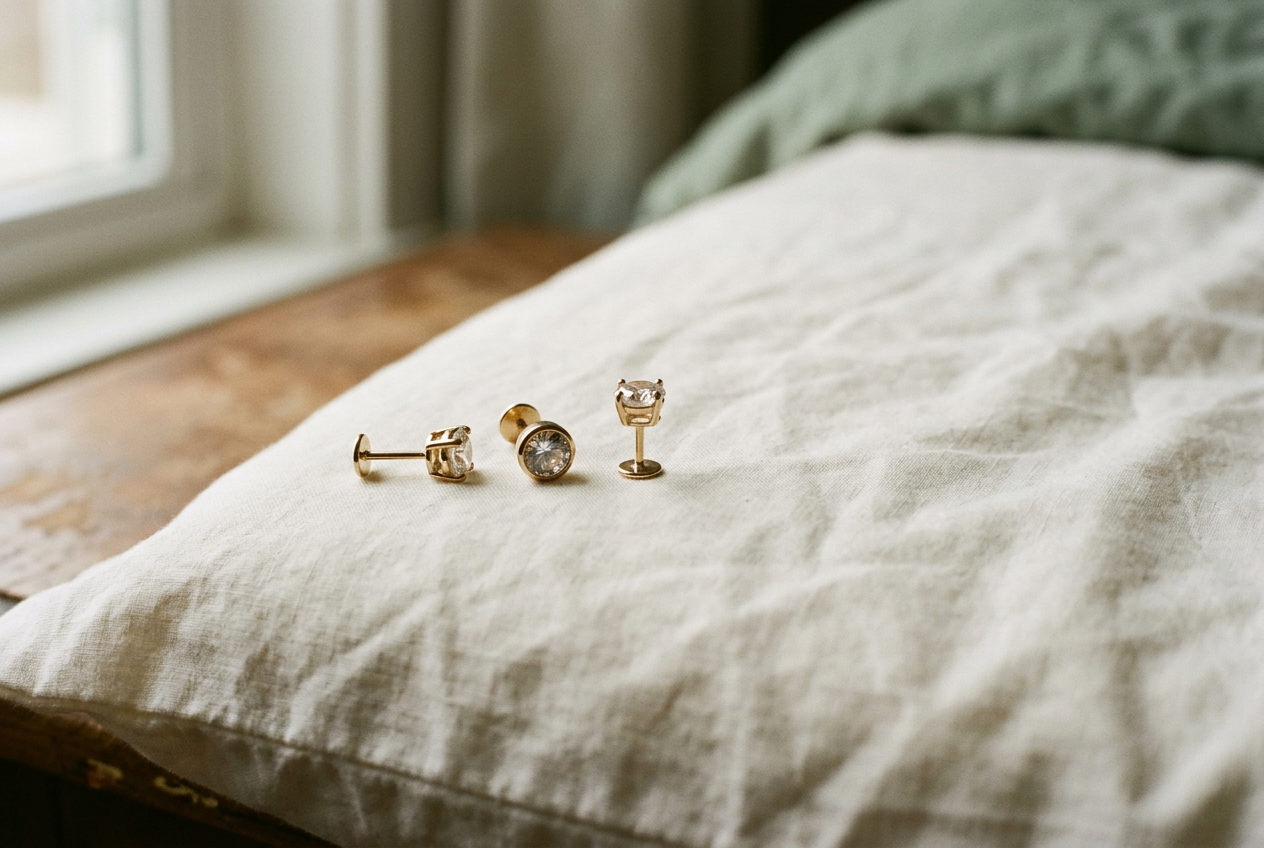
For this comparison, I handled three round, clear-stone earring ends of similar face-up size: a low basket, a smooth bezel and a raised prong setting. Each was fitted to the same style of flat back post and checked against the same plain cotton pillowcase, then inspected and cleaned around the underside of the stone. The exercise was deliberately narrow. Stone shape, decorative clusters and chains create separate snag points.
A flat back earring, meaning the post’s backing sits flush against the earlobe, removes the butterfly clutch that often presses into skin during sleep. It does not make the whole earring flat. The front may still rise several layers above the piercing, and its exposed metal can behave like a small hook when the ear moves across fabric.
This is unisex advice. Setting height and post fit work the same way across wardrobes, whether the earring is a single clear stone, a black diamond or one bright point in a larger ear stack.
The low basket is the compromise setting
The low basket in the comparison held the stone in a shallow metal framework, with prongs folding over its upper edge and openings beneath it. Those openings matter. They let water reach the underside during cleaning, and they allow light around a transparent stone, which can make a small earring look livelier than a fully enclosed setting.
Against the pillowcase, the basket itself caused little trouble because it sat close to the lobe. The exposed prongs were the variable. A well-finished prong glided over the cotton when I moved the earring face across it; the prong with the least even edge caught a thread, released it and caught again when approached from the same direction.
That distinction is difficult to judge from a straight-on product image. Look for side views. The prong tips should appear rounded and pressed firmly against the stone, without a visible gap, sharp corner or long metal arm extending above the surface. Run a clean fingertip around the setting when the earring arrives.
Then draw it gently across a piece of tightly woven fabric before wearing it overnight. Do not use a loose knit for the first check, since an open loop can exaggerate a minor texture into a hard pull.
Projection was modest. The stone still stood away from the ear, but the low basket did not create the lever-like feeling of the raised setting when pressed from the side. For sleepers who want visible facets and reasonably easy cleaning, this was the most balanced construction in the group.
It still needs inspection. Prongs can shift after a knock, and dried product under the stone can disguise the tiny gap that starts catching hair or fabric.
The bezel gave the pillowcase nothing to grab
A bezel setting, which wraps a continuous rim of metal around the stone, had the cleanest outer edge in the pillowcase check. There were no separate claws. The cotton moved over the rim rather than entering gaps around individual prongs, and the front felt more like one compact piece when pressed against the lobe.
For a side sleeper, that smoothness is more useful than the word “flat” in a listing. The bezel end was not perfectly level with the ear, but its low, uninterrupted profile distributed contact better than the raised prong version. It also avoided the intermittent tug of the imperfect basket prong, the sort of small disturbance that can make an earring noticeable at night even when it never becomes painful.
The tradeoff appeared at the sink. A full bezel limits access around the stone’s edge, while the enclosed underside can collect skin oil, shampoo and styling product where a cloth cannot reach. Warm water and mild, residue-free soap can loosen ordinary buildup, followed by a thorough rinse and drying. The appropriate care still depends on the stone.
Pearls, opals and other delicate materials should not be treated like durable glass, diamond or sapphire.
A bezel can also change the visual effect. More metal is visible from the front, so the stone may look slightly smaller or more graphic than a prong-set stone with the same general footprint. That is useful in a minimal stack, particularly when the rim repeats the color of nearby gold or titanium ends. Someone buying for maximum sparkle may find it less airy.
Of the three settings on the pillowcase, this was the easiest choice for uninterrupted overnight wear. It is the setting I would put first for a dedicated sleep earring, provided the wearer accepts slower cleaning around the enclosed edge.
Raised prongs make the backing almost irrelevant
The raised prong setting lifted the stone farther from the lobe, leaving an open area beneath it. It was the easiest to rinse from multiple angles, and the stone remained visually exposed rather than bordered by metal. Those are real benefits in an occasion earring. They were less persuasive in bed.
Height changes how an earring responds to pressure. When the pillow pushes against a raised stone, the force lands farther from the piercing channel, so the front can tilt even though the disc behind the ear stays smooth. A longer post makes that movement worse. A very short post may prevent tilting but press the setting into swollen or irritated tissue.
The prongs also met the pillowcase before the lower metalwork did. Each additional contact point created another place where a cotton thread, towel loop or strand of hair could enter. Nothing about a flat disc backing corrects that geometry.
This was the easiest setting to clean and the least convincing for sleep. I would reserve it for daytime wear, especially if the stone is large enough to feel top-heavy or the prongs rise visibly above its edge. Removing an earring at night costs a little time. Replacing a pulled thread, bent prong or loosened stone costs more.
Post fit can undo the right setting
The front design is only half the fit. A flat back post should leave enough room for the tissue without creating a visible length of bare post between the earring and the lobe. Too much room allows the front to tip and travel. Too little can leave a pressure mark or make normal changes in the ear feel tight.
Earlobes and cartilage placements need different lengths, and anatomy varies enough that a post that fits one ear may not suit the matching piercing on the other side. Healed piercings can often be downsized after initial swelling has passed, but a fresh or troubled piercing belongs with a qualified piercer rather than a home fit experiment.
The attachment deserves attention as well. A threadless end, which uses a slightly bent pin held inside the post by tension, should seat fully without wobbling. A threaded end should tighten securely according to its maker’s directions. In either case, the wearer should hold the front and back rather than twisting the whole earring through the piercing.
In the original cotton-pillowcase check, the low basket improved further when held close to the ear on the correctly fitted post. On excess post length, the same front had room to angle toward the cloth, bringing its prongs into contact more often. Setting and post cannot be judged separately.
What to inspect before buying
Start with the side profile, not the styled front image. The useful photograph shows how much metal and stone sit above the base, whether prong tips protrude and whether the underside is open enough to rinse. If a retailer supplies only a face-on view, ask for a side image or choose a design whose construction is already clear.
Material affects value more reliably than setting name. Implant-grade titanium, a biocompatible grade used for body jewelry, is often the practical route for a durable everyday post without the cost of solid gold. Solid 14k or 18k gold sits in a higher price band, while stone type and complexity can move either design further upward. Gold plating over an unspecified base metal is a weaker overnight proposition because constant skin contact, moisture and cleaning can wear the surface.
Do not pay more for a raised setting solely because it makes the stone look prominent. For a piece intended to stay in through showers and sleep, lower construction has functional value. A well-made bezel may justify its price through smooth finishing and secure stone coverage; a low basket earns its place when its prongs are polished, compact and easy to inspect.
The quickest decision rule is physical. Choose the bezel if pillow contact and snagging are the priority. Choose the low basket if you want more exposed stone and will check the prongs. Skip the raised prong setting for overnight wear unless you rarely sleep on that ear and the front is exceptionally small.
Questions people ask
Can prong-set flat back earrings be worn to sleep?
Yes, if the setting sits low, the prongs are smooth and the post fits closely without pressure. Test the front against tightly woven cotton and inspect it from the side. A raised stone or a prong that catches a fingertip is better removed before bed, regardless of the flat backing.
Is a bezel setting always more comfortable than prongs?
A low bezel usually presents fewer snag points, but comfort still depends on its height, edge finish and post length. A thick bezel on an overlong post can tilt against the ear, while a compact, polished basket may disappear in wear. Compare the complete profile rather than relying on the setting label.
How should the underside of a flat back stone be cleaned?
Use warm water and a mild soap that rinses clean, working around accessible openings without forcing the setting. Rinse and dry it well. Check the care requirements for the stone first, since pearls, opals and some treated gems can be damaged by soaking, chemicals or aggressive brushing.
Do flat back earrings work for a fresh piercing?
Flat back posts are commonly used for new piercings, but the jewelry must allow room for swelling and use an appropriate material. Have a qualified piercer choose and fit it. Do not substitute a short sleep-focused post or change the decorative end while the piercing is still healing.
One update a day
Today's fashion update, in your inbox
One fashion update each morning — no hype, no filler, just pieces worth wearing.