A Threadless Earring Pin Needs Less Bend Than You Think
The pin should curve just enough to press against the inside of the post. Here is how to add tension, test the fit and spot a connection that should be replaced.
October 16, 2026 · 8 min read
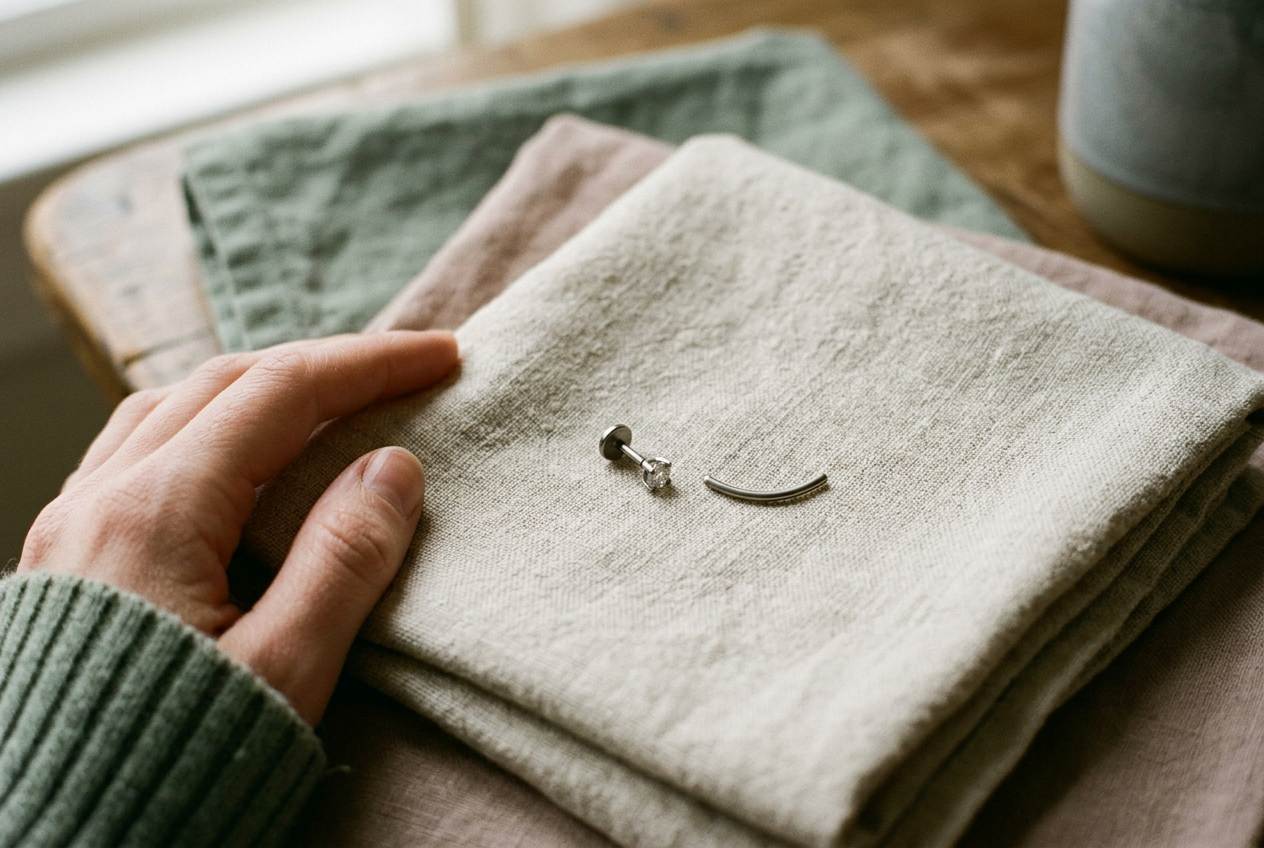
The useful detail is barely visible. On a threadless flat back earring, meaning an earring whose backing sits flush against the earlobe, the slim pin attached to the decorative end should look a little off-center when it is outside the post. It should not look folded, kinked or bowed into a semicircle.
For a concrete test case, consider a pair of 18-gauge implant-grade titanium flat-back studs with small bezel-set cubic zirconia ends, worn in healed second-lobe piercings. Gauge means the thickness of the post; 18 gauge is about 1 millimeter. This is a common everyday setup: light enough to forget during the day, smooth at the back and low-profile against a pillow.
The fit quirk sits inside the earring. A threadless end, meaning a decorative top with a plain pressure-fit pin rather than a screw, stays attached because that pin presses against the inner wall of the hollow post. The slight bend creates the pressure. Too little, and the top can work loose while changing a sweater or drying hair.
Too much, and the pin can become difficult to seat, weaken at the bend or damage the inside of the post.
This is unisex advice. The mechanics do not change with wardrobe, styling or the position of the piercing, although larger and heavier decorative ends deserve more frequent fit checks than the small titanium studs used here.
The bend creates friction, not a lock
A threadless connection has no click mechanism and no threads to tighten. As the bent pin slides into the straight channel of the post, it tries to straighten, which pushes part of the pin against the channel wall and creates friction. The top remains removable, but ordinary movement should not pull it free.
That distinction matters when judging the bend. A secure pin does not need to be dramatically curved before insertion. On the 18-gauge stud, the tip only needs to sit slightly away from the pin’s original centerline, with a smooth curve rather than one sharp crease. There is no useful universal angle because pin thickness, pin length and the post’s internal diameter vary among makers, even when the jewelry has the same stated gauge.
Compatibility can vary too. An 18-gauge post describes the outside thickness, not the exact size of the inner channel, so a threadless end from one jewelry maker may feel looser or tighter in another maker’s post. A bigger bend can sometimes compensate for a mildly loose pairing. It should not be used to force together parts that plainly do not match.
Adjust the pin in small increments
Work over a tray or a folded towel, not a sink. Clean hands give a better grip, while the soft surface keeps the small end from bouncing away if it slips. Remove the jewelry from the ear only if the piercing is fully healed and normally tolerates jewelry changes; a professional piercer should handle a fresh or irritated piercing.
Start with the decorative end and post separated. Look along the length of the pin under direct light. If it already has a gentle curve, test it before changing anything. Repeated bending is more likely to fatigue the metal than one restrained adjustment, so there is no benefit in straightening a pin merely to rebuild the same curve.
Insert the pin partway into the post, stopping at roughly the middle rather than pushing the decorative top flush. The post now supports the pin while leaving enough length exposed to make a controlled adjustment. Hold the post close to its opening, then press the decorative end a tiny distance to one side with a fingertip. The movement should feel modest.
Remove the end and inspect the pin.
The target is a continuous, shallow curve. If the pin has a distinct corner near the decorative setting, stop rather than bending that corner back and forth, because the junction between the ornament and pin is a poor place to concentrate stress. Pliers are also a poor trade for ordinary fitting: their jaws can notch a soft pin, mark a polished end or apply much more force than expected.
Reinsert the pin and press the end toward the post. A suitable bend produces mild resistance that becomes more noticeable as the last section enters. The end should still seat fully, with no unintended gap between the decorative top and the front of the post. If it glides in without any resistance, remove it and add another very small amount of bend.
If it stops abruptly or requires painful pressure while the post is in the ear, the curve is too strong.
For the titanium second-lobe stud, this should take a few minutes and perhaps one adjustment. Repeatedly moving from loose to overbent and back again is not a fitting technique. It is metal fatigue, and replacing the inexpensive component is a better decision than trying to rescue it through another cycle.
Test the connection before daily wear
Test the assembled jewelry in your hands first. Hold the post with one hand and the decorative end with the other, then apply a light, straight pull. A properly tensioned end should remain in place under gentle pressure. Do not twist and yank it as a strength test; threadless jewelry is designed to come apart when deliberately removed, and excessive force proves little about how it will behave during a normal day.
Next, point the post downward over the towel. The decorative end should not slide out under its own weight. Press it flush again and check the seam where the end meets the post. A persistent gap can mean the bend is excessive, the pin is distorted or debris is blocking the channel.
Once the stud is in a healed piercing, check it again after dressing and before bed. Place one fingertip on the flat disc behind the ear and another on the decorative top, then press the two pieces together. This prevents the whole earring from being tugged through the piercing and confirms that the pin is seated. For the anchored pair of second-lobe studs, that quick check matters most after pulling a close-neck sweater overhead, using a towel around the ears or removing headphones.
Rotation is not a reliable security test. A threadless top may turn while remaining firmly seated because the pin can rotate inside the channel, and a top that does not rotate may merely be held by skin oils or residue. Straight pulling resistance and a fully seated end give more useful information.
A loose connection has recognizable signs
The clearest warning is an end that enters the post with no resistance and falls out when the jewelry is pointed downward. A decorative top that repeatedly develops a gap during ordinary wear also needs attention, especially if pushing it closed only fixes the problem for a few hours.
Inspect both pieces. A pin that looks polished flat on one side, sharply kinked or loose at the decorative setting should be replaced rather than bent again. The post can fail too: its opening may be distorted, or its internal channel may be too wide for that particular pin. Testing the end in a known-compatible post, or testing another compatible end in the original post, can identify which half is responsible without adding more bend.
Daily wear raises the stakes. A slightly loose end might survive while someone is sitting at a desk, then disappear into a towel, pillowcase or sweater collar. Larger clusters and charms place more leverage on the pin than the small cubic zirconia stud, so a connection that feels marginal in the hand is not secure enough for an active day or overnight wear.
Residue can also change the feel. If the maker’s care instructions allow it, clean the removed components and dry them before retesting; do not push cream, soap or polishing compound into the hollow channel. A dirty post can feel falsely tight on insertion, while lubricant left by skincare can reduce friction.
Know when adjustment is no longer worth it
One restrained bend is normal fitting. A pin that needs correction every few days is telling you that the parts are worn, damaged or mismatched. At that point, replacing the threadless end or labret post, the hollow post with a flat disc at the back, costs less in frustration than searching for a bend that will not hold.
The alternative is internally threaded jewelry, which uses a decorative end that screws into the post. It removes the bend adjustment but introduces tiny threads that take longer to align, particularly with short nails or limited dexterity. Neither system is universally more secure. A well-fitted threadless connection is fast to use and comfortable for everyday wear; a loose one is not improved by loyalty to the format.
Keep compatible parts together when possible. For the 18-gauge titanium pair, storing each top with its original post avoids turning every jewelry change into another round of pin adjustment, and it reduces the temptation to overwork a sound pin just because a different post has a wider internal channel.
Questions people ask
How much should a threadless earring pin bend?
The pin needs a shallow, smooth curve that creates resistance inside the post. Its tip should sit slightly off the original centerline, but the pin should not form a hook or show a sharp corner. Test after each tiny adjustment because the correct bend depends on the pin and post pairing.
Can I bend a threadless pin with pliers?
Finger pressure is safer for a normal adjustment. Pliers can notch the pin, scratch the finish or create a sharp bend that concentrates stress. If the pin is too stiff to move with restrained hand pressure, or the setting makes it hard to hold, take the jewelry to a professional piercer.
Why is the earring still loose after I bend the pin?
The post’s internal channel may be too wide for that pin, particularly when the end and post come from different makers. The pin may also be worn or damaged. Stop after small adjustments fail, then test with known-compatible components and replace whichever piece cannot maintain tension.
Should
I adjust threadless jewelry in a fresh piercing?
Do not remove or refit jewelry in a fresh, swollen or irritated piercing on your own. The channel can narrow quickly, and extra handling adds trauma. Ask a professional piercer to check the fit, post length and connection while keeping appropriate jewelry in place.
One update a day
Today's fashion update, in your inbox
One fashion update each morning — no hype, no filler, just pieces worth wearing.