Insertion Tapers Make Flat Back Earring Changes Less Rough
A gauge-matched taper gives a threadless post a smooth path through the piercing. The catch is that the connector, gauge and angle all have to agree.
October 15, 2026 · 8 min read
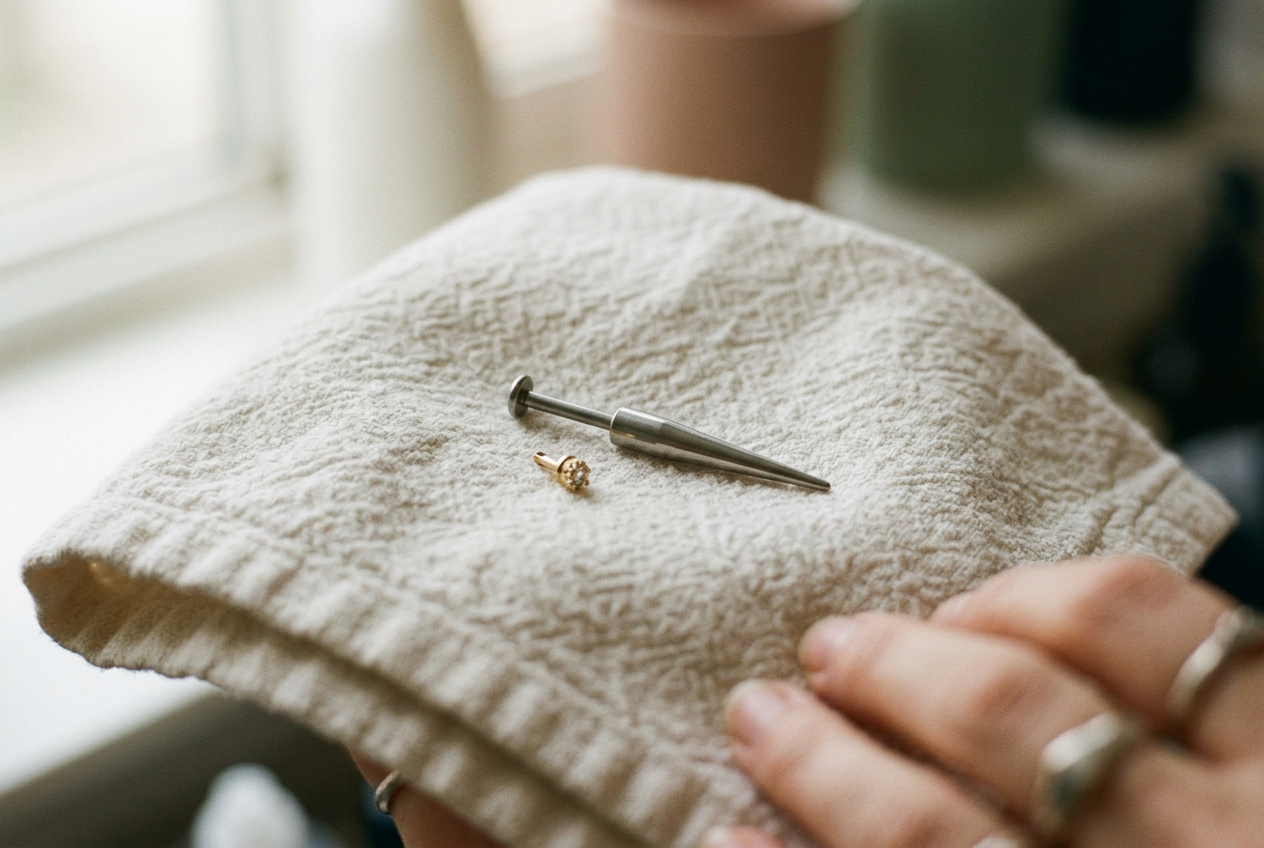
The useful part is smaller than a matchstick: a straight connector pin at the narrow end of a polished taper. That pin temporarily joins the guide to the hollow post, allowing both pieces to travel through the piercing as one continuous line rather than making the post’s blunt edge find the channel on its own.
The reference pair here is an 18-gauge implant-grade titanium threadless labret with an 8-millimeter wearable length, a 3-millimeter flat disc and a small 14-karat gold end. A labret is a post with a fixed flat backing, while threadless means the decorative end uses a tension-fit pin rather than a screw. Those dimensions are a worked example, not a universal prescription; an 8-millimeter post can be roomy on a thin lobe and tight on thicker tissue.
This is unisex jewelry advice. The hardware does not change by wardrobe, though anatomy and piercing placement determine the correct post length.
What the taper changes
Without a guide, changing the reference post requires reaching behind the ear, aiming its open tube at a channel that cannot be seen and pushing forward without catching tissue. A healed lobe may tolerate that clumsy moment, but tolerance is not the same as comfort. The square edge at the opening of a labret can scrape if the post meets the channel off-center.
An insertion taper replaces that blind search with a gradual surface. For the reference earring, the guide enters from the front, its narrow end emerges behind the lobe, and the titanium post connects at the back. Drawing the taper forward then brings the labret through in the correct direction, with the disc finishing behind the ear.
The improvement is control, not speed. Setting out the pieces, washing and drying hands, checking the connector and making the pass can take longer than pushing in a familiar post. It feels more orderly because the piercing is occupied by a smooth guide while the jewelry changes, which also reduces the chance of losing the channel during a hesitant swap.
There is still friction. A taper that is too large stretches tissue rather than guiding it, and a loose connection can separate halfway through. Neither problem should be solved with more force.
Gauge matters twice
Gauge describes post thickness, with a lower gauge number indicating a thicker post. The reference 18-gauge labret is about 1 millimeter thick. A 16-gauge post is thicker, while a 20-gauge post is thinner.
The taper’s main body should match the jewelry gauge and the established piercing channel. An 18-gauge guide paired with the 18-gauge reference post should create a nearly continuous profile, without a raised shoulder where metal can catch. Using a 16-gauge taper in an 18-gauge channel is an attempt to enlarge the piercing. That belongs with a professional piercer, even when the numerical difference looks minor.
Connector fit is a separate issue. Many 16- and 18-gauge threadless posts accept similarly sized decorative pins, but that does not make every taper interchangeable, and narrower 20-gauge systems can use different openings. Product labeling needs to identify both the body gauge and threadless compatibility. If a listing only says “universal,” ask the seller for measurements or skip it.
The connector pin should enter the hollow labret straight and sit firmly enough to survive a gentle pull. It should not need twisting, levering or a hard push. Decorative threadless ends often have a slight intentional bend in their pins to create tension inside the post; the taper’s connector is a transfer joint and should align without that visible kink.
With the reference titanium pair, the decisive check happens before anything touches the ear: join taper and post on a clean surface, run a fingertip lightly over the seam, then pull with modest pressure. A ridge means the profiles do not match. A connector that drops out under its own weight is not secure enough for the pass.
A controlled change at home
Use a clean, well-lit counter with a mirror and a folded towel beneath the jewelry. The towel keeps the tiny gold end from bouncing away. Wash and dry your hands, then clean the jewelry and taper according to the maker’s instructions; household disinfectants, alcohol and peroxide can be unsuitable for some finishes or irritating around the piercing.
Grip is the first practical problem. Polished steel tapers are easy to drop once fingers become damp, and the small disc on the reference labret offers little leverage behind the lobe. Clean nitrile gloves can improve traction. A square of clean, lint-free gauze also helps, provided no fibers catch on the connector.
Pliers and household tweezers can gouge polished metal or crush a hollow post.
Remove the decorative end from the current threadless post by holding the flat disc steady and pulling the end straight out with a slight rocking motion. Do not yank the ear. If the end will not release with controlled hand pressure, stop before the post bends or the channel becomes sore.
For a straightforward replacement, insert the gauge-matched taper from the front of the healed piercing, following the existing angle rather than aiming perpendicular to the earlobe. Piercings are not always straight. Once the narrow connector appears behind the ear, press it into the open end of the new labret and check that the join is flush.
Draw the taper back toward the front in one slow pass. The titanium post should follow from behind until its open end appears at the front and the flat disc rests against the back of the ear. Hold the disc, detach the taper without tilting the post, then insert the gold end. A threadless end needs enough pin tension to stay put, but adjusting that bend is delicate; a piercer can set it without overbending or snapping the pin.
Do not keep advancing if the seam catches. Back up slightly while maintaining the original angle, then stop if it catches again. Repeated passes turn a neat jewelry change into irritated tissue, and the taper has lost its advantage at that point.
Post length remains important after the successful transfer. The 8-millimeter reference labret should leave enough room that its disc does not press into the skin, yet not so much that the post tips and snags. A taper cannot make a too-short post safe or stop an overly long one from shifting. If the original flat back was comfortable and the new post matches its wearable length, that is a more reliable starting point than guessing from total post length on a product page.
Where the tool earns its place
An insertion taper makes sense for someone who rotates healed threadless jewelry, struggles to guide rear-entry posts or maintains a closely spaced ear stack where fingers block the angle. It is also useful when the decorative end is easy to handle but the tiny backing is not.
The tool sits in the price category of a small jewelry-care accessory rather than fine jewelry, although material and finish affect cost. Implant-grade titanium and well-finished stainless steel are common practical choices. A polished surface and accurate connector matter more than a decorative handle.
For a person who changes one healed lobe pair twice a year, the purchase may not be worth storing and cleaning. A piercer can change the jewelry and confirm post length at the same appointment. The taper becomes better value when several compatible flat backs share one gauge, since a single correctly sized guide can assist repeated swaps.
It also introduces one more compatibility point. Threaded tapers, which screw into internally threaded jewelry, do not connect to the hollow tension-fit post used by the reference pair. Similar silhouettes do not mean similar hardware.
Leave resistance to a piercer
Fresh or still-healing piercings should not be used for at-home jewelry practice. The channel may be fragile even when the surface looks calm, and removing the initial jewelry can disturb healing or allow the opening to narrow. Planned downsizing, meaning replacement of a longer initial post after swelling settles, is best handled by a piercer.
Professional help also makes sense for cartilage placements, hard-to-see angles, embedded discs, jewelry that will not release, unexplained bleeding or a channel that feels tight around its current post. Heat, spreading redness, substantial swelling, worsening pain or discharge needs assessment by an appropriate health care professional rather than repeated jewelry changes.
The stopping point is physical and clear. The matched reference taper should meet light resistance as it follows the established path, not sharp pain or a firm wall. Once force enters the job, the tool is no longer acting as a guide.
Questions people ask
Can an insertion taper stretch an ear piercing?
A larger taper can stretch or injure the channel, even if the difference appears small. Match the taper body to the established jewelry gauge. Moving from the 18-gauge reference post to a thicker 16-gauge size should be planned with a professional piercer rather than treated as a routine jewelry change.
Do threadless insertion tapers fit every flat back earring?
No. The taper must match the post gauge and use a connector sized for that post’s hollow opening. A guide made for internally threaded jewelry will not connect correctly, while some narrow threadless systems use smaller openings than common 16- and 18-gauge posts.
Can I use a taper on a fresh piercing?
Leave fresh and healing piercings alone unless a professional piercer is changing the jewelry for a specific reason. A taper can keep the route occupied, but it cannot protect fragile tissue from movement, contamination, an incorrect angle or a post that is too short for swelling.
Why does the taper stop halfway through?
The guide may be following the wrong angle, meeting a narrowed channel or catching at a mismatched seam between taper and post. Back up gently and stop after a second catch. Forcing the taper can scrape tissue, and repeated attempts make swelling more likely to obscure the original route.
One update a day
Today's fashion update, in your inbox
One fashion update each morning — no hype, no filler, just pieces worth wearing.