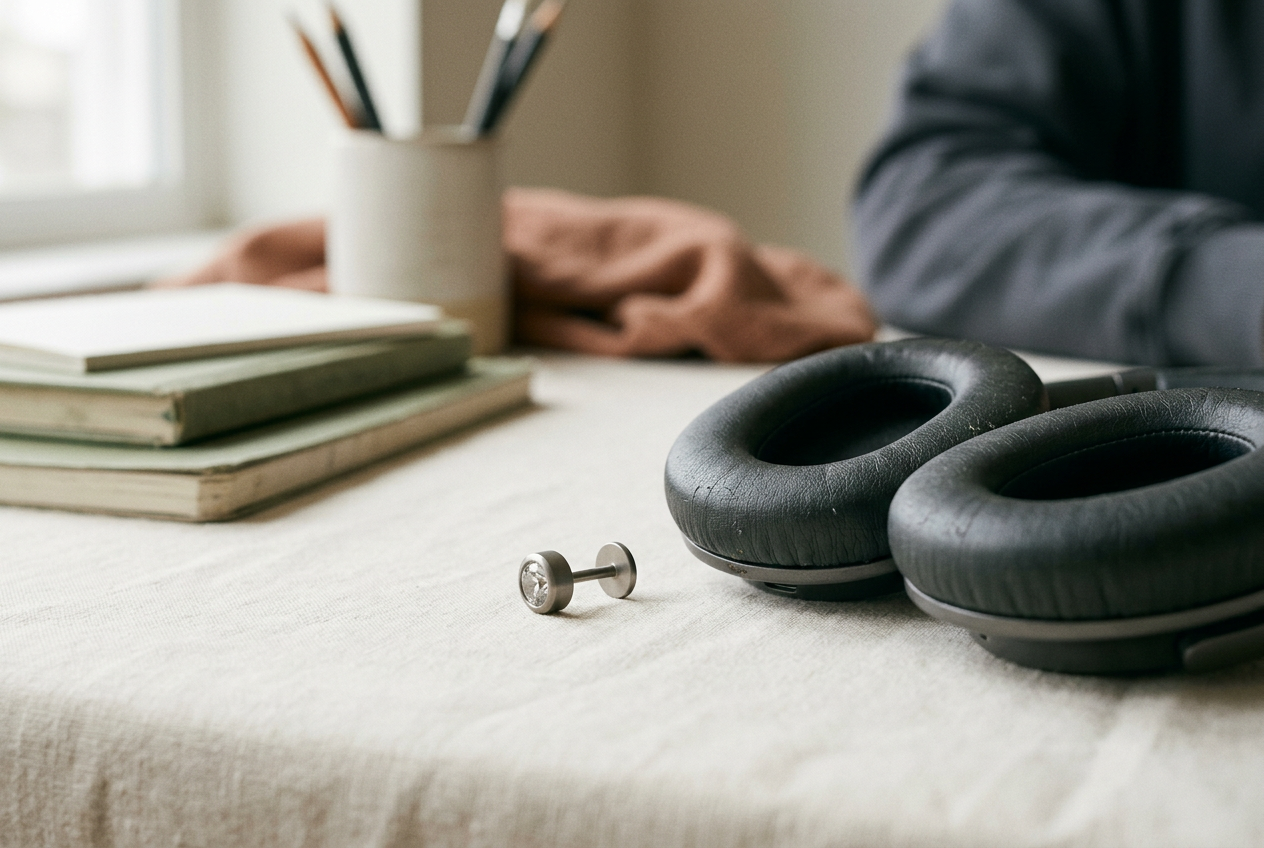
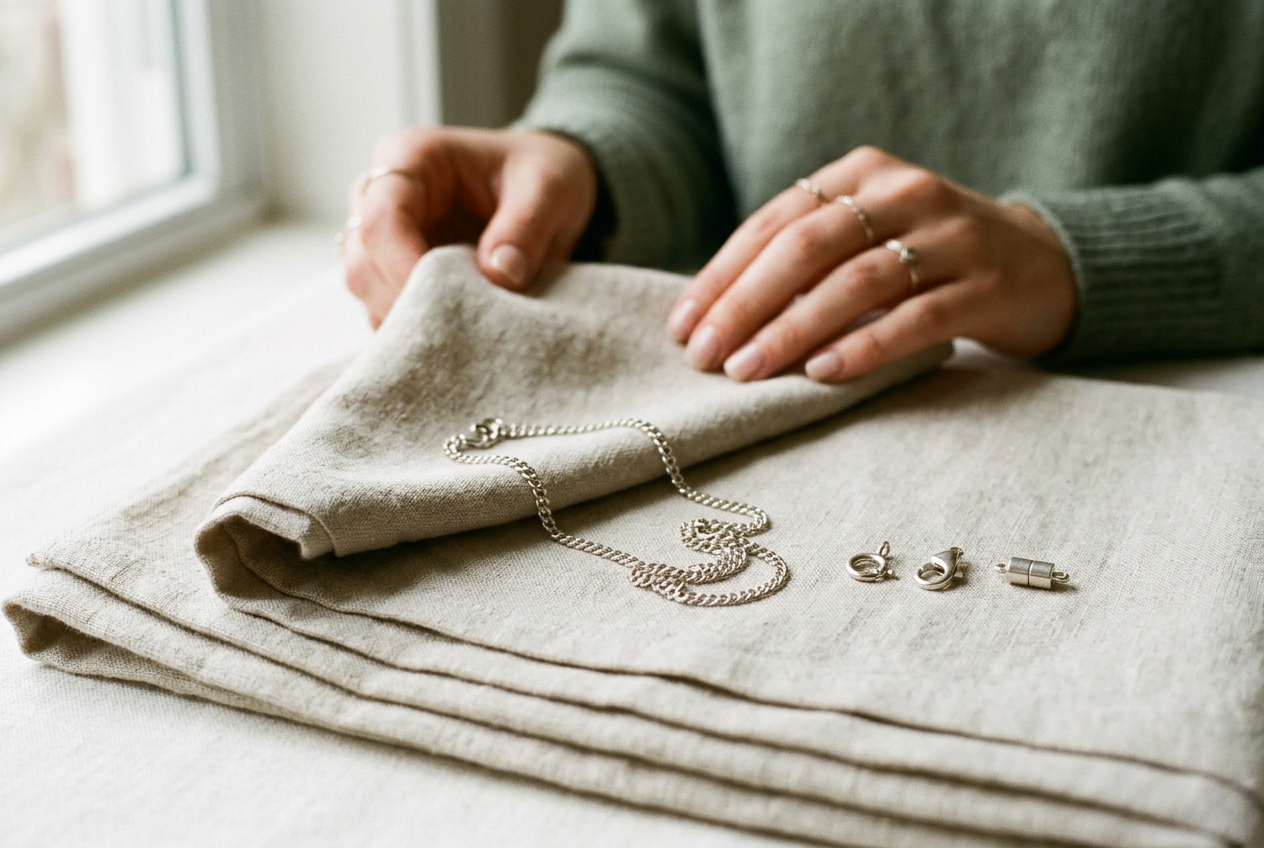
Most Butterfly-Back Studs Cannot Become Flat Backs
A flat back is not a replacement butterfly clutch. Post size, threading and the way the decorative front was built determine whether a sentimental stud can be converted safely.
November 4, 2026 · 7 min read
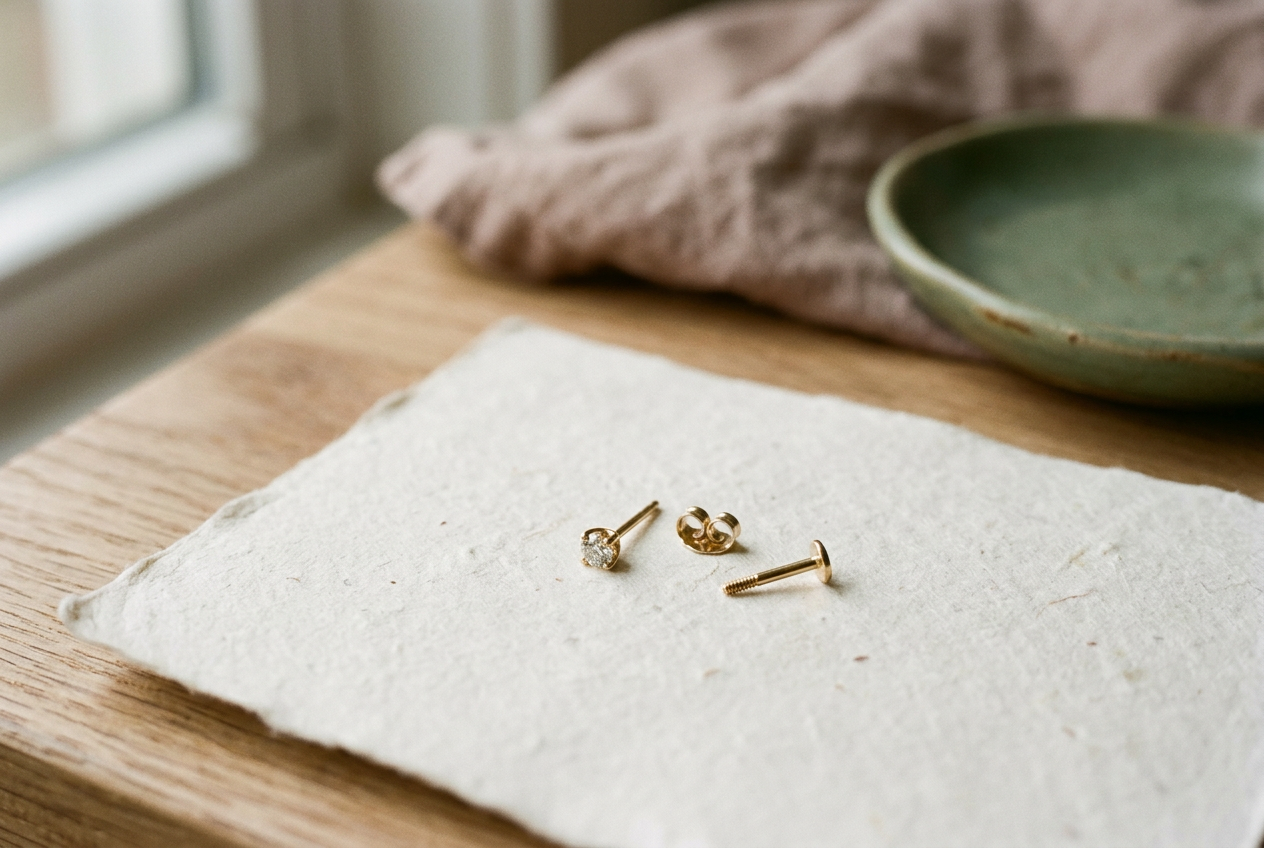
Start with a familiar pair: small 14k yellow gold diamond studs, each stone held in a four-prong basket, with straight posts and butterfly clutches. They look like ideal candidates for flat backs. The stones sit close to the ear, the setting is simple, and the pointed posts are precisely what make the pair uncomfortable against a pillow.
The apparent fix is to keep each diamond front and swap its butterfly for a flat disc. That is where the plan fails. A flat back earring, meaning an earring whose backing sits flush against the ear, is built as a two-part system rather than a conventional stud with a different clutch.
This is unisex advice. The mechanical limits are the same across wardrobes, whether the studs are tiny diamonds, black onyx dots or a mismatched ear stack.
The old post does not plug into the new one
A conventional stud usually has a solid post. Near its pointed end, a groove gives the butterfly clutch somewhere to grip. The front, post and clutch were designed around one another, even if replacement butterflies from another pair happen to fit.
A labret post, the hollow post used for many flat back earrings, works differently. Its disc is fixed at the rear, while the decorative end attaches from the front. A threadless end uses a very slender pin that is bent slightly so tension holds it inside the hollow post. An internally threaded end has a tiny screw on the decorative front that turns into threads hidden inside the post.
The solid post on the 14k diamond stud can do neither job. It is far too thick to act as a threadless pin, it has no screw fitting, and cutting off its pointed tip does not change that geometry. A labret is not a sleeve that accepts an ordinary earring post.
Diameter matters elsewhere, too. Piercing jewelry is sold by gauge, a measurement in which a lower gauge number indicates a thicker post. Common flat back systems may use different post gauges, and the opening inside a threadless or threaded post is smaller still. Two pieces that look almost identical beside a ruler may have no usable connection.
Even components sold under the same broad description are not guaranteed to mix. Thread pitch, pin thickness, manufacturing tolerances and the intended post gauge can vary. A decorative end should be matched to a post system rather than forced into whichever labret happens to be in the jewelry box.
The front may be harder to save than the diamond
For the example pair, conversion would mean removing each conventional post from the back of the four-prong basket, finishing that area, and attaching a compatible threadless pin or threaded fitting. The diamonds are not the difficult concept. The junction behind them is.
A substantial solid-gold basket may give a bench jeweler enough metal to work with, especially if the original post was soldered onto a defined base rather than incorporated into a thin stamped setting. A jeweler who handles small-scale repair can inspect the joint under magnification and decide whether conventional soldering or more localized laser welding is suitable.
Thin, hollow and plated fronts are poorer candidates. Removing the post can tear a stamped shell or expose base metal beneath plating, while the new attachment concentrates stress in an area never intended to hold it. A front that bends during normal handling will not become sturdier because its backing is flatter.
Heat introduces another limit. Diamonds and some durable stones may tolerate certain bench procedures when a qualified jeweler assesses the complete setting, but glued components, pearls, enamel, foil-backed stones and many treated or unidentified gems require more caution. The risk may come from adhesive failure, surface damage or an existing fracture that is not obvious from the front.
Construction can block access as well. On a cluster stud, the post may disappear into an open gallery beneath several stones. On a tiny bezel, there may be too little metal behind the setting for a new fitting without making the front sit farther from the ear. That extra depth defeats part of the appeal: a low-profile end should not become a top-heavy lump merely to preserve its original face.
Return to the 14k diamond pair. Its odds are better than those of a plated crystal stud, but “14k” and “diamond” are not an automatic yes. The jeweler still needs to inspect wall thickness, previous repairs, solder seams and the amount of level metal available behind each basket.
A safe conversion starts with the receiving post
Do not ask only whether the old post can come off. Bring the intended flat back system, or choose it with a piercer and jeweler who understand compatible body-jewelry components. The new front must fit a known post securely, sit at the intended angle and leave enough clearance for installation.
For healed lobe piercings, post length controls comfort. Too long, and the front tips or the disc slides away from the ear; too short, and the jewelry presses into tissue as the ear fluctuates. Disc diameter matters as well, because a very small disc can feel sharper under pressure while a larger one may crowd a nearby piercing.
Material deserves the same attention. Verified implant-grade titanium and suitable solid gold are common choices for quality flat back posts, but an unidentified conversion fitting creates uncertainty at the part passing through the piercing. Gold color alone says little about alloy composition, plating or long-term wear.
The practical sequence is straightforward: have a professional piercer assess the healed channel and select the post dimensions, then have the jeweler judge whether the original fronts can accept the matching pin or screw component. If the two specialists use different component systems, settle compatibility before anyone cuts the sentimental studs.
Custom conversion is bench work, not a cheap backing swap. The quote reflects two post removals, two new attachments, finishing, component sourcing and the possibility that stones must be unset and reset. On a modest pair, labor can approach or exceed the cost of buying well-made flat backs with a similar look. Sentimental value may justify that.
Market value often does not.
When copying the front is the better decision
A replica becomes practical when the original is fragile, irreplaceable or awkwardly constructed. The jeweler can leave the 14k diamond studs intact and reproduce the visible proportions as compatible flat back ends, using a new setting designed around a threadless pin or screw from the start.
“Replica” can mean several things. The least expensive route may be an existing commercial end with the same scale and setting style. A closer version may require measurements, computer modeling or a mold, followed by casting and stone setting. That custom route carries more setup cost, particularly for one small pair, but it avoids testing an heirloom joint every night.
A replica also lets the back geometry improve. The new basket can be lower, the attachment can sit centrally, and the metal can be thick enough where the pin or threaded fitting joins it. If exact sentimental material matters, copying the appearance will not satisfy that requirement; the original remains in the jewelry box. That tradeoff should be stated plainly before commissioning anything.
Moving the original diamonds into newly made flat back settings is another possibility, though it is a reset rather than a no-loss conversion. The stones must come out of their original baskets, and old prongs may not survive the work. For inherited jewelry, preserving the complete pair may matter more than wearing those specific stones overnight.
For the example studs, the decision turns on the rear of the baskets. Thick, sound 14k construction with accessible joints may support a conversion after inspection. A thin or previously repaired basket points toward a lookalike pair, leaving the originals available for daytime wear with their butterfly backs.
Comfort still depends on the final fit
Flat backs remove the pointed post and protruding clutch that can press into the neck or catch on fabric. They do not make every earring sleep-friendly. A tall gem setting can still snag a pillowcase, and an incorrectly sized post can pinch after several hours.
Have the finished ends checked for rough solder, sharp edges and looseness before wearing them continuously. Threadless jewelry needs an appropriate bend in the pin to create tension; threaded jewelry needs secure engagement without cross-threading, which means the screw has entered at the wrong angle and damaged the fine threads.
Fresh or irritated piercings are not the place to test a custom conversion. A professional piercer should choose jewelry for a healing channel and handle changes when needed. Once healed, the useful test is physical: the disc should rest without digging in, the front should not droop, and the connection should stay firm through dressing and sleep.
Questions people ask
Can
I put a normal stud into a flat back post?
Usually not. A normal stud has a solid post made for a butterfly clutch, while a labret post accepts a much thinner threadless pin or a matching screw end. Similar appearance does not make the components interchangeable.
Can a jeweler convert diamond studs to flat backs?
Sometimes. Solid precious-metal settings with enough accessible metal behind the stone may accept a compatible fitting, but the jeweler must inspect the basket, solder joints and any previous repairs before removing the original posts.
Is converting sentimental earrings worth the cost?
It can be when wearing the original material matters more than resale value. For modest studs, custom bench labor may rival the price of a new pair, and a replica front is often the lower-risk choice when the original construction is thin or fragile.
Are converted flat backs comfortable enough to sleep in?
They can be, provided the front stays low and a piercer selects the correct post length and disc size for a healed piercing. A flat disc removes the pointed backing, but a post that is too short can still create pressure.
One update a day
Today's fashion update, in your inbox
One fashion update each morning — no hype, no filler, just pieces worth wearing.