Gradient Sunglasses Help With Dashboards, Until the Sun Sits Low
A dark upper lens and pale lower lens can smooth the shift from bright road to dashboard. Solid tint is steadier when glare comes from below or the side.
November 7, 2026 · 8 min read
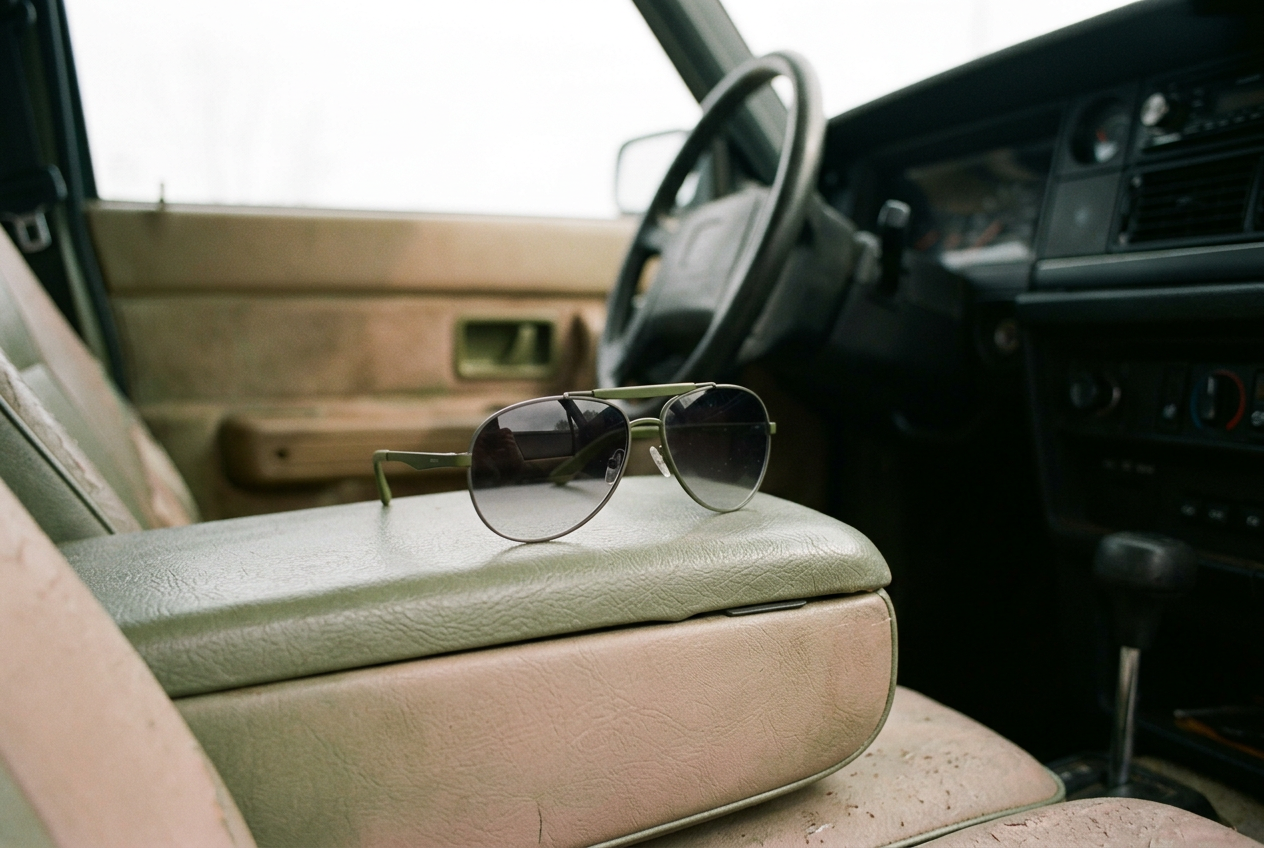
The useful detail sits in the fade. On a Ray-Ban Aviator Classic with gray gradient lenses, the teardrop lens is darkest along the brow and progressively paler toward the lower rim; the same frame with a solid G-15 green lens keeps one tint density from top to bottom. That difference matters more in motion than it does at the mirror.
Look through the upper half toward a bright street and the gradient behaves much like an ordinary dark sunglass lens. Drop your eyes to the instrument panel and the view becomes lighter. A solid lens does not make that adjustment for you, which can feel calmer in hard glare but dimmer around a recessed dashboard or shaded phone screen.
Neither layout proves that the lens protects against ultraviolet radiation. Darkness and verified UV filtration are separate specifications, and a pale or clear lens can filter UV while an unverified dark lens may only make the world look less bright.
This is unisex advice. Lens height, bridge fit and driving conditions matter across wardrobes, whether the frame is a slim metal aviator or a substantial acetate rectangle.
What the gradient changes behind the wheel
A gradient tint is a lens treatment whose density changes from darker at the top to lighter at the bottom. Its logic fits a familiar driving posture: the road and sky occupy the upper field of view, while gauges, navigation displays and climate controls sit below.
That geometry works best in broad daylight with the sun above the sightline. In the gray-gradient Aviator, a straight-ahead gaze passes through the darker area, then a brief downward glance crosses the fade and reaches the paler lower section. The dashboard can look less muted without removing the glasses. The effect is especially noticeable in a car with a deep instrument hood, where the display is already shaded.
The compromise arrives when brightness fails to stay overhead. A low sun can land directly in the middle or lower portion of the lens, depending on the frame’s position and the wearer’s head angle. Reflections from a pale hood, wet pavement, water or snow also rise from below. The lighter zone then admits more visible light at the exact point where a solid tint would remain dark.
That does not make gradient lenses unsuitable for driving. It makes them conditional. They suit daytime trips that repeatedly shift between an open road and a dim cabin, while drivers who regularly meet sunrise, sunset or strong reflected glare have a clearer reason to choose solid tint.
A car windshield complicates the buying decision in another way. It can reduce much of the UV reaching the cabin, but visible brightness still pours through, and side-window performance varies. Sunglasses remain useful for brightness and glare even when the glass around the driver filters UV.
At night, skip both dark gradient and dark solid lenses. Any tinted lens that reduces visible light can make an already dim scene harder to read.
The frame decides where the fade lands
The Ray-Ban Aviator case is useful because its tall, teardrop-shaped lens gives the gradient room to change. A shallow rectangular frame compresses the transition, so a large share of its lens may feel either dark or pale rather than offering a generous middle zone.
Fit shifts the tint as well. If an aviator slides down the nose, the pupils sit higher relative to the lens and may remain behind its darker section. If the bridge holds the frame high, the pupils can meet a lighter part of the fade. A few millimeters alter the view.
Try a gradient pair in normal posture rather than tilting your chin for the fitting-room mirror. Look straight ahead, then glance down with your eyes toward something held around dashboard height. The upper field should feel comfortably shaded, and the lower field should brighten without exposing the pupil to a distracting stripe of light.
The brow matters too. A large gap between the frame and face lets overhead light enter behind the lens, regardless of tint style, while very flat lenses can admit brightness from the sides. More wrap improves coverage, although deeply wrapped frames may be harder to fit with some prescriptions and can look more technical than a classic aviator.
Solid G-15 green in the same Aviator shape removes the placement issue. The dashboard remains behind the same tint as the road. That consistency is useful in open vehicles, on exposed highways and around reflective surfaces, even though it asks the eyes to work through a darker lens when checking a shaded display.
Phone screens favor the pale lower lens, with limits
While walking, a gradient lens follows the same upper-dark, lower-light logic. Buildings, sky and bright pavement fill the forward view; a phone held below eye level appears through the paler section. Text can be easier to read without pushing the glasses onto the head.
There is a tradeoff on very bright sidewalks. Pale concrete and shop windows can throw light upward, and the lower fade offers less reduction in visible brightness. A solid tint feels more even when the entire scene is reflective. The stronger choice for a long waterfront walk or an exposed summer commute may therefore be the less convenient one at the screen.
Screen behavior also depends on polarization, a filter that reduces glare traveling in particular orientations. Polarized lenses can cut harsh reflection from roads and water, making them valuable for many drivers, but some liquid-crystal displays appear dim, uneven or rainbow-colored when viewed through them. Rotate the phone or tilt the head and the display may change.
Check that interaction before buying. Use the dashboard and phone only while the car is safely parked. Gradient and polarization solve different problems, so a lens can have either feature or both; the fade controls tint density by height, while polarization manages directional glare.
Dark tint does not certify UV protection
Visible light transmission, usually shortened to VLT, is the percentage of visible light that passes through a lens. A lower VLT looks darker. UV protection describes filtration outside the visible spectrum, so color depth cannot confirm it by inspection.
Look for explicit manufacturer documentation stating UV400 or 100 percent UVA and UVB protection. UV400 means the lens is designed to block ultraviolet wavelengths up to 400 nanometers, covering the UVA and UVB ranges. Packaging, an etched marking or a product specification is more useful than a salesperson’s description of the lens as “dark” or “sun protective.”
Ray-Ban documents UV protection separately from the appearance and performance of its lens colors, which is the right distinction to carry into any brand comparison. Gray, green and brown alter color perception and contrast in different ways, but none should be treated as proof of UV filtration on color alone.
If the labeling is absent or vague, an optical shop can check the lenses with a UV transmission meter. That is worth doing for an older secondhand pair, an unmarked fashion frame or replacement lenses whose origin is uncertain. Scratches are visible. Missing documentation is not.
Very dark lenses deserve particular scrutiny because they reduce visible light and cause the pupil to dilate. Reliable UV filtration matters behind that darkness. For driving, also check any filter-category warning supplied by the maker, since some very dark specialty lenses are not intended for road use.
Choose for the repeated part of the day
Pick the gray-gradient Aviator type when most wear happens in bright overhead sun, frequent dashboard glances and mixed indoor-outdoor errands. Its lower lens is practical at a phone, receipt or transit map. The wearer accepts weaker shading from low and reflected light.
Choose the solid G-15 type when exposure is broad and persistent: long highway stretches, low sun, wet roads or open walks with light bouncing from the ground. The cabin and screen stay darker, but the eye receives consistent visible-light reduction across the lens.
Color comes after that decision. Neutral gray tends to preserve color relationships, green can keep a natural-looking balance while moderating brightness, and brown often increases perceived contrast. The precise result depends on density, coatings and the wearer’s vision, so the name printed on the color option tells only part of the story.
Gradient tint is not inherently a premium construction. It may sit beside solid colors at a similar price, while polarization, prescription work, lens material and brand positioning can add more. Paying extra for a fade that lands badly on the pupil is poor value. Fit it first.
The most useful comparison is still the two Aviators: identical lens shape, different distribution of tint. One makes the lower half easier to use. The other keeps glare control steady. Verified UV protection belongs on the specification sheet for either pair.
Questions people ask
Are gradient sunglasses safe for driving?
They can be suitable for daytime driving when the manufacturer identifies them for road use and documents UV protection. Their lighter lower section helps with a shaded dashboard, but it can admit more visible glare from low sun, wet pavement or a pale hood. Very dark specialty lenses and tinted lenses at night should be avoided.
Do darker sunglass lenses block more UV?
No reliable visual link exists between tint darkness and UV filtration. A light lens can carry verified UV400 protection, while darkness alone proves nothing. Check the manufacturer’s specification for UV400 or 100 percent UVA and UVB protection, and ask an optical shop to test an unmarked or secondhand pair.
Are gradient lenses better for looking at a phone?
They are often more convenient because a phone held below eye level sits behind the paler part of the lens. Polarization may still make some screens look dark or uneven, however. Test the actual device through the glasses, and make any dashboard or phone check while the vehicle is safely parked.
Do gradient lenses work in small frames?
They can, but a shallow lens leaves less vertical space for a gradual transition. The fade may place the pupil in a zone that feels too light or too dark. Try the frame in a natural head position and compare straight-ahead vision with a downward glance before committing to prescription lenses.
One update a day
Today's fashion update, in your inbox
One fashion update each morning — no hype, no filler, just pieces worth wearing.