Rotate Your Phone Before You Buy Polarized Sunglasses
A frame can fit perfectly and still make your phone hard to read. A quarter-turn test reveals the problem before polarized sunglasses leave the store.
October 24, 2026 · 7 min read
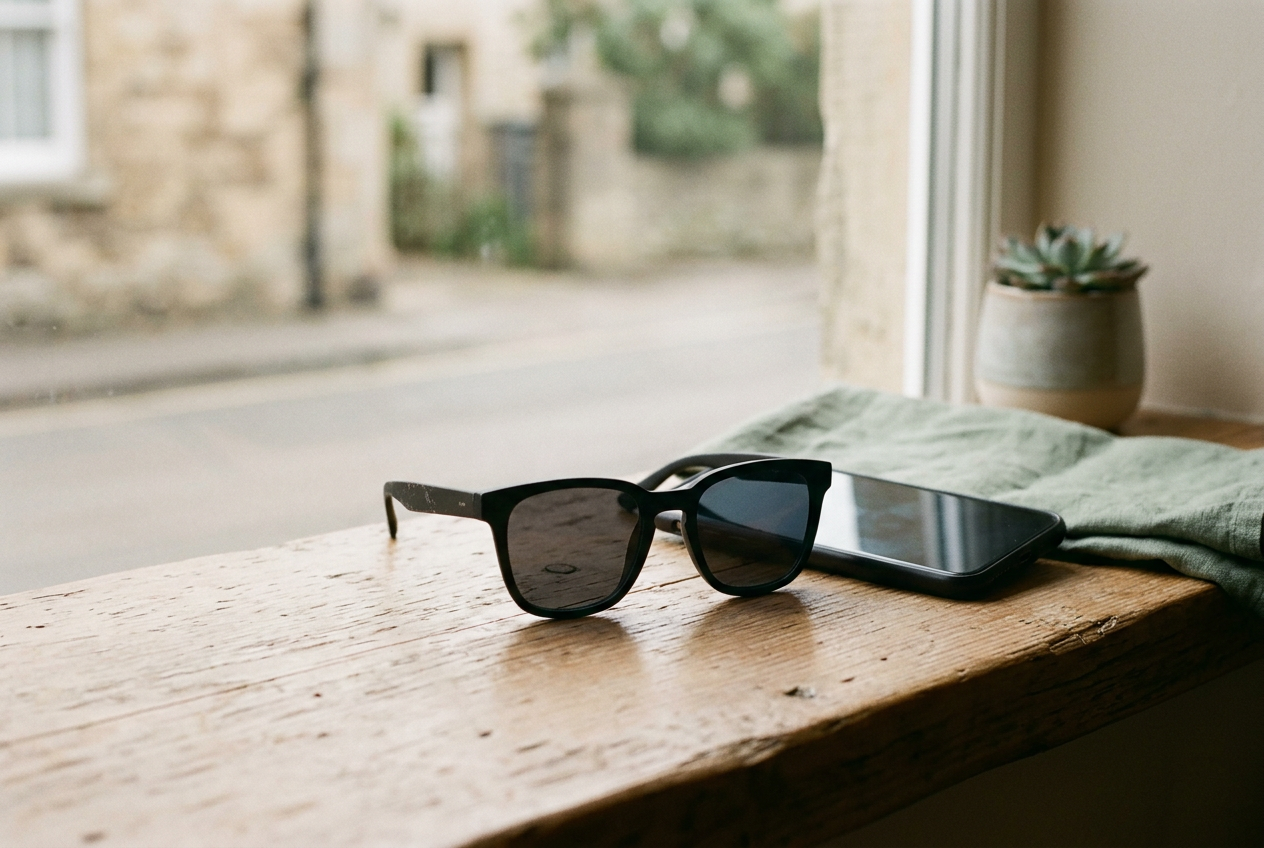
The fit test misses this problem
The matte black acetate frame looked settled on the face. Its soft-square lenses cleared the cheeks, the bridge stayed put, and the temples did not pinch. Acetate, a cellulose-based frame plastic, also gave the pair enough substance to feel polished rather than sporty. Nothing in the mirror suggested a problem.
Then I looked at my phone.
Through the neutral-gray polarized lenses, the display was clear in portrait position but became much darker as I turned it toward landscape. Near a quarter-turn, white areas picked up a faint colored cast. Tilting my head produced the same effect, which matters when a phone is mounted sideways for directions or held low while sitting outside.
That matte black pair is the useful case here because its frame fit passed an ordinary try-on. The failure appeared only when the lenses met another object used all day. Frame width, bridge comfort and lens color cannot tell you whether a particular pair will cooperate with your particular phone.
This is unisex advice. The screen effect comes from the lenses and display rather than the section of the store where the frame is sold, so the same test applies across wardrobes and frame sizes.
Why the screen changes as you turn it
A polarizing filter inside the lens blocks light traveling in a particular orientation. Reflected glare from a wet road, water or a shiny car hood tends to line up strongly in one direction, so the filter cuts much of that harsh brightness before it reaches the eye.
Phone displays also manage light through layers. Some use polarizing layers of their own, while protective glass, coatings and add-on screen protectors can alter what reaches the sunglasses. The polarizing axis, meaning the orientation in which the filter admits light, may align reasonably well with the display in one position and conflict with it after the phone rotates.
The result ranges from a mild loss of brightness to a screen that looks nearly black. Colored bands or rainbow patches can also appear, particularly where layered glass or plastic changes the light unevenly. Two phones may behave differently behind the same sunglasses, and a replacement screen protector can change a result that seemed fine before.
Lens price does not settle it. Polarization appears in budget frames, specialist outdoor eyewear and designer sunglasses, but spending more does not guarantee that the lens axis will suit the phone you own. A premium frame may offer better hinges, more refined finishing or a shape that fits beautifully. It can still darken the display at an inconvenient angle.
The quarter-turn test takes less than a minute
Use your own phone rather than a store display. Set the brightness where you normally keep it outdoors, open a mostly white page with some dark text, and put on the sunglasses. A notes screen, settings page or article works better than a colorful photo because changes in brightness and color are easier to see.
Hold the phone at your usual reading distance in portrait position. Keep your head level and look through the center of both lenses, not through the outer edge, where curved lenses can introduce extra distortion. Check whether the white background stays neutral and whether small text remains comfortable to read.
Now rotate the phone slowly toward landscape. Do not jump straight from one position to the other. The troublesome point may sit between them, and that intermediate angle is common when a phone rests on a table or moves in your hand.
Pause at roughly a quarter-turn. On the matte black soft-square pair, this was where the display became too dim for relaxed reading even though it had looked normal at the start. Continue through landscape, then rotate in the opposite direction. A small change is ordinary.
A near-black screen is a practical limitation.
Repeat the movement while tilting the phone slightly forward and back. After that, hold the phone still and tilt your head toward each shoulder. This second pass catches the same alignment problem from the other side, which is useful if you read while reclining or glance at a navigation screen from an off-center seat.
If you use a privacy filter or tempered-glass screen protector, leave it on for the test. It belongs to the setup the sunglasses must work with. Removing it may produce a cleaner result in the store while telling you little about daily wear.
Drivers should also check a parked car's dashboard and center display before committing to a pair. Some instrument panels and navigation screens shift in brightness or color through polarized lenses. Do this while the vehicle is stationary, with the display set as it is normally used.
Decide by the angle, not by perfection
A slight dimming in landscape is not an automatic rejection. The useful threshold is whether text remains readable without raising screen brightness, lifting the glasses or straightening the phone every time. Those small corrections become tiresome when directions, payment codes and messages are involved.
The matte black pair failed that threshold for frequent landscape use. It remained workable in portrait position, and the tint itself was calm and neutral, but the quarter-turn darkening asked too much of the wearer. A non-polarized version of a similar frame would have been the cleaner alternative for someone who spends much of the day moving between a phone and the street.
For another wearer, the same result could be acceptable. Someone who checks a phone briefly but spends hours near water may value glare control more than perfect screen consistency. The test is not designed to produce one universal answer. It reveals the exact compromise before the tags come off.
Also separate polarization from ultraviolet protection. UV protection limits exposure to ultraviolet radiation, while polarization controls directional glare; one feature does not prove the presence or quality of the other. Check the retailer's stated UV specification even if the lens performs well in the rotation test.
Polarization still earns its place outdoors
The screen drawback does not cancel the main benefit. On bright pavement after rain, beside water or around reflective vehicle surfaces, polarized lenses can remove the flat sheet of glare that an ordinary tinted lens merely darkens. Details become easier to distinguish because reflected brightness no longer washes across the whole view.
That difference is most persuasive when glare is part of the day rather than an occasional nuisance. A regular dark lens reduces the amount of light entering the eye, but it does not selectively target reflected glare. Polarization does, which is why a pair that behaves imperfectly with a phone can still be the better tool for driving in daylight or spending time near water.
There is a middle route. Keep polarized sunglasses for high-glare days and choose a non-polarized pair for city errands, travel days built around navigation, or work that requires constant screen checking. Buying two pairs is not necessary for everyone, but it makes more sense than paying extra for polarization that repeatedly interferes with the object in your hand.
Before leaving the counter, return once more to the original viewing position. If the display recovers as the phone comes upright, the issue is alignment rather than an underpowered screen. That final movement is the point of the test: frame fit tells you how sunglasses sit, while rotation shows how they work.
Questions people ask
Do all polarized sunglasses black out phone screens?
No. The result depends on the orientation of the lens filter, the display construction and the angle between them. Some combinations show only mild dimming, while others become nearly black around a quarter-turn. Test the exact sunglasses with the exact phone you carry.
Can a screen protector cause rainbow colors?
It can contribute. Tempered glass, privacy filters and plastic protectors may change how light passes through the display, revealing colored patches through polarized lenses. Leave the protector installed during the in-store test, since removing it creates a setup you will not use day to day.
Are polarized sunglasses worth it if I use my phone outdoors?
They can be, especially around water, wet roads or other reflective surfaces where glare makes details harder to see. Keep the pair if your phone remains readable at the angles you use most. Choose non-polarized lenses if navigation, photography or frequent landscape viewing becomes frustrating.
Does a darker lens mean stronger polarization?
No. Lens tint controls overall visible brightness, while polarization filters directional glare. A very dark non-polarized lens may still show strong reflections, and a lighter polarized lens may reduce them. Evaluate tint comfort outdoors, then use the phone rotation test to judge screen compatibility separately.
One update a day
Today's fashion update, in your inbox
One fashion update each morning — no hype, no filler, just pieces worth wearing.