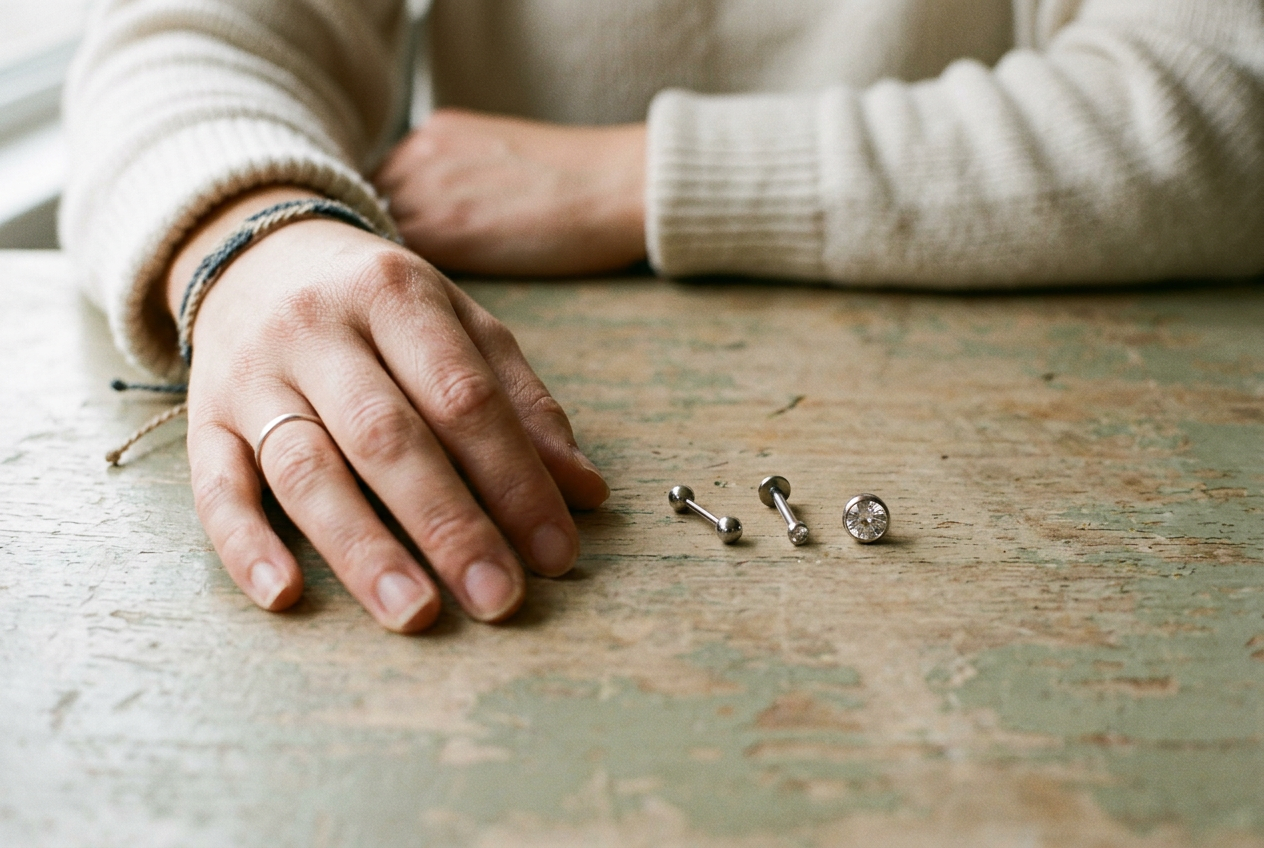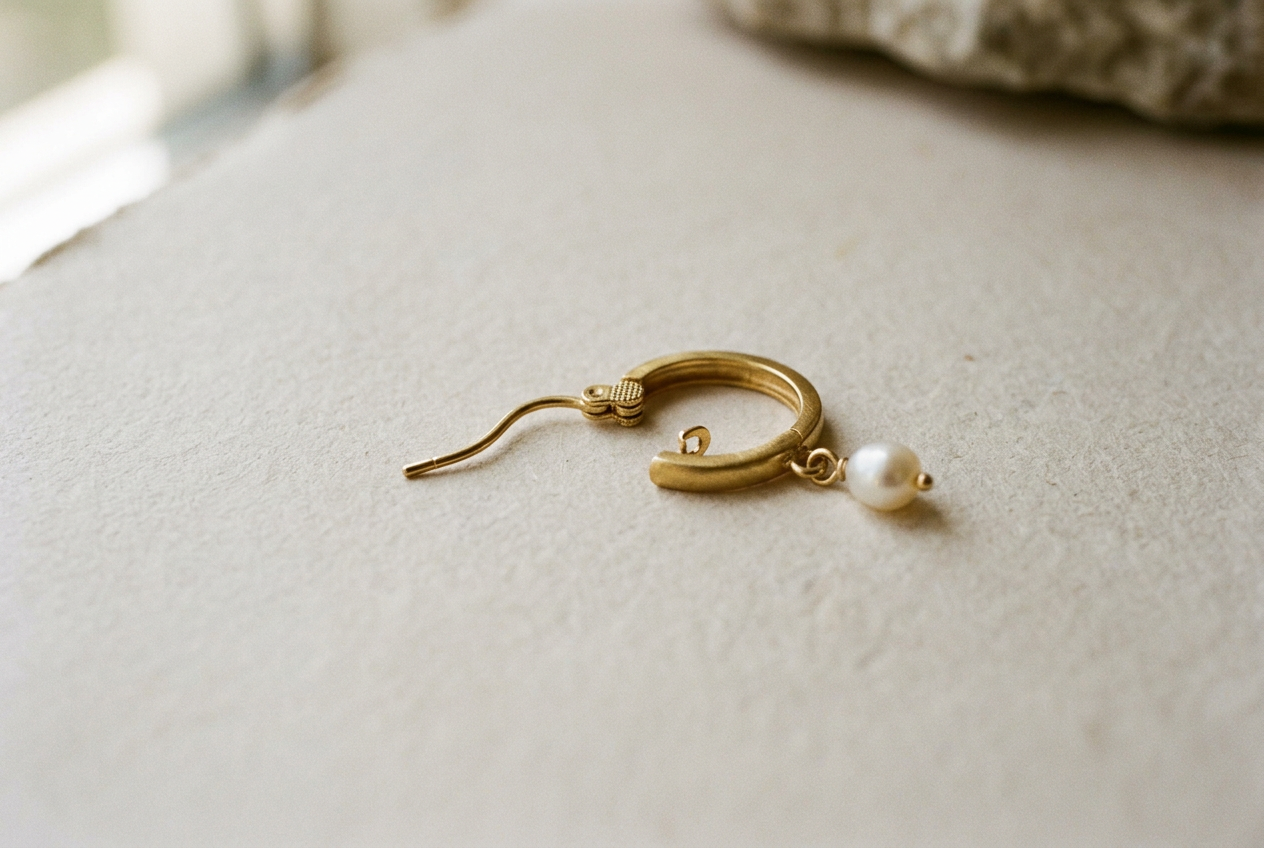
Side Sleepers Need a Low Setting, Not Just a Flat Back
A flush disc can keep an earring from poking behind the lobe, but a tall stone setting still presses from the front. Here is how to spot the difference before buying.
September 9, 2026 · 7 min read
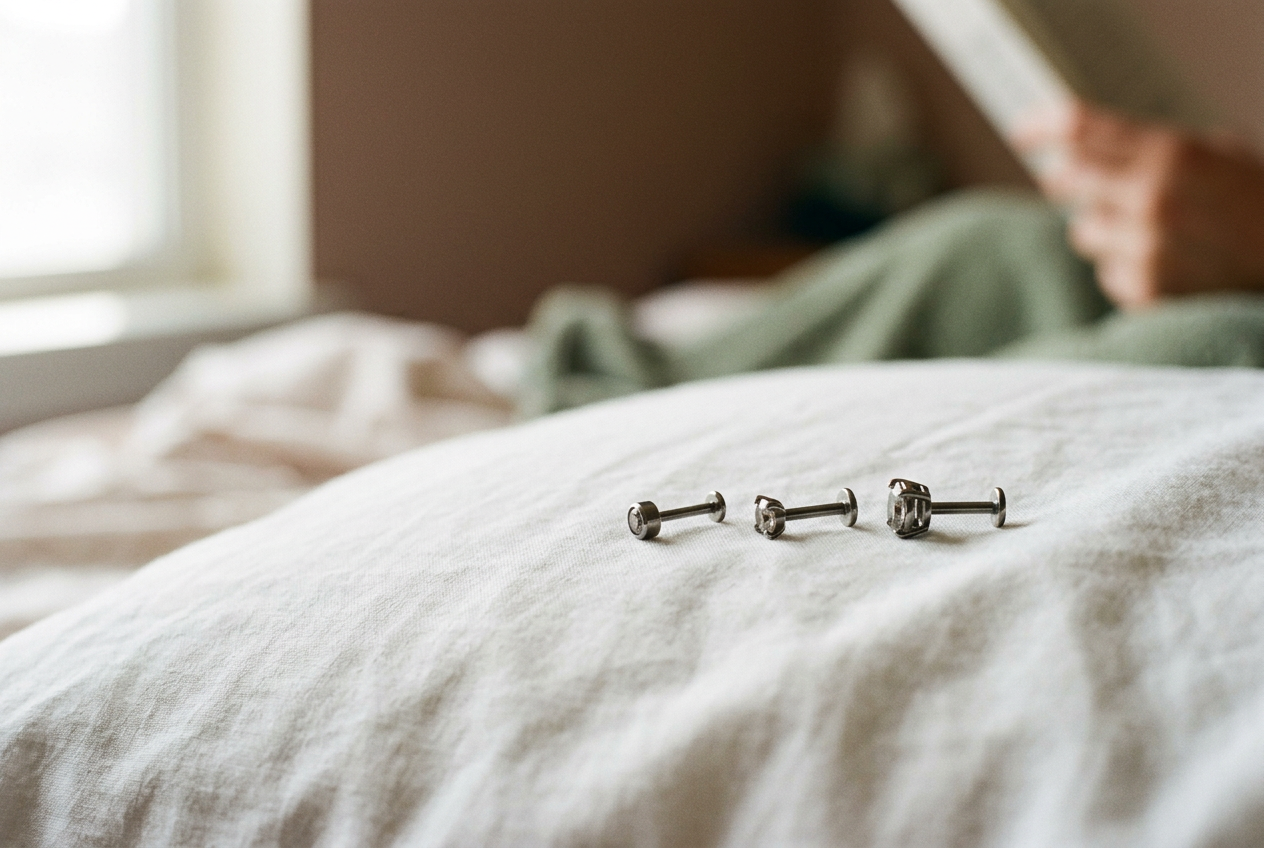
The earring that settled this was a 3 mm round cubic-zirconia stud in titanium, worn in a healed second-lobe piercing for a week. Its backing was a smooth disc. The stone sat inside a low metal rim, with very little space between the underside of the setting and the ear.
That small front detail mattered more than expected. The stud stayed quiet against a cotton pillowcase, while comparable round tops in taller prong and open basket settings created a distinct pressure point during side sleeping, even though every earring had a flush disc behind the lobe.
A flat back earring, meaning the post’s backing sits flush against the earlobe, solves the familiar poke from a butterfly clutch or exposed post. It does not make the whole earring flat. The decorative front can still rise several millimeters, tilt under pressure, or catch bedding at an exposed corner.
This is unisex fit advice. Ear anatomy and piercing placement matter here, not the wardrobe attached to them.
Flat at the back can still be tall at the front
Think of an earring as two contact points. The disc controls what touches the skin behind the ear. The setting controls what meets the pillow in front.
On the 3 mm test stud, the low bezel spread pressure across a smooth, rounded surface. A bezel is a metal rim that surrounds the stone’s edge. The rim also covered the cubic zirconia’s sharpest transition, so neither the stone nor its mount offered much for fabric to catch.
A taller setting behaved differently. When the head pressed into the pillow, the force traveled through a smaller area and pushed the post at an angle. The backing remained flush, but the piercing channel still felt the leverage. This is the fit quirk shoppers miss when a product page emphasizes only the rear disc.
Placement changes the result. A low setting in a fleshy lobe piercing usually has more room than the same setting tucked into a crowded upper-lobe stack, where neighboring jewelry can make the front sit crooked. A small stud can also become irritating when its post is too long, because the extra space lets the entire earring seesaw between the pillow and backing.
The setting shapes pressure and snagging
Low-profile bezel settings give side sleepers the clearest advantage. Their outer edge is continuous, and the stone usually sits close to the base, although product photos still need checking because some bezels are built on raised cups. The 3 mm titanium pair remained the most stable option in the comparison. Its modest size helped, but the smooth transition from base to rim did most of the work.
The tradeoff is visual. A bezel adds a visible border around the stone, which can make a tiny gem read as a neat metal dot rather than a nearly floating flash of light. It may also cover more of the stone’s edge. For an everyday stack, that contained shape often looks intentional; shoppers seeking maximum sparkle may find it restrained.
Prong settings use small metal claws to hold a stone. They expose more of its surface and can look finer from straight on, which explains their popularity in delicate ear stacks, but the same open construction creates potential contact points around the perimeter. Rounded, closely finished prongs may wear comfortably. High claws, uneven tips, or visible gaps beneath the stone are more likely to graze a pillowcase or knit blanket.
Height is the deciding factor. A shallow prong setting whose base rests close to the ear may be a better sleep earring than a bulky bezel raised on a pedestal. Setting names are useful clues, not guarantees.
Basket settings deserve the closest side view. A basket is an open-sided mount that holds the stone above its base, often with a rail or framework beneath it. That lift allows light to enter and can make a small stone appear more prominent, yet it also creates a taller lever on the post. In the comparison, the basket top was the easiest to feel through the pillow and the quickest to catch when drawn lightly across cotton fabric.
For daytime jewelry, that may be an acceptable trade. For a piece intended to stay in through showers, sweaters, sleep, and rushed changes, extra architecture has to earn its place. A high basket rarely does for a committed side sleeper.
Read the profile photo before the front view
Start with the side image. Ignore sparkle for a moment and look for the distance between the flat base of the decorative top and its highest point. The useful measurement is total front projection, not just stone diameter. A product can list a tiny 2 mm or 3 mm gem while leaving out the mount that raises it away from the ear.
The best documentation shows the earring from the side beside a dimension diagram. Some brands publish top width and height separately; others show only post length or overall dimensions, so check which part each number describes rather than assuming the smallest figure is the profile.
If no height is listed, enlarge the side photo and examine the silhouette. A low-profile top looks compressed, with little daylight beneath the stone and a base that appears nearly as wide as the decorative face. A tall top has visible walls, an elevated basket, or a narrow stem connecting the ornament to the post. Perspective can distort scale, but the construction remains legible.
Then inspect the perimeter. Smooth metal around the full circumference generally slides across bedding more easily than separated claws or pointed motifs. Pavé surfaces, in which tiny stones are set closely across metal, need sharp photography because raised beads can feel rough even when the overall top is shallow.
Product photos taken only from the front are insufficient for sleep jewelry. Ask customer service for the setting height or a true side image before paying solid-gold or genuine-gem prices. A return policy also has practical value here, since two ears can react differently to the same profile.
The 3 mm bezel remains a useful reference point: compact face, continuous rim, almost no visible lift. A candidate does not need to copy it exactly. It should look similarly uneventful from the side.
Post length can amplify a tall setting
A flush disc works best when the post is fitted to the ear. Wearable post length is the space between the back of the decorative top and the front of the backing. Too little room can compress the lobe. Too much leaves a gap that lets the earring tilt, slide, and catch.
Threadless flat backs, whose decorative top presses into a hollow post with a bent pin, often allow tops and posts to be purchased separately. That makes it possible to keep a favorite front while changing the post length, provided the components are compatible. Internally threaded versions screw the decorative end into the post and offer similar flexibility within their own system.
A shorter post will not turn a high basket into a low setting. It can reduce movement, though, which may be enough for a shallow prong top that otherwise fits well. The rear disc also needs enough diameter to feel stable without crowding nearby piercings.
Material is a separate decision. Implant-grade titanium documented to an applicable material standard is light and often costs less than solid gold, while solid 14-karat or 18-karat gold offers a warmer color and a higher price. A material label cannot compensate for rough prongs, excessive front height, or the wrong post length.
The practical buying threshold
For an earring meant to stay in overnight, prioritize a side-view measurement over a larger stone or an elaborate setting. Choose a low bezel when comfort has to be predictable. Consider a shallow, well-finished prong top when exposed sparkle matters and returns are easy. Keep a raised basket for daytime unless the product documentation proves that its total profile is unusually compact.
Run one final check after the earring arrives. In a healed piercing, fasten it with a small amount of breathing room, press a clean fingertip gently across the front, and notice whether the top stays centered or rocks. Draw clean cotton fabric lightly across its surface. Any repeated catch at this stage is likely to become more noticeable against bedding.
Questions people ask
Are all bezel-set flat back earrings comfortable for sleeping?
No. A bezel can still sit on a raised cup or narrow base, creating more front projection than its smooth outline suggests. Check a true side photo and the setting-height measurement. The most sleep-friendly version has a broad base, a rounded perimeter, and little visible space beneath the stone.
Can a shorter post fix pressure from the front of an earring?
A correctly fitted post can reduce rocking and stop the top from leaning into the pillow, but it cannot remove the height of a tall basket or prominent stone. If the front remains uncomfortable after the post fit is corrected, switch to a lower setting rather than tightening the backing against the ear.
Do flat back earrings work for a fresh piercing?
Flat backs are commonly used for initial piercings, but fresh tissue needs room for swelling and professional assessment. Do not apply the close-fit test used for a healed lobe. Ask a qualified piercer to choose the material, post length, backing size, and setting shape, then leave the jewelry undisturbed as directed.
Is a larger backing disc better for side sleeping?
A broader disc can distribute pressure and stabilize the post, provided it fits the available space behind the ear. Oversized discs may overlap neighboring piercings or press into ear folds. Compare the disc diameter with your placement, then pair it with a low front setting rather than treating the backing as the only comfort feature.
One update a day
Today's fashion update, in your inbox
One fashion update each morning — no hype, no filler, just pieces worth wearing.