A Tiny Pin Bend Keeps Threadless Earrings From Falling Out
A threadless end stays in through pressure, not threading. Here is how to set a shallow bend, recognize poor tension, and remove a stubborn flat back without reaching for pliers.
August 31, 2026 · 7 min read
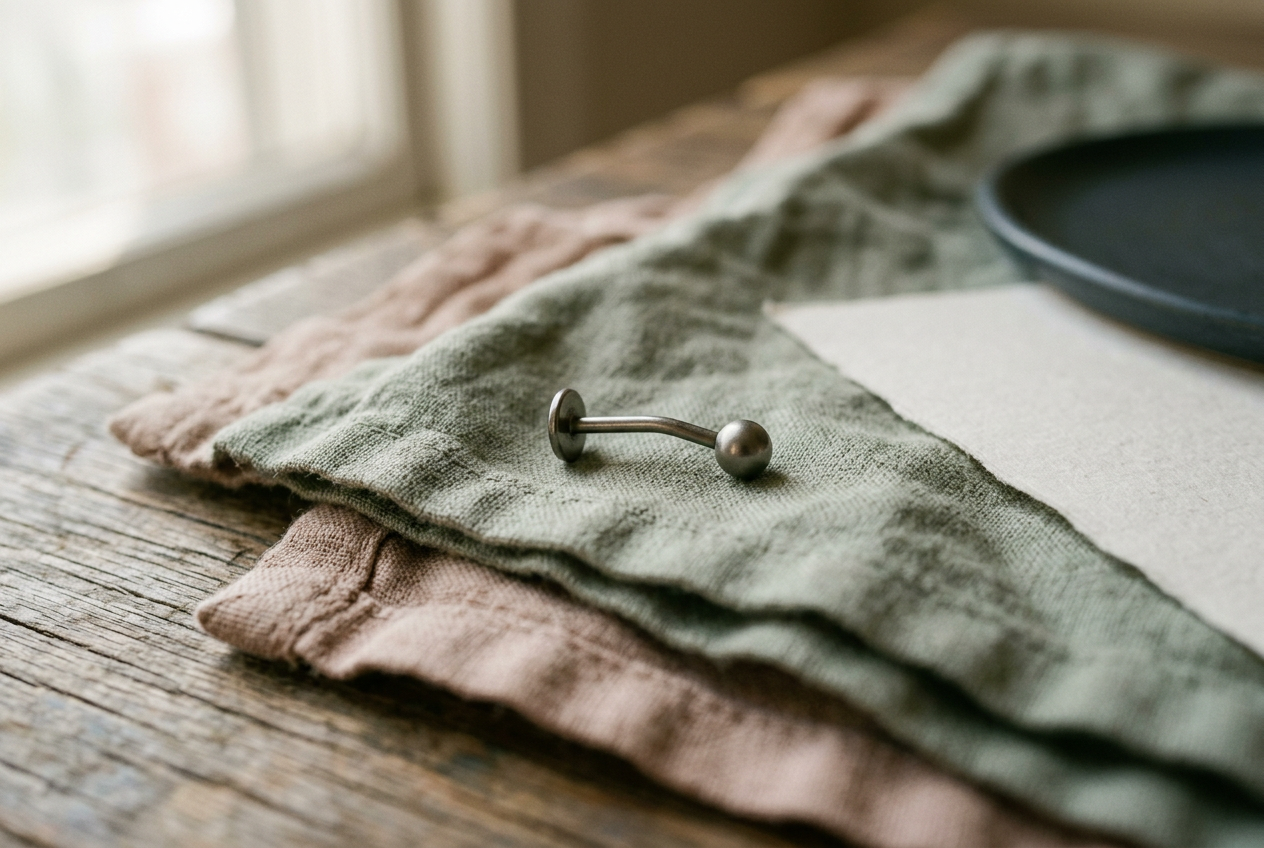
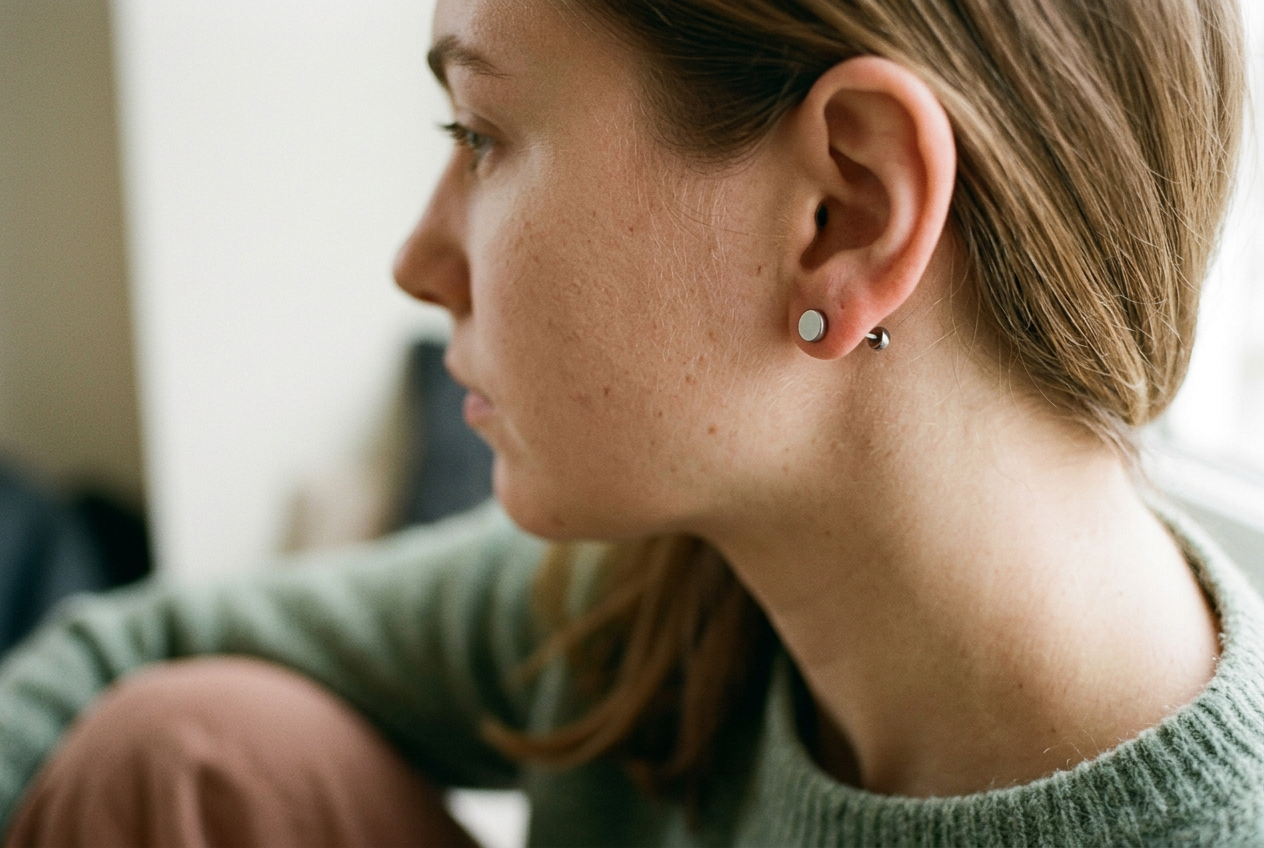
The working example here is a 16-gauge implant-grade titanium flat back worn for one week in a healed second-lobe piercing, including overnight. A flat back earring, meaning the backing sits flush against the ear, replaces the usual butterfly clutch with a smooth disc.
Its polished ball end stayed put for the first few days, then came away during a light hand check. Nothing had unscrewed. The pin was nearly straight, so there was too little pressure inside the hollow post to hold it.
That small failure is the useful part. Threadless jewelry can look closed while barely gripping, and its front may rotate even when the fit is sound, which makes visual checks and casual twisting unreliable. The bend supplies the hold.
This fitting advice is unisex and applies to healed piercings across wardrobes. It concerns jewelry mechanics, not piercing aftercare or a sore, swollen, or newly pierced ear.
The bend is the fastening mechanism
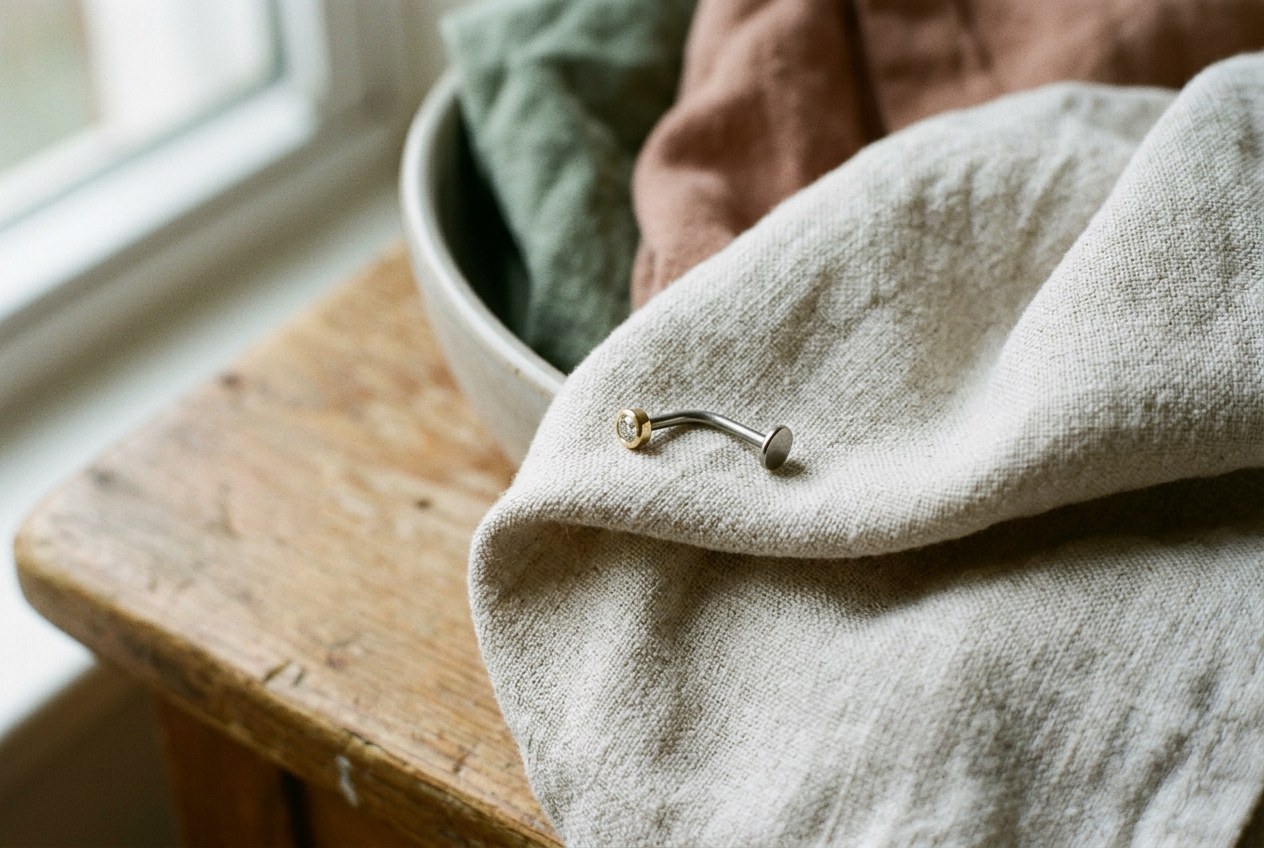
A threadless labret post, a hollow post with a flat disc at the back, accepts a slender pin attached to the decorative front. Unlike a threaded end, it has no screw cut into either piece. The pin presses against the inner wall of the post instead.
A nearly straight pin touches too lightly. A sharply bent pin can bind at the opening, scrape the inside, or become so difficult to pull free that the jewelry stops being convenient. Between those extremes, a shallow bend acts like a spring: the post nudges the pin toward straight, while the pin pushes back against the post wall.
The amount is deliberately small. There is no useful universal angle because pin thickness, post construction, manufacturing tolerances, and the compatibility of the two pieces all affect the hold. A pin that works in one post may feel loose or excessively tight in another, even when both pieces are sold for the same nominal gauge.
Gauge describes the thickness of the post, with a lower gauge number indicating a thicker post. It does not, by itself, guarantee that every threadless front will fit every post. Matching components from one jewelry system removes some uncertainty.
On the titanium test earring, the right bend was visible when the loose end was viewed from the side, but it never looked hooked. The pin remained mostly straight. Its free tip sat just off the original center line.
Set the tension in small moves
Work over a tray or folded towel so that the front cannot bounce into a sink or floor gap. Dry fingers matter more than force; a clean paper towel or a pair of snug disposable gloves can add grip without marking polished metal.
1. Test the pin straight first. Slide the front into the post partway. Do not push it fully home yet.
If the pin already meets firm resistance, confirm that the pieces belong together rather than assuming they need more pressure.
2. Use the post as the bending point. With roughly half the pin inside, hold the post steady and angle the decorative front a little to one side. This puts a shallow bend in the exposed pin without folding it into a hard kink.
Keep pressure away from the joint where the pin meets the decorative end, which is the vulnerable point on a tiny front.
3. Push the pieces together by hand. Support the flat disc with one fingertip and press the front inward with another. The movement should feel controlled and increasingly snug, followed by a secure seated position.
A dramatic snap is not required, and sound is a poor test on something this small.
4. Check, then adjust once. Hold the disc and give the front a light, direct pull. If it begins sliding out with little effort, remove it and add a fraction more bend.
Repeated back-and-forth bending fatigues a fine pin, so several large corrections are worse than one conservative adjustment.
The titanium ball needed one small correction after its loose check. Once reset, it resisted a deliberate fingertip pull yet still came apart by hand. That middle result is the target. Secure does not mean immovable.
What too little tension feels like
An under-bent pin often inserts with almost no resistance from start to finish. The front may creep outward during dressing, after catching on a knit, or while being handled, leaving a visible gap between the decoration and the ear. A light pull can then remove it without a clear increase in force.
Rotation is less informative. A secure threadless end may turn inside the post, especially when the decorative front is round and easy to spin, so tightening it clockwise achieves nothing. There are no threads to advance. The direct pull test tells you more.
Do not compensate for a loose fit by pushing the front against the ear until the tissue is pinched. Post length controls how closely the flat back sits, while pin tension controls whether the front remains in the post. A shorter post is not a fastening repair.
If another slight bend does not improve the grip, suspect mismatched or worn components. Trying a compatible end in the same post, or the original end in a known compatible post, can identify which piece has lost tolerance. Replacing one component is more sensible than repeatedly reshaping the pin.
What too much tension feels like
An over-bent pin catches immediately or stops before the decorative front reaches the post. The temptation is to squeeze harder. Skip it. Force can score the opening, distort the hollow post, bend the pin into a sharper angle, or stress the connection beneath a stone setting.
Excess tension can also reveal itself later. If ordinary fingertip pressure cannot separate the pieces, or the decorative end rocks from side to side while the pin remains trapped, the bend may be too aggressive. A hard kink that stays after removal is another warning.
Remove the front and reduce the bend only if the pin is intact and the movement can be made gently. If it has a crease, appears loose at its attachment point, or requires pliers to move, replacement is the better tradeoff. Tiny threadless ends cost more than basic butterfly-back studs, but damaging a post and a front together costs more than retiring one compromised component.
Remove it without unscrewing
Threadless jewelry pulls apart. Hold the flat disc behind the ear with one hand, grip the decorative front with the other, and draw the pieces in opposite directions along the line of the post. A tiny side-to-side motion can help break the initial friction, but continuous twisting does not release a hidden mechanism.
The 3 mm ball on the test earring was harder to grasp than the post was to release. A folded paper towel solved that. Long nails made the job less precise because they pushed against the ear before the fingertips reached the jewelry, while dry, gloved fingertips gave direct contact with both pieces.
Avoid household pliers. Their jaws can flatten a hollow titanium post, scratch gold, loosen a set stone, or apply far more force than the pin needs. If a correctly gripped end will not move, a professional piercer has tools designed to hold small jewelry securely and can assess the fitting without turning removal into a metalworking job at home.
Threaded labrets remain the practical alternative for someone who dislikes this pressure-fit judgment. They take longer to fasten and their tiny ends can still be awkward, but their screw action gives a clearer sense of closure. Threadless fronts are faster once their tension is set. The tradeoff is that the bend must be checked whenever an end and post are newly paired.
Questions people ask
How often should I check a threadless earring end?
Check a newly paired front and post before wearing them, then again after dressing or sleep if the fit was recently adjusted. Hold the flat disc and use one light, direct pull. Constant tugging adds wear and gives little extra information once the tension has proved stable.
Can I bend a threadless pin more than once?
A small correction is reasonable when the pin remains smooth and firmly attached to its decorative end. Avoid repeated bending in opposite directions, which can fatigue the metal. Replace the front if the pin develops a hard crease, wobbles at its joint, or no longer holds a predictable curve.
Do flat back earrings work for a fresh piercing?
Flat backs are commonly used as initial jewelry, but fitting a new piercing is not the same job as adjusting jewelry in a healed lobe. Have a professional piercer choose the material, gauge, post length, and tension, particularly while extra room may be needed for early swelling.
Why does my threadless earring spin if it is secure?
The pin relies on pressure against the post wall, not threads that lock its rotational position. A front can therefore turn while still resisting a direct pull. Test separation rather than rotation, and do not keep twisting clockwise in an attempt to tighten it.
One update a day
Today's fashion update, in your inbox
One fashion update each morning — no hype, no filler, just pieces worth wearing.