An 18g Flat Back Earring Is Not the Same Fit as 16g
The 0.2-millimeter difference between 18g and 16g posts is easy to miss on a product page. At the piercing, it can mean pressure, movement, or the wrong replacement entirely.
August 15, 2026 · 8 min read

Use one ordinary stud as the fitting case: an implant-grade titanium threadless flat back worn in a healed second-lobe piercing. A flat back earring, meaning the post’s backing sits flush against the ear, looks almost identical whether its post is 18g or 16g. The difference hides in the shaft.
That small distinction controls whether a replacement slides in with familiar resistance, presses against the piercing channel, or feels oddly loose after several days. It applies across women’s and men’s jewelry, so this is genuinely unisex sizing rather than a category determined by styling.
Gauge measures the post, not the visible earring
Gauge is the thickness of the post that passes through the piercing. In the sizing used for most body jewelry, the number runs backward: 18g is about 1.0 millimeter thick, while 16g is about 1.2 millimeters thick.
The lower gauge number belongs to the thicker post.
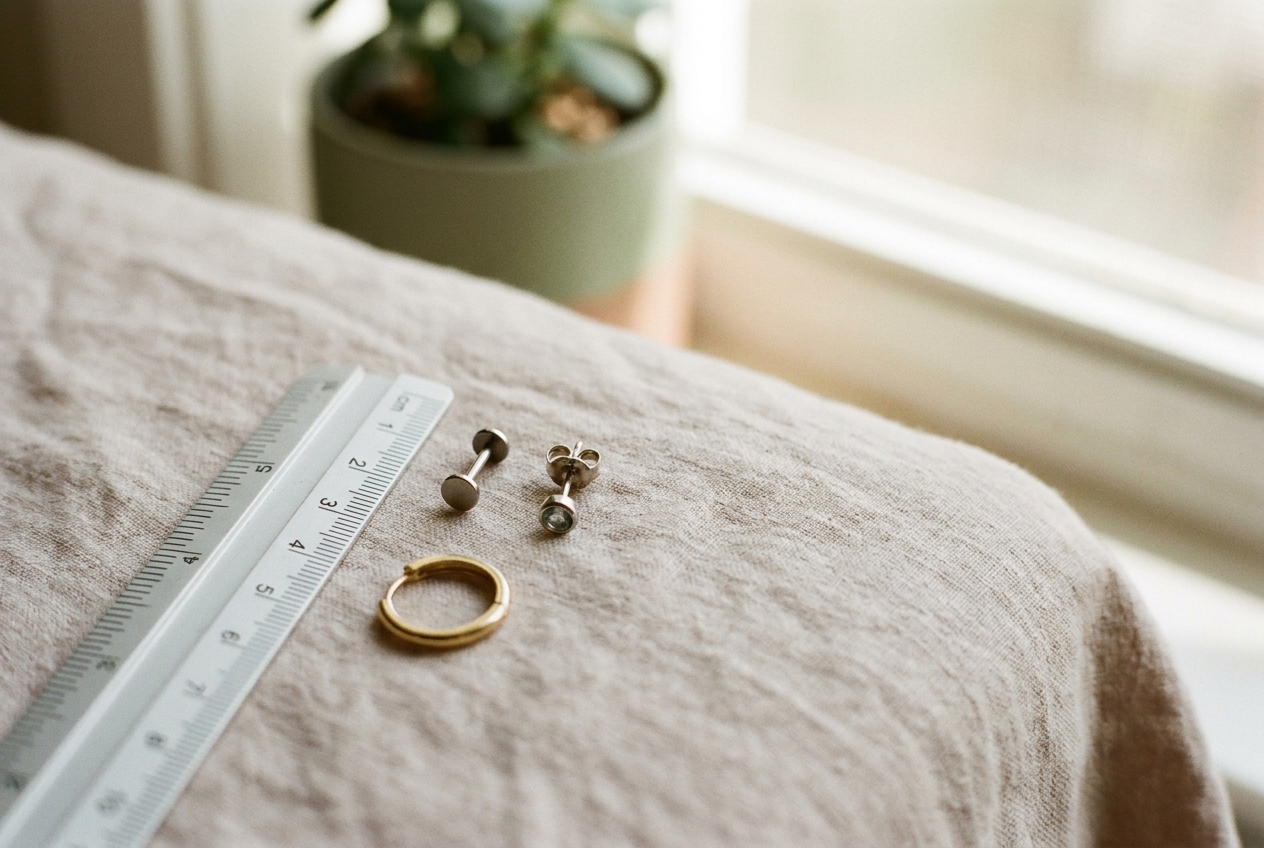
Two-tenths of a millimeter looks negligible beside a ruler. At the ear, it changes how much space the post occupies along the full piercing channel, which is why the two sizes should not be treated as automatic substitutes even when the decorative ends and backing discs appear identical.
Return to the titanium stud. Its tiny front might be compatible with several threadless posts, and its flat disc might have the same diameter in both listings, but neither detail identifies the gauge. The shaft does. A larger disc can spread pressure across the back of the ear, while a smaller one may tuck into a tight stack more neatly, yet disc size does not make a 16g post fit an 18g piercing.
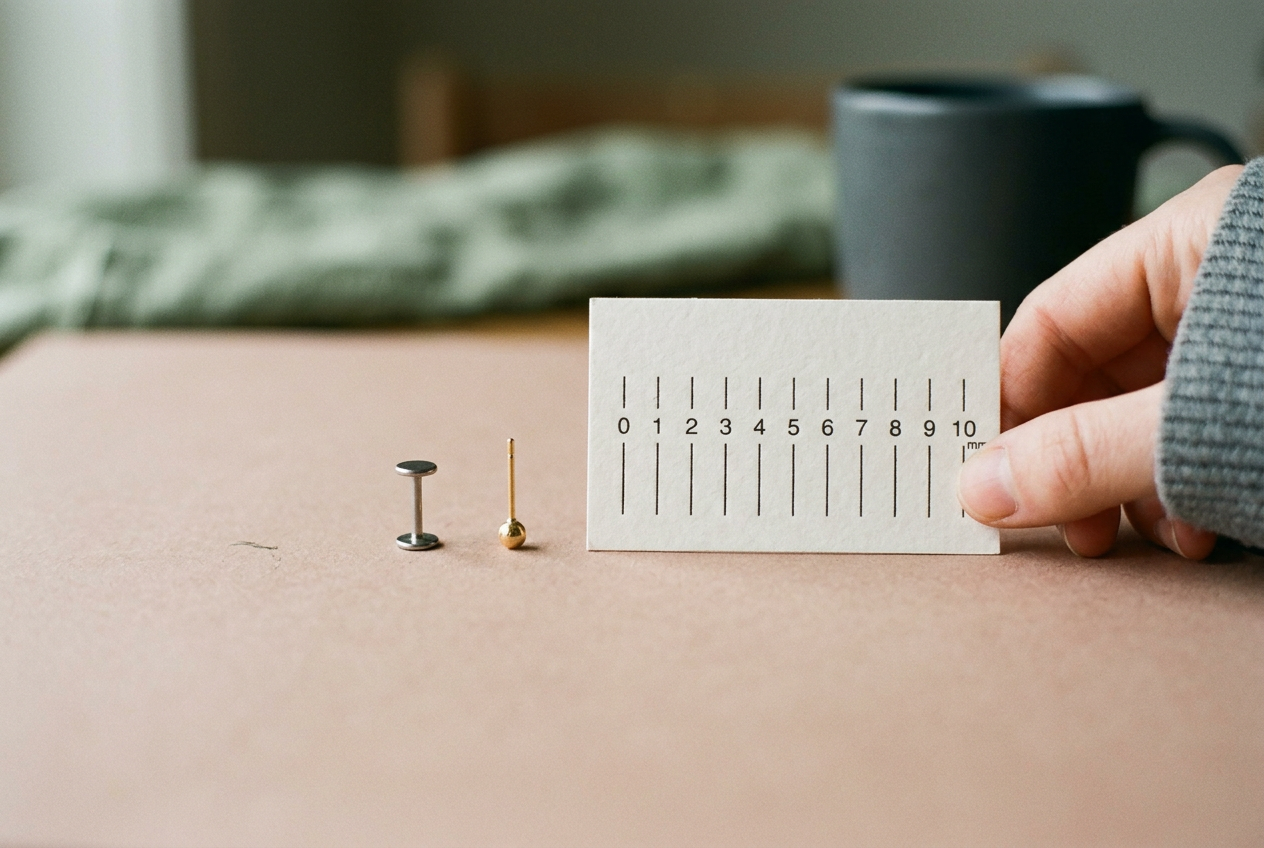
Post length is another separate measurement. It describes the wearable distance between the decorative front and the backing, although retailers may illustrate that distance slightly differently. A post can have the correct gauge and still pinch because it is too short, or project and tilt because it is too long.
Why a 16g post can resist an 18g piercing
A healed piercing that has been wearing an 18g post may be accustomed to a shaft about 1.0 millimeter thick. Replacing it with a 16g post asks the channel to accept roughly 1.2 millimeters.
That is an increase in thickness, not a naming variation.
Do not use the threaded or threadless end as a handle to push through resistance. Pressure can scrape or irritate the channel, and swelling can then make a correctly chosen post length feel too tight. If the thicker post does not enter with the ease expected from a settled piercing, stop rather than treating discomfort as part of ordinary jewelry changing.
A professional piercer may determine that a well-healed piercing can move to a thicker gauge, but that is an intentional sizing change. It is different from ordering 16g because the preferred 18g finish was unavailable and assuming the ear will adjust.
The titanium stud in our example could look perfectly calm from the front while the thicker replacement presses inside the piercing. The visible crystal, ball, or gold shape offers no useful warning. Fit trouble may first show up as tenderness, warmth, persistent redness, or a post that becomes difficult to move. Those symptoms are reasons to stop experimenting and seek qualified help, not cues to force the jewelry farther.
Why an 18g post may feel unstable in a 16g channel
Moving the other direction often feels easier at insertion because the post is thinner. Easier does not always mean compatible.
An 18g post placed in a piercing accustomed to 16g leaves more room around the shaft. In a mature lobe piercing, that may cause no immediate problem, but the stud can angle more readily, move during cleaning, or feel less anchored when the front is relatively heavy. Over time, a piercing can also tighten around thinner jewelry, which may make returning to 16g less straightforward.
This matters in a curated ear, where several small fronts are aligned closely. A loose post can let one end lean into its neighbor even though the backing itself stays secure. Choosing a shorter post will not correct the mismatch; shortening changes front-to-back room, while gauge changes shaft thickness.
For the second-lobe titanium stud, an 18g replacement in a known 16g channel might still stay in place because the decorative end and disc are wider than the opening. That only addresses retention. It does not restore the supported feel of the original 16g shaft.
Check the jewelry you already own
The best evidence is the original order confirmation, packaging, or product page. Look for a line that identifies the post as 18g, 16g, 1.0 millimeter, or 1.2 millimeters.
Check the selected variant rather than the general product description, since the same decorative end may be sold with several post options.
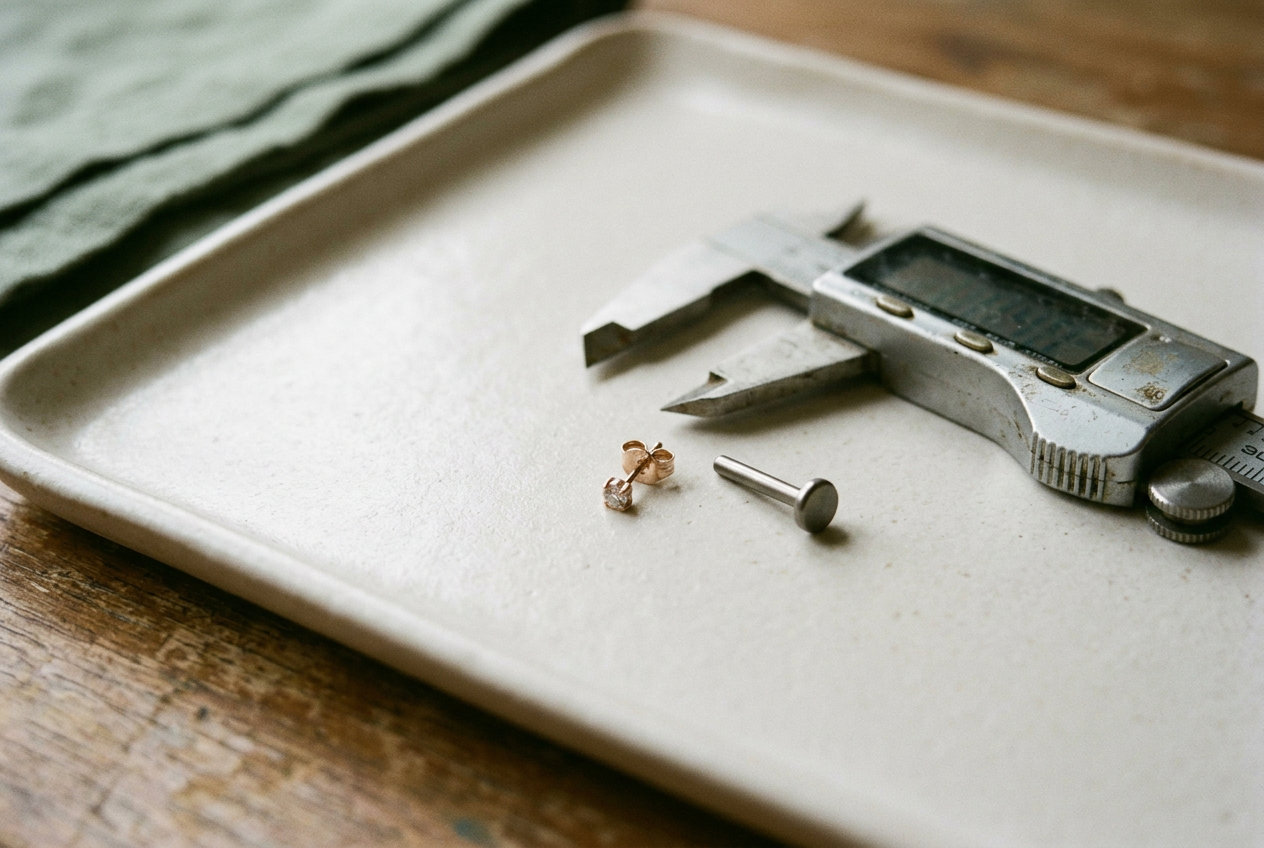
If the record is gone, a digital caliper can measure the outside diameter of a clean, removed post. A ruler is too coarse for a dependable call between 1.0 and 1.2 millimeters, and measuring the backing disc will answer the wrong question.
Do not remove jewelry from a fresh or unsettled piercing merely to measure it; a professional piercer can assess the post and whether changing it is appropriate.
Also confirm the connection system. A threadless post is hollow, and a slightly bent pin on the decorative end holds through tension. An internally threaded post has threading inside the shaft, with the decorative end screwing into it. Gauge alone does not guarantee that an end from one system, thread size, or manufacturer will fit another post.
This is where the titanium stud becomes a useful shopping filter. Its replacement listing must match the known gauge first, then the wearable length and connection. Only after those points line up should disc diameter, metal color, and front design decide the purchase.
Order the post before replacing the whole earring
When the decorative end is removable and compatible, buying a replacement post can cost less than replacing the complete earring. Implant-grade titanium, meaning titanium sold to a recognized implant-material standard, usually sits at the practical end of this decision because the post can be plain and largely hidden. Solid-gold posts and ends occupy a higher price band, especially when the visible piece includes stones or detailed construction.
Compatibility deserves more attention than the saving. Some brands publish separate charts for post gauge, threadless pin fit, wearable length, and end compatibility. Read those charts as specifications, not suggestions. A listing that says only “standard post” does not provide enough information to replace a known 18g or 16g piece with confidence.
For a settled second-lobe piercing already comfortable in the 18g titanium stud, the lowest-friction choice is another 18g post in the same length and connection system. If the original post protruded, snagged hair, or allowed the front to tip, a shorter length may improve the fit once a piercer has confirmed there is room. Keep the gauge unchanged while solving the length problem.
Fresh piercings require different judgment because swelling allowance, placement, and healing stage affect the post choice. This explainer is a shopping and sizing walkthrough, not medical advice. Leave difficult changes to a qualified piercer, and seek appropriate medical care for substantial swelling, spreading redness, severe pain, or discharge that concerns you.
Questions people ask
Can
I put a 16g flat back in an 18g piercing?
A 16g post is thicker, about 1.2 millimeters compared with roughly 1.0 millimeter for 18g. It may not pass comfortably through a piercing accustomed to 18g.
Do not force it; moving to a thicker gauge should be treated as an intentional change and discussed with a professional piercer.
Will an 18g earring fall out of a 16g piercing?
The front and backing may keep it from falling through, but the thinner shaft can feel loose, angle under a heavier end, or move more than the original 16g post. A mature piercing may also tighten around the smaller gauge, so switching back later may require help.
How can
I tell whether my flat back is 18g or 16g?
Check the receipt, packaging, or selected product variant for 18g, 16g, 1.0 millimeter, or 1.2 millimeters. If no record remains, measure the clean post with a digital caliper or ask a piercer.
The front design and backing-disc diameter do not reveal the gauge.
Do all threadless ends fit 18g and 16g posts?
No. Some threadless ends work with several compatible hollow posts, but fit depends on the pin and the manufacturer’s system, not gauge alone. Confirm the brand’s compatibility guidance before ordering. Internally threaded ends require the correct thread pattern as well as an appropriate post gauge.
One update a day
Today's fashion update, in your inbox
One fashion update each morning — no hype, no filler, just pieces worth wearing.