Your Flat Back Earring May Be Too Small to Sit Straight
A tiny backing can press into a soft lobe and let the stud tip forward. One extra millimeter of disc width may steady it, though the edge becomes easier to see.
August 10, 2026 · 7 min read
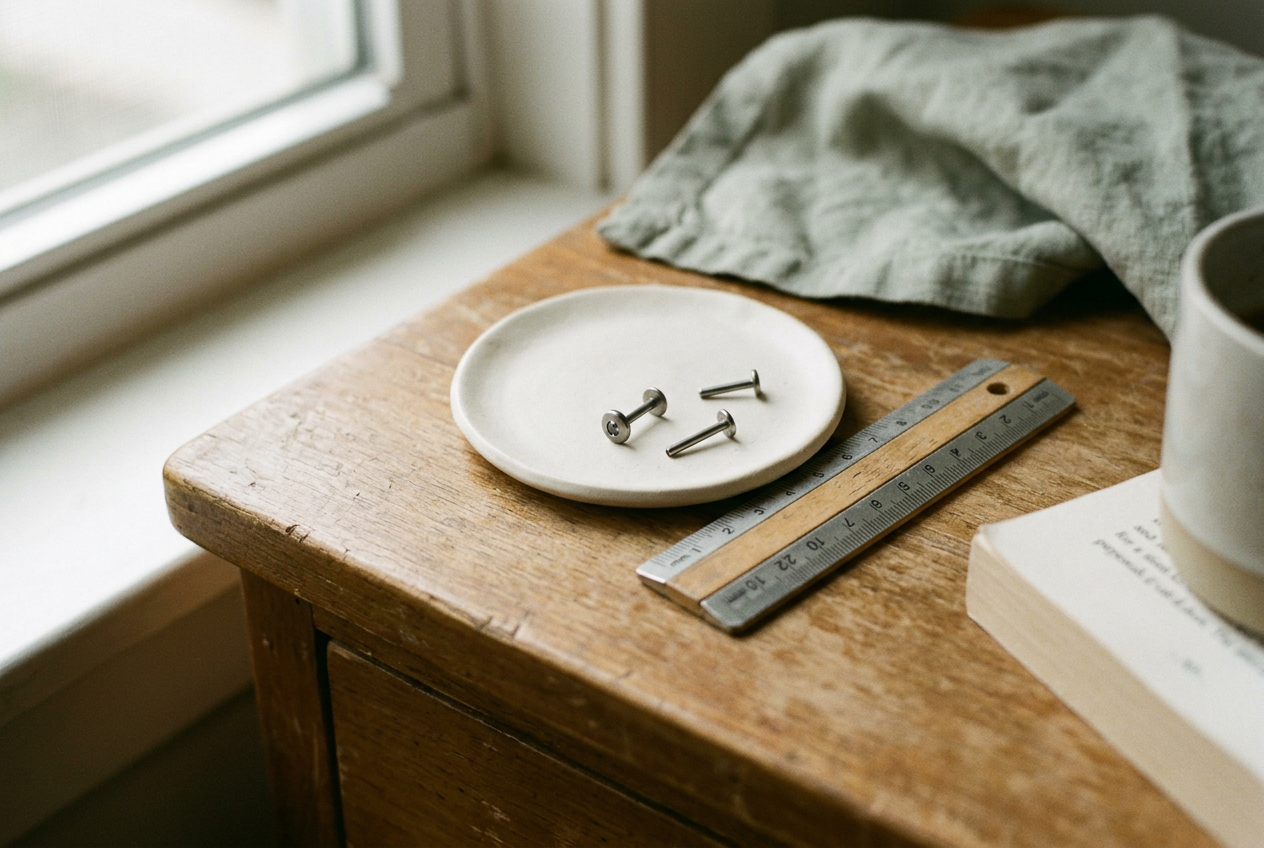
A 2-millimeter titanium ball looked centered when the earring went in. By the end of the day, it pointed slightly downward, while the 3-millimeter disc behind the lobe had pressed a distinct circle into the skin. The post was not loose. The backing was simply too small for this soft lobe and that front-heavy angle.
The concrete test case for this piece was an 18-gauge implant-grade titanium threadless labret, a straight post whose decorative end is held by tension rather than a screw. Gauge means the thickness of the post. The wearable length was 6 millimeters, and the fixed rear disc was compared in 3- and 4-millimeter diameters while the same small ball stayed at the front.
Those numbers are not a universal prescription. They make the fit quirk visible. The extra millimeter at the back changed how the earring carried pressure, even though the post length and decorative top did not change.
This is unisex advice. Disc fit follows anatomy, piercing placement and jewelry construction rather than wardrobe category.
The backing is part of the fit
A flat back earring, meaning the post’s backing sits flush against the earlobe, removes the butterfly clutch and its projecting stem. That is why this style tends to catch less on hair, collars and pillowcases. Flat does not automatically mean well fitted.
The rear disc has two jobs. It stops the post from pulling through, and it gives the jewelry a surface against which to rest. A small disc concentrates the earring’s force over less skin, so it may leave a sharper impression or settle into a soft lobe. A wider disc spreads that load and resists tilting because the post has a broader base.
The effect is easiest to see with a tiny front. On the test labret, the 3-millimeter backing allowed the 2-millimeter ball to dip as the lobe moved, particularly after a phone was held against the ear or the earring was slept on. The 4-millimeter disc kept the post closer to perpendicular. It did not make the jewelry weightless.
It gave that weight a steadier platform.
A larger disc cannot correct every lean. If the post is too long, the decorative end still has room to droop and rotate. If the post is too short, a wider backing may increase the area being compressed without creating the clearance the ear needs. Post length comes first.
One millimeter is visible on an ear
A 3-millimeter disc is appealing because it disappears neatly behind many lobes. It is also easier to place in a tight stack where neighboring posts sit close together. For a light, low-profile end on a firm lobe, that smaller footprint may be all the support required.
The 4-millimeter version looked more deliberate. From straight ahead, it remained hidden behind the test lobe, but its lower edge appeared from an angled rear view and whenever the lobe folded slightly. On a very small lobe, or on a piercing placed close to the edge, that silver-toned crescent could become part of the visible jewelry.
That is the tradeoff. A wider disc offers more stability, yet there is more metal to notice and more perimeter that can meet another backing in a crowded ear. It can also be harder to clean around if two flat backs are installed nearly touching.
Material changes how intrusive that extra width feels. Implant-grade titanium is light, corrosion resistant and available in a cool gray finish, making it a practical choice for a backing that may be larger than expected. Solid gold can match a gold ear stack, but putting precious metal into a mostly hidden post raises the price. A certified titanium post is generally the budget-conscious route; replacing only the post, rather than the decorative threadless end, also limits the cost.
Compatibility matters. Threadless ends and posts are not guaranteed to fit across every maker, even when the listed gauge appears the same, because pin dimensions and tolerances can differ. Buy the wider post from the same jewelry system when possible. With internally threaded jewelry, where the decorative end screws into the post, the threading must match as well.
Soft lobes and cartilage need different judgments
A soft lobe can wrap slightly around a small backing. That movement is what made the test labret look off-center after several hours, even though the post itself had not bent and the front had not loosened. Moving from the 3-millimeter disc to the 4-millimeter one reduced the visible tilt and left a shallower, broader mark after overnight wear.
Cartilage is firmer, but a wider backing is not automatically better there. Ear cartilage curves. If a disc is too broad for the particular hollow or ridge behind a piercing, only one edge may touch, concentrating pressure rather than distributing it. The disc can also contact neighboring anatomy when the ear is pressed into a pillow, which defeats the sleep-friendly point.
Placement decides more than the label on the earring. A flat piercing area can accept a wider disc cleanly. A sharply curved area may suit a smaller disc with a correctly fitted post, even if the front is moderately substantial. For a hard-to-see cartilage placement, a reputable piercer can check whether the entire backing lies flat instead of balancing on one rim.
Front design counts too. A low-profile bezel, in which a slim metal rim holds the stone, puts less leverage on the post than a raised cluster of the same diameter. A chain connecting two piercings can tug sideways. A charm adds movement.
If the front keeps rotating or pitching despite a snug post, increasing the backing diameter is reasonable, but reducing the weight or projection of the front may be the cleaner fix.
Test the post before buying another earring
Start with the space along the post. The jewelry should not clamp the ear, and it should not leave enough exposed post for the front to seesaw. Earlobes can change slightly with temperature, sleep position and ordinary irritation, so a fit that is exact at one moment may become tight later. Fresh or unsettled piercings need professional fitting rather than a close DIY downsize.
Next, look at the rear disc in a mirror or phone photo taken from behind. A backing that lies fully against the skin can distribute pressure. One that disappears into the lobe, leaves a pronounced rim or sits on a single edge is giving useful evidence that its diameter, post length or placement is wrong.
Then check the front after a normal day, not only after installation. The 3-millimeter test backing seemed adequate during the first few minutes. Its weakness appeared after the ear met headphones, a sweater neckline and a pillow. After the switch to 4 millimeters, the same ball returned to center more reliably without tightening the jewelry.
For buying, treat disc diameter as a separate measurement from gauge and wearable length. Product pages often lead with post thickness and length because those determine whether the jewelry enters the piercing and spans the tissue, but neither number tells you how broad the rear support will be. If the disc diameter is missing, ask before ordering.
Choose the smaller backing when the front is light, the tissue is firm and the disc sits flush without leaving a concentrated mark. Move wider when a correctly sized post still sinks into soft tissue or lets the front tilt. Stop increasing the diameter when the edge peeks past the lobe, hits another earring or bridges a cartilage curve.
The sleep test is useful but limited
Overnight comfort depends on more than having no butterfly clutch. In the test, both titanium backs avoided the sharp poke associated with a conventional post, yet the 3-millimeter disc was more noticeable by morning because its edge pressed into a smaller area. The 4-millimeter disc felt calmer on the lobe, though it occupied more room behind the ear.
Pillow pressure can expose a marginal fit, but it should not be used to force a sore piercing to adapt. A travel pillow or piercing pillow, which leaves the ear suspended over an opening, removes more pressure than any backing change. That is the better alternative when the whole ear feels compressed rather than one small disc.
For the test labret, 4 millimeters was the useful ceiling. It steadied the tiny ball and spread the contact without showing from the front. Going larger would have solved no remaining problem and would have made the backing the most conspicuous part of an otherwise minimal earring.
Questions people ask
Does a larger flat back disc always feel better?
No. It can reduce concentrated pressure on a soft lobe, but a broad disc may catch the curve of cartilage, touch another backing or become visible at the edge of a small lobe. Comfort improves only when the full disc lies flat and the post length already suits the tissue.
Can a wider backing fix a stud that tilts forward?
It can help when the post length is correct and the small backing is sinking into soft tissue. A long post, heavy charm or raised stone creates leverage that disc width alone cannot remove. Check exposed post space and front weight before replacing the backing.
Are flat back earrings suitable for fresh piercings?
Flat back labrets are commonly used in piercing jewelry, but fresh piercings need room for early swelling and an appropriate material, gauge and post length. Have a reputable piercer choose and install the post; changing to a shorter or wider backing too soon can add pressure even when the jewelry looks neat.
What disc size should I buy for sleeping?
There is no single sleep size. Use the smallest disc that stays flat, does not sink and keeps the front centered through an ordinary day. If a 3-millimeter disc leaves a sharp circle on a soft lobe, trying the same compatible post system with a 4-millimeter disc is a measured next step.
One update a day
Today's fashion update, in your inbox
One fashion update each morning — no hype, no filler, just pieces worth wearing.