Pebbled Leather Hides Scratches. Coated Canvas Shrugs Off Rain.
Two commuter totes met the same laptop, train doors, wet sidewalks, and crowded seats. Their lower corners reveal the tradeoff that matters.
November 23, 2026 · 8 min read
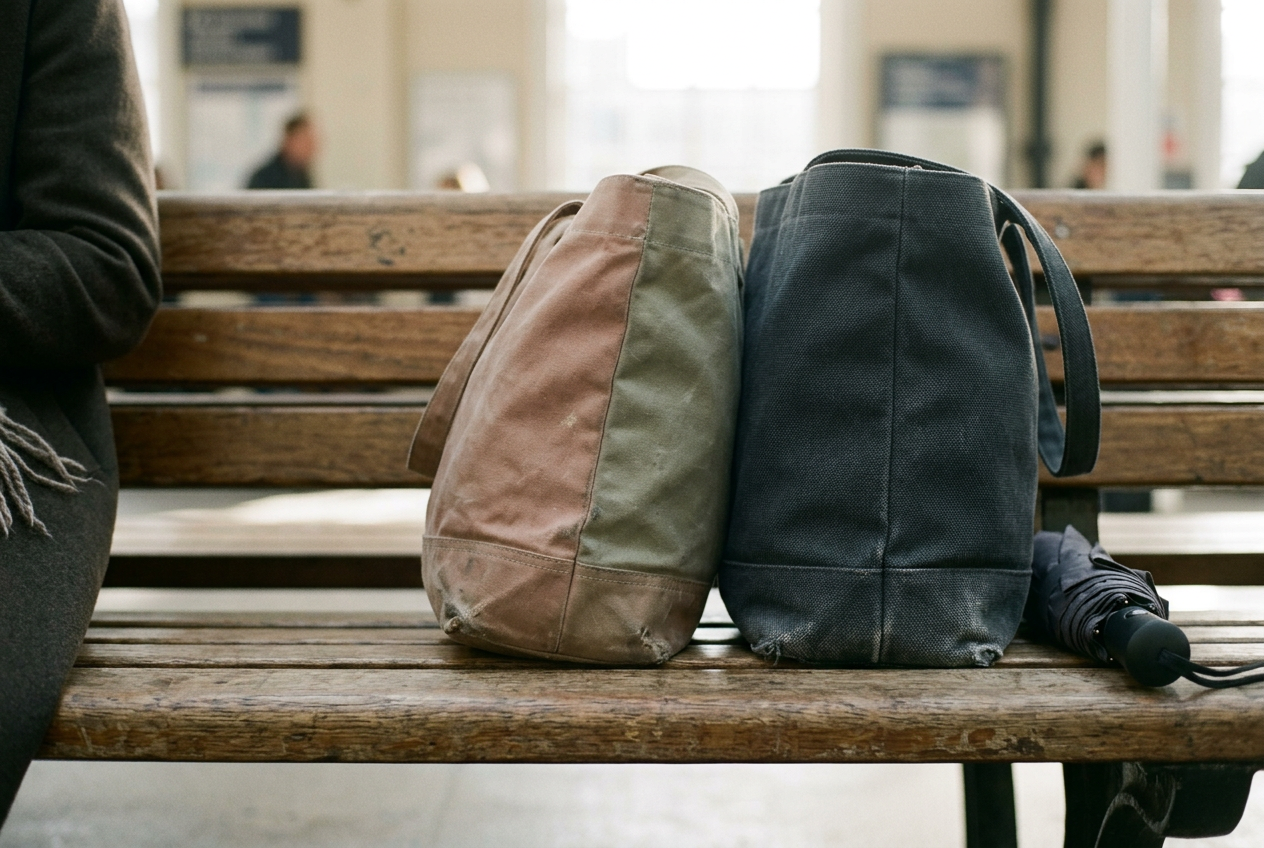
The useful detail sits at the lower front corner. That is where a shoulder bag clips a train door, lands beside a desk, and rubs against a coat while its owner reaches for a transit card.
For this comparison, I alternated two medium zip-top commuter totes from my own rotation: one black pebbled leather, meaning hide tumbled or pressed to produce a raised grain, and one coated canvas, meaning woven fabric covered with a synthetic protective layer. Each carried the same ordinary load, including a laptop, charger, water bottle, umbrella, and small pouch, through walking and public-transit days.
The bags were similar in footprint and shoulder carry, though this was a practical comparison rather than a laboratory abrasion test. I checked the results against publicly available brand guidance on cleaning, storage, and repair. The advice applies across women’s and men’s wardrobes, so this is unisex coverage.
The corner tells the truth first
Pebbled leather is good at breaking up a shallow scratch. The uneven grain prevents a fine mark from reflecting light as one clean line, particularly on black, brown, or another color that runs close to the leather beneath the finish. On the test tote, ordinary contact registered first as a slight flattening of the grain at that lower front corner. It looked burnished before it looked damaged.
Repeated friction eventually removes color. Once that happens, the bag may show a lighter dot or crescent where the corner bends around its reinforcement. A leather tote with piping, the rounded corded trim that strengthens a seam, can wear through its surface finish at that raised point before the broad side panel looks tired.
The coated-canvas tote resisted light rubbing cleanly. Its printed surface did not collect the small, pale scratches that smooth leather often shows. The failure, when it begins, is sharper: the coating can abrade at the fold, exposing the textile base beneath it, and a lifted or cracked layer is difficult to disguise with routine care.
That distinction matters more than which material feels luxurious in the hand. Pebbled leather tends to age by degrees. Coated canvas can look nearly unchanged for a long stretch, then develop a small area that reads as damage rather than patina. The lower corner of my canvas tote remained crisp through ordinary handling, but it offered less visual camouflage once the surface was compromised.
Construction changes the outcome. A rounded corner spreads friction across a curve, while a sharply folded corner concentrates wear along one narrow line; protective feet help only when the bag lands upright, which commuter totes rarely do on a crowded train or beneath a café chair.
Rain favors coated canvas, with limits
The practical advantage of coated canvas appeared after wet walks. Surface droplets wiped away with a soft cloth, and the bag did not need conditioner afterward. Brand care instructions commonly recommend gentle wiping rather than soaking, solvents, or aggressive household cleaners, though owners should follow the guidance for their specific coating.
Water can still enter through stitching, zipper tape, an open top, or an uncoated edge. Coated does not mean waterproof. A laptop sleeve or separate water-resistant pouch remains sensible if the commute includes sustained rain.
Pebbled leather asks for more attention. I blotted moisture rather than rubbing it, emptied the tote so that damp panels were not held in a distorted shape, and let it dry at room temperature away from direct heat. Saturated leather can stiffen, darken unevenly, or lose oils, while heat may make those effects worse.
Conditioner is not an automatic next step. Products can alter color or sheen, and many brands advise testing any cleaner or conditioner on a concealed area first. A dark, heavily grained bag is forgiving; pale leather, absorbent finishes, and contrast stitching leave less room for improvisation.
Rain cleanup therefore has two costs. Coated canvas takes less time after an ordinary shower. Leather requires a dry place, a little patience, and occasional material-specific care, though neither bag should be put away wet with receipts, cables, and a damp umbrella pressing against its lining.
Empty weight changes the commute
The coated-canvas tote felt lighter before loading, but material alone does not settle this category. Thick leather handles, metal feet, large clasps, dense cotton lining, and reinforced laptop compartments can make a coated bag unexpectedly heavy. An unlined pebbled-leather tote with restrained hardware may weigh less than a highly structured canvas design.
Check the published empty weight when a brand supplies it. If it does not, lift the display bag with every paper insert and detachable pouch removed, then hold it by the strap rather than supporting its base. A bag that feels substantial in both hands can become tiring once all of that weight hangs from one shoulder.
The test became clearest on stairs. The leather tote’s extra unloaded weight was easy to ignore at home and difficult to ignore after adding the laptop and water bottle, especially when the shoulder strap sat close to the neck. Short handles with no crossbody option magnify that burden.
For a walking-heavy or transfer-heavy commute, empty weight deserves priority over the prestige of full leather. Someone who drives, carries little, or stores the bag beside a desk may reasonably give more weight to repairability and how the surface ages.
Structure comes from the hidden layers
Coated canvas often looks crisp without the thickness of full leather, which helps a tote keep a clean plane at a lower weight. It can also develop set creases where the body repeatedly collapses around a laptop or is folded for storage. Once the coating has bent along the same line many times, that crease deserves watching for surface stress.
Pebbled leather softened around the load. The tote became easier to tuck under an arm, but its base sagged when the laptop was not seated squarely against the interior sleeve. Softness is comfortable. It can also pull the zipper into a curve and make one-handed closing harder.
A bag’s interlining, the supportive layer placed between its exterior and lining, does much of the structural work. Baseboards, reinforced corners, and the way handles are anchored matter as well. Material labels do not reveal those details, so place an empty bag upright, open and close it with one hand, and then add the item you carry most often. Watch the top line and lower corners.
The black leather tote looked richer as it relaxed, but it became less orderly. The coated-canvas tote kept its rectangular outline and was easier to search quickly. That is a functional difference for someone opening a bag at a station gate, not a verdict on which exterior is more refined.
Repair is where leather earns its case
A skilled leather repair shop may be able to clean and recolor worn corners, replace edge paint, restitch a seam, repair a handle, or rebuild damaged piping, depending on how the bag was constructed. Edge paint is the flexible colored coating applied to a cut leather edge. Repairs may remain visible, but leather gives the technician workable material.
Coated canvas presents a narrower path. Stitching and leather trim may be repairable, yet a cracked or abraded printed coating cannot always be restored invisibly because paint or adhesive placed on top may differ in flexibility, color, and sheen. A patch can stabilize damage, though it changes the appearance.
Brand repair programs vary by product, damage, location, and proof-of-purchase requirements. Check the current policy before buying, particularly for an investment bag, and do not assume that a high retail price includes future refurbishment. Independent repair shops also differ in what they will accept.
Both materials occupy a broad price range, from accessible department-store bags to luxury pieces, with substantial overlap. At any price, inspect whether high-wear components are replaceable. Screwed or stitched hardware, accessible handle attachments, and corners that are not buried beneath bonded layers give a repairer more options later.
The commuter verdict
Choose coated canvas when the bag will meet frequent rain, long walking transfers, crowded floors, and a load that already feels heavy. Its low-fuss surface and potentially lower empty weight solve daily problems, provided you accept that coating damage may resist an elegant repair.
Choose pebbled leather when corner wear bothers you more than rain care, you prefer a surface that changes gradually, and access to recoloring or structural repair could keep the bag in use longer. Look for dark color, rounded corners, restrained hardware, and a base that supports the items you carry.
The decisive check takes place before checkout. Load the bag, put it on your usual shoulder, and look at that lower front corner. Its shape, reinforcement, and distance from the floor will tell you more about the next several commutes than the material’s place in a luxury hierarchy.
Questions people ask
Is coated canvas waterproof enough for a laptop commute?
Usually not on its own. The coated panels may shed an ordinary shower, but water can enter through zipper tape, seams, openings, and uncoated trim. Use an interior water-resistant laptop sleeve if you walk in sustained rain, and wipe the bag before moisture sits against the lining.
Does pebbled leather scratch less than smooth leather?
It often hides fine surface scratches better because the raised grain breaks up the mark, but it is not scratch-proof. Corners can still lose pigment, piping can wear, and softer leather may dent under pressure. Dark colors and rounded construction make everyday abrasion less obvious.
Which material keeps its shape better?
Coated canvas often holds a crisp outline at a lower weight, while pebbled leather commonly softens and slouches with use. Interlining, base reinforcement, lining, and handle construction can reverse that expectation, so test the bag with your usual load rather than judging an empty display sample.
Can cracked coated canvas be repaired?
Sometimes it can be stabilized, patched, or reinforced, but an invisible cosmetic repair is difficult when the coating has separated from its textile base. Stop carrying the bag if a crack is spreading at a load-bearing corner, and ask the brand or a repair shop about options before applying glue.
One update a day
Today's fashion update, in your inbox
One fashion update each morning — no hype, no filler, just pieces worth wearing.