A Crescent Bag Can Keep Its Curve and Still Be Collapsed
The curved bag silhouette is still around. On resale, the useful distinction is whether a soft bag has relaxed attractively or lost the structure that made it worth buying.
November 21, 2026 · 7 min read
The crescent bag remains easy to find across new and secondhand assortments, from slim leather shoulder bags worn under the arm to padded nylon versions that sit lower against the hip. That continuity can make a resale purchase feel safe. The shape still looks current, and soft construction appears forgiving.
It is forgiving up to a point.
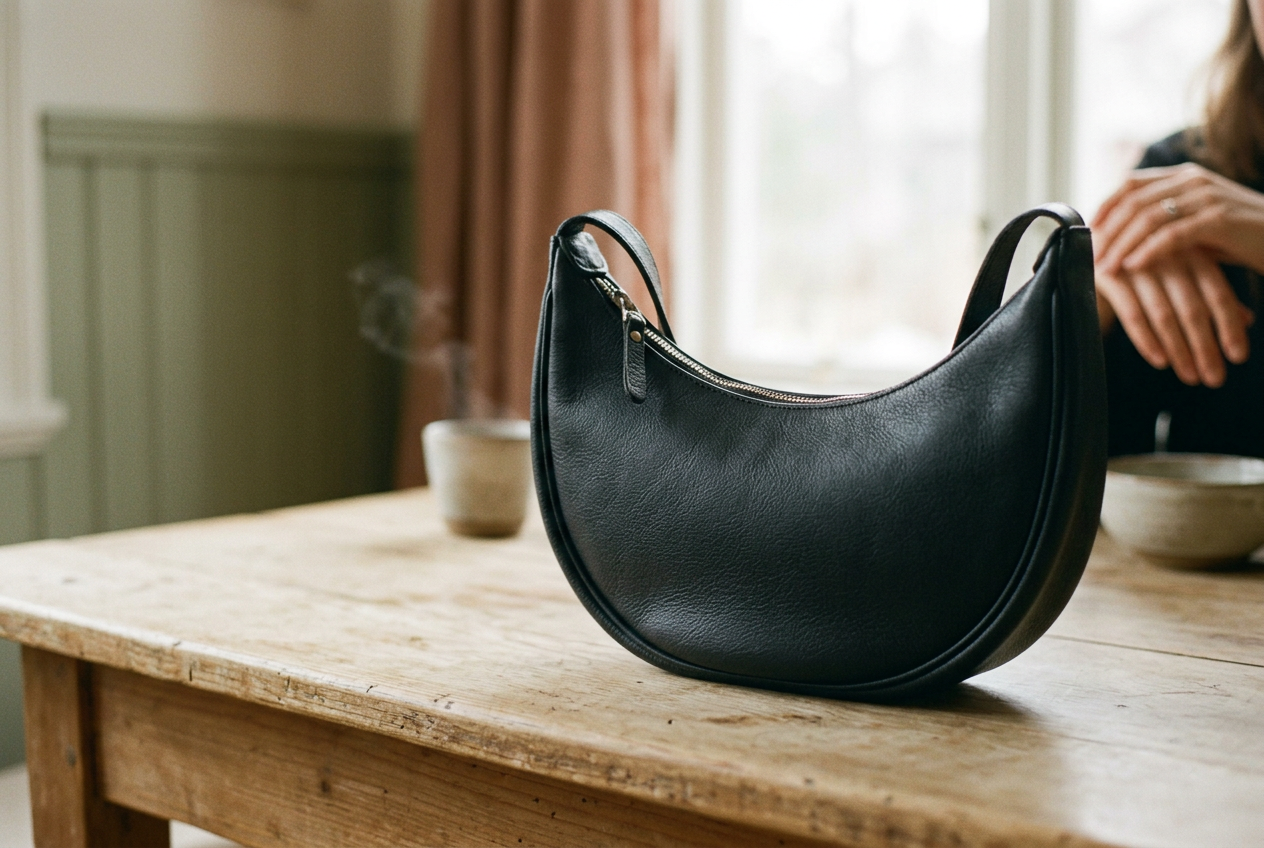
Use one familiar version as the inspection case: a black calf-leather crescent with a top zipper, cotton lining, narrow leather-wrapped piping around the lower curve, and no rigid feet underneath. It is worn high under the arm, where an empty bag should read as a clean arc rather than a folded pouch. This is unisex buying advice; the relevant fit question is strap drop and body placement, while the construction checks apply across wardrobes.
A used bag like this can look curved in the first photograph because the seller has stuffed it, arranged the strap, and shot it from the most flattering angle. The revealing evidence usually sits later in the image set. Two minutes spent comparing the zipper, edge, and base can separate normal softness from a shape that has collapsed.
Start with the closed zipper
The first useful photograph is a straight-on view with the bag zipped and standing or hanging without a hand supporting it. Zipper tape, meaning the woven strip that holds the zipper teeth, should follow the upper crescent in a reasonably smooth line. Small ripples are common in soft leather. A section that bows sharply inward, waves repeatedly, or looks longer than the leather opening suggests that the top edge has stretched unevenly.
Return to the black calf-leather test case. If its zipper rises gently toward both strap attachments, the opening still has tension. If the middle sinks while one end twists forward, the bag may have spent long periods hanging with weight inside, or the leather around the opening may have softened faster than the tape. Either condition changes how the bag sits under the arm.
The zipper can begin to buckle against the body, and closing it one-handed becomes less tidy because the two sides no longer meet on the same plane.
Inspect the teeth at both ends. A seller may describe a zipper as functional even when the tape is distorted, because the slider still travels from one side to the other. Function matters, but it does not answer the shape question. Ask for a photograph of the bag closed, empty, and viewed from directly above if the listing supplies only an open interior shot.
Leather type changes the standard. Supple lambskin will show more movement than firm calfskin, while nylon can wrinkle around a zipper without suffering permanent distortion. Compare both halves of the same bag rather than demanding a perfectly rigid line from material designed to bend.
Follow the piping instead of the body
A dark bag photographed against a dark background can hide a collapsed side panel. Its perimeter is harder to disguise. Piping, meaning a cord wrapped in leather or fabric and sewn into an edge, should trace the lower crescent without abrupt flats or corners.
On the black test bag, begin at one strap attachment and follow the piping with your eye until it reaches the other side. A broad, shallow curve is expected. A hard kink near the bottom suggests the bag has repeatedly folded at that point, while a section that rolls toward the back can indicate that the front and rear panels no longer pull evenly against the edge.
Scuffing on the piping is mostly a surface issue until the wrapping wears through. Distortion is different. Once the cord inside has flattened or shifted, conditioning the leather will not restore the original outline, and an edge repair may cost enough to defeat the reason for buying secondhand. A repair shop would need to inspect the construction before promising a result.
Photographic perspective can produce a false warning. Wide-angle phone images enlarge the nearest end of a bag, and a crescent placed diagonally on a table may look asymmetrical even when it is sound. Compare the straight-on front image with the rear view. When the same dip appears in both, in the same place along the piping, it is more likely to belong to the bag.
Read the base with and without weight
The base panel is the piece that supports the contents at the bottom of a bag. Many soft crescents have only a narrow curved base, and some merge the front and back panels with little internal reinforcement. They are meant to settle against the body. They are not meant to form a deep central pocket before anything has been placed inside.
Look first at the empty side profile. The lower edge of the black leather case should remain visible as a continuous curve, even if it rests lightly on the surface. If the center disappears upward between the front and back panels, the base has started to hammock. That can make a phone, keys, and sunglasses collect in one low point, pulling the zipper line down and exaggerating every weakness already visible at the top.
Then request a loaded photograph. A folded cotton T-shirt makes a better test than tissue paper because it adds modest, even weight without concealing the interior. The base may drop slightly. If it develops a narrow bulge while the ends remain empty, the panel has lost support or was lightly constructed from the start.
The distinction matters at near-retail resale prices. A deliberately slouchy bag can be pleasant to carry, especially in washed leather or padded nylon, but a collapsed base reduces usable space and makes the crescent look narrower once worn. Buyers who want a crisp underarm line should pass. Someone planning to carry very little may accept the tradeoff if the price sits well below cleaner examples.
Separate wear from staging
Resale photographs often show a bag stuffed because stuffing gives buyers a clearer view of its nominal dimensions. That practice is not deceptive by itself. It becomes unhelpful when every exterior image uses enough paper to push the leather beyond the shape it would hold in use.
For the black crescent, compare four states if the listing allows it: zipped and empty, open and empty, standing with light weight, and hanging from the strap. They do not need to be professional photographs. Ordinary daylight and a plain table reveal more than a heavily edited image in which black leather loses its seams.
Also inspect the lining where it meets the base. A loose lining can create an internal sag that feels like structural failure even when the outer panel remains intact, while staining concentrated at one low point confirms that contents have been settling there for some time. Check the seller’s written condition notes for stretching, creasing, loss of shape, edge wear, or storage without stuffing. Labels such as “good” and “excellent” are less useful than those details because grading language varies by platform and seller.
A short video is worth requesting for an expensive bag. Ask the seller to zip it, lift it by the strap, and set it down without reshaping it. That sequence shows whether the upper curve twists under its own weight and whether the base recovers after contact with the table.
Decide what kind of softness you are buying
The silhouette has not collapsed as a trend merely because individual bags collapse in use. Current crescent designs range from molded leather shells to intentionally loose fabric bodies, so resale inspection has to begin with the original construction. Product photographs from the brand or an established retailer can provide a reference, though studio stuffing may make a new bag appear firmer than it is.
For the calf-leather test case, the strongest resale example has a calm zipper arc, piping that remains rounded, and a base that lowers evenly under modest weight. It may still have creases near the strap attachments and softened leather where it touched clothing. Those signs fit ordinary wear.
A bag showing trouble in all three areas deserves more caution. Stretched zipper tape pulls the eye upward, distorted piping interrupts the curve, and a sagging base drags the whole object down once loaded. Cleaning will improve grime. Leather conditioner may reduce dryness.
Neither treatment rebuilds missing structure.
The alternative is not necessarily a new crescent. A used bag with a wider base, firmer calfskin, or an internal reinforcement panel will usually preserve its outline better, though it may feel bulkier under the arm. If softness is the reason you like the shape, accept some relaxation and focus on symmetry. If the precise arc is the reason, wait for photographs that prove it remains.
Questions people ask
Can a sagging crescent bag be repaired?
A repair shop may be able to add internal reinforcement, replace damaged piping, or address a loose lining, but access depends on how the bag was assembled. Ask for an assessment before buying. A major structural repair can erase the savings of resale, especially when the exterior leather must be unstitched.
Does stuffing restore a crescent bag’s shape?
Light stuffing can help a sound leather bag retain its form during storage, and it may relax shallow creases over time. It will not shorten stretched zipper tape, reposition flattened piping, or rebuild a weakened base. Avoid packing the bag so tightly that the seams and zipper opening remain under pressure.
Should nylon crescent bags pass the same checks?
Yes, with more tolerance for wrinkling. Nylon bodies often fold when empty and recover once lightly loaded, so concentrate on the zipper opening, seam alignment, and whether the base drops evenly. Persistent twisting, puckered stitching, or one sharply stretched area matters more than general softness.
How much should shape loss affect the resale price?
There is no universal discount because brand, material, rarity, and repairability all matter. Treat structural sag as more serious than surface scuffing and compare the bag with cleaner examples of the same model. If the seller is asking close to the price of a well-kept example, wait for the better curve.
One update a day
Today's fashion update, in your inbox
One fashion update each morning — no hype, no filler, just pieces worth wearing.