Woven Leather Bags Are Leaving Vacation. Check the Lining.
Woven leather now turns up in bags meant for work and fall, not just resort dressing. An unlined basket and a lined carryall may look related, but they do different jobs.
November 3, 2026 · 7 min read
Woven leather has moved into the part of the bag market occupied by serious totes, shoulder bags and compact top handles. The colors help: black, dark brown and oxblood look less tied to beach clothes than pale raffia does. More important, brands are applying woven surfaces to familiar city shapes rather than leaving them as open baskets.
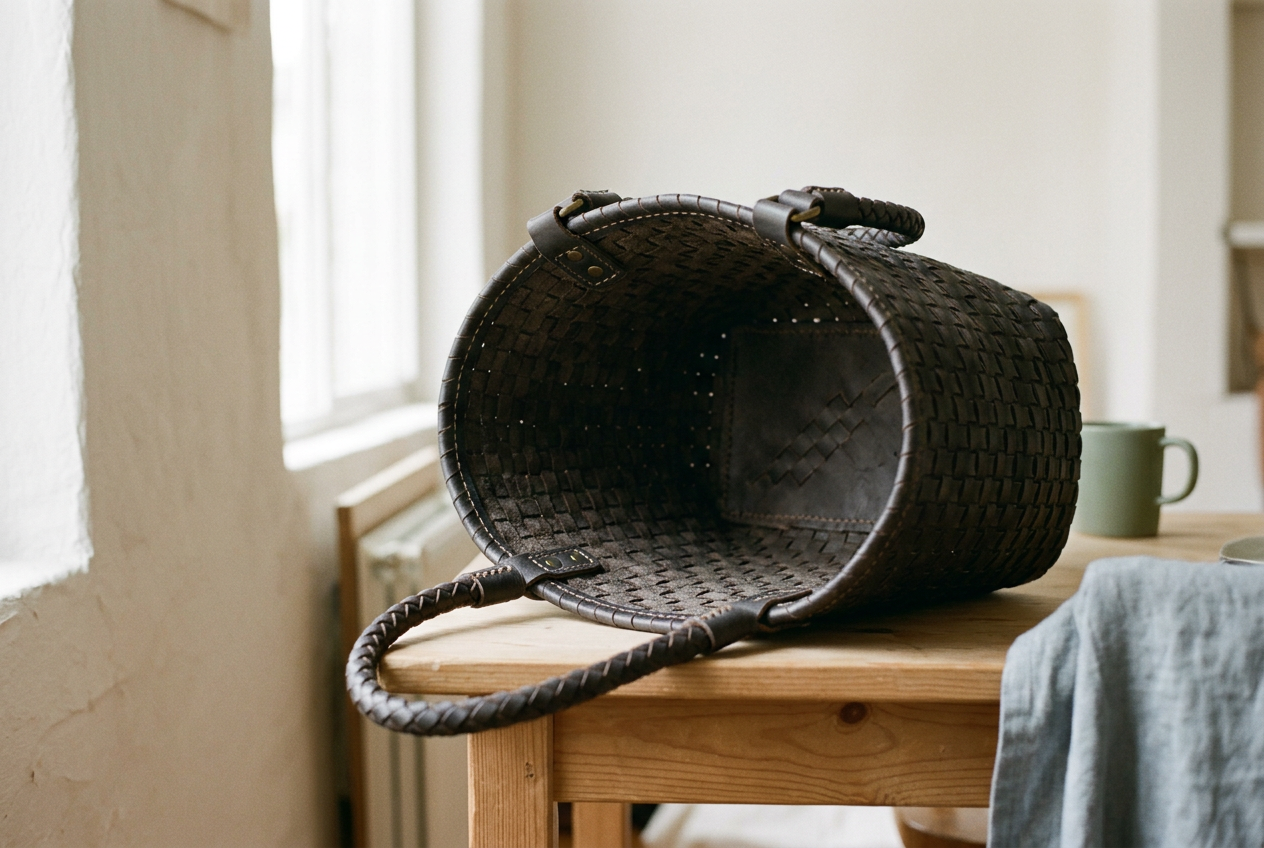
That shift makes the Dragon Diffusion Santa Croce useful to examine. Brand documentation describes it as a handwoven bag in buffalo calf leather, and the decisive detail is its unlined basket construction. It is an appealing, established example of the texture, but the lack of lining also exposes the difference between looking like an everyday tote and behaving like one.
This is unisex coverage. The bag may be styled differently across wardrobes, but keys, charging cables, water bottles and work devices place the same demands on its weave.
The lining changes the job
A lining is the layer attached inside a bag, separating its contents from the outer material. In a conventional leather tote, it keeps small objects away from seams, covers rough surfaces and distributes some friction across fabric or suede. In a woven bag, it has another task: closing the spaces between leather strips.
The Santa Croce leaves those spaces visible. That gives the leather room to remain flexible and allows the handwoven construction to be seen from both sides, which is part of the point, but it also means the weave itself must contain everything. A cardholder or lipstick can press into an opening. Pen clips catch.
Receipts find their way between strips, and crumbs have more places to stay.
An unlined woven tote can still manage a real day if its contents are consolidated in one zip pouch and a padded device sleeve. That packing method preserves the bag’s lightness and makes changing bags faster. It also adds bulk, leaves the pouch visible through larger gaps and asks the owner to provide the internal organization that the bag did not.
A fixed lining makes the stronger everyday proposition. Cotton canvas is practical and easier to inspect, while suede feels richer but can hold lint and show marks. Some woven leather bags use bonded suede, meaning the suede layer is adhered directly to the outer leather rather than hanging as a separate insert; this keeps the interior neat and close to the bag’s shape, although repairs can be more involved if the layers separate.
Bottega Veneta documents bonded suede linings on selected Intrecciato bags, including versions of the Andiamo. Intrecciato is the house’s name for its leather-weaving technique. This is a different construction and price proposition from the Santa Croce, yet the comparison makes the practical point: two bags can offer a broad field of woven leather while only one puts a continuous barrier between the weave and a set of keys.
Gap size matters more than weave density sounds
Descriptions such as “tightly woven” are not enough. The useful measurement is the opening left where strips cross after the bag has been filled, because a weave that looks closed while empty can spread around a laptop sleeve or bottle.
Hold the bag at eye level with a contrasting piece of paper inside. Light should reveal whether the openings are merely pinpoints or wide enough to expose the edge of a card. Then press outward from inside with two fingers. The test does not need force.
It shows whether the strips remain seated or slide apart as the leather bends.
The Santa Croce’s open construction makes this inspection especially relevant. Its woven surface can accommodate irregular contents, which is pleasant when carrying a scarf or soft sweater, but a hard rectangular object concentrates pressure at a few crossings. A laptop therefore belongs in a sleeve with rounded, padded edges rather than directly against the leather. The sleeve protects the device and stops its corners from levering the weave open.
Very small gaps are not an automatic sign of better quality. A compact weave can create a heavier, stiffer bag, and strips placed under substantial tension may distort once the leather softens. The best daily version has consistent openings and enough flexibility to bend without individual strips lifting away from their neighbors.
The rim predicts how the bag will age
The top edge receives more contact than the broad woven panels. Hands rub it, sleeves drag across it and every object entering the bag passes over it. An unfinished rim may soften attractively, but exposed cut edges can become fuzzy or curl, especially where narrow woven strips terminate.
Look for a folded leather binding around the opening or another continuous piece that contains those ends. Edge paint, a flexible coating applied to a cut leather edge, can also produce a clean finish; it deserves close inspection at corners, where cracking often appears first. A little texture is normal. Splits that already expose pale leather underneath are not.
The Santa Croce’s basket character makes a separate pouch useful again here. A zip pouch prevents a metal lipstick tube or charger from repeatedly scraping the rim, though it cannot protect the edge from a large laptop sleeve. If the intended load includes a computer every weekday, a woven tote with a reinforced opening is the better purchase even when the unbound version looks more relaxed.
There is also a clothing issue. Rough strip ends on the interior face can catch loose knits, and dark leather may transfer color when new or damp. Before committing, rub a clean white cloth over an inconspicuous inside section. This will not predict every case of dye transfer, but visible pigment on the cloth is enough reason to keep a pale linen jacket away.
Handles reveal the difference between carrying and displaying
Leather stretches under repeated load. On woven bags, that change may occur in the handles, at their attachment points or in the body directly below them. Narrow straps concentrate weight into a smaller area, while broad handles spread it across the hand and the bag.
The useful detail is reinforcement. A handle may look fully woven yet contain a nonstretch core, or it may attach to a solid leather panel that carries the load past several rows of weaving. By contrast, a handle connected to only a few narrow strips asks those crossings to support everything inside. The first sign of strain is often an elongated opening near the attachment rather than a visibly damaged handle.
Set an empty display bag on a counter, lift each handle and watch the upper edge. The body should rise without one strip pulling sharply ahead of the rest. If the store permits a loaded try-on, use belongings rather than adding excessive weight: a water bottle, pouch and normal daily device will show whether the handle narrows uncomfortably or whether the top edge collapses around it.
Handle drop, the distance between the top of the bag and the underside of the handle, deserves attention too. A short drop may work in the hand but become restrictive over a coat. Long, soft woven handles can fit the shoulder more easily, although they are also more likely to lengthen. Hardware attachments or a detachable solid-leather strap give the bag another carrying route when the main handles need relief.
For the Santa Croce, the sensible load is soft and edited rather than office-heavy. A wallet, pouch, sunglasses case and folded layer suit what the open basket does well. Repeatedly adding a large device, full bottle and several hard cases turns its flexibility into a drawback, then requires enough organizers that the original lightness starts to disappear.
The trend has split into two useful categories
The decorative version keeps the visible openness of basketry. It works when texture is the primary reason to own it, and when the contents can fit inside a pouch without making the bag cumbersome. The Santa Croce sits convincingly here. Calling it decorative does not mean fragile or poorly made; it means its construction asks the wearer to accept exposure and provide organization.
The everyday version borrows the appearance but adds a full lining, a secure closure and load-bearing handles. It may be heavier and less airy. It is also the version more likely to replace a smooth leather work bag rather than merely alternate with one.
Price does not settle the distinction. Hand weaving is labor-intensive, so an unlined bag can cost several times as much as a standard leather tote without offering the same containment. That premium may be worthwhile for skilled construction and a surface that improves with wear. It is not payment for utility that the bag does not have.
A shopper deciding between the two should start with the least glamorous object carried most often. If that object is a laptop, choose lining and reinforced handles before evaluating color. If it is a small zip pouch, the unlined bag remains viable. The woven trend has expanded beyond vacation dressing, but some of its best-looking examples still prefer vacation-sized responsibilities.
Questions people ask
Do woven leather bags lose their shape?
Soft leather strips can relax and openings may widen where the bag carries repeated pressure. A lining, reinforced base and solid handle attachments help preserve the shape. Store an unlined basket empty or lightly supported rather than hanging it by the handles, which keeps constant tension on the upper weave.
Does an unlined woven bag work for commuting?
It can work for a light commute if small items sit in a zipped organizer and any device has a padded sleeve. For a daily laptop, bottle and charger load, a lined woven tote with a reinforced rim and handles is the more dependable choice.
Can small objects fall through woven leather?
They can if the weave has visible gaps that spread under pressure. Test the bag with contrasting paper inside, then push lightly against the weave to see how far the crossings move. Cards, pens and loose cosmetics should stay in a closed pouch even when the empty bag appears tightly woven.
Is a woven leather bag only a summer purchase?
No. Dark leather, structured shapes and closed interiors move easily into fall and winter wardrobes. Construction matters more than season: a black woven tote without lining remains an open basket, while a lined version with secure handles can perform much like a conventional city bag.
One update a day
Today's fashion update, in your inbox
One fashion update each morning — no hype, no filler, just pieces worth wearing.