Scarf Belts Are Back, but Belt Loops Decide If They Stay Put
A silk square can soften tailored trousers, or spend all day creeping loose. Loop width, waistband stiffness and the front closure make the difference.
November 2, 2026 · 7 min read
Recent runway photographs and retailer styling have moved the scarf belt away from its familiar vacation setting. It is appearing with tailored trousers, dark denim and longer shorts, threaded through the loops rather than wrapped casually over a dress. The effect is softer than leather and less final. It also exposes every weak decision in the trousers.
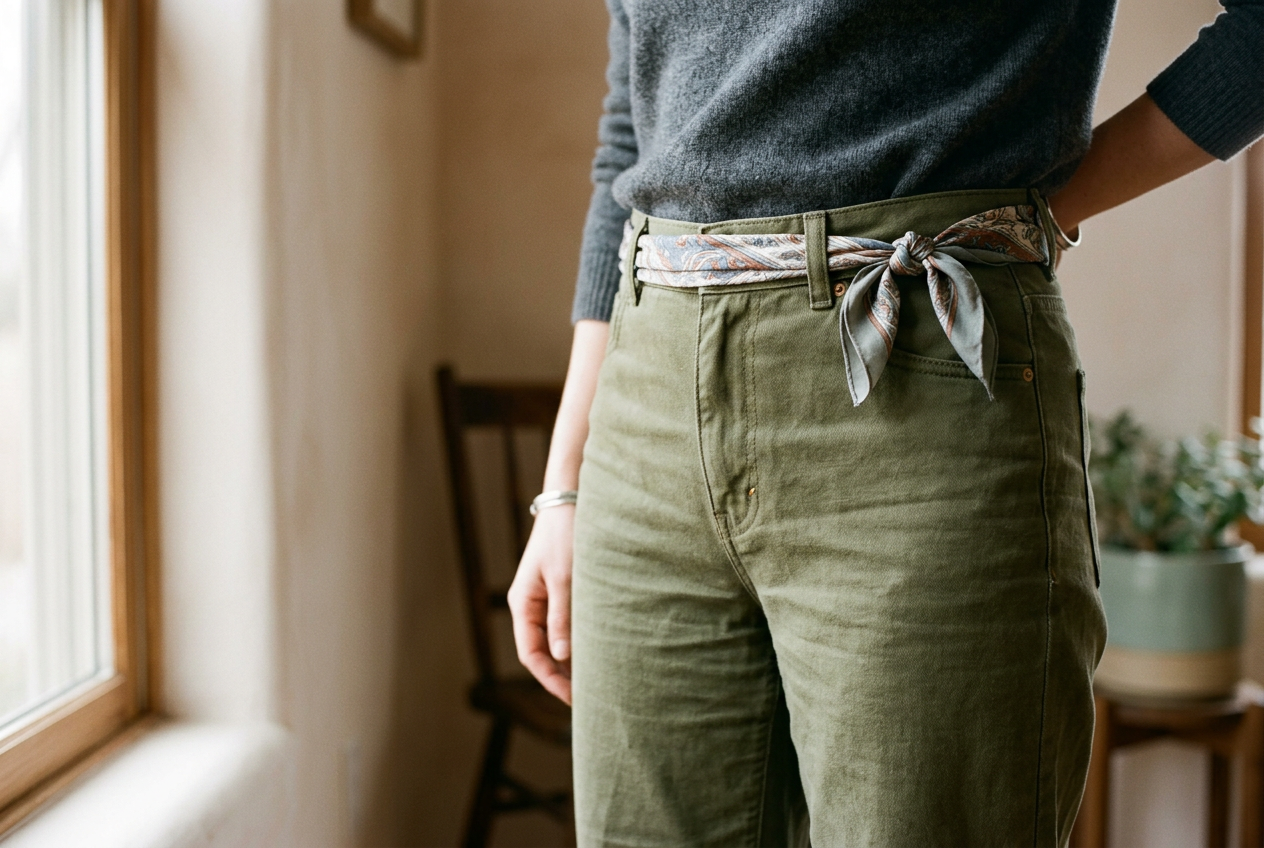
The useful test case here is an olive pair of mid-rise cotton twill trousers with five belt loops, a button-and-zip closure and a firm waistband. I wore them with a 35-inch silk twill square, meaning silk woven with a fine diagonal texture, folded corner to corner and reduced to a band about two inches wide. The diagonal fold supplied enough length to thread the waist and tie a compact side knot.
Across a week, that combination stayed presentable through walking, desk sitting and a meal. The same scarf performed badly on trousers with narrow loops and a softer waistband. It bunched at the first loop, pulled the waistband unevenly and needed resetting after sitting down.
That contrast matters more than the scarf's print.
The return is happening through styling, not new hardware
A scarf worn as a belt is an unusually easy runway idea for retail to translate. The trousers do not need redesigning, and the scarf may already be in the shopper's closet. A printed square introduces color without committing the wearer to a printed garment, while the loose ends interrupt the straight horizontal line created by an ordinary belt.
The move recalls late 1990s and early 2000s styling, though the current version looks more controlled. Instead of a long chiffon scarf hanging low over flared jeans, the stronger examples use compact knots with pleated or straight trousers. The waist is visible. The scarf reads as part of the construction rather than an extra layer draped over it.
That makes this a unisex styling proposition. The mechanics do not change across wardrobes, though trouser sizing and waist placement do: the scarf needs to follow the waistband without carrying the job of holding up the trousers.
Retail imagery can hide that distinction. A scarf belt behaves perfectly while the wearer is standing still, particularly when the knot has been arranged for a photograph. Movement introduces drag at the loops, pressure from the front closure and repeated compression at the back waist. A workable outfit must survive those forces without relying on a discreet safety pin.
Start with the opening inside the loop
The labeled width of a belt loop is less useful than its clear internal opening. Bar tacks, the dense stitches securing each end of a loop, can take up enough space to turn a generous-looking loop into a narrow channel. On the olive trousers, each loop accepted the two-inch folded scarf with light compression but no forcing. The silk could move while I tied it, then settled once the knot was tightened.
A practical fitting-room test takes seconds. Fold the scarf to the width you intend to wear, pinch the band firmly and pass that doubled section through a front loop. If the edges must be rolled or pushed in separately, the scarf will probably snag during dressing and emerge wrinkled. Narrow loops can work with a slim cotton strip, but they are poor partners for a padded silk square.
Loop placement matters next. Five loops kept the scarf close to the olive waistband, particularly at the center back, where a missing loop would have allowed the band to rise when I sat. Trousers with only a few widely spaced loops leave stretches of scarf unsupported; on a softer waistband, those spans can twist into a cord or drift above the waist seam.
Inspect the front pair as well. Loops set close to the fly guide the scarf toward the closure, where a bulky knot can press against the button or cover it awkwardly. A little clear space at one side of the fly gives the knot somewhere to sit. If both front loops crowd the closure, tie farther toward the hip or skip the look.
The loop's surface is another quiet factor. Rough denim stitching grips, which helps a slippery scarf stay level but may pull delicate silk. Smooth, tightly finished cotton loops are kinder. Before using a valuable scarf, run a fingertip along the inside for exposed thread ends or a sharp seam allowance.
Fabric decides how often the knot loosens
The silk twill square worked because its faint texture created more resistance than glossy satin. After the initial knot settled, it moved little. A polyester satin scarf tested on the same olive trousers looked fluid but loosened sooner, and its ends gradually became uneven because one side slid through the knot faster than the other.
Cotton is the easiest low-cost alternative. A washed cotton bandana holds a knot, tolerates firm pulling and does not object to rougher belt loops. It produces a drier, more casual finish, which suits denim and workwear trousers better than polished tailoring. Cotton voile, a lightweight plain-woven fabric, is softer but can collapse into a narrow rope unless folded with care.
Thickness creates the opposite problem. A large square folded repeatedly concentrates many layers at the waist, and every layer must pass through each loop before becoming a knot. The olive test scarf was manageable because the silk was light and the fold stayed flat. A heavier wool-silk square made the same front loop feel crowded and left a knot thick enough to press against the hip while seated.
Do not assume that a premium silk scarf is the best purchase for this use. An inexpensive cotton square is often more stable, and a narrow rectangular scarf avoids much of the folded bulk. If the appeal lies in using a scarf already owned, test it before buying different trousers to support the trend. Trouser replacement is a high price for a styling detail with an uncertain shelf life.
Length should be checked before threading. Fold the scarf, wrap it around the outside of the waistband and confirm that the ends overlap enough to make one secure knot with short tails. A square gains useful length when folded corner to corner, but a higher rise or larger waist still consumes fabric quickly. Very long ends are not more secure; they add weight that can pull a slippery knot downward.
A scarf cannot repair a loose waistband
The scarf belt looks functional, yet it is best treated as decoration. Silk compresses, cotton can stretch with wear and neither offers the fixed resistance of leather webbing. If the trousers slide without a belt, the scarf will tighten into an uncomfortable cord before it gives reliable support.
The olive trousers passed because their waistband already sat securely. Their cotton twill had enough body to resist folding, and the scarf only followed the existing line. On a pair with a soft waistband, the same knot drew one side inward while the back edge dipped. Loosening the scarf corrected the distortion but left it floating above the trousers.
Pleats add another complication. When front pleats are meant to open slightly with movement, a tightly tied scarf can pin them closed and change the intended volume. A looser knot preserves the shape but increases slippage. Flat-front trousers are less temperamental, especially for a first attempt.
Check the closure while seated. A centered scarf knot can stack directly over a trouser button, creating a hard mound under a close-fitting top. Side placement solved that on the olive pair, though moving too far around the hip made the tails catch against a chair arm. The stable position was between the front loop and the side seam, with the ends finishing above the pocket opening.
The knot should stay small
A single overhand knot, the basic knot formed by passing one end through a loop, was compact but slipped in satin. A square knot held the silk twill more reliably, provided the first crossing was pulled flat before the second was formed. Its tails pointed in opposite directions rather than falling together, which kept the result from becoming a rosette.
Bulk can also be reduced before tying. Keep the folded band flat through every loop, then untwist only the last few inches at each end. Opening the entire tail produces a fuller flourish, but it also feeds extra fabric into the knot. On the olive trousers, leaving the ends folded created the cleanest line and required no adjustment after the first retie.
I would adopt the move only with trousers that pass the loop and waistband tests already in the closet. It adds useful color and changes the proportion of a plain trouser outfit, but buying a costly scarf for this purpose is premature. The olive pair earned repeat wear. The narrow-loop pair did not.
Questions people ask
What type of scarf works best as a belt?
A lightweight silk twill or washed cotton square offers the best balance of flexibility and grip. Glossy satin slips more readily, while thick wool blends create pressure and knot bulk. A narrow rectangular scarf is easier if repeated folding already makes the loops feel crowded.
How wide should belt loops be for a scarf belt?
The folded scarf should pass through the clear opening without being rolled, forced or threaded edge by edge. Test the actual space between the bar tacks rather than judging the loop from outside. If the scarf emerges deeply creased, choose a thinner fabric or different trousers.
Can a scarf belt hold up loose trousers?
It should not be expected to. Fabric compresses and may stretch, so tightening it enough to support loose trousers can create a narrow pressure point at the waist. Start with trousers that stay in place unaided, then use the scarf as a decorative layer.
How do I stop a scarf belt from slipping?
Choose textured silk twill or cotton, keep the band flat through the loops and use a compact square knot at the side waist. A center-back loop helps prevent upward drift. If glossy fabric still loosens, changing the scarf is more effective than repeatedly tightening it.
One update a day
Today's fashion update, in your inbox
One fashion update each morning — no hype, no filler, just pieces worth wearing.