Barrel Jeans Have Hit Resale. The Wildest Curves Are the Risk.
Used barrel jeans are becoming easier to find, but the loudest horseshoe cuts are poor alteration candidates. The safer buy has a moderate curve, familiar rise and intact hem.
Women's · October 21, 2026 · 8 min read
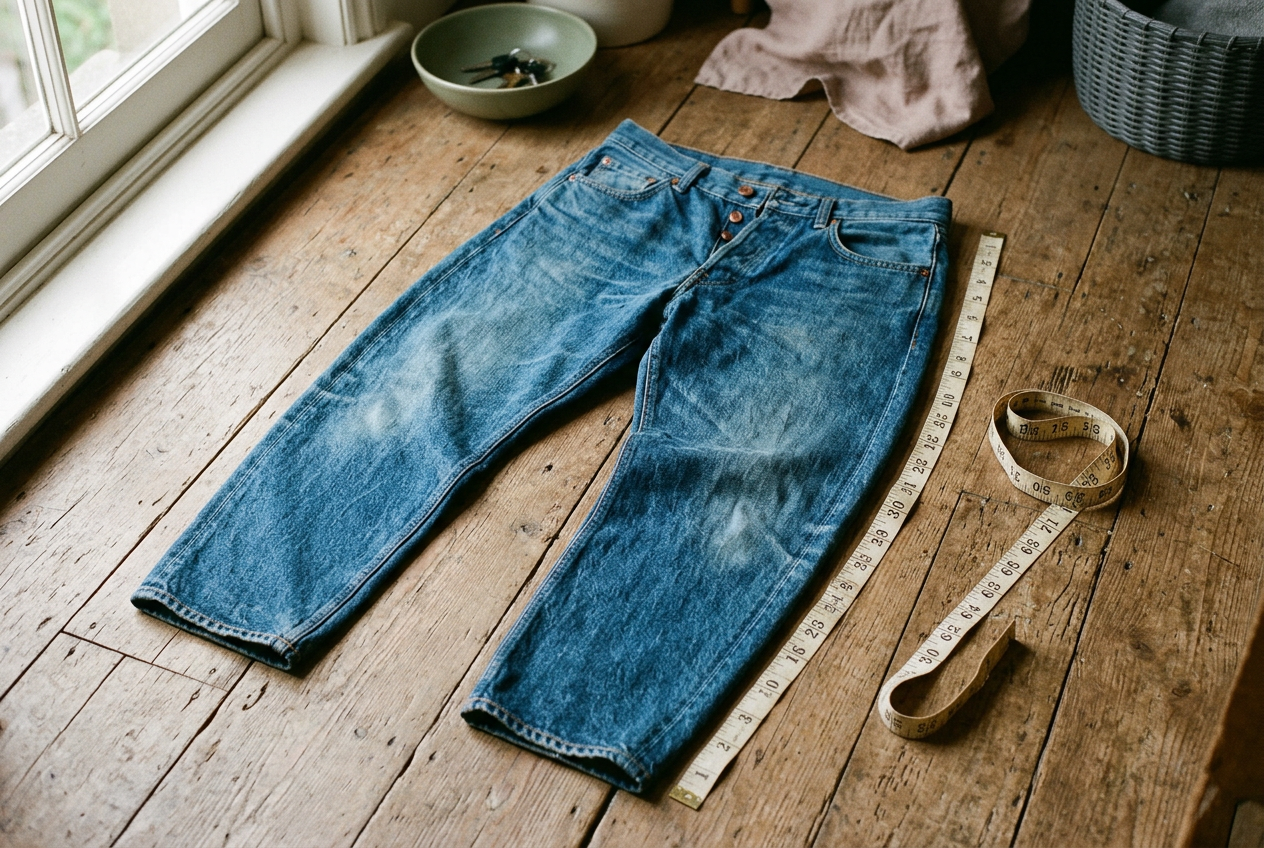
The useful change is not that barrel jeans exist. It is that secondhand searches now turn up recognizable versions from contemporary denim brands alongside the vague “balloon jean” listings that have circulated for years, giving shoppers enough choice to reject the wrong rise, length or degree of curve.
This is women’s coverage because the sizing references and resale categories discussed here come from women’s denim, although the construction checks apply to any curved-leg jean. The anchor is the Citizens of Humanity Horseshoe jean, one of the clearest expressions of the silhouette: roomy through the leg, bowed outward at the side and narrowed again toward the ankle. In blue denim, that curve is visible before an outfit supplies any context.
It is also a useful warning. The Horseshoe’s character comes from its pattern rather than loose sizing, which means buying a larger conventional jean will not reproduce it, and tailoring a dramatic pair into a quieter one is more complicated than taking in a straight leg. That distinction should govern a secondhand search.
Resale has enough choice, with some friction
A secondhand sweet spot arrives when supply is broad enough to compare, while the item still looks current enough to wear without turning the purchase into trend archaeology. Barrel jeans appear to be entering that phase, though not evenly across sizes, washes or platforms.
Marketplace language remains messy. Sellers use barrel, horseshoe, balloon, curved leg and tapered leg for overlapping shapes, while automated product descriptions sometimes repeat a brand name without explaining how the jeans fit. A saved search for only “barrel-leg jeans” will therefore miss useful pairs and overrepresent sellers who follow current terminology.
Search the named product when you know it, then repeat the search using “horseshoe jean” and “curved-leg denim.” Madewell, Everlane, Free People and Citizens of Humanity are among the real labels associated with versions of this shape, but the brand matters less than photographs showing the whole leg laid flat. A front view on a hanger can hide the curve; a flat back view and an outside-leg view reveal whether the volume comes from a shaped seam, a dart or ordinary looseness.
Asking prices do not prove what buyers pay. Check sold listings where a platform makes them available, compare the exact wash and fabric rather than the product name alone, and treat a missing measurement as work still to do. For a common contemporary-brand pair, paying more than half the price of a comparable new jean only makes sense if the size is scarce or the condition is unusually good. An extreme pair deserves a steeper discount because its resale audience is narrower and alteration options are worse.
Rise is the first nonnegotiable measurement
Rise, the distance from the crotch seam to the top of the waistband, controls where the curve begins on the body. A high-rise barrel jean usually holds the waist and sends volume outward below the hip. A lower rise drops that visual weight, which can make the same side-seam curve look slouchier and longer.
Do not rely on “high rise” in the listing title. Ask for the front-rise measurement with the jeans buttoned and laid flat, then compare it with a pair you already wear at the intended waist position. Measuring your body is less reliable here because waistband shape and denim stiffness change how a rise feels.
The Horseshoe jean demonstrates the issue well. Its bowed leg reads as deliberate when the waistband sits where the pattern expects; if the rise is wrong and the waistband slides down, the widest section can fall lower than intended and the crotch may appear dropped. A belt can secure the waist, but it cannot relocate the leg shape.
Waist alterations are possible, within limits. A tailor may remove modest excess at the center back, though the work can shift pockets and alter the back rise. Changing the rise itself means reconstructing the upper jean and is rarely sensible for a secondhand trend purchase. If the rise measurement is absent, wait for the seller to provide it.
Inseam decides whether the ankle taper works
Inseam means the inside-leg measurement from crotch to hem. On straight jeans, a little extra length can stack over a shoe without changing the basic silhouette. Barrel jeans are less forgiving because the hem often marks the point where the leg has finished narrowing.
Compare the listed inseam with a jean that hits at the same place you want this pair to hit, not with your full trouser inseam. A cropped barrel pair may be intended to expose the ankle or meet the top of a shoe. Extra fabric pooling on a sneaker can make the lower curve collapse inward, while a cut that finishes too high may exaggerate the roundness above it.
This is where the used Horseshoe pair becomes a risky bargain. If it is several inches too long, shortening from the bottom may remove the narrowest section and leave a wider opening than the designer intended. Preserving the original hem, a tailoring method that reattaches the factory-finished edge, keeps the fading and stitching but does not restore the missing taper.
A tailor can narrow the new opening, yet that adds another intervention to shaped seams that may already twist under tension. The better secondhand candidate is within roughly an inch of the desired finished length, or has a plain enough lower leg that the tailor can show exactly where the new hem will land before cutting.
The side seam reveals the trend’s shelf life
Study the outseam, the seam running down the outside of the leg. A moderate barrel jean drifts outward through the thigh or knee and returns gradually toward the ankle. It still looks curved when laid flat, but the denim does not form a near semicircle.
The versions most likely to date quickly push that geometry further: a strongly bowed outseam, a low and very wide midpoint, or an ankle opening pinched enough to make the upper leg appear inflated. None is inherently bad. The risk is that the seam announces a narrow moment in silhouette, so changing the shoes or top will not quiet it.
Moderate curves have more routes out. With a tucked knit and loafers, they can read as an update to tapered jeans; with a loose shirt and low-profile sneakers, the same pair becomes less formal without losing its shape. The most exaggerated Horseshoe cut remains the main event even under a long coat.
Look at how the curve was made. Darts, stitched folds that remove fabric to create shape, can produce volume without forcing the side seam far outward. Curved side panels are harder to disguise because their seam placement remains visible after fading. If the listing includes only modeled photographs, ask for the jeans laid flat and measure the widest point across each leg as well as the hem opening.
Those numbers are most useful in comparison with your own jeans. They do not create a universal good ratio, since size and fabric weight affect the result, but they expose a pair whose leg expands dramatically before closing to a narrow cuff.
Fabric determines whether used is better
Rigid cotton denim can be a good secondhand buy because the first owner has already started softening it, and photographs may reveal the real creasing at the hip and knee. It can relax with wear, particularly at the waistband, but it will not acquire the easy stretch of denim containing elastane.
Stretch denim offers more tolerance through the waist and seat. On a sculpted leg, however, repeated wear can leave the knees bagged while the ankle remains narrow, weakening the clean curve that justified the purchase. Check for pale stress lines, rippling near the zipper and a knee bulge visible when the jeans lie flat.
Fabric weight matters too. A substantial denim holds a pronounced horseshoe shape but can feel bulky when seated, especially where the leg folds behind the knee. Softer denim falls closer to the body and makes a moderate barrel easier to wear, although the silhouette may look less architectural than it did in product photography.
Ask for the fiber label. Product names sometimes stay constant across washes even when composition changes, so an online review of one Horseshoe color may not describe another. The care label is more dependable than a seller’s impression that the fabric is “soft” or “rigid.”
Alteration potential separates the bargains
A useful resale pair should fit at the rise, seat and upper hip before any tailoring. The waist can sometimes come in; the hem can sometimes come up. Rebuilding a curved leg is closer to remaking the jeans.
Inspect whether both legs hang symmetrically, since twisted seams are difficult to correct after washing and wear. Check that the ankle opening will pass comfortably over the heel, particularly on nonstretch denim. A very narrow cuff can make dressing awkward even when it looks balanced once on.
Pass on a pair that requires changes at both the waist and lower leg unless it is inexpensive enough to absorb tailoring and the return policy gives you time for an in-person assessment. Alteration cost can erase the advantage of buying used, while a nonreturnable mistake leaves you with a distinctive shape that is difficult to resell accurately.
My safer secondhand target is quieter than the Horseshoe: cotton-forward denim, a curve visible mainly from the side, and an ankle opening that narrows without gripping. The rise must match a known pair, and the inseam should work without removing the shaped bottom section. That version may look less exciting in a marketplace thumbnail. It is also less dependent on this exact phase of the denim cycle.
The full Horseshoe remains compelling for someone who wants the seam to be seen and has confirmed every measurement. It is not yet the automatic resale bargain its growing availability might suggest.
Questions people ask
Are secondhand barrel-leg jeans cheaper than buying new?
Often, but the listing price alone is not enough. Compare sold listings where available, add shipping and possible tailoring, then measure the discount against a similar new pair rather than an inflated original price supplied by the seller. Common contemporary-brand pairs should offer a meaningful reduction because sizing and shape carry real risk.
Can barrel-leg jeans be shortened?
Yes, but hemming can remove the narrowest part of the leg and change the silhouette. Choose a pair close to your target inseam, then ask a tailor to pin the proposed length before cutting. Reattaching the original hem preserves its finish, not the taper that was removed.
Which barrel jeans will look current longest?
Moderate curves have the longer runway: the outseam bows gently, the widest point sits around the knee area, and the ankle narrows without looking pinched. Extreme horseshoe legs may remain appealing, but their pronounced geometry identifies the trend more clearly and gives styling fewer ways to soften it.
What measurements should a resale seller provide?
Prioritize front rise, waist laid flat, inseam and hem opening, plus a full-leg photograph laid flat. If the curve is pronounced, request the width at the leg’s widest point and an image of the fiber label. Those details show more than a tagged size, especially after denim has been washed and worn.
One update a day
Today's fashion update, in your inbox
One fashion update each morning — no hype, no filler, just pieces worth wearing.