Almond-Toe Shoes Give Pointed Flats More Room to Work
The almond toe is returning between severe points and soft rounds. Its value depends less on the label than on where the shoe starts to narrow.
Women's · October 31, 2026 · 7 min read
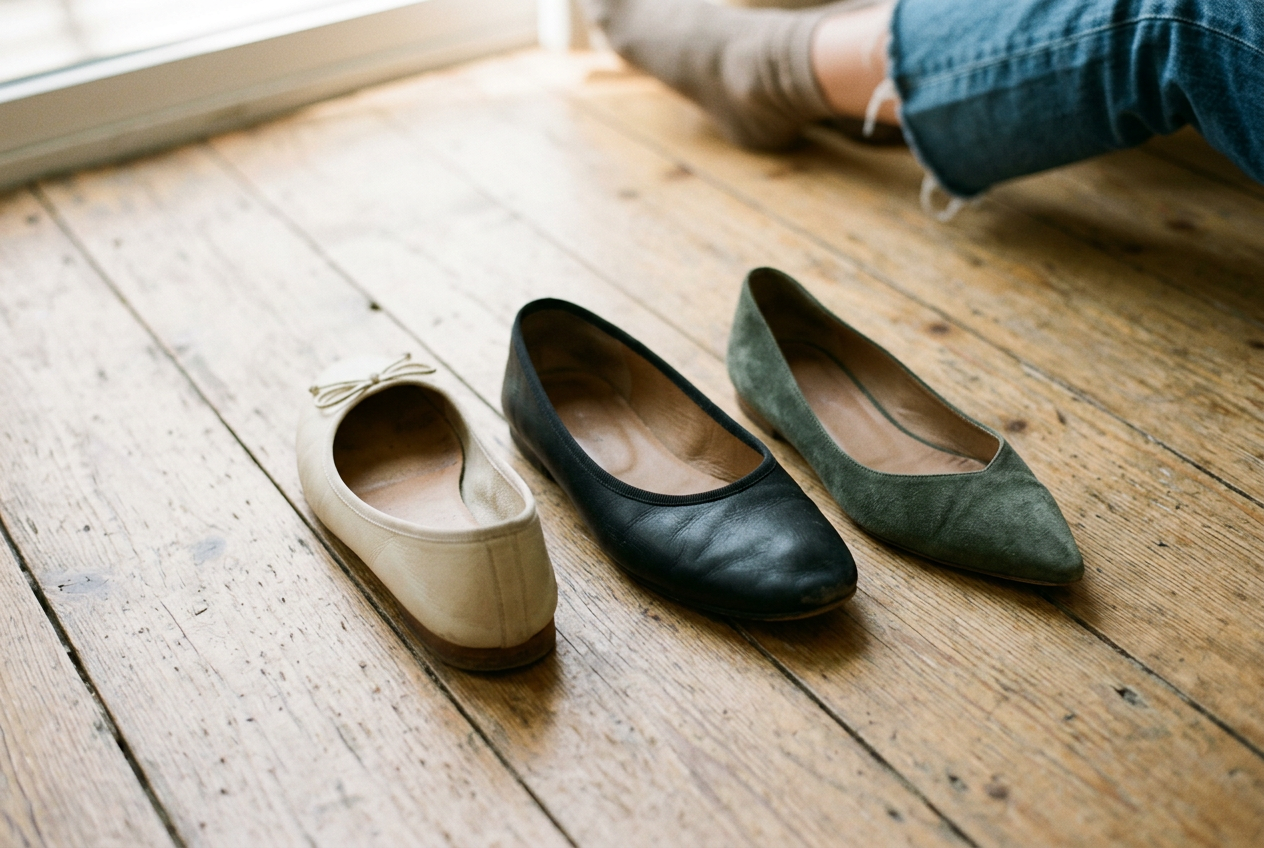
The useful case is Margaux’s black leather Demi ballet flat, a long-running style with an almond toe, low-cut vamp and small bow. It sits in the premium end of the flat market and looks almost neutral beside the elongated points and very round ballet shapes moving through current assortments. That restraint makes it a good test: if an almond toe has a durable wardrobe role, it should show up here rather than on a shoe loaded with studs, mesh or multiple straps.
The Demi also exposes the term’s central problem. “Almond” describes the outline seen from above, not a standardized fit. The shoe is widest around the ball, then curves inward toward a softly tapered tip. That sounds roomier than a point, although the comfort difference depends on whether the curve begins beyond the little toe or cuts across it.
The point has softened, not disappeared
Recent footwear cycles have moved through visibly engineered extremes. Square toes gave sandals and boots a broad front edge. Rounded ballet flats then returned with a smaller, softer footprint, while pointed slingbacks and kitten heels supplied the opposite line: narrow, extended and unmistakably dressed.
The almond toe borrows from both ends. It keeps enough length to sharpen a trouser hem or make a flat read less like a slipper, but it removes the severe tip that can dominate an outfit. Across department stores and mass-market retailers, the shape now appears on ballet flats, low pumps, ankle boots and loafers, sometimes under descriptions such as tapered, soft point or oval toe. Those labels are not interchangeable, so the product image from above matters more than the search filter.
Against a full round toe, the Demi’s front looks quieter and slightly longer. Against a sharply pointed flat, it looks conservative. Worn with straight-leg jeans that stop at the ankle, that moderation is useful because the visible strip of shoe finishes the line without becoming the outfit’s main event. Under a wide trouser, the taper remains legible where a very round flat can disappear beneath the hem.
This is women’s coverage, and the fit discussion reflects women’s footwear sizing, where width choices remain inconsistent even among brands selling the same numerical size. The underlying mechanics apply more broadly, but shoppers should not treat a women’s size conversion as a substitute for trying the relevant last, meaning the foot-shaped form around which a shoe is built.
Toe room is about the start of the taper
A pointed shoe may contain plenty of unused length at its tip while still squeezing the toes farther back. An almond toe usually reduces that dead space, yet it can produce the same pressure if its sides turn inward too early. The useful measurement is not tip to heel. It is the width across the ball and the amount of straight space allowed before the upper begins to curve.
Look again at the Demi. Its almond outline does not promise natural toe splay, the spreading of the toes under body weight, in the way a broad anatomical shoe might. It offers a polished compromise. A narrower or medium-width forefoot is more likely to experience that compromise as extra ease; a broad forefoot may meet the taper at the little-toe joint and gain little over a conventional point.
Material changes the result. Soft nappa leather, a supple full-grain leather with a smooth surface, can relax across the width after wear, though it will not create meaningful extra length. Patent leather and heavily coated leather yield less. A synthetic upper may soften at flex points but still resist stretching where the toe box presses, leaving the wearer with a crease and the same crowded edge.
Sizing up is an unreliable fix. The wider part of the larger shoe may line up better with the foot, but the heel can then lift, particularly in a low-cut ballet flat without a strap. Heel grips take up volume at the back; they do not move the taper forward. On the Demi, the shallow upper and neat opening are part of the visual appeal, so a size that is too long undermines the secure, close fit the design needs.
The better fitting test takes several minutes indoors. Stand with full weight on both feet, then check whether the little-toe joint sits before the side begins to curve. Walk down a hard hallway and listen for heel slap. Finally, hold a shallow squat or rise onto the balls of the feet; pressure that becomes sharp at the widest part is unlikely to be solved by admiring the silhouette.
The wardrobe gap is narrower than it looks
An almond-toe flat earns space when a closet contains casual round shoes and formal pointed ones, but lacks a pair that can move between them. The black Demi illustrates that middle job clearly. It can sit under cropped denim with a fine knit, then move to a fluid midi skirt or full-length tailored trousers without forcing the outfit toward office formality.
That range comes from subtraction. Black leather, a low heel and minimal decoration leave the toe shape to do the work. Add a glossy finish, an oversized buckle or a high-cut Mary Jane strap, and the pair becomes easier to date because those details attach it to a more specific retail moment. The almond outline itself has persisted in pumps and boots for years, even when stores used other names for it.
A sharp pointed flat does something different. It extends the foot and creates a decisive edge under long trousers, which can be useful when the clothing is loose or visually heavy. The tradeoff is that the extra tip scuffs easily, catches on stairs and may feel overly formal with relaxed shorts or washed denim. A very round ballet flat softens those outfits, although its compact shape can look slight beneath wide hems.
The almond sits between those effects. That is its strength and its possible redundancy.
Before buying, place the candidate beside the two pairs already doing most of the work. If the new shoe has nearly the same opening, sole thickness and black leather finish as an existing round flat, a modestly tapered tip will not create many new outfits. If the closet’s only polished option is a pointed pump that becomes uncomfortable after a commute, the almond flat fills a practical gap.
Price should follow that distinction. At the mass-market level, almond flats often cost less than or roughly as much as everyday sneakers, with more variation in lining quality and sole flexibility. Contemporary leather pairs tend to sit around the price of a good sneaker or above it. Premium examples such as the Demi cost more again, so their case rests on width availability, material, construction and repeated use rather than the novelty of the outline.
Where the middle ground fails
The shape does not solve a bunion, a wide toe spread or forefoot swelling. A softly drawn tip can disguise a narrow internal platform, and overhead product photography rarely shows the usable space inside the upper. Shoppers who need room should prioritize a wide option and a later taper, then consider a rounder toe if the side still crosses the joint.
Thin soles are another limit. Many ballet flats place little material between the foot and pavement, regardless of how elegantly the toe is shaped. Padding can soften initial impact, but it is not the same as structural arch support, and a flexible leather sole will behave differently from a rubber outsole on wet sidewalks. The almond toe addresses front-of-shoe geometry.
It does not turn a delicate flat into a walking shoe.
There is also a styling failure at the other end. An almond pump with a high stiletto heel still carries much of the formality and forefoot load of a pointed pump. Softening the tip may make it easier to wear visually, but heel height continues to push weight forward. For long standing days, a lower block heel or supportive loafer remains the more consequential alternative.
This is why the Demi remains a useful reference rather than an automatic recommendation. Its black leather almond toe can bridge denim and tailoring, and the less extreme outline should survive the next swing toward rounder footwear. It is still a low ballet flat whose value depends on close heel fit, enough width at the ball and a wardrobe that needs precisely that level of polish.
The decision
Buy an almond-toe shoe when the taper begins beyond the widest part of your foot and when its styling replaces an uncomfortable point rather than duplicating a round flat. Choose leather if some width relaxation matters, but do not expect stretching to correct a short or badly placed toe box. For heavy walking, judge the sole and heel hold before the outline.
Skip it when “almond” is only a retail label attached to a narrow last, or when the pair adds a near-copy of shoes already in rotation. The silhouette is durable enough. Whether another black flat is useful remains a more personal and less settled matter.
Questions people ask
Are almond-toe shoes more comfortable than pointed shoes?
They can be, provided the sides stay straight until they pass the widest part of the foot. A rounded tip alone does not guarantee room. Check for pressure at the little-toe joint and ball of the foot, where an early taper can feel almost identical to a conventional pointed shoe.
Do almond-toe flats work for wide feet?
Some do, especially when the brand offers a true wide width and the upper is soft leather. The outline should curve inward after the forefoot rather than across it. If sizing up causes heel lift, move to a wider fitting or rounder toe instead of adding length.
Will almond-toe shoes look dated quickly?
A plain leather almond toe has more staying power than a highly elongated point or an exaggerated round shape because versions of it remain common in pumps, loafers and boots. Trend-heavy straps, hardware and finishes will date the shoe faster than its gently tapered outline.
Is an almond-toe flat worth buying if I own ballet flats?
Compare jobs rather than labels. If your current flat is round, comfortable and polished enough for trousers, the almond pair may duplicate it. If your only dressier shoe is a pointed style you avoid for walking, a restrained black leather version such as the Demi can fill a real gap.
One update a day
Today's fashion update, in your inbox
One fashion update each morning — no hype, no filler, just pieces worth wearing.