Sport Sunglasses Work Off the Bike When the Shield Shrinks
The sport-sunglasses trend becomes more wearable when a single broad shield gives way to two compact wrapped lenses. The tradeoff is less coverage, but a better fit with ordinary clothes.
October 30, 2026 · 7 min read
Sport sunglasses have moved beyond technical jackets and cycling jerseys, but the version entering everyday fashion is not quite the frame built for a long ride. Full shields remain visible, particularly with oversized outerwear and deliberate sportswear, while retailers are also making room for compact wraps with separate lenses, narrow eye shapes and enough curvature to retain the athletic reference.
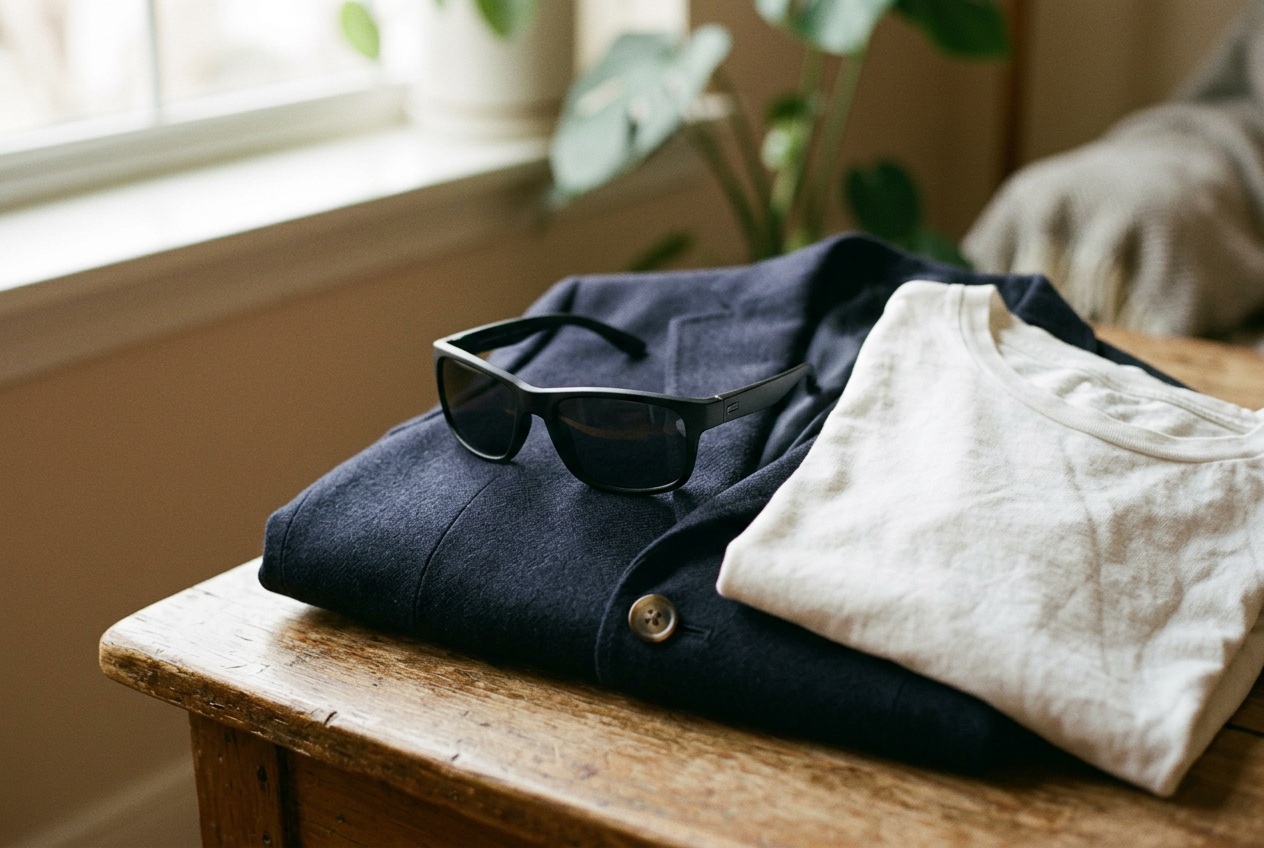
The Oakley Eye Jacket Redux became my test case. It is a close-fitting, two-lens frame made from O Matter, Oakley’s proprietary lightweight frame material, with rubberized Unobtainium contact points at the nose and temples. In matte black with dark lenses, it carries the visual speed of a performance frame without placing one uninterrupted pane of lens across the face.
I wore it for a week with the clothes that expose a trend’s limits: a white T-shirt and straight jeans, a loose navy blazer, a gray knit, and a weatherproof shell. The Eye Jacket Redux worked often enough to explain the shift, though one fit issue kept it from becoming an uncomplicated recommendation.
This is unisex coverage. The useful distinctions are face width, cheek height and prescription needs rather than the gender label attached to a retailer’s assortment.
The shield and the wrap are doing different jobs
A full shield uses one broad lens across both eyes. Models such as the Oakley Sutro and comparable cycling frames from Smith or 100% extend toward the temples, where the extra lens area can improve peripheral coverage and help block wind, dust and glare from the side. That expanse is functional on a bike. In an everyday outfit, it also becomes the first thing anyone sees.
The Eye Jacket Redux keeps a high-wrap fit, meaning the frame curves around the sides of the face rather than sitting on a relatively flat plane, but its two oval lenses leave more frame visible. That border matters. It gives the eye somewhere to stop, reduces the visor effect and lets the sunglasses behave more like an accessory than a piece of equipment.
Coverage falls with the smaller shape. Looking straight ahead, the dark lenses screened the field well, and the curved frame admitted less side light than a flat acetate pair. The open area around the lower outer edge was more apparent while walking into bright cross-light, though, and the compact lenses did not create the sheltered feeling of a full shield. That is the central exchange: the shape becomes easier to wear with a blazer or knit because it gives up some of the enclosure that makes a shield useful at speed.
For daily use, that can be the correct compromise. Most people crossing town on foot do not need a lens extending almost to the temples, while cyclists and runners may notice the lost coverage immediately. A fashion assortment can place both silhouettes under “sport,” but they should not be treated as interchangeable.
Cheek contact decides the fit
Wraps fit close by design. The problem arrives when the lower lens or frame edge meets the cheeks, particularly when smiling, talking or climbing stairs. On my face, the Eye Jacket Redux cleared the cheeks at rest but touched lightly when I smiled, leaving a faint contact mark in warm weather. It never became painful during the week, yet the repeated tap was enough to rule out buying the shape without trying it on.
That test takes less than a minute in a store. Set the frame on the nose without pushing it unusually high, smile fully, then look down and turn the head. The frame should stay stable without the lower edge riding on the cheeks. Check the temples as well: a curved arm may hold securely behind the ear, but pressure near the hinge can turn into a headache after an hour even when the front looks correctly sized.
Rubberized nose pads can improve grip as skin warms, which helps performance frames stay in place, but grip does not correct incompatible geometry. A low bridge, prominent cheeks or long eyelashes may bring the lenses into contact even when the listed frame width appears suitable. Lens fogging and makeup transfer then become practical annoyances, not minor cosmetic details.
The alternative is a shallower wrap with adjustable nose pads, or a sport-influenced frame that carries narrow lenses without curving so aggressively around the head. It will admit more light at the side, yet it may sit cleanly enough to wear for an entire day. Fit beats purity here.
Prescription lenses narrow the field
Strong curvature complicates prescriptions because the wearer looks through a lens set at an angle rather than one positioned nearly flat in front of the eye. Optical labs can compensate for wrap, but available prescription ranges depend on the frame, lens material, correction and manufacturer. A model appearing in a brand’s prescription program does not mean every prescription can be made in it.
Full shields create another hurdle. Many are sold only with nonprescription lenses, while some use a separate optical insert behind the shield. An insert preserves the broad outer lens, although it adds another surface that can fog, collect dust or become visible from certain angles. It also makes an already technical object look more technical.
A two-lens frame such as the Eye Jacket Redux starts with a more familiar construction, but its deep curve still requires confirmation from the dispensing optician or authorized prescription supplier. Anyone with a substantial prescription should make that check before choosing a color or ordering a nonreturnable lens. The flatter sport-inspired alternative may be less dramatic, though it often leaves more room for optical adjustment.
This is also where price rises. A branded performance frame already sits around the cost of a decent pair of sneakers, and prescription lenses can move the total well beyond an impulse purchase. The trend is not worth that money if the frame touches the cheeks, distorts peripheral vision or spends most days in a case because it only works with one outfit.
The outfit needs some visual quiet
The Eye Jacket Redux was easiest with plain clothes that had enough structure to answer its curved shape. A loose navy blazer over a white T-shirt worked because the jacket kept the sunglasses from reading as leftover training gear, while the matte black frame connected to ordinary shoes and a belt without demanding a matching technical fabric.
A weatherproof shell also made sense, predictably. The less convincing combination was a gray textured knit with several visible accessories. The wrapped lenses added another point of emphasis near the face, and the outfit became busy without gaining anything useful. These frames do not need a complete sportswear costume, but they benefit from fewer competing details.
Dark gray, brown or muted green lenses are easier to place than a highly mirrored finish. Mirror coatings can reduce visible light and glare depending on the lens specification, yet their reflective surface pushes the frame back toward performance equipment. For someone testing the trend rather than collecting it, a dark neutral lens and a frame close to hair color or usual accessories will have more range.
Scale matters more than the logo. A shield that reaches from brow to cheek turns even a plain outfit into a sports-fashion statement, while a smaller wrap can sit beside straight denim, tailoring or a simple dress without controlling the entire look. That does not make the compact frame timeless. It makes it compatible.
The practical version is smaller
After a week, the Eye Jacket Redux passed the outfit test and only partly passed the comfort test. Its separate lenses preserved the sport reference, the O Matter frame stayed light, and the matte finish avoided the hard shine of some molded performance frames. Cheek contact remained the deciding flaw on my face.
The trend is practical for a buyer who finds a compact wrap with clean cheek clearance and does not need maximum wind protection. A full shield still earns its place for riding, running and strong side coverage, but as an everyday purchase it asks more from both the face and the wardrobe. The smaller wrapped silhouette is the one crossing over. Whether it lasts beyond the current micro-trend is still open.
Questions people ask
Which sport sunglasses look best with everyday clothes?
Compact two-lens wraps usually integrate more easily than broad single-lens shields. Look for a restrained lens color, a visible frame border and a shape that does not extend far beyond the temples. Those details retain the sport reference without making a T-shirt, blazer or knit look like supporting equipment.
Should sport sunglasses touch your cheeks?
No. A brief touch when smiling may seem harmless, but repeated contact can cause smudging, makeup transfer, pressure and fogging. Try the frame while smiling and moving your head; if the lower edge rests on the cheeks, choose a different bridge shape or a shallower wrap.
Can wrapped sunglasses take prescription lenses?
Some can, but strong curvature limits which prescriptions and lens designs will work. Two-lens frames tend to offer more options than one-piece shields, although the exact range depends on the authorized lab. Confirm compatibility before ordering, especially when the lenses are customized or nonreturnable.
Are full-shield sunglasses practical away from cycling?
They can be practical in strong sun, wind or dusty conditions because their broad lens improves coverage around the eyes. For ordinary outfits, however, the shield dominates the face and may be harder to combine with tailoring or textured clothing. A smaller wrap gives up coverage in exchange for greater wardrobe range.
One update a day
Today's fashion update, in your inbox
One fashion update each morning — no hype, no filler, just pieces worth wearing.