Old Ballet Flats Show Which New Pairs Will Age Badly
A worn leather flat can tell you more than a pristine product page. Toe structure, lining, sole depth and the shape of the opening reveal which revived styles may have a short life.
Women's · October 28, 2026 · 8 min read
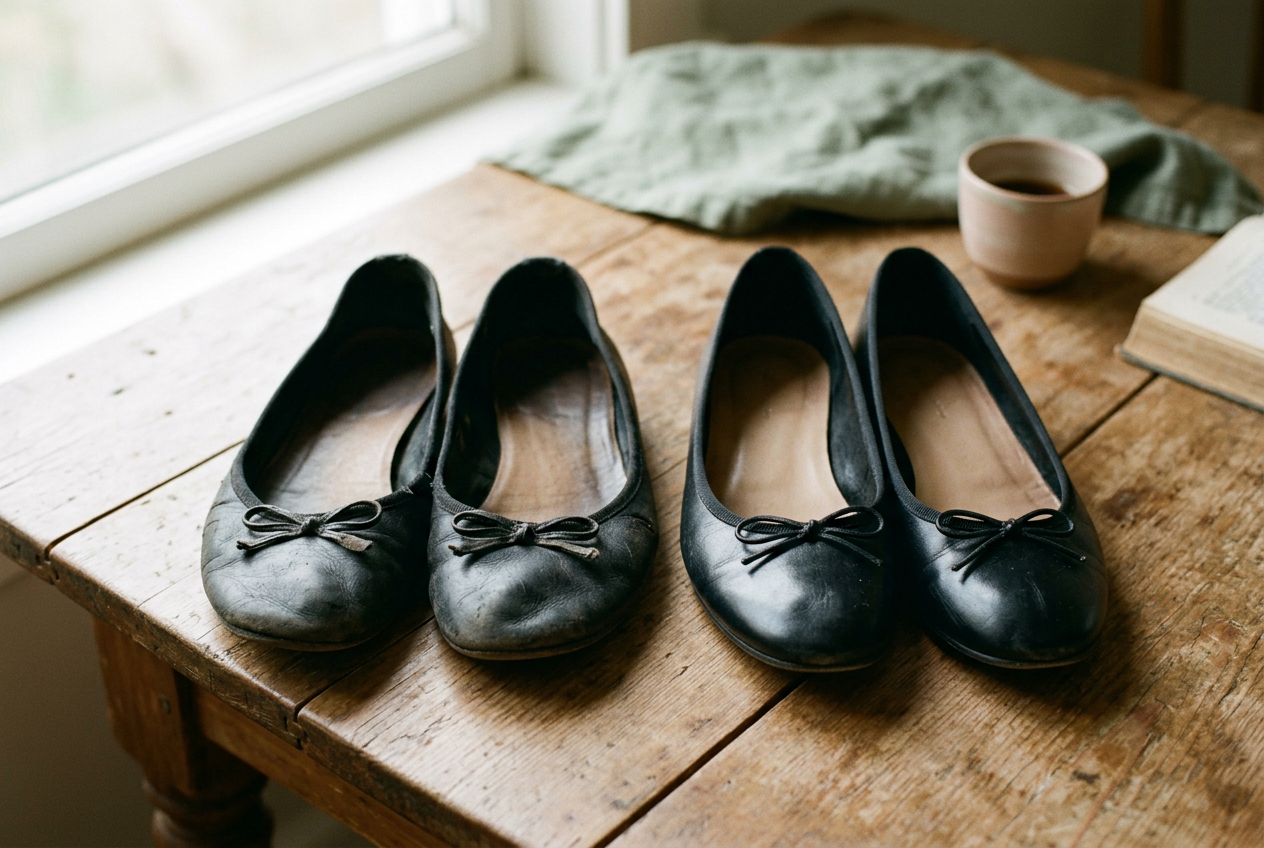
The useful view of a ballet flat is not from above, unworn, with the bow centered. It is from the side after the shoe has carried weight, flexed at the forefoot and been pulled off by the heel dozens of times.
For this check, I used an older black leather Tory Burch Reva flat sourced secondhand as the control pair, then compared its failure points with the construction visible across public resale listings. The Reva has the familiar round toe, elasticized opening and very low profile that defined an earlier ballet-flat cycle. Its age is an advantage here. The leather has had time to show where softness becomes collapse, while the opening reveals what sustained tension does to a shoe that depends on elastic for fit.
One worn pair cannot grade an entire model or brand. It can expose the decisions that matter. On the control pair, the upper remains recognizable and the hardware is intact, yet the toe has softened asymmetrically, the lining is rubbed at the heel, the outsole is thin under the ball of the foot, and the sides no longer sit in a clean oval when the shoe is empty.
Those are the four areas worth checking on renewed ballet flats now, particularly the glove-soft versions whose immediate comfort can disguise how little structure they contain.
The toe should flex without giving up its shape
A ballet flat needs some resistance at the front. The toe puff, a concealed stiffener between the upper and lining, keeps the front from flattening under pressure and helps protect the toes from minor knocks. It need not feel rigid, but it should recover after being pressed.
The older Reva does not recover evenly. One toe rises again; the other keeps a shallow dent and tilts inward. That difference matters more than ordinary leather creasing. Fine horizontal wrinkles show that a shoe has flexed, while a broad depression across the top suggests that the upper and toe puff are no longer working together.
When shopping new, press the side of the toe lightly and release it. A good candidate returns close to its original profile without a crackling sound or a crease that remains sharply marked. Then look inside. If the lining is loose at the toe before purchase, the upper may wrinkle independently of its support, which accelerates the crumpled look visible in heavily worn resale pairs.
Material changes the tradeoff. Supple lambskin feels easy immediately but shows pressure and toe outlines sooner than firmer calf leather. Thin polyurethane, often labeled PU, can hold a crisp shape on the shelf yet later crease or peel rather than soften attractively. Satin makes every pressure point legible.
Mesh avoids the pretense of structure altogether, which is acceptable if the intended look is sheer and relaxed, but less convincing if the shoe is meant to keep a precise almond or square toe.
Lining wear predicts comfort before the upper looks old
Resale photographs often concentrate on the exterior, although the interior gives the clearer account of use. The sockliner, meaning the layer directly beneath the foot, takes friction, moisture and pressure from every step. Darkening alone is mostly cosmetic. Lifting edges, exposed foam and a polished patch at the heel are more consequential.
The control Reva is rubbed where the heel meets the back seam. That location suggests repeated movement rather than even wear, and it fits the loosened opening: once the elastic stops holding the rear securely, the heel moves, the lining abrades and the wearer may grip with the toes to keep the shoe on. A flat can therefore feel larger without becoming longer.
For women’s sizing, which varies enough between brands that the printed number is only a starting point, check whether the heel stays down during a normal stride without the opening biting into the Achilles area. A tight elastic edge may solve slipping in the fitting room, yet older pairs show the cost when that narrow strip carries most of the fit. A shaped heel cup and a lining that lies smoothly are better signs than aggressive elastic.
Leather lining usually handles friction more gracefully than a thin synthetic sheet, though leather still wears through if the fit is loose. On a new pair, run a finger around the inner heel and side seams. A raised join that is noticeable by hand will become more noticeable during a long walk.
A thin sole has no reserve
Ballet flats are visually defined by their closeness to the ground, but there is a difference between a slim profile and an outsole with almost nothing available to wear away. The outsole is the bottom layer that meets the pavement. On the older Reva, its forefoot is smoother and thinner beneath the ball of the foot than at the perimeter, while the heel has worn at an angle.
That pattern is ordinary. The concern is how little material remains between the worn area and the upper. Product photos rarely show this clearly, so turn a new shoe over and compare the thickness at the center of the forefoot with the edge. Deep decorative grooves do not prove substance; some soles carry an embossed pattern on a very shallow layer.
Flex the shoe where the foot naturally bends, just behind the toes. It should bend there rather than fold through the middle. A flat that can be rolled tightly in one hand may suit a commute as a packable spare, but it asks the foot to provide nearly all the structure and gives the outsole little protection from concentrated pressure. That is a comfort choice, not evidence of quality.
Repairability remains limited. Most contemporary ballet flats use cemented construction, meaning the upper is glued to the sole rather than stitched, and some can accept a protective half sole if a cobbler has enough clean surface to work with. A razor-thin, heavily sculpted or wrapped sole may leave fewer options. If the shoe costs roughly what you would spend on a decent pair of sneakers, asking about repair before the first wear is reasonable.
A bowed opening rarely straightens itself
Place an empty ballet flat on a level surface and look down. The opening should form a balanced shape, with both sides standing rather than rolling outward. The topline, the finished edge around the foot opening, can soften with wear, but permanent waves or a side that bows away from the foot signal lost tension or distortion.
This is the clearest weakness on the older Reva. Its elasticized edge still contracts, yet the sidewalls remain bowed between heel and toe. Elastic can shorten an opening without restoring the shape of stretched leather beneath it, so a pair may feel tight at the rim while gaping lower down.
Current high-cut ballet flats, especially those that cover more of the instep, may age better because a broader upper distributes tension. Very low vamps look delicate, but they leave a narrow band of material to resist the foot spreading during a step. The vamp is the part of the upper covering the front of the foot; if it barely reaches past the toe joints, width fit becomes unforgiving.
This is where shopping by usual size fails. A broad forefoot forced into a narrow flat can bow the opening even when the length is correct, while sizing up may create heel slip and lining wear. Try the shoe late enough in the day that the foot is not at its smallest, walk on a hard surface if the store permits it, and reject a pair whose sides gape during the first few steps. The opening will not learn a cleaner shape.
The best buy is not necessarily the firmest pair
The secondhand lesson is not to seek a stiff ballet flat. Excess structure can create pressure across the toe joints, and a hard binding can cut into the heel before it loosens. The better target is selective structure: a toe that rebounds, a smooth lining, an outsole with visible depth and an opening that holds its shape without squeezing.
At the budget end, inspect construction rather than treating synthetic material as an automatic failure. A neatly bonded upper with a stable toe and substantial rubber outsole can outlast a softer leather shoe whose appeal rests on delicacy. It may not develop the same surface character, and once peeling starts it is difficult to disguise, but the initial shape can still be sound.
In the middle and premium bands, leather should buy more than a material label. Look for a lined interior, a heel that feels shaped rather than folded, and enough sole to survive regular pavement. Paying extra for paper-thin leather, exposed seams and a sole designed mainly to disappear from view is paying for the silhouette at its most temporary.
The older black Reva remains useful precisely because it has not failed in one dramatic way. It has drifted: the toe is less decisive, the heel lining rougher, the sole closer to spent and the opening less controlled. Many renewed flats will follow that route, particularly those sold as slipper-soft from the first step.
Before buying, set the pair side by side on a table. Compare the toe heights, look through both openings, press each forefoot and inspect the soles under direct light. If the two shoes already sit differently before anyone has walked outside, leave that pair where it is.
Questions people ask
How can
I tell whether a ballet flat will collapse at the toe?
Press the side and top of the toe gently, then release. The shape should return without a sharp crease remaining. A visible toe outline, loose internal lining or upper that dents with almost no resistance suggests the shoe may lose definition quickly, especially in very soft leather or satin.
Is leather always better for ballet flats?
No. Leather can soften attractively and is often easier to live with than peeling polyurethane, but thin leather without a stable toe puff or smooth lining may collapse early. Judge the complete shoe: the upper should recover after pressure, the interior should lie flat, and the outsole needs enough depth for pavement.
Can a bowed ballet-flat opening be repaired?
Minor stretching may be manageable, but a permanently waved topline or distorted sidewall is difficult to restore because the upper itself has changed shape. Replacing elastic can tighten the rim without flattening bowed leather. On resale, treat obvious gaping as a fit and construction issue rather than a cosmetic flaw.
Are very flexible ballet flats comfortable for walking?
They can feel comfortable at first because little material resists the foot, but flexibility does not provide cushioning or stability. If the shoe folds through its middle instead of bending behind the toes, expect the foot to do more work. For regular walking, choose a defined flex point and measurable outsole thickness.
One update a day
Today's fashion update, in your inbox
One fashion update each morning — no hype, no filler, just pieces worth wearing.