Peep-Toe Shoes Are Back. The Cutout Decides the Pain.
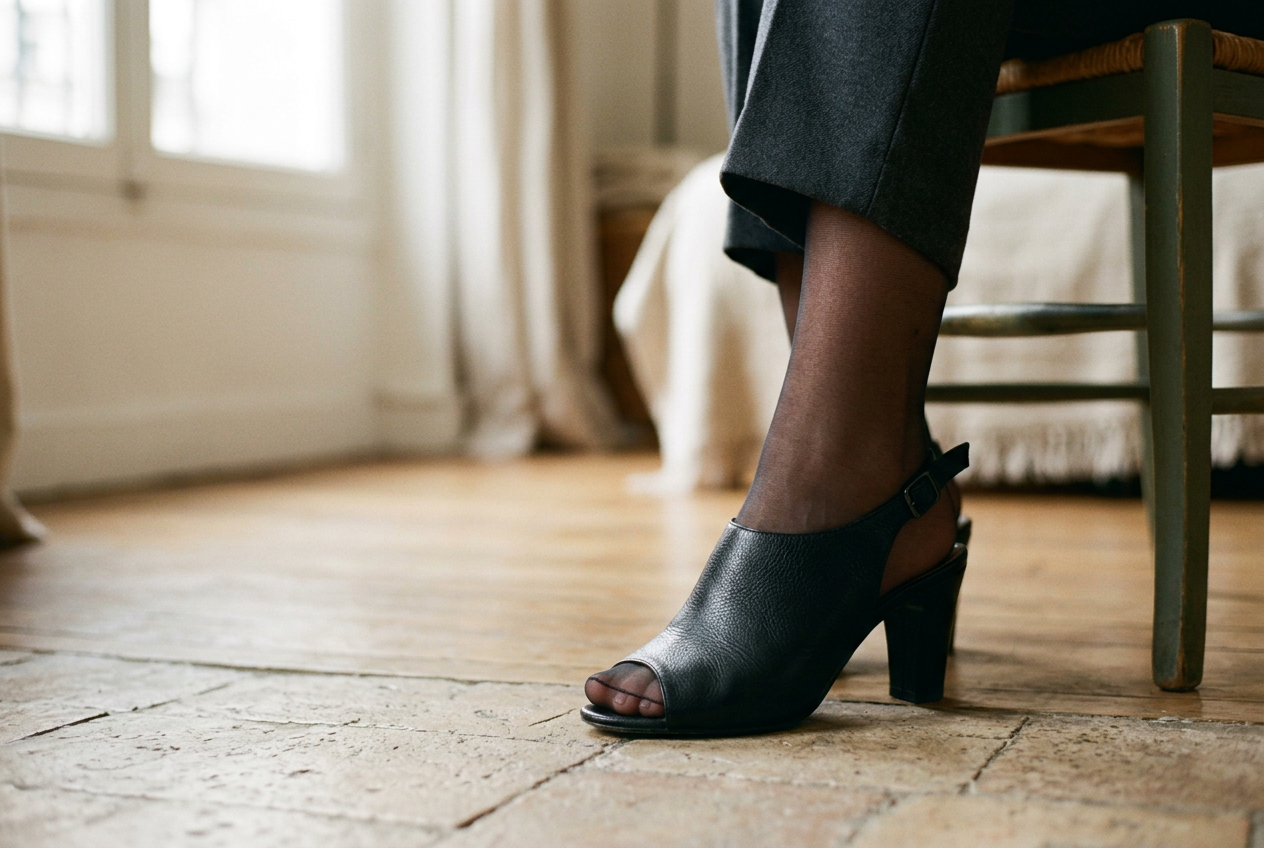
The workable versions frame the front toes with a broad opening and a yielding edge. Narrow, reinforced cutouts can turn into pressure points as the foot slides forward.
Women's · October 21, 2026 · 8 min read
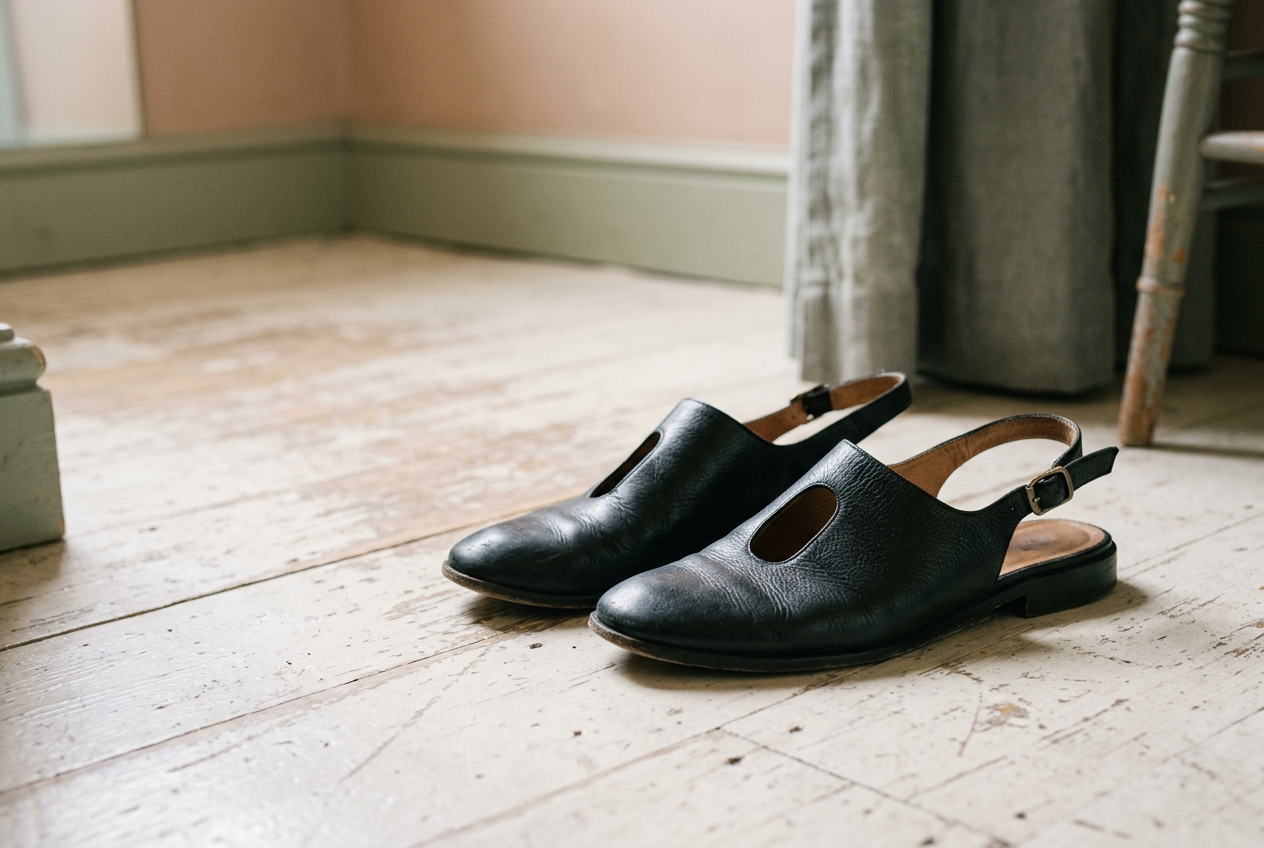
The shoe to keep in view is a black leather slingback pump appearing repeatedly in the current retail mix: a mid-height heel, a pointed vamp and a narrow oval cutout finished with a firm bound edge. It looks precise from above. Under walking pressure, though, that little oval has to manage the front of a foot moving downhill inside the shoe.
That is where the comeback divides into two quite different propositions. Some peep toes merely reveal the tips of the toes. Others use the opening as an exit point, allowing soft tissue to press against or through the edge with every step. The distinction is hard to see in a product image and easy to feel after several minutes upright.
This is women’s coverage, since the current return is concentrated in women’s pumps, slingbacks and heeled mules. The fit principle travels beyond those categories: an opening should frame the foot at rest and remain a frame while walking. If it starts behaving like a funnel, the shoe is too narrow, too steep or cut in the wrong place for that foot.
The narrow oval is the difficult version
A narrow peep toe has visual advantages. It preserves much of the uninterrupted line of a closed pump, makes a pointed shoe look less severe and gives just enough exposure to register as intentionally retro. It is also the version most likely to produce the familiar toe-squeeze problem.
Return to that black slingback. Its pointed last, meaning the foot-shaped form around which the shoe is built, narrows before the toes naturally do. The heel raises the back of the foot, while the slingback offers less rear containment than a full counter. As the wearer steps, the foot can shift forward and the oval edge meets whichever toe reaches it first.
Often that is the second toe rather than the big toe, especially when the opening sits centrally instead of following the foot’s shape.
A soft leather upper may disguise this mismatch during a seated try-on. Standing changes the evidence. The toes spread under body weight, then move forward as the heel lifts from the ground; if one toe begins to dome through the opening or the skin rises over its edge, more breaking in is unlikely to solve the basic geometry. Leather can relax across width.
It cannot relocate a cutout or make the shoe longer.
The narrow opening is therefore best treated as a demanding fit rather than an automatic rejection. It can work on a lower-pitched shoe, where pitch describes the downward angle from heel to toe, provided the vamp holds the foot without pinching and the aperture aligns with the first two toes. Add a high heel, a slick lining and a backless construction, and the margin becomes much smaller.
A squared opening gives the toes somewhere to go
The more wearable return is the wider, softly squared peep toe. Instead of concentrating pressure around a small oval, it exposes a broader section across the toe tips, and its corners tend to sit outside the point where the first and second toes advance. The shoe still reads as a peep toe, but the opening acts more like the front edge of an open-toe sandal.
Width alone does not settle the fit. A squared opening on a short shoe can expose too much toe, and a shallow toe box can press down from above even when the front feels open. The useful version leaves the toe pads supported by the insole, with only the ends visible. If the toes appear to be gripping the sole to stop the shoe slipping, the opening has not fixed the underlying instability.
This shape asks for a small aesthetic tradeoff. A broad square cutout interrupts the long line that makes a pointed pump look elegant, and on a delicate slingback it can read heavier than the narrow oval. That may be worth accepting. Under a wide-leg trouser or a midi skirt, only part of the front is visible anyway, while the extra room continues to matter after the first hour.
The squared opening also has a better chance of surviving the trend cycle. It connects with the longer movement toward wider toe shapes rather than depending entirely on a literal mid-century peep-toe reference. I would still hesitate over an expensive, sharply pointed version with a tiny aperture. The design is distinctive, but the cost buys finish and material rather than a guarantee that the opening will suit the foot.
Soft edges help, until they collapse
The edge finish is nearly as important as the cutout. On the reference slingback, a bound edge means the opening has been folded, stitched or wrapped to keep its shape. That can look clean and resist stretching, yet each extra layer creates a firmer ridge. If a toe reaches that ridge while walking, the pressure repeats in exactly the same place.
Soft nappa leather, a smooth and pliable leather made for close-fitting uppers, is usually more forgiving than patent leather or a heavily coated synthetic. Suede can also yield at the edge, although a thin unreinforced opening may curl outward with wear and begin to look tired. Woven fabric feels gentle in the hand but needs inspection: a stiff backing or hidden piping can make the visible textile softer than the structure beneath it.
Reinforcement is not bad construction. A peep toe needs enough support to stop its opening stretching into an uneven shape, particularly on a high heel where the foot repeatedly bears against the front. The better compromise is a broad opening whose edge feels rounded and compressible, with reinforcement set farther back inside the upper. Press the rim between finger and thumb.
A sharp, board-like response is useful information even before the shoe goes on.
Patent finishes deserve more skepticism in the narrow-oval format. Their shine makes the returning silhouette look deliberate, but the coated surface generally gives less readily than an uncoated leather, and a rigid edge can remain conspicuous against bare skin. A patent peep toe that fits beautifully from the start may be fine. Buying one that pinches in the hope of dramatic softening is a poor bet.
The fitting-room test is movement, not visibility
A good peep toe does not need to display a symmetrical row of toes. Feet are not arranged for the benefit of the cutout. The practical test is whether the opening stays in the same relationship to the toes when the wearer takes a full stride, turns and comes to a stop.
Try both shoes with the hosiery, if any, planned for them, then remain standing long enough for the foot to settle. Walk on the hardest permitted store surface rather than only carpet. On the reference black slingback, watch the second toe during the push-off phase, when weight moves through the front of the foot: if it advances into the oval and retreats again each step, the edge is working against motion rather than containing it.
Next, stop on a slight incline or use a fitting-area ramp if one is available. The foot should not surge forward. A slingback strap may need adjustment, but tightening it until it digs into the heel is not a sound way to correct a loose forefoot. The shoe needs to hold around the vamp, which is the upper section covering the front of the foot, without squeezing the toes together.
Sizing up is unreliable here. Extra length can increase forward sliding, leaving the same toes pressed through the opening while the heel becomes less secure. A wider fitting, a rounder last or a lower heel usually addresses the mechanism more directly. If none is available, the sensible alternative is a fully open square-toe sandal, where the front edge sits beneath the toes instead of surrounding them.
In the lower-priced high-street band, inspect both shoes for uneven binding and glue around the aperture. Contemporary and designer pairs may offer finer leather, cleaner lining and a more sculpted last, but price does not cancel the pressure created by a misplaced opening. Spend more only after walking establishes that the toes remain behind the frame.
The version worth considering
The useful peep toe for summer is less dainty than the comeback’s most photogenic example. Look for a low or moderate heel, a wider squared aperture and a soft leather edge with enough internal structure to retain its shape. A secure slingback is preferable to a loose mule when the insole is smooth, since it reduces the forward movement the opening has to resist.
That leaves the black pointed slingback with the narrow oval in an awkward place. It captures the trend cleanly and may fit a foot whose toe line matches it. For everyone else, the problem is not a failure to tolerate fashion or break in leather. The cutout is asking a moving foot to remain arranged like a still product photograph.
Questions people ask
Should toes stick through a peep-toe shoe?
Only the tips should be visible, while the pads of the toes remain supported by the insole. If a toe bulges through the opening, catches under its edge or moves in and out during each stride, the cutout is acting as a pressure point rather than a frame.
Will leather peep-toe shoes stretch enough to become comfortable?
Soft leather may relax across the forefoot and a rounded edge may become less rigid. It will not move the opening, add length or correct a steep pitch that drives the foot forward. A pair that already pinches around one toe should not be bought on the assumption that wear will remake its shape.
Are wide peep-toe openings always more comfortable?
They spread contact over a broader area, which usually reduces the focused pressure of a narrow oval. Comfort still depends on shoe length, toe-box depth and how securely the vamp holds the foot. A wide opening cannot compensate for a short sole or a loose mule that makes the toes grip while walking.
One update a day
Today's fashion update, in your inbox
One fashion update each morning — no hype, no filler, just pieces worth wearing.