Softer Fisherman Sandals Look Better. Check the Sole.
Fisherman sandals have moved into cream leather, metallic finishes and flexible soles. The update is easier to style, but some pairs trade away the structure that made the original useful.
Women's · October 16, 2026 · 8 min read
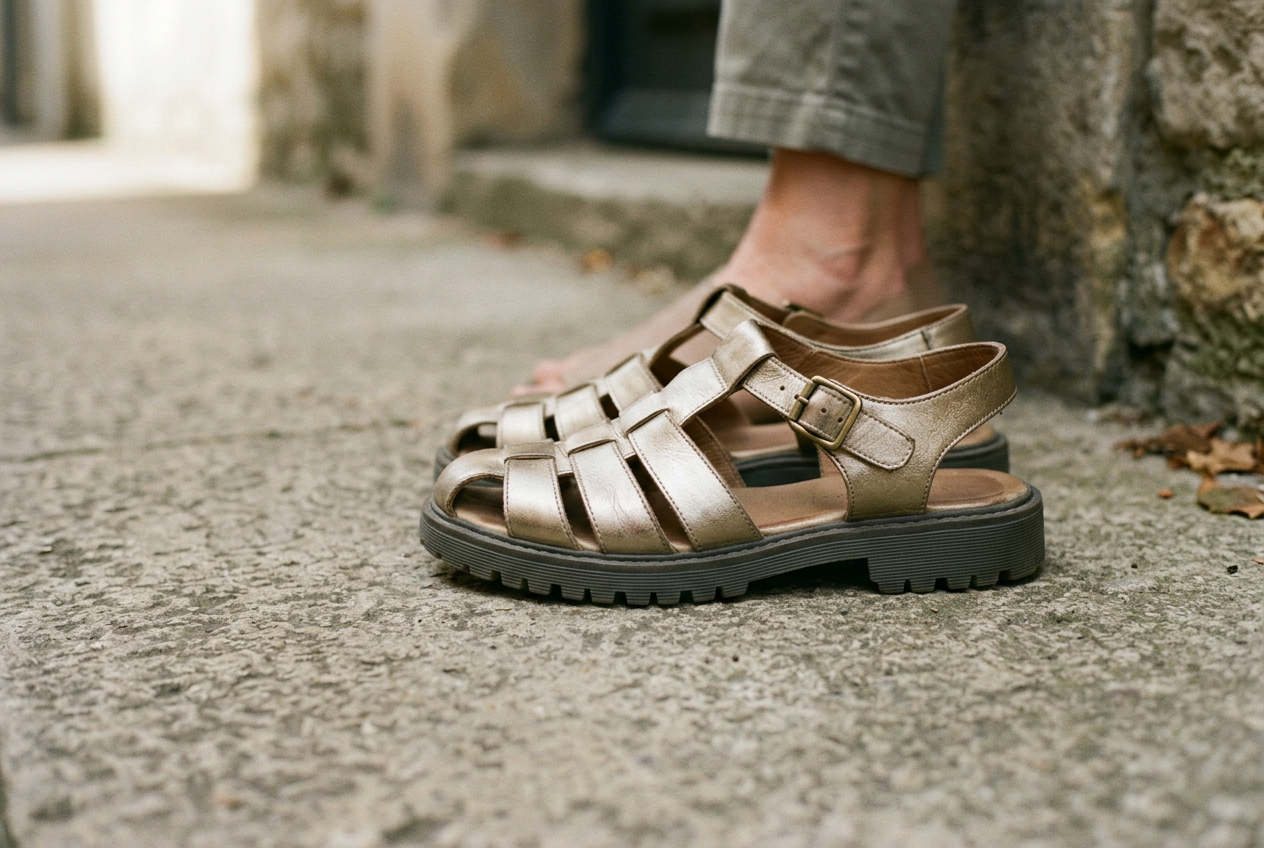
The pair I kept returning to while reviewing the current shift was the Clarks Sensa 15 Shine, a metallic leather fisherman sandal with an adjustable ankle strap, cushioned footbed and flexible thermoplastic rubber outsole. Thermoplastic rubber, usually shortened to TPR, is a molded material that can bend more readily than dense conventional rubber while still providing grip.
It captures what has changed. The fisherman sandal is no longer confined to heavy black leather over a deep lug sole, the version that worked with wide trousers and long dresses partly because it brought so much visual weight. The newer sandal is finer through the straps, softer underfoot and reflective rather than matte. It asks to be treated less like a practical cage shoe and more like an everyday summer flat.
This is women's coverage, although much of the construction advice carries across sizing categories. The fit observations matter most for women's assortments, where narrow heel cups, tapered forefeet and delicate ankle straps can make a shoe look lighter without making it more secure.
What the softer sandal changes
Current assortments across Clarks, COS, Madewell, Mango and multi-brand retailers show fisherman shapes spreading into cream, tan and metallic leather, alongside versions with slimmer soles and less aggressive tread. Some uppers retain the familiar closed basket of interlaced straps. Others open the pattern until they are only one or two bands away from a regular ankle-strap sandal.
That distinction matters. A traditional fisherman upper holds the forefoot from several directions, which limits sideways movement and protects more of the toes. Once the straps become thin and widely spaced, the shoe may keep the outline while losing much of that function. It can still look good.
It just should not receive automatic credit for being sturdy.
The Sensa 15 Shine sits in the useful middle. Its metallic upper makes the closed shape feel less severe, while the flexible sole avoids the stiff, heel-heavy step associated with some lugged pairs. With straight jeans, the shine supplies a deliberate finish without requiring a dressier shoe. Under a cotton skirt, the covered toe area has enough presence to balance fabric that falls below the knee.
A black chunky fisherman sandal can do both jobs, but it tends to dictate the rest of the outfit.
Cream and pale tan versions offer similar range, especially with washed denim, white trousers and printed dresses. Their weakness is less conceptual and more ordinary: pale straps collect grime at the edges, while footbeds darken where bare skin repeatedly meets them. A light sandal bought for its clean color needs more wiping and more careful storage than black leather, particularly if the lining is also pale.
Flexibility is useful until the shoe twists
A sole that bends at the ball of the foot can make a fisherman sandal comfortable sooner. That is a real improvement over a rigid platform that forces the heel to lift before the sole follows, often causing the back strap to rub during the first few outings.
Bend is not the only test. Hold the shoe at the heel and forefoot, then twist gently in opposite directions. Some movement is normal, but a sandal that wrings out with little resistance offers limited control when a foot lands on broken pavement or the sloped edge of a curb. The Sensa 15 Shine's flexible outsole is therefore the feature to inspect rather than accept on description alone.
Flex at the forefoot is welcome; easy twisting through the middle is less convincing.
Thickness also tells part of the story. A very thin outsole leaves less material between the foot and hot pavement, and it has less depth to lose before wear reaches the softer layer above it. Look from the side rather than judging the sole from the product's top view. The heel and forefoot should have enough substance to survive repeated contact, with tread extending across the places that strike the ground rather than appearing as a small decorative patch.
A softer footbed can disguise a weak sole during a brief indoor try-on. Cushioning compresses. It does not stop the sandal from twisting, nor does it protect the toe edge when the wearer catches it against a raised paving slab. For a pair intended for commuting, the outsole should carry more of the argument than the foam beneath the foot.
The alternative remains the lug sole, which usually brings better separation from the ground and a firmer platform. It also adds weight and can feel visually blunt with narrow trousers or lighter dresses. There is no need to retreat fully to that version. A moderately thick, flexible rubber outsole with a stable middle is the more useful compromise.
The upper has to hold its shape
Soft leather sounds universally preferable because it reduces break-in time. Around a fisherman sandal, however, the upper is also the frame. If every strap stretches, the forefoot can start sliding forward while the ankle buckle takes on work it was not designed to do.
Check the widest horizontal strap first. It should lie flat without cutting across the toes, and the foot should not bulge between adjacent straps when standing. Then lift the heel. If it rises noticeably before the back of the shoe follows, tightening the ankle strap may only create pressure at the buckle while leaving the heel unstable.
This is the main fit quirk of the softer update. Supple straps feel forgiving in the box, but leather relaxes with heat and movement, so a pair that already feels loose is unlikely to become more precise. The Sensa 15 Shine's adjustable strap gives the wearer room to refine the fit, yet the enclosed forefoot still needs to match the foot before that strap is fastened. An ankle buckle cannot correct excessive width at the toes.
Leather lining is worth seeking where the edges touch skin. It generally manages heat better than an unlined synthetic underside and tends to soften at friction points, although dyed leather can transfer color when damp. Exposed seams deserve attention as well. Run a finger beneath the strap junctions, particularly near the little toe and the inside of the foot, because a small ridge that seems harmless in a store can become the fixed rubbing point on a longer walk.
Metallic leather introduces another tradeoff. Its surface finish can make the sandal more adaptable for dinner or an office, but scratches may disturb the reflective coating rather than blend into the grain as they can on tan leather. Neutral leather cream is not a universal repair because it can dull or alter the metallic layer. A soft dry cloth and a product approved for metallic leather are the safer starting points; aggressive polishing defeats the reason for buying the finish.
Price should follow the construction
The broadening assortment now runs from high-street pairs priced below a typical premium sneaker to designer sandals costing several times as much. The middle of that span is where scrutiny matters most. A refined color and soft footbed can lift the price while the shoe still relies on a thin glued sole that is difficult to repair.
Look at the join between upper and sole. Cemented construction, meaning the upper is attached with adhesive rather than stitching around the perimeter, is common and not automatically poor, but it gives a repairer fewer straightforward options once a slim molded outsole separates or wears through. A clean, continuous bond is reassuring. Visible gaps, excess glue and an edge that lifts under light pressure are reasons to leave the pair behind.
For occasional restaurant, office and weekend wear, a lighter cemented fisherman sandal may earn its place through styling range. It can cover situations in which a lug sole feels heavy and a minimal strappy sandal feels exposed. Repeated city use sets a higher bar. The shoe needs a stable middle, replaceable heel rubber where possible, secure strap junctions and enough outsole depth to take abrasion.
That is where I remain undecided on the softest versions. The Sensa 15 Shine shows that metallic leather and flexibility can update the fisherman shape without stripping away all of its identity. Whether a given pair is worth roughly the price of a decent sneaker depends on a physical check that the online silhouette cannot answer: bend the forefoot, twist the middle and watch whether the heel follows the foot.
What to buy, and what to skip
Buy the lighter update if the forefoot feels held without pressure, the back strap stays up and the sole bends mainly where the toes bend. Cream or tan leather will give the widest daytime range, while metallic leather makes more sense for a wardrobe that needs the sandal to cross into evening.
Skip a pair that is loose before the leather has relaxed, twists easily through the arch or places hard strap edges against the little toe. Also pause if the sole is so thin that the upper appears to sit almost directly on the pavement. That profile may look elegant in a product image, but city wear is not kind to exposed toe edges or shallow tread.
The chunky black fisherman sandal is not fading because it stopped working. It is losing its monopoly on the shape. The softer version earns consideration when it keeps enough of the old structure to remain a walking shoe, rather than relying on a closed toe and buckle to suggest durability it does not have.
Questions people ask
Are flexible fisherman sandals supportive enough for city walking?
They can be, provided the sole bends at the forefoot but resists easy twisting through the middle. Check that the heel stays aligned, the ankle strap does not carry the whole fit and the outsole has enough thickness to separate the foot from hot or uneven pavement.
Should fisherman sandals feel tight when they are new?
They should feel secure, not tight. Leather straps may relax with wear, but pressure ridges, bulging between straps or pinching at the little toe are poor starting points. If the forefoot already slides forward, sizing down may shorten the shoe without fixing a width mismatch.
Do metallic fisherman sandals wear as well as plain leather?
The leather underneath may be durable, but the metallic surface can show scratches and scuffs differently from plain tan or black leather. Avoid ordinary colored polish unless the care instructions permit it. For heavy commuting, a matte leather is easier to maintain; for mixed daytime and evening wear, metallic has greater styling range.
Are chunky fisherman sandals more durable than slim ones?
Often, but not by definition. A deeper rubber outsole usually tolerates more abrasion and shields the upper from pavement, while a thick-looking platform can still fail if it twists or separates at the edge. Judge the sole's material, stability and attachment rather than its bulk alone.
One update a day
Today's fashion update, in your inbox
One fashion update each morning — no hype, no filler, just pieces worth wearing.