Fisherman Sandals Rub Hardest Where the Buckle Hides
A leather fisherman sandal can fit at the heel and still punish the foot under its buckle tab. Loosening the strap helps only if the forefoot stays put.
October 10, 2026 · 7 min read
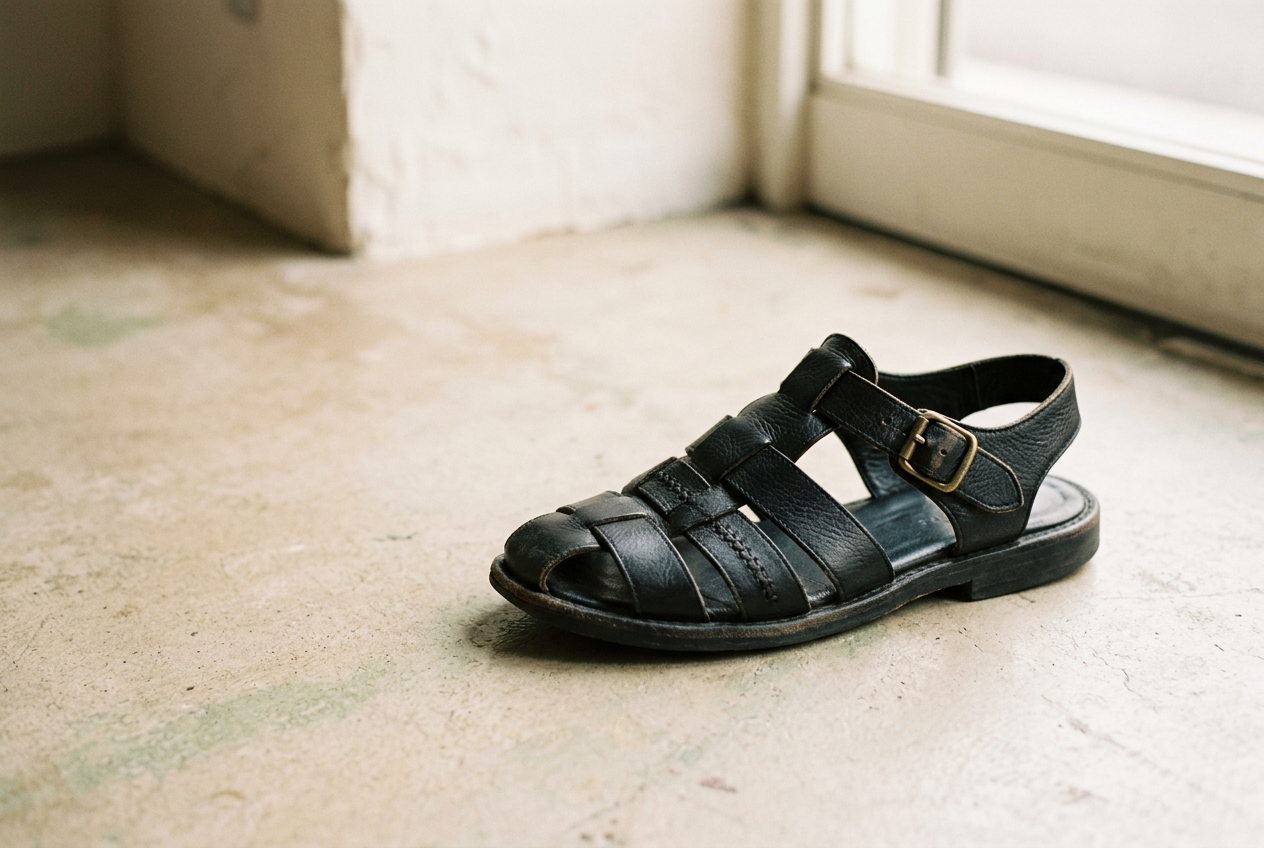
The pair behind this assessment is a black leather fisherman sandal with a closed woven toe, a leather lining, an adjustable outer-ankle buckle and a low rubber sole. I wore it across a week of ordinary use, first for short errands and then for a longer paved walk, mostly barefoot and once with thin socks.
This is unisex fit advice. The relevant measurements are foot width, instep volume and where the buckle lands, not which side of a store supplied the shoe.
The sandal looked settled almost immediately. The heel stayed inside the sole, the closed toe did not appear cramped, and the ankle strap had enough adjustment in both directions. After sustained walking, however, the buckle tab, meaning the short piece of leather beneath the metal buckle, pressed into the soft area below my outer ankle. It was not a dramatic blister factory.
It was the more irritating kind of failure: mild for twenty minutes, difficult to ignore later and positioned where every step repeated it.
The buckle is rarely working alone
A buckle can look guilty while the forefoot creates the pressure. On the evaluation pair, the leather tab sat flat when I was standing still, but walking pushed my foot forward until the instep met the woven upper; that movement pulled the ankle strap diagonally, tipping one edge of the tab into the foot.
The hardware itself never touched skin. That matters, because covering the metal or choosing a rounded buckle would not have solved this case. The leather beneath it had enough thickness to resist bending, while its cut edge sat precisely where the foot flexed and widened under load.
Many fisherman sandals use a broad tab to shield the foot from hardware. Broad sounds reassuring. In practice, a large tab can create more edge to encounter, especially if the buckle sits low rather than hovering near the ankle bone. Soft leather may conform after wear, but “break-in” is doing suspiciously generous work when the edge is already leaving a clear red line.
I first loosened the ankle strap by one hole. Standing comfort improved. Walking did not. The heel began lifting slightly, my foot traveled farther forward, and the tab met the foot at a lower angle.
The pressure had moved a little toward the side of the heel without disappearing. A looser strap had produced a roaming foot, which is not the same thing as a relaxed fit.
Tightening by one hole also failed, more efficiently. It held the heel down but increased the tab’s downward force, turning a delayed irritation into an immediate one. If adjacent buckle holes give you a choice between heel slip and a hard edge, the adjustment range is not fine enough for your foot in that shoe.
Strap crossings reveal the width problem
The evaluation pair’s woven upper used leather strips that crossed over the forefoot, with the lower layer stitched to the sole edge and the upper layer running toward the instep. Strap intersections feel thicker because two pieces occupy the same spot, and that extra bulk becomes noticeable when the foot expands during a longer walk.
My first pressure mark appeared below the buckle, but the second sat at the outer forefoot under a crossing. Those marks were connected. The upper was holding the widest part of the foot too firmly, so the foot could not settle backward after each step; the ankle strap then absorbed movement that should have been distributed through the shoe.
This is why a larger overall size is an unreliable fix. Going longer may put the strap crossing behind the widest part of the foot, but it also adds unused space at the toe and lets the heel shift. A wider fitting, when offered on the same foot-shaped base, is better than extra length because it changes room across the forefoot without moving every contact point backward.
Fisherman sandals are often built on a last, the foot-shaped form used to give a shoe its dimensions. If that form narrows early toward the toe, decorative openings between the straps do not make the shoe functionally wide. Air can get in. Your foot cannot negotiate with the stitching.
Press along each intersection during a fitting. A raised ridge that feels harmless under a fingertip may become the main contact point once body weight spreads the foot. Check the outer forefoot in particular, then bend the shoe at the ball and see whether a crossing folds inward. The leather on my pair creased toward the skin at one junction; wearing it longer softened the crease but did not change its direction.
The closed toe needs spare depth
The woven toe on the black pair looked roomy from above. Its trouble was vertical. During the longer walk, the top of my second toe brushed the lining where one strap passed beneath another, while the front edge remained clear.
That distinction changes the remedy. Sizing up helps a toe that reaches the end, but it does little for a toe rubbing against a low roof unless the larger size also gains depth. A shoe stretcher may create limited width in leather, although stretching a closed woven toe evenly is difficult because the straps, stitching and lined sections resist at different rates.
Thin socks reduced friction at the toe and made the buckle tab worse. The sock added a small amount of volume, lifting the foot closer to the upper and pushing it outward against the tab; meanwhile, its smooth surface protected the toe from the lining. One local improvement came with a new pressure point attached.
A closed toe should have enough depth for the toes to rise slightly during push-off, when the heel lifts and weight rolls through the front of the foot. Try that motion in the store rather than taking a few flat steps on carpet. If the toe roof touches before the shoe bends, an afternoon of walking is unlikely to negotiate better terms.
Adjustments that changed the fit
The useful adjustment on this pair was not at the buckle. I added a slim, noncompressible forefoot insole under the front half of the footbed for a short test, mainly to reduce forward travel. It stabilized the foot and eased the diagonal pull beneath the buckle, but it also reduced toe depth, so it was informative rather than wearable. The test showed that movement caused part of the problem; it did not create enough internal space to solve it.
A thin heel grip placed high at the back performed better. It reduced lift without forcing the toes forward and allowed the ankle strap to sit at its original setting. The buckle-tab pressure arrived later and with less force, though the outer strap crossing still pressed. This was an acceptable correction for a slightly loose heel, not a rescue for a narrow forefoot.
Conditioning the leather made the tab more flexible after it dried, but it did not erase the cut edge. Any conditioner should suit the leather finish and be tested somewhere inconspicuous, since darkening and surface change are possible. Sanding, trimming or cutting the tab would alter the shoe and make a return unlikely, which is a large commitment to a pair that has not proved itself outdoors.
A small adhesive patch on the underside of the tab can cushion a distinct edge. It also thickens the tab, and on the evaluation pair that extra bulk increased contact until the leather softened. Moleskin on the foot worked for one walk, although sweat and repeated flexing loosened it. That is useful emergency equipment, not evidence of a good fit.
The fitting test worth doing before purchase
Wear both sandals for more than a ceremonial lap. Fasten the buckle at the hole that holds the heel without pinning it, then stand long enough for the foot to spread and roll forward onto the ball several times. Look for a tab edge that tilts inward, a strap crossing that turns pale from tension, or a toe roof that moves with the toes beneath it.
Slide a fingertip beneath the buckle tab while standing. There should be contact without a sharp boundary. Next, hold the heel in place and push the foot forward gently; if the tab immediately rotates into the skin, the forefoot is moving more than the ankle adjustment can manage.
At the mid-market level, where leather fisherman sandals can cost roughly what a decent pair of sneakers does, alterations are a poor first plan. Choose a pair with a higher buckle position, a narrower and softer protective tab, or a more open heel arrangement instead. A model with an adjustable forefoot strap can be less visually tidy, but it gives width somewhere useful rather than asking one ankle buckle to control the entire shoe.
The black evaluation pair remained wearable for short outings. I would not choose it for a full walking day, because the heel-grip adjustment moderated the buckle pressure without fixing the strap intersection, and loosening the shoe enough to free the forefoot brought back heel movement. That is the practical line: a sandal can be broken in when the material is stiff, but not when the geometry repeatedly puts an edge in the same place.
Questions people ask
Why does my fisherman sandal hurt under the buckle?
The buckle tab may be tilting into the foot as the heel lifts or the forefoot moves forward. Check whether the metal itself touches skin, then watch the leather beneath it while you roll onto the ball of the foot. Pressure that appears during movement usually needs better foot stability, not merely a looser ankle strap.
Should fisherman sandals feel tight when new?
Firm leather can soften, but the shoe should not leave a sharp red line beneath a buckle tab or at a strap crossing. Toes need enough vertical room to lift during push-off, and the heel should stay controlled without the ankle strap bearing down. Distinct edge pressure is a fit warning, not a break-in requirement.
Can
I size up to stop fisherman sandals rubbing?
Size up only if your toes reach the front or the widest part of your foot sits ahead of the sandal’s widest point. Extra length can increase sliding and pull the buckle tab across a new patch of skin. For forefoot pressure, a wider shape or adjustable front strap is usually the cleaner answer.
Do socks prevent rubbing in fisherman sandals?
Thin socks reduce skin friction and can help beneath a closed toe, but they also add volume. On the tested pair, that extra volume lifted the foot into the buckle tab even as it protected the toes. Wear the intended socks during fitting and reassess every pressure point rather than assuming fabric fixes the whole shoe.
One update a day
Today's fashion update, in your inbox
One fashion update each morning — no hype, no filler, just pieces worth wearing.