Fine-Strap Fisherman Sandals Give Up More Than Bulk
The fisherman sandal is shedding leather and looking sharper. A weeklong comparison shows where finer straps improve the line, and where the old cage still works harder.
September 24, 2026 · 8 min read
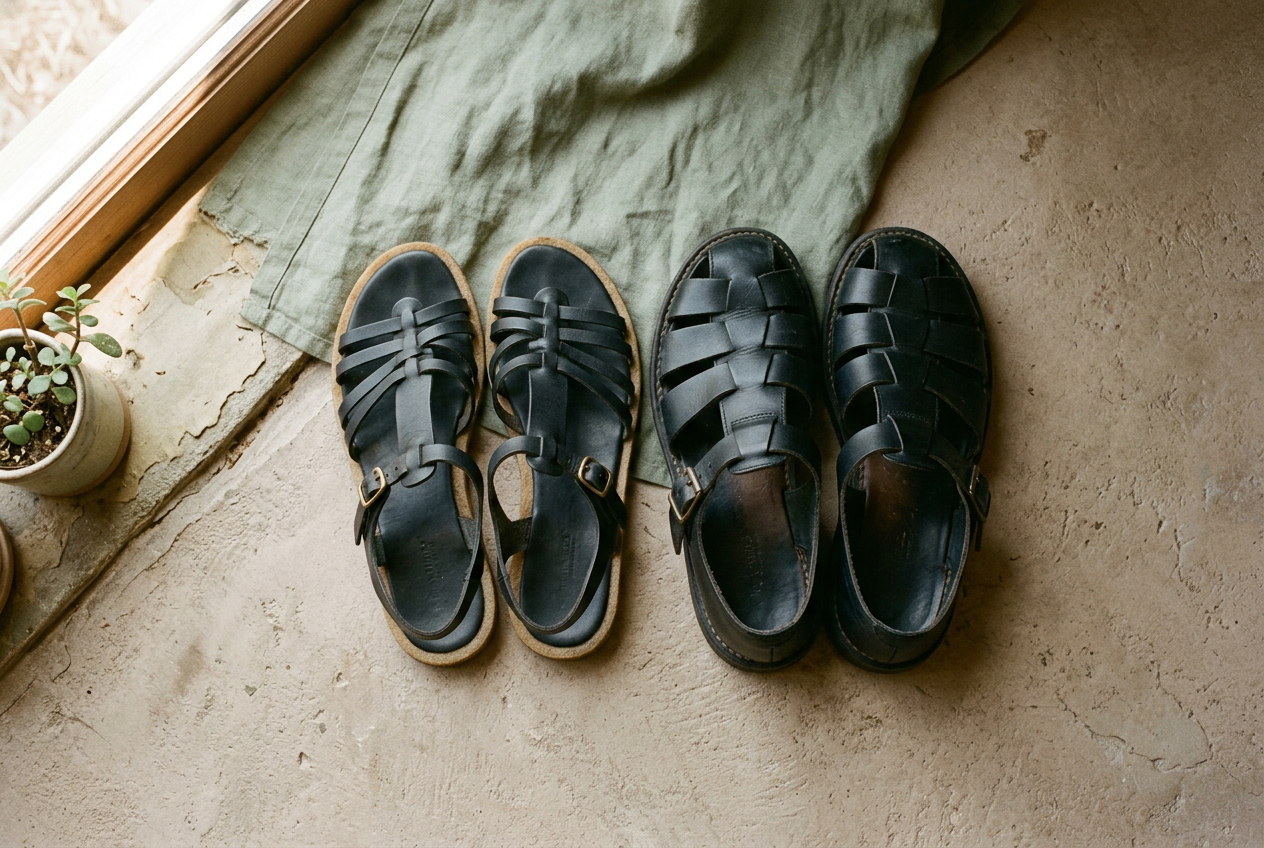
The pair at the center of this test was a black calf-leather review sample with five narrow cross-straps, an open heel and a thin rubber outsole. I wore it on alternating days for one week against a traditional black leather fisherman sandal whose broad straps formed a nearly closed cage over the front of the foot.
Both pairs were flat, leather-lined and secured by an ankle buckle. That is roughly where the resemblance ended.
The narrow pair looked cleaner with straight-leg pants and less heavy under a long skirt. On foot, however, its little-toe side opened under pressure, the forefoot moved laterally on turns, and the recessed buckle required sitting down and using both hands. The traditional pair was visually heavier. It also kept the foot where the maker intended.
That difference is the whole trend in miniature. The fisherman sandal is becoming finer, but refinement here often means removing the structure that gave the style a practical reason to exist.
The cage is opening up
A traditional fisherman sandal uses interlaced leather straps to build a cage over the toes and sides of the foot. The front may be fully closed or interrupted by small gaps, while the heel strap and buckle stop the foot from sliding backward. Unlike a simple strappy sandal, the upper spreads pressure across a larger area.
Newer versions preserve the recognizable woven outline but narrow each strip of leather, increase the space between straps and sometimes remove the closed toe panel. Soles are becoming thinner too. The result sits closer to a delicate city sandal than to the sturdy shoes associated with fishing, school uniforms or practical summer walking.
That visual change is useful. Broad fisherman cages can dominate a narrow ankle, especially in black leather, and their rounded fronts sometimes look blunt beneath fluid pants. The fine-strap sample avoided that problem. Its upper left enough skin visible to break up the dark leather, and the shallow sole did not interrupt the line of a calf-length hem.
It also exposed more foot than the product category suggests.
During the week, my fourth and fifth toes remained behind the front strap while standing still, but the smallest toe approached the outer gap whenever the foot flexed around a corner. Nothing dramatic happened. There was no blister. The repeated need to place the toe back inside the cage was enough to make the shoe feel less dependable than its name implied.
Toe coverage needs a moving test
A fisherman sandal can look secure in a mirror because the foot is unloaded and centered on the footbed, meaning the surface directly beneath the sole of the foot. Walking changes the geometry. Toes spread, the forefoot bends and the upper pulls diagonally as weight moves from heel to toe.
The most useful fitting-room check is therefore not the usual few steps in a straight line. Fasten both shoes, turn tightly in each direction, then rise onto the ball of one foot. Watch the outer toes rather than the ankle. If a toe presses into a gap, begins to slip under a narrow strap or reaches the edge of the sole, more walking will not improve the placement.
On the black fine-strap sample, the first cross-strap sat behind the tips of the toes rather than over them. This created an elegant open area at the front, but it also allowed the toes to advance when walking downhill. Tightening the ankle buckle reduced heel movement without changing that front placement, because an ankle strap cannot correct a cage cut too far back.
Foot shape matters more in this newer silhouette. A square forefoot, where the outer toes finish close to the length of the big toe, needs a straighter front edge and a wider final strap. A tapered foot has more room inside the same shape. Anyone whose little toe regularly escapes from woven huaraches should treat a widely spaced fisherman cage with similar suspicion.
This is unisex coverage, and the mechanics apply across wardrobes. The obstacle is availability: finer versions appear more often in women’s size runs, while men’s and extended-size offerings still tend to use broad straps and heavier soles. Converting sizes may change length, but it does not guarantee enough width through the cage.
Lateral hold disappears quietly
Lateral hold is the upper’s ability to resist side-to-side foot movement. A sandal does not need to grip like a trail shoe, but it should keep the forefoot from drifting over the edge of the sole when the wearer turns, crosses a sloped sidewalk or steps around someone.
The traditional comparison pair managed this through broad side straps that connected low to the sole. The fine-strap sample attached at similar points, yet each narrow strip flexed more and covered less of the foot. On level pavement it felt adequate. A quick direction change produced a small sideways shift before the leather caught up.
That delay may be irrelevant for a dinner sandal or an office commute with little walking. It matters on a travel day, when uneven paving and longer distances expose every loose part of the fit. A thick, cushioned footbed cannot solve it. Cushioning changes impact underfoot; it does not stop the foot moving across the shoe.
Leather quality influences how the problem develops. Calf leather can soften and conform attractively, while an unlined raw edge may become more pliable at the same point where the shoe needs resistance. Thin synthetic straps can hold their original shape, though their edges may feel harsher and the finish can crease rather than mellow. The relevant question is not whether a material is natural.
It is whether the strap remains broad and firm enough after repeated flexing.
After the test week, the sample’s outer forefoot strap had developed a pronounced bend where my foot pushed against it. The leather itself remained sound. The changed angle made the gap beside the little toe wider while walking, which suggests the fit issue would grow rather than settle.
The buckle can cancel the elegance
Fine straps leave less room for hardware. Some makers respond with a tiny conventional buckle, while others place a buckle near the inside ankle to preserve a clean outer profile. Both choices can turn fastening into the least refined part of wearing the shoe.
The sample’s buckle sat low beneath the ankle bone, partly screened by the heel strap. Closing it required threading a narrow leather tail through the frame and then finding a slim keeper loop. I could not do that reliably while standing. The traditional pair used a larger buckle farther forward, where the hole and prong remained visible.
A hidden elastic insert can help, allowing the buckled strap to stretch over the heel after the first adjustment. Check that the elastic returns firmly and that pulling the sandal on does not fold the heel strap inward. A snap fastening is quicker, though it gives fewer fit positions unless the strap also includes an adjustable buckle.
Buckle access belongs in the buying decision because it adds friction every time the shoe is worn. Someone who removes shoes at the door may stop choosing a pair that demands a chair and both hands, even if it looked convincing in the store.
Where the price starts to matter
Fine straps do not necessarily use less skilled labor. Narrow leather pieces need clean edge finishing, aligned spacing and secure attachment points, especially when the sole is too slim to hide bulky joins. Poor execution is easy to see: painted edges crack at buckle holes, straps twist before reaching the sole, or one side of the cage sits higher than the other.
At the lower end of the market, synthetic versions can cost less than an everyday sneaker. They make sense as an occasional styling shoe if the edges feel smooth and the straps recover after being bent by hand. A leather pair commonly occupies the territory of a decent leather sneaker, while designer versions can cost several times that amount without supplying more coverage or a more walkable sole.
The premium is not worth paying for thinness alone.
Look inside instead. A fully lined strap has a second layer against the skin, which can soften the edge and help it hold shape. Press near each point where the upper enters the sole; the strap should not wrinkle or lift independently. Inspect the outsole at the toe, since a very thin leather sole may look polished but offers little isolation from hot pavement and wears faster than rubber.
The black sample passed the finishing checks. Its strap edges were smooth, the lining stayed flat and the rubber outsole showed only light surface wear after the week. Its weakness was not poor manufacture. The pattern had allocated too much open space exactly where my foot needed restraint.
The refined version has a narrower job
For light walking, indoor wear and outfits where a traditional cage feels too heavy, the newer shape has a place. It works particularly well when trousers end above the ankle and the sandal needs to register as a line rather than a block of leather. A dark brown or muted tan pair also reduces contrast without requiring the straps to become extremely thin.
For long urban days, choose the less photogenic details: a closed or nearly closed toe, substantial side straps and a buckle that can be reached without folding forward. A sole with moderate depth will separate the foot from pavement without turning the shoe into a platform.
The middle ground may be the better buy. A fisherman sandal with moderately narrowed straps, small gaps and a proper front panel keeps much of the lighter appearance while retaining the cage’s function. The black test pair went farther than I would for regular walking, though its shape remained persuasive enough that I would not dismiss it as decorative. I would assign it a shorter day.
Questions people ask
Should fisherman sandals fit tightly at first?
They should feel secure rather than tight. Leather may soften, but a strap that compresses the toes or leaves a deep edge mark is unlikely to become well placed through wear. The heel should stay centered, and the forefoot should not move over the sole during a tight turn.
Are fine-strap fisherman sandals good for wide feet?
They can be, but width on the size chart does not reveal where the straps cross the foot. Look for a straight front edge, a broad outer strap and enough room for the toes to spread without entering the cage gaps. Sizing up may add unwanted length while leaving the same pressure points.
Do thinner straps make fisherman sandals more comfortable?
Not by themselves. Narrow straps may feel less enclosing and look lighter, but they concentrate pressure across smaller areas and provide less lateral hold. Comfort depends on strap placement, edge finishing and whether the upper keeps the foot centered once the leather begins to flex.
What is the best alternative if the delicate version feels loose?
Try a fisherman sandal with medium-width straps and a mostly closed front rather than abandoning the silhouette. A woven huarache offers a similar airy texture, but it can create the same toe-escape problem; the useful detail is a final strap that sits across the toes, not behind them.
One update a day
Today's fashion update, in your inbox
One fashion update each morning — no hype, no filler, just pieces worth wearing.