Brooches Are Leaving Lapels, but Fine Knits Pay the Price
Brooches now sit on sweaters, shirts, and bags, where pin thickness and ornament weight matter more than the styling shot suggests. Some fabrics need support; others are better left unpierced.
November 6, 2026 · 8 min read
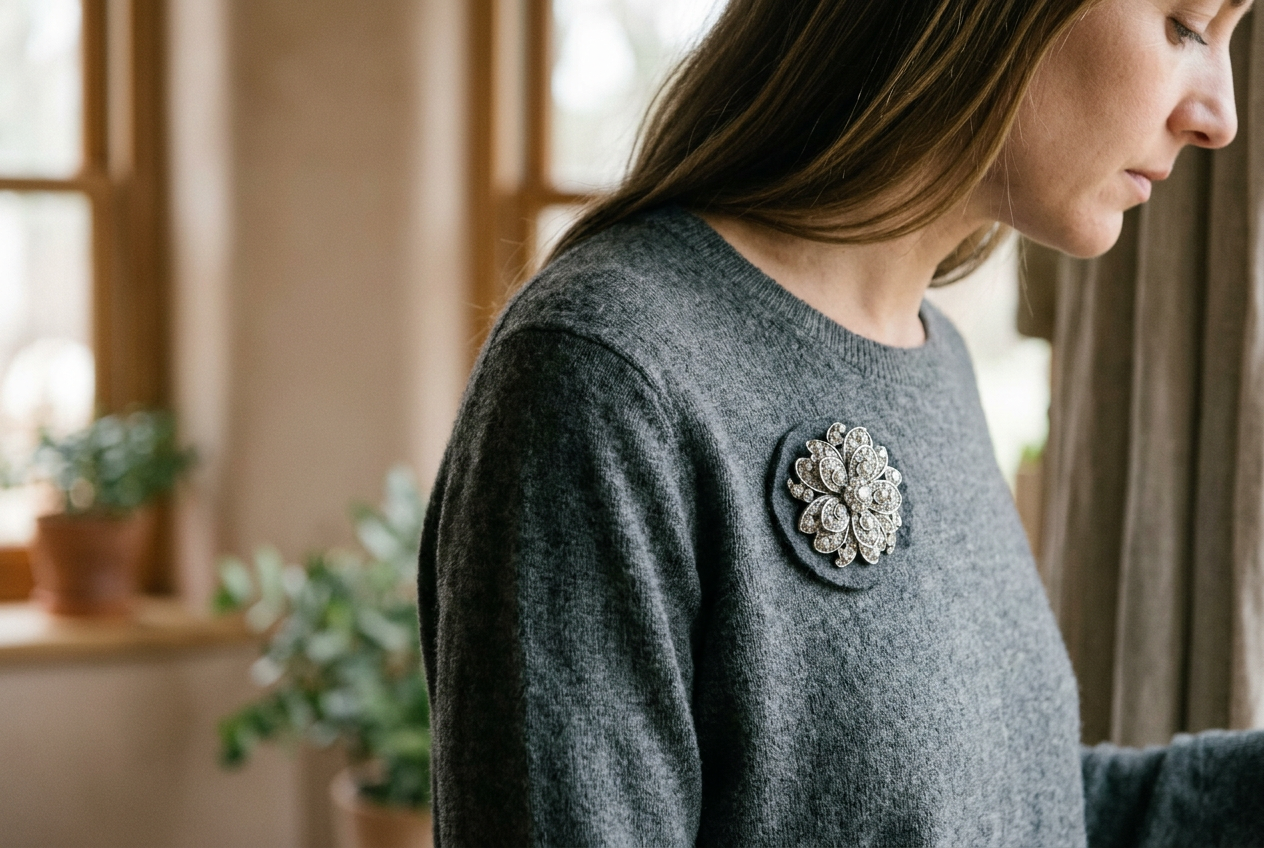
The brooch to keep in view is a palm-width, silver-tone flower with glass stones, a long steel pin, and a rollover clasp. It is substantial enough to feel satisfying in the hand and polished enough to change a plain crewneck. Placed high on the chest of a fine-gauge merino sweater, however, its lower petals tip forward while the knit gathers around the pin.
That small collapse explains the practical limit of the current brooch revival. Moving a brooch from a tailored wool lapel to a shirt collar or light sweater changes the structure underneath it, even when the outfit looks nearly identical in a photograph. A lapel has layers. Fine merino is a field of interlocking loops, and it stretches under a load.
This is unisex advice because the relevant differences are in the accessory and cloth, not the side of a department store where either was sold. A heavy military-style badge on a men's cardigan and a stone-set flower on a women's blouse pose the same construction problem.
Weight and pin thickness are separate problems
A brooch can damage fabric in two ways. Its pin can force apart or cut fibers, while its weight can pull the pierced area downward over several hours. Solving one does not solve the other.
Pin gauge means the thickness of the pin itself. Older brooches and pieces designed for coats may have a visibly stout pin, sometimes with a point that has dulled through wear. That pin can pass comfortably between the yarns of open tweed yet leave an obvious opening in dense cotton poplin. A sharper point reduces the force needed to enter the cloth, but it does not make a thick pin thin.
Before wearing the silver-tone flower, run the closed pin lightly across a cotton pad or an inconspicuous scrap of similar fabric. If it catches, the point may have a burr, meaning a rough raised edge that can snag fibers. Do not test it on the garment and hope for the best. A jeweler may be able to smooth or replace damaged hardware, although altering an inexpensive brooch can cost more than the piece warrants.
Weight shows itself after fastening. If the flower rotates, points toward the floor, or forms a basin of stretched cloth beneath it, the garment is not supporting the ornament. Shifting the piece closer to a seam can help, but a heavy brooch does not become light because it has been pinned higher.
Fine knits need a hidden second layer
Fine-gauge merino, cashmere, viscose knit, and lightweight cotton jersey are poor candidates for an unsupported stone-set brooch. Their loops move, which is useful for comfort and drape, but the same movement lets a pin opening widen under tension. A blunt point can also split a yarn rather than pass between loops, leaving a run or a fuzzy broken spot.
The least intrusive support is a small patch of firm fabric placed inside the sweater, directly behind the brooch. Felt works for an opaque knit because it grips and does not fray; a tightly woven cotton patch is flatter when bulk would show. The brooch pin passes through the sweater and the hidden patch, spreading the pull across a broader area instead of asking a few knit loops to carry the flower.
The patch should sit flat rather than bunch inside the pin. Lay the sweater on a table, position the support underneath, and close the brooch before putting the garment on. Fastening a long pin while the knit is already stretched across the body makes it easy to catch skin, scoop too little fabric, or distort the neckline.
Placement still matters. The upper chest near a shoulder seam usually has more stability than the center of a loose sweater, while a ribbed neckband may resist sagging but can retain a visible hole if the pin is thick. On the reference merino crewneck, the flower behaves better near the shoulder with felt behind it, though it still feels like an ornament being managed rather than an effortless everyday pin.
Chunkier knits are not automatically safer. An open cable or loose hand-knit structure may accept a thick pin without a puncture, yet a heavy brooch can stretch one loop far beyond its neighbors. Put the pin between yarns, never through a strand, and skip any placement that drags a cable sideways.
Shirts show holes before they show sagging
A crisp shirt can hold a light brooch surprisingly well at a structural point such as a placket, collar stand, pocket edge, or yoke seam. Those areas contain folded fabric or stitching, so they offer more resistance than the middle of a single-layer panel. A small stamped-metal pin at the collar is a different proposition from the glass-stone flower over one layer of poplin.
Cotton oxford cloth, denim shirting, and sturdy twill tolerate pinning better because their yarns and weave are relatively substantial. Fine poplin may retain two neat holes, particularly after pressing makes the surface look smooth again. Silk charmeuse and satin are worse bets: the pin can separate threads, pull a float, or leave a mark that catches light long after the brooch comes off.
Sheer fabrics offer nowhere to hide reinforcement. A backing patch will be visible, and the weight may make the whole panel collapse around it. For silk chiffon, organza, fine satin, or a blouse with a loose, fluid weave, the useful decision is often to move the brooch elsewhere. Pin it to a removable ribbon at the neck, a fabric belt, or a jacket worn over the blouse.
The reference flower belongs on the jacket in that outfit. Trying to make it work on the blouse adds risk without improving the line.
Bags can take a pin, but coatings cannot forgive one
Brooches on bags look practical because a bag does not stretch across the body, yet the surface material determines whether the hole closes. Canvas, dense denim, felt, and heavy woven wool are the most cooperative. Pin near a top edge or seam where the layers are firmer, while checking inside first so the hardware does not catch the lining or scratch what the bag carries.
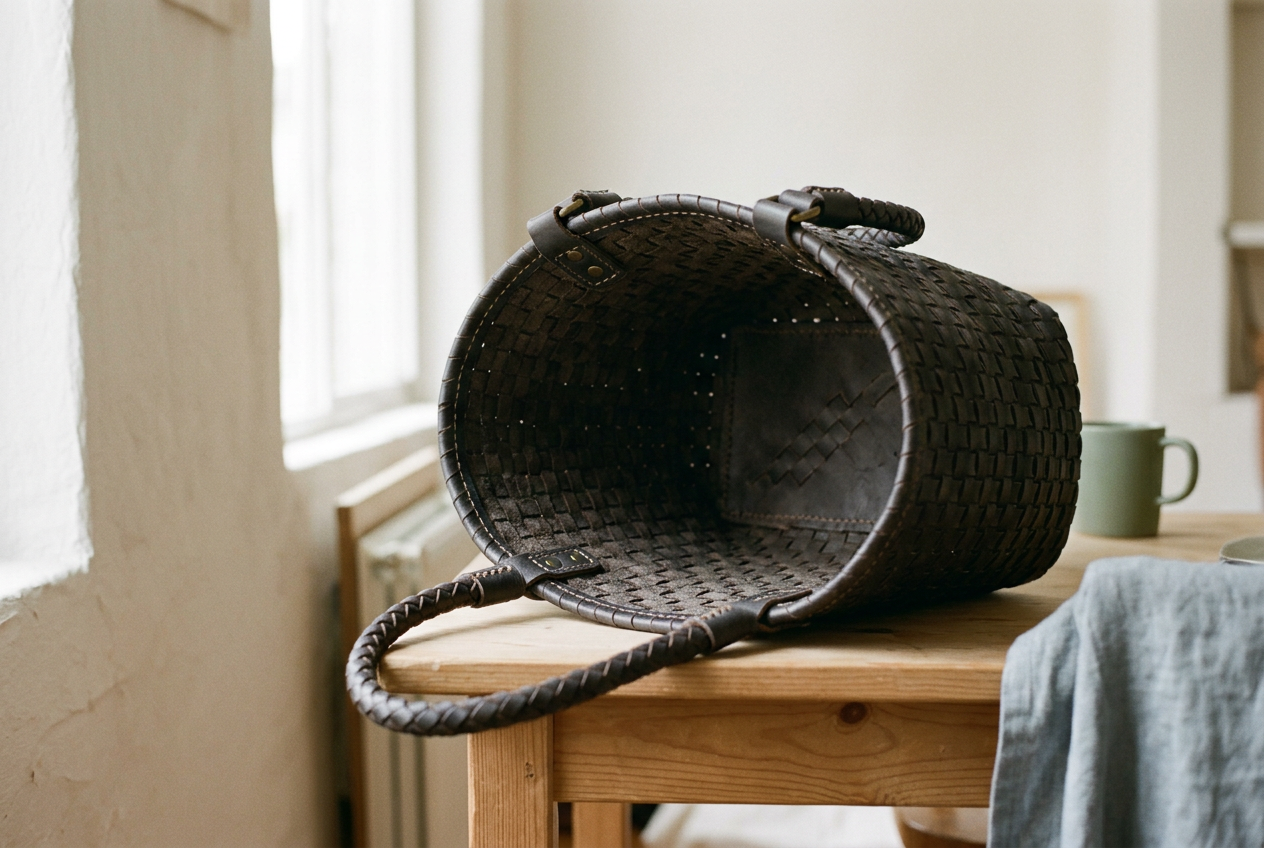
Leather, suede, faux leather, and coated or waterproof textiles should be treated as permanent-hole materials. A pin does not slide harmlessly between knitted loops on these surfaces. It punctures them. Coatings may crack or lift around the opening, and faux leather can begin peeling from a tiny damaged point.
Straps are also a poor shortcut. A brooch on a shoulder strap takes repeated pressure from the body, can open as the strap flexes, and may snag a coat or seat belt. If the bag needs an ornament, a lightweight brooch on a removable fabric tag gives the look without putting the bag itself at stake.
The silver-tone flower is too heavy for a soft, unstructured tote unless it has a firm canvas patch behind it. On a dense wool bag with accessible lining, it makes more sense. That distinction is less visible than color coordination, but it determines whether the styling survives a day out.
Clusters multiply punctures and weight
Clustered brooches are the most persuasive development in the trend: several small pieces can read as a composition rather than a single formal jewel. They also create several pin paths, and their combined weight can exceed that of one medium brooch even when no individual piece seems demanding.
Start with the lightest brooch at the least supported point, then keep heavier pieces close to a seam or reinforced area. Stamped metal, thin resin, fabric-covered buttons converted into pins, and small enamel pieces usually ask less of cloth than cast metal and glass stones. Do not overlap hardware at the back, where one clasp can press another open.
For a cluster on a knit, the sounder method is to arrange the brooches on a separate felt panel, wide ribbon, or removable collar and attach that carrier to the outfit at stronger points. The carrier may show, so it becomes part of the design rather than an invisible repair. It also prevents a sweater from accumulating fresh holes every time the arrangement changes.
Magnetic brooch backs avoid puncturing fabric, but they are not a universal answer. A magnet strong enough to hold the flower through a thick sweater adds weight and can still slide as the knit moves; on a thin blouse, the backing may create a visible hard circle. Anyone who needs to avoid strong magnets around a medical device should follow the device maker's guidance rather than treating magnetic jewelry as routine.
The trend works best when the brooch is chosen last
The old habit was to buy a brooch and find a lapel. The newer styling asks the accessory to travel among cardigans, shirts, scarves, and bags, which favors lighter construction and finer pins over the reassuring heft of a traditional statement piece.
When shopping, open the clasp and look along the pin before considering the stones. It should be straight, pointed, and long enough to take a stable bite of fabric without forcing the ornament to sit on the clasp itself. Check whether the front feels markedly heavier than the hardware behind it. A large hollow brooch may be easier to wear than a small solid casting.
The palm-width flower remains appealing, but it is not versatile. It belongs on tailored wool, dense canvas, or a reinforced knit, and the trend does not change that. A lightweight leaf in stamped metal will travel further through a real wardrobe, even if it looks less consequential in the jewelry tray.
Whether clustered brooches last beyond the current cycle is still open. The useful part may be the permission to move pins around; the less useful part is pretending every surface can take one.
Questions people ask
Can I wear a brooch on a cashmere sweater?
Yes, if the pin is sharp, the brooch is light, and a small fabric patch supports the cashmere from behind. Pass the pin between knit loops rather than through a yarn. A heavy stone-set piece that tilts or pulls the surface should move to a jacket, scarf, or reinforced carrier.
Will brooch holes disappear after washing?
Some openings in resilient knits relax after the surrounding loops are gently eased back into place and the garment is cleaned according to its care label. A severed yarn, snag, or puncture in silk, leather, coated fabric, and tightly woven shirting may remain. Never rely on laundering to reverse damage from a thick or rough pin.
Where is the safest place to pin a brooch on a shirt?
Choose an area with more than one layer, such as a placket, pocket edge, collar stand, or yoke seam, and keep heavy pieces away from unsupported shirt fronts. Test the pin on a hidden seam allowance or comparable scrap first. Fine poplin, satin, and silk can retain visible holes even at reinforced points.
How do I keep a heavy brooch from drooping?
Place a firm felt or tightly woven cotton patch behind the fabric, close the pin through both layers, and position the brooch near a seam that can share the load. If the ornament still rotates or gathers the garment, the fabric is too light for it. Move the brooch rather than adding a larger patch.
One update a day
Today's fashion update, in your inbox
One fashion update each morning — no hype, no filler, just pieces worth wearing.