Fisherman Sandals Get Tight Where Swollen Feet Hit the Cage
A closed leather cage can fit at breakfast and pinch by dinner. Check forefoot depth, strap position and lining seams before trusting a fisherman sandal for a full day.
September 9, 2026 · 8 min read
The useful fitting moment for a fisherman sandal is not the first minute in the store. It is the point late in the day when the foot has spread, the skin is warm and every decorative strip of leather has acquired managerial authority.
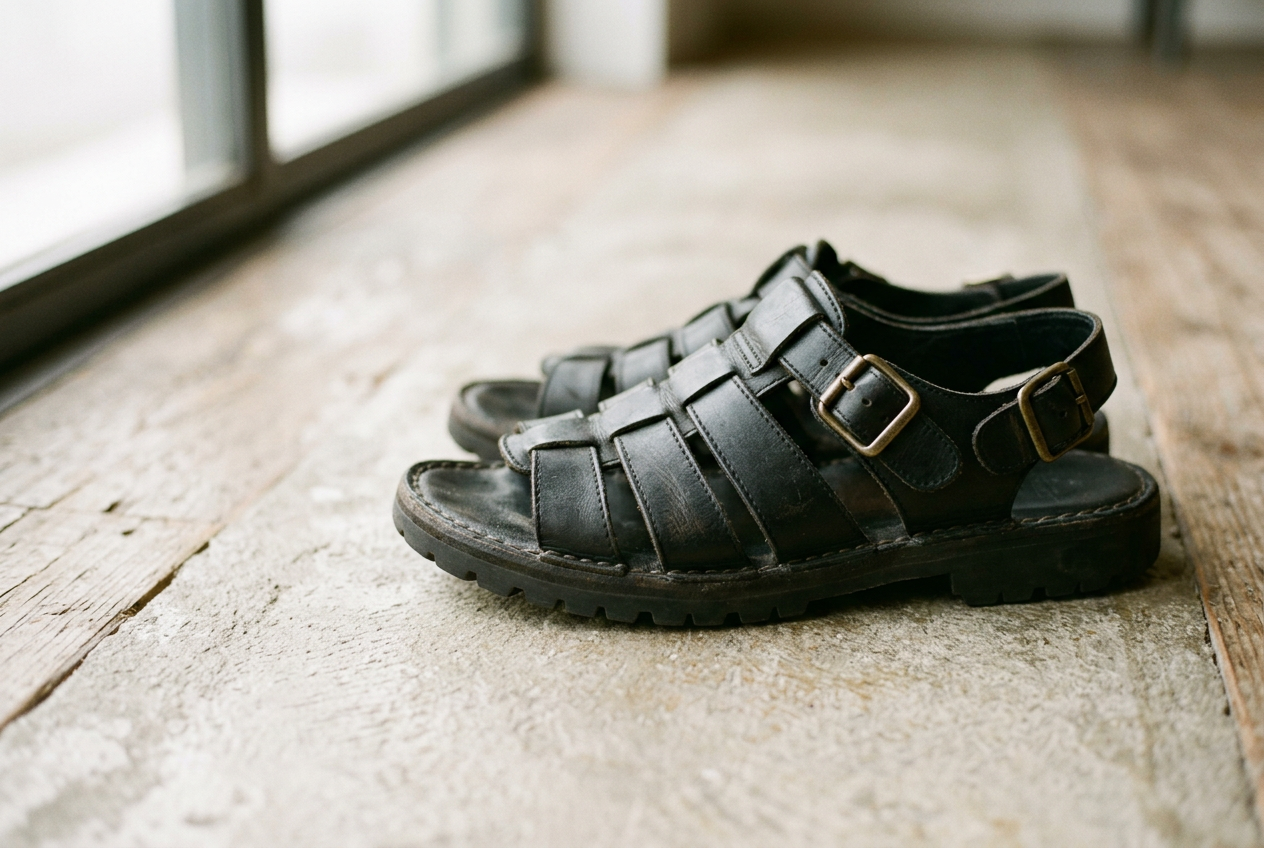
I used one black closed-toe fisherman sandal as the test case: a leather upper with five broad woven straps, a leather lining, an adjustable ankle buckle and a rubber sole. It looked roomy from above. On foot, the fourth strap crossed the widest part of the forefoot, while the closed woven toe prevented the toes from moving away from pressure.
The pair felt secure during a morning fitting. By late afternoon, the same size pressed across the forefoot and left a clear line where the lining seam sat under that fourth strap. The length had not changed, of course. The usable space had.
This is unisex fit advice. Foot volume and strap position matter more here than the department named on the box, although anyone crossing between men's and women's sizing should use the brand's own length chart rather than relying on a standard size conversion.
The cage can be long enough and still be too small
Forefoot volume means the three-dimensional space around the ball of the foot and toes, rather than width measured only across the floor of the shoe. A foot can fit neatly within the edges of a sandal yet press upward into its straps, which is exactly what happened in the black leather pair.
That distinction matters in fisherman sandals because their woven uppers divide the forefoot into small openings. An open slide lets a swollen foot rise without meeting much resistance. A closed cage puts a strap over each section, so pressure can appear above the big-toe joint, across the smaller toes or directly behind the toe cap even when the sole looks broad enough.
Start by standing in both sandals and looking at the straps, not the outline of the footbed. Leather should lie against the foot without being pulled into a rounded ridge. If flesh rises firmly between two straps during a morning fitting, the cage has already spent its swelling allowance. It may soften, but it cannot create unlimited internal height.
Length does not rescue this problem. Sizing up can move the widest part of the shoe away from the widest part of the foot, leaving extra space at the toe while the troublesome strap still lands in the wrong place. In the test pair, a longer footbed would not have changed the fourth strap's low position enough to justify heel movement and a less secure buckle fit.
Strap placement decides where the day goes wrong
The most important strap is usually the one crossing the ball of the foot, where the toes join the forefoot and the foot flexes during a step. Press a thumb lightly over that area while standing. There should be enough give to move the strap slightly without forcing a finger underneath or turning the exercise into minor upholstery work.
Next, take several full steps and watch the leather bend. A strap that sits just behind the flex point may remain calm; one placed directly over it can dig in whenever the toes bend. The black pair's fourth strap looked harmless while I stood still, then tightened at toe-off, the stage of a step when the heel lifts and weight moves through the front of the foot.
Also inspect the inside edge of every opening. Narrow strips tend to concentrate pressure, while broad straps distribute it over more skin, but width does not help if a firm edge lands on a toe joint. A polished leather edge can feel smooth to a fingertip and still become abrasive once heat, movement and swelling enter the arrangement.
The ankle strap has a different job. It should stabilize the heel without being tightened to compensate for an oversized or poorly shaped forefoot. If the buckle must be pulled hard to stop the sandal sliding, the footbed or heel shape may be wrong. Over-tightening at the ankle also makes the front cage feel more restrictive by holding the foot against the same pressure points on every step.
Lining seams are small until they are not
A lining is the material against the foot inside the upper. In a leather fisherman sandal, it may make rough strap backs feel cleaner and reduce direct contact with edge finishing, but every folded junction or stitched overlap adds thickness.
Run a fingertip under the forefoot straps and around the closed toe. The test pair had a seam tucked beneath the fourth strap, where the lining ended in a slightly raised edge. I barely noticed it at the first fitting. Once the foot pressed upward later in the day, that ridge became the most precise and least welcome part of the shoe.
Look for bulky overlaps, exposed thread ends and changes in texture. Pay particular attention beside the little toe and over the big-toe joint, where a seam can sit against bone rather than softer tissue. Socks may soften the contact during a fitting, but if the sandals will usually be worn barefoot, test them that way within the retailer's try-on rules.
Padding is not an automatic fix. A cushioned lining occupies room, and a plush strap that feels pleasant for ten minutes can reduce the cage's internal volume. In a close-fitting design, thin and smooth may be more useful than thick and soft.
Test the afternoon foot, not the optimistic morning one
Try fisherman sandals after several hours upright, ideally when the feet have already done an ordinary amount of standing and walking. This does not require a punishing shopping expedition. It requires avoiding the fiction that the foot at 9 a.m.
represents the foot carrying you home.
Wear the sandals indoors on a clean surface for as long as the return policy permits. Stand, bend the toes, walk at a normal pace and remain still for a few minutes, because pressure sometimes announces itself faster during standing than walking. Check the skin immediately after removal. A light temporary imprint can occur with close straps; a deep line, burning spot or numb area means the fit is relying on your foot to surrender first.
Repeat the thumb check across the widest strap late in the trial. On the black pair, the morning movement had almost disappeared by afternoon, and the strap edge no longer shifted independently of the foot. That was the deciding evidence. Waiting for leather to stretch would have meant paying full price for a break-in period with no reliable finish line.
Leather, soft synthetics and open cages trade different things
Leather uppers can mold with wear, especially when the leather is supple and uncoated, but stretching varies by thickness, backing and construction. A lined, structured cage will usually yield less freely than a single layer of soft leather. The closed black pair had enough body to preserve its shape, which looked polished and also kept the pressure exactly where it started.
Leather usually sits in the higher price band of this category, from the territory of a decent pair of sneakers upward, depending on construction and brand. That premium may buy better finishing and repair potential. It does not buy extra forefoot volume unless the pattern includes it.
Soft synthetic straps can be more forgiving from the first wear, particularly when they flex rather than hold a rigid molded shape. They can also trap heat, stretch unevenly or develop tacky friction against damp skin. Check the underside rather than judging softness from the display-facing surface, and bend each forefoot strap to see whether the edge remains stiff.
A more open fisherman design is the cleaner answer when swelling is predictable. Look for fewer straps over the widest part of the foot, a genuinely open toe or adjustable forefoot sections. You lose some of the traditional closed-cage effect and a little protection from pavement debris, but you gain somewhere for the foot to go. That is a useful trade, not a styling defeat.
The fitting checklist
- Shop with a used foot. Try the pair later in the day, after normal walking or standing, rather than immediately after getting up.
- Check volume while standing. The foot should not bulge firmly between cage straps, and the strap over the ball of the foot should retain slight movement.
- Match the flex point. Walk far enough to see whether a strap folds or tightens where the toes bend. Static mirror approval is insufficient evidence.
- Trace the lining. Use a fingertip to find raised seams, folded edges and thread ends, then compare their positions with toe joints and pressure-prone areas.
- Test barefoot if that is how you will wear them. A try-on sock can conceal friction and consume space in ways that do not represent the eventual outfit.
- Reject compensatory buckling. The ankle strap should hold the heel without dragging the foot backward or requiring the tightest hole.
- Choose the material for the existing fit. Buy leather when the cage already has room and you want structure; choose a flexible synthetic or more open upper when the foot needs immediate give. Do not assign leather an unpaid job as a shoe stretcher.
For the black pair, the checklist ended at the lining seam and disappearing thumb room. The correct alternative was not the next size. It was a less closed cage.
Questions people ask
Do leather fisherman sandals stretch across the forefoot?
Leather can soften and mold, but the amount depends on its thickness, lining and finish. A lined closed cage may give only modestly, while its seams and strap edges remain in place. Buy for a comfortable standing fit now, with visible spare volume, rather than for a painful fit that might improve.
How much room should fisherman sandals have for swelling?
There should be slight movable space between the foot and the key strap across the ball of the foot when standing later in the day. The skin should not bulge firmly through the openings. Extra sole width alone does not count if the upper presses from above.
Are synthetic fisherman sandals better for swollen feet?
A soft, flexible synthetic can forgive changing foot volume sooner than structured lined leather, but molded or sharply edged synthetics may be just as restrictive. Bend the straps, inspect the underside and test for heat or tacky friction. A more open pattern is often more dependable than changing material alone.
Should
I size up in closed-toe fisherman sandals?
Size up only if the brand's next size places the forefoot correctly and still holds the heel. Added length can create sliding without moving a badly placed strap. If the cage presses across the widest part of the foot in the correct length, switch width, construction or design instead.
One update a day
Today's fashion update, in your inbox
One fashion update each morning — no hype, no filler, just pieces worth wearing.