Slim Fisherman Sandals Look Lighter but Lose Toe Protection
Fine straps and thin soles make the fisherman sandal easier to style, but they reduce its protective, adjustable character. Here is what earns the cleaner look.
Women's · August 22, 2026 · 8 min read
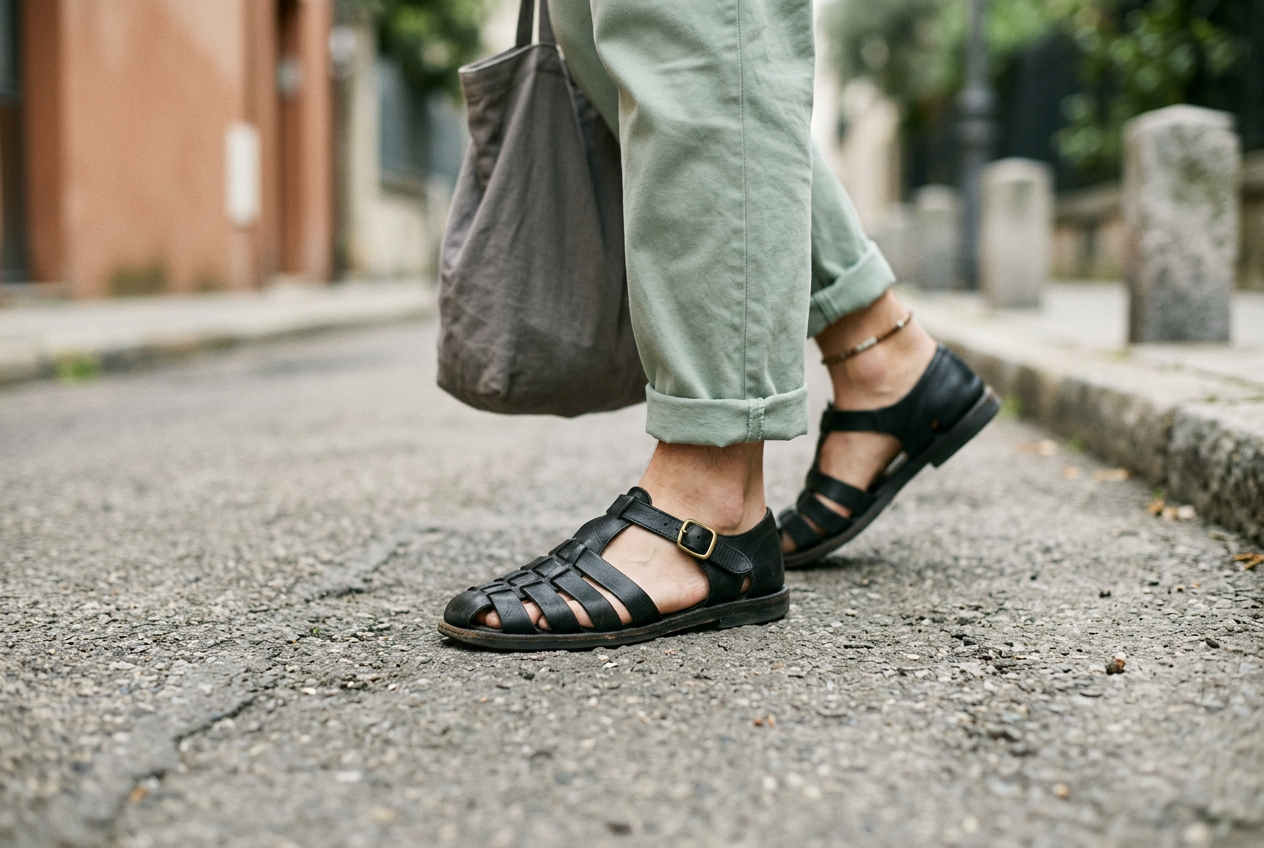
The pair that clarified the shift for me was Ancient Greek Sandals’ Homeria, a leather fisherman sandal with a closely woven forefoot, a buckle at the ankle and none of the visual ballast of a lug sole. I wore the black version in my usual women’s size through a week of ordinary summer use, including errands, public transit and an afternoon that required more standing than planned.
It looked composed throughout. The surprise was how quickly the familiar fisherman shape stopped behaving like the practical sandal it references.
This is women’s coverage, although most of the construction advice applies to any similar caged sandal. The main fit issue is less about gender than foot volume: a narrow-looking upper may still hold a broad forefoot if its straps are long enough, while delicate straps cut short can pinch even a slender foot.
The cage is becoming an outline
A traditional fisherman sandal uses broad interlaced straps to form a cage over the toes, usually with a substantial sole below. That cage does useful work. It spreads contact across the foot, keeps toes from reaching the outer edge and softens minor knocks against curbs, chair legs and other feet.
On the Homeria, the leather weave still covered more of the forefoot than an ordinary strappy sandal, but the protection was partial. The toe sat near the front edge, and the slim sole did little to absorb contact from below or from the side. A fine strap can stop a toe from sliding through a gap; it cannot imitate a broad leather panel backed by a raised sole wall.
That distinction matters in current slimmer versions, where brands retain the closed-looking shape while reducing the amount of material around it. From above, the shoe reads as sheltered. During a crowded commute, it behaves closer to an open sandal.
The update is useful if the older, heavier cage made the style feel orthopedic or visually dominant. Fine straps reveal more skin, sit more easily under a fluid trouser hem and do not compete with a long skirt. The loss is physical rather than aesthetic: less leather stands between the foot and the day.
Look at the front in profile, not only from above. A toe cage that extends past the toes, paired with an outsole that rises a little around the edge, still offers meaningful coverage. If the toes sit level with narrow straps on a nearly flat sole, most of the protective effect is photographic.
Thin soles flex sooner and tire sooner
The Homeria became easy to bend almost immediately. That was pleasant on smooth floors and short trips because the sandal followed the forefoot rather than making the foot lever against a rigid platform. Flex, meaning the shoe’s ability to bend where the foot bends, is one genuine benefit of the refined silhouette.
A thin sole can still resist twisting, however, and that difference is worth testing. Hold the heel in one hand and the forefoot in the other. The sandal should bend across the ball of the foot, but it should not wring out through the middle with almost no resistance. That central stability matters once the ground becomes uneven or the wearer is tired.
By the longer standing day, the Homeria’s low-profile construction transmitted more pavement than its woven upper suggested. The sensation was not sharp pain or a dramatic failure. It was cumulative fatigue, especially under the heel and forefoot, where a chunkier fisherman sandal would usually place more rubber, foam or molded footbed between the body and the ground.
Sole thickness alone does not guarantee support. A deep slab of soft foam can collapse, and a heavy rubber sole can stay stiff in the wrong place. Still, the current thinning trend often removes cushioning without adding a shaped footbed, a firm heel area or stronger midfoot structure, which means the buyer gives something up while receiving little beyond a cleaner side view.
A slim outsole with a rubber contact layer is a meaningful refinement. A leather sole left exposed at the forefoot is elegant but less reassuring on wet tile, and it wears faster when used as everyday summer footwear. If the sandal is intended for dinners and office days, that may be acceptable. For travel, commuting or several hours on foot, it is a poor exchange.
More straps do not mean more adjustment
The fisherman upper appears highly adjustable because it is made from many pieces. Most of those pieces are fixed.
On the Homeria, the ankle buckle controlled whether the heel stayed attached to the shoe, but it did not loosen the woven forefoot or change the pressure over the instep, the raised upper surface of the foot. The forefoot fit therefore had to be right from the start. During the week, the leather relaxed enough to feel less insistent across the widest point, yet the sandal did not become a different width.
This is where some refined updates earn their place. A hidden elastic section near the buckle can reduce pulling when the foot flexes. A second functional buckle over the instep can accommodate swelling and different foot volumes. Straps anchored separately into the sole can distribute pressure better than a decorative weave stitched onto a narrow base.
By contrast, a finer ankle strap often creates the appearance of delicacy while concentrating force over a smaller area. If the heel lifts, tightening that strap may stop the movement, but it can also leave a hard line around the ankle. A broader back strap or a properly cupped heel solves the underlying problem with less tension.
Try the sandal late in the day, when feet are more likely to be warm and expanded. Fasten it firmly enough to control the heel, then check whether the front strap still allows the toes to spread. If the only workable setting is the final buckle hole, the adjustment range is already spent.
Support has moved out of sight
Chunkier fisherman sandals announce their engineering. Their tread, heel depth and broad straps are visible. A refined pair has to hide the same work, or accept that it is becoming an occasion sandal.
The useful details are quiet: a footbed with a shallow heel cup, meaning the heel sits inside a shaped depression rather than on a flat sheet; a little firmness through the middle; smooth lining where strap edges meet skin; and enough outsole under the toe that the foot does not overhang during a downhill step. None makes the shoe look substantially heavier from above.
The Homeria’s appeal remained strongest when the day was controlled. It worked with a straight cotton trouser, a soft midi skirt and a plain dress without making the outfit look grounded by a large black sole. That styling range is real. It is also separate from all-day performance.
For a one-sandal vacation, I would move back toward the chunkier end: broad straps, a contoured footbed and a rubber outsole with visible depth, even if the result photographs heavier. For office wear, dinners and shorter city trips, the refined form makes sense, particularly when the leather is soft and the heel stays centered without aggressive buckle tension.
Where the money should go
Slim fisherman sandals now appear from high-street retailers through contemporary labels and into luxury pricing. The silhouette does not become more supportive with price, and an unlined strip of expensive leather can still rub.
At the lower end, inspect the strap edges and attachment points. Painted edges should feel smooth rather than sharp, and the straps should enter the sole cleanly without stiff ridges beneath the foot. Synthetic lining is not automatically a problem, but it can hold heat; a rough exposed underside is more likely to become irritating as the foot swells.
In the middle price band, expect better leather, a more considered footbed and an outsole that can handle repeated street wear. That is the sensible area for a pair intended to work several days a week. Paying luxury prices for a thin leather sole, minimal padding and a recognizable shape may still be a style decision, but it is not an investment in greater walking capacity.
The Homeria passed the finish test more convincingly than the endurance test. Its woven leather made the slimmer fisherman sandal feel deliberate rather than flimsy, and it softened without losing its shape during the evaluation week. The limited adjustment and low amount of material underfoot remained unchanged. Leather can settle around a foot; it cannot turn a flat sole into a supportive one.
A five-minute store test
Start by checking where the longest toe ends while standing, with full weight on the foot. A small margin is useful, but a long empty extension can catch the ground and alter the refined proportion that attracted you in the first place.
Walk quickly enough to make the heel work. If it drifts sideways, first adjust the ankle strap; if the drift continues, the shape of the footbed is wrong, and tightening further will only move pressure to the skin. Then stand on one foot for a few seconds. Excessive wobble exposes a narrow base or a sole that twists too freely.
Finally, press the forefoot straps with a thumb and inspect the marks after walking. A brief impression is normal. A deep line, numbness or a toe forced beneath a neighboring strap is a fit failure, not a break-in project.
The slimmer fisherman sandal is worth buying when it preserves a stable base, usable adjustment and enough rubber for the intended day. Fine straps are a welcome visual edit. A thin sole with no hidden structure is mostly an edit to the photograph.
Questions people ask
Are slim fisherman sandals comfortable for all-day walking?
Some are, but fine straps and a flat sole do not create all-day support by themselves. Look for a shaped footbed, resistance to twisting, a secure heel and rubber beneath the forefoot. If the sandal feels like a leather sheet underfoot in the store, it is better reserved for shorter days.
Should fisherman sandals fit tightly at first?
The leather may soften, but the toes should lie flat and the forefoot should not feel compressed. A secure ankle is useful; deep strap marks or numbness are not. Buy for the foot’s current width and volume rather than expecting fixed woven straps to stretch into a full size adjustment.
Do thin soles make fisherman sandals more flexible?
Usually, although the useful kind of flexibility occurs across the ball of the foot. A sandal that twists easily through its center may feel free at first and tiring later. Bend the forefoot, then test the middle separately before deciding that softness equals comfort.
Are chunky fisherman sandals already out of style?
No. The slimmer version is rising because it works neatly with fluid trousers, skirts and less casual summer clothes, but chunkier pairs remain the practical choice for travel and long walking days. A moderately deep rubber sole will also date more slowly than an extreme platform or an almost paper-thin one.
One update a day
Today's fashion update, in your inbox
One fashion update each morning — no hype, no filler, just pieces worth wearing.