Fisherman Sandals Protect Toes, but Long Walks Expose the Gaps
A woven leather toe cage offers useful coverage without the sealed fit of a sneaker. Flex, buckle placement, grit, and heat decide whether it remains pleasant beyond lunch.
August 19, 2026 · 8 min read
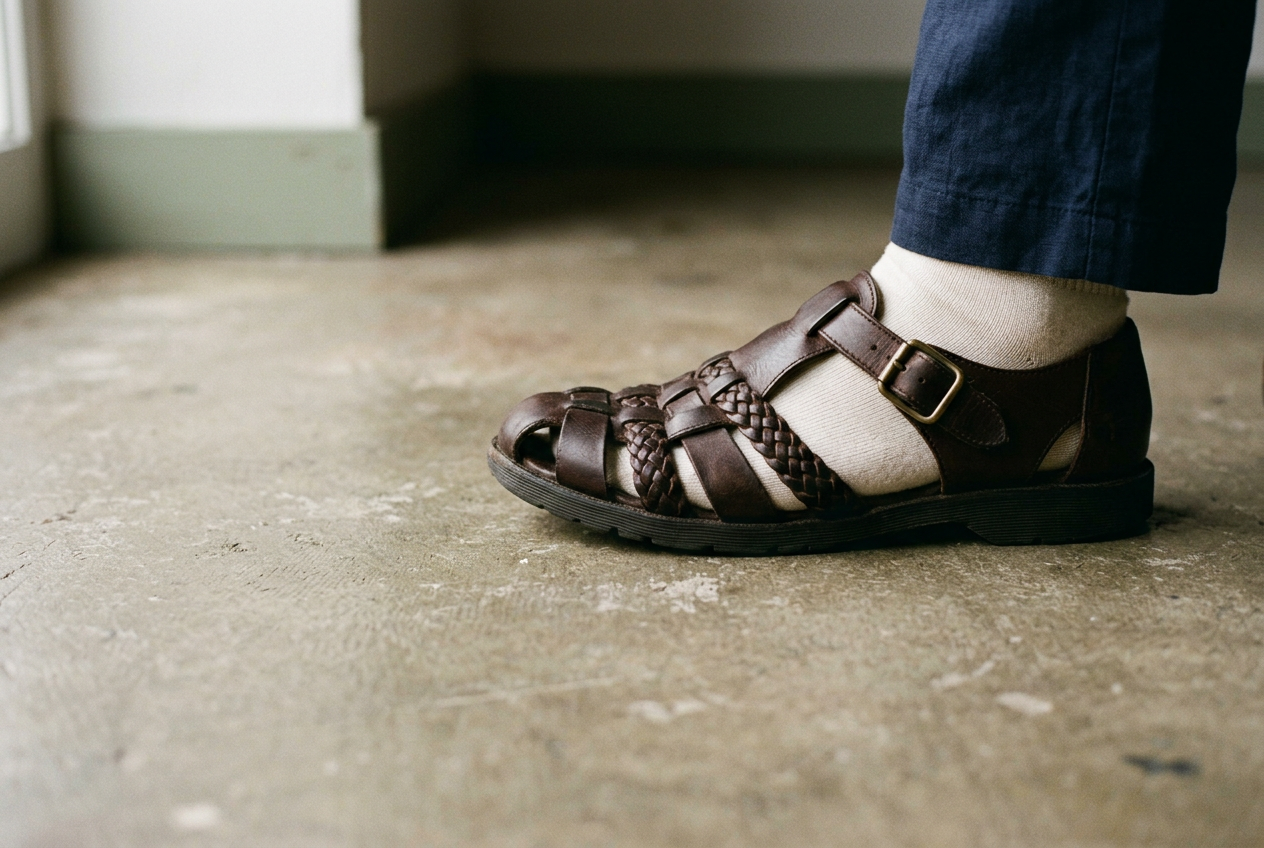
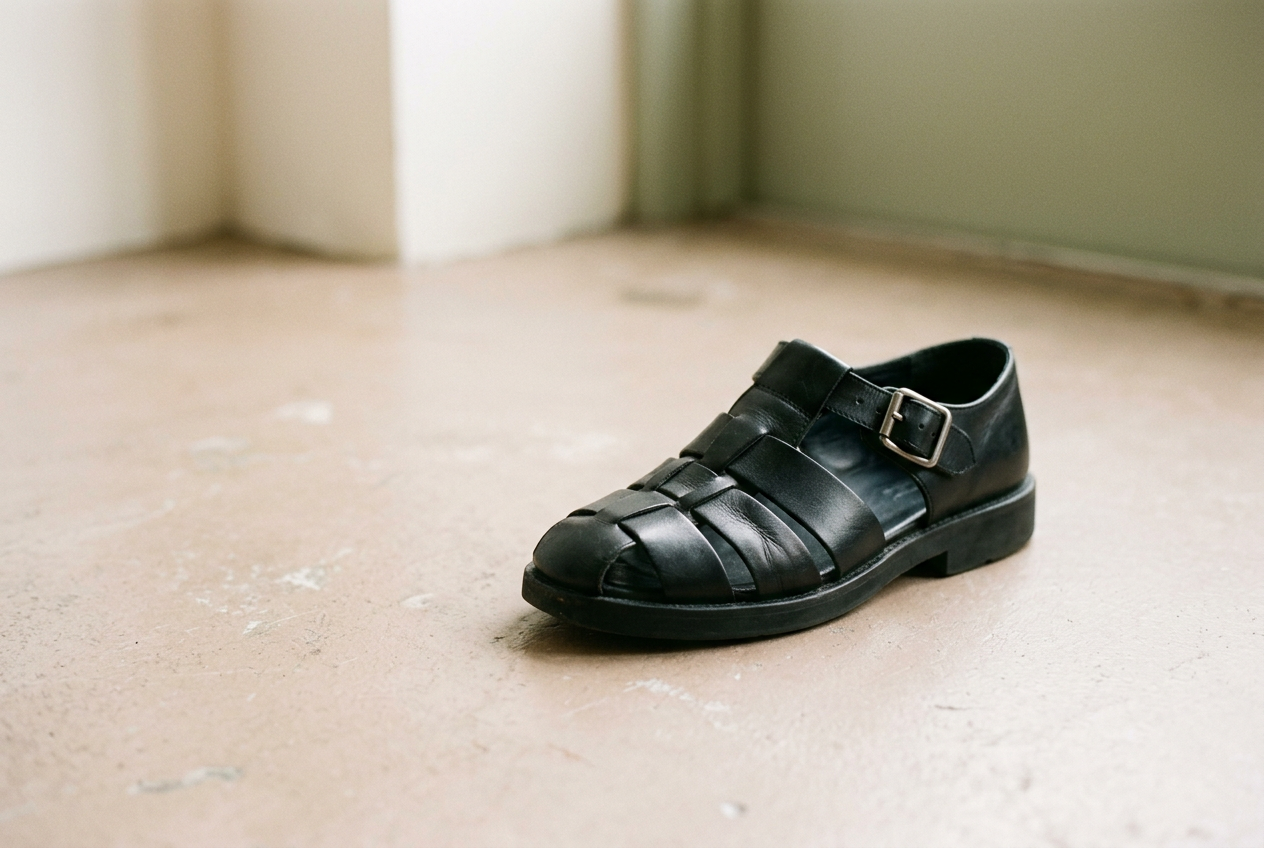
The concrete case for this analysis is the classic closed-toe fisherman sandal specified in the brief: interlaced leather strips over the toes, an adjustable buckle at the ankle and enough open space to distinguish it from a leather shoe. It promises moderation. Your toes get a barrier from curbs and chair legs, while your foot avoids the close embrace of a sneaker. Moderation, unfortunately, still has seams.
A reporting limitation matters here. No physical sample, named model or wear log came with the commission, so I cannot honestly claim that one pair covered a particular number of miles or produced a blister on cue. What follows is a construction-led verdict and a practical fitting protocol, rather than a fictional road test dressed up with suspiciously precise suffering.
This is unisex advice. Fisherman sandals appear in women’s and men’s size runs, but the useful distinctions are foot width, instep volume and where the woven strips meet the toes, not the department sign above the shelf.
The toe cage protects without sealing the foot
The woven upper is the reason to consider this silhouette. Compared with a two-strap sandal, leather strips across the front reduce direct contact with pavement debris and give the toes some defense in crowds. Compared with a sneaker, they leave openings for air and do not press every side of the forefoot into fabric or foam.
That protection has limits. A fisherman sandal’s closed toe is usually a cage rather than a solid cap, so fine grit can still enter through the sides and settle beneath the ball of the foot. The strips may also cross the little toe or the joint of the big toe, precisely where feet become wider during a long, warm walk. Leather can soften with wear, but break-in is not a sound plan for a strip that already pinches a joint in the store.
Look down while standing. No toe should bulge through an opening, and the edge of a strip should not bisect a toenail or sit directly on a prominent joint. Then rise onto the balls of your feet. If the leather bites now, repeated steps will not improve its manners.
Toe length deserves equal attention. A protective cage works only when a small amount of sole remains ahead of the toes; if the longest toe touches the front stitching, every downhill stretch pushes it into leather. Excess length is not better, because the projecting sole catches on uneven pavement. The correct fit looks slightly roomy and feels uneventful.
Shoes rarely receive enough credit for being uneventful.
Forefoot flex separates walking pairs from decorative ones
Forefoot flex means the sole bends where the foot bends, around the joints behind the toes. It is the first mechanical check because a stiff sandal forces either the heel to lift excessively or the foot to work against the sole, and neither arrangement improves after several blocks.
Hold the sandal at the heel and press the front upward. The sole should bend near the ball of the foot rather than fold through the middle. A sole that twists like a dish towel may lack stability, while one that refuses to move will make the woven upper crease against the toes as the foot tries to roll forward. The useful middle ground has controlled flex under the forefoot and enough structure beneath the arch that the shoe does not collapse sideways.
Repeat the test on foot. Walk quickly, take a short incline if the store permits it and notice whether the heel follows the foot or slaps down after each step. A heavy leather sole can look excellent under tailored pants yet demand more work than its refined appearance suggests. A thin, flat sole may bend easily but leave the forefoot feeling every pavement joint.
Neither is automatically a walking sole.
Cushioning also needs proportion. A little resilience under the ball and heel helps on hard sidewalks, but a soft footbed cannot rescue badly placed flex, and thick foam can make a loosely held sandal less stable. Readers seeking sneaker mileage should look for a contoured footbed, meaning one shaped to support the heel and arch, plus a rubber outsole with visible grip. Those additions may make the sandal look more substantial.
That is the trade.
The buckle must control the heel, not tourniquet the ankle
The buckle cannot turn a fisherman sandal into a sneaker because it does not surround the midfoot with laces, padding and a firm heel counter. Its narrower job is to stop the foot sliding forward into the toe cage.
Fasten the strap so one finger fits beneath it without forcing. Walk down a slope or imitate that motion by stepping firmly forward. If the toes brace to keep the sandal on, tighten one hole. If that leaves a strap mark within minutes or pulls the heel off-center, the last, meaning the foot-shaped form used to build the shoe, does not suit your foot.
Buckle placement can fail even when the length is adjustable. A strap that sits too close to the ankle joint rubs as the foot flexes; one placed farther forward may press a high instep. Elastic hidden near the buckle gives useful movement as feet swell, although too much stretch allows the heel to wander. Check the strap from the side rather than assuming another hole will solve the geometry.
The brief’s reference sandal depends on this small piece of hardware more than its airy appearance suggests. Without firm heel control, the wearer grips with the toes, friction increases under the forefoot and grit gets rubbed into the skin rather than shaken out. Discomfort has departments. They communicate.
Grit enters easily and leaves reluctantly
Openings in the upper help ventilation, but they are also doors. Fine sand, dry soil and crumbs of urban landscaping can enter around the forefoot, while the closed toe makes it harder to flick them out without stopping.
The problem becomes worse with a suede or brushed footbed because its textured surface holds particles. Smooth leather releases grit more readily but can become slick with sweat, especially when the footbed has no contour to resist forward movement. A removable footbed would make cleaning easier, though that construction is less common in dressier fisherman sandals.
For a realistic fitting test, place the sandal on a clean floor and take several tight turns. Lateral movement, meaning movement from side to side, reveals whether the foot slides across the footbed before a straight walk does. If the little toe presses through the weave or the heel shifts toward the sole edge, outdoor grit will add abrasion exactly where the fit is already weakest.
After dusty wear, undo the buckle and wipe the interior with a barely damp cloth appropriate for finished leather, then let the pair dry away from direct heat. Do not soak woven leather. Water can change the finish, stiffen some leathers and stress the many edges and intersections that give the sandal its shape. Care takes longer than shaking out a flip-flop, which is worth remembering before assigning fisherman sandals to a beach holiday.
More openings do not guarantee a cool foot
A woven upper ventilates better than an unperforated leather shoe, but the leather strips still cover much of the forefoot and create overlapping areas with limited airflow. Heat also builds underfoot, where a leather footbed and broad rubber outsole can retain warmth even though the toes look ventilated from above.
Fit changes as temperature rises. Feet commonly need more room after hours of standing and walking, so a close cage that feels secure in an air-conditioned store can become restrictive outside. Try the pair later in the day, using the sock or bare-foot setup you intend to wear. Most fisherman sandals are designed for bare feet, but the seams and strip edges must then be judged without a sock acting as unpaid protective equipment.
Dark leather may feel hotter in direct sun, though construction and fit matter more than color alone. The better clue is coverage: broad, tightly spaced strips create a smarter, shoe-like appearance and retain more heat; narrower strips open the upper but provide less protection. There is no version that maximizes airflow, coverage and support without compromise.
The buying verdict is short-distance unless proven otherwise
Closed-toe woven leather fisherman sandals are not automatic walking-shoe substitutes. They are polished sandals with more toe coverage, and a well-built pair can handle an active city day when its flex point, heel control and footbed suit the wearer. That is a higher bar than looking good during a lap of the shoe department.
Before paying roughly the price of a decent pair of sneakers, allow enough try-on time for the leather to warm against the foot. Walk briskly, turn, climb stairs and stand still for several minutes. Reject a pair if a strip crosses a toe joint, the buckle must be overtightened to stop sliding, the sole bends through the arch or the footbed becomes warm and slick during this limited test. A return policy is more useful than romantic ideas about break-in.
For long sightseeing days, repeated hills or routes where changing shoes is impossible, a ventilated walking sneaker remains the safer choice because it controls the heel and midfoot while shielding the foot from grit. A supportive sport sandal is the alternative when airflow matters more than polish. The fisherman sandal earns its place on commutes, museum days, dinners reached on foot and other mixed plans where coverage and appearance count, but the walking distance remains negotiable.
That is the verdict on the brief’s reference sandal: the silhouette solves exposed toes, not long-distance footwear as a category. Buy the specific construction, not the outline.
Questions people ask
Are fisherman sandals good for long walks?
Some can manage long urban walks if the sole flexes at the ball of the foot, the buckle prevents forward sliding and the footbed has useful shape. The silhouette alone proves none of that. For sustained mileage, hills or hot days without a backup pair, a walking sneaker remains more predictable.
Should fisherman sandals fit loosely?
They should leave swelling room around the toes without allowing the heel to travel sideways or the foot to slide into the front cage. No toe should protrude through the weave. If tightening the buckle enough to control the heel makes the strap press into the ankle or instep, try a different last rather than another hole.
Do woven leather fisherman sandals need breaking in?
Leather strips may soften, but a new sandal should not pinch a toe joint, scrape the ankle or force the toes to grip. Minor stiffness is reasonable; concentrated pressure is a fit problem. Wear a returnable pair indoors long enough for it to warm up before deciding that discomfort is temporary.
How do you keep grit out of fisherman sandals?
You cannot keep it out completely because the woven openings admit small particles. A secure heel and a footbed that limits sliding reduce abrasion once grit enters. After dusty wear, undo the buckle, wipe the interior with a barely damp leather-safe cloth and dry the sandals away from direct heat.
One update a day
Today's fashion update, in your inbox
One fashion update each morning — no hype, no filler, just pieces worth wearing.