Thin Leather Is Changing How Fisherman Sandals Fit
The fisherman sandal has become a summer basic, but cheaper, thinner uppers alter its fit. Strap stretch and buckle support now matter as much as the familiar woven toe.
Women's · August 15, 2026 · 7 min read
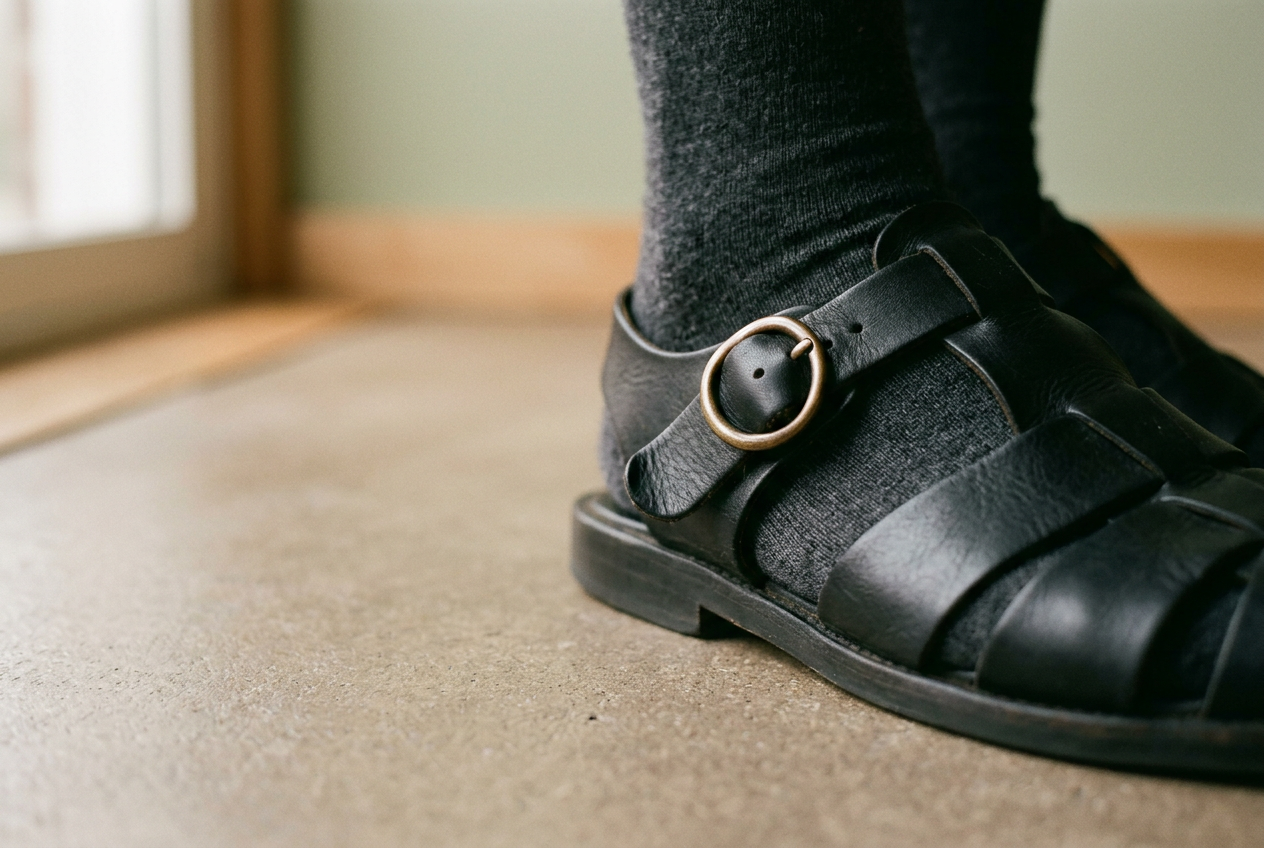
The pair that clarified the tradeoff was a black split-leather fisherman sandal worn for a week of city errands. Its closed woven toe looked almost identical to heavier leather versions, and the footbed felt comfortable immediately, yet the fit changed faster than the silhouette suggested it would.
On the first wear, the ankle strap sat correctly on its fourth hole. By the end of the week, the third hole held the foot more securely, the strap crossing the instep had relaxed, and the buckle had begun to lean toward the outside edge of its slot. Nothing had broken. The sandal had still moved from fitted to slightly loose before it had accumulated the scuffs that usually make a new shoe look worn.
That is the useful distinction in the fisherman sandal’s move from niche object to mass-market basic. The shape has survived translation: a covered toe, interlaced straps, an ankle fastening and a low sole. The structure has not always come with it.
This is women’s coverage, though the construction checks apply to equivalent men’s styles. Women’s versions are more likely to use narrow straps and lighter soles, which can make a graceful shoe but leave less material around the buckle and instep.
The same cage with less structure
A substantial leather fisherman sandal asks for patience. Its straps can feel firm across the toes, the upper may crease before it softens, and the ankle strap often needs several wears before it curves naturally around the foot. That resistance is part of what keeps the woven cage stable: each strap supports the next, so the foot stays centered rather than pressing one section outward.
The better versions do not have to be heavy, nor does expensive automatically mean durable. What matters is whether the leather has enough body to resist folding at the buckle and whether the underside is finished or lined, since an unlined rough edge can rub even when the visible surface looks polished.
Split leather, meaning the lower fibrous layer left after a hide is divided, can produce a convincing smooth upper when coated or finished. It is real leather, but it generally has less dense fiber structure than the outer layer of a hide. In the black test pair, that difference appeared as stretch rather than cracking: the instep strap lengthened slightly and stopped helping the ankle strap hold the foot back.
That matters more in a fisherman sandal than in a slide. A slide can tolerate some upper movement because the toes grip and release with every step. The fisherman sandal is supposed to act like a closed shoe with ventilation. Once its lattice relaxes unevenly, the foot can move forward inside a toe cage that still looks correctly sized from above.
Synthetic versions make a different bargain. A polyurethane-coated upper, which places a plastic surface over a textile base, may resist visible stretching at first, and it usually arrives with little break-in. The base cloth can still distort around punched holes, while the coating may crease where a leather strap would gradually mold. Heat also exposes the difference: a closed synthetic lattice traps more moisture, particularly when the lining uses the same material rather than fabric or leather.
The week-long fit change
The black split-leather pair did not fail at the toe. That was where I expected trouble, because a covered sandal can rub the little toe or catch the front of a longer second toe when its shape is too tapered. The toe cage remained comfortable, and the short break-in was persuasive.
The fit changed behind it. As the instep strap softened, my heel began lifting slightly before the sole left the ground, even after the ankle strap moved in by one hole. Tightening corrected the lift but pulled the buckle off center. The shoe was still wearable for a short trip, although a longer walk produced more friction at the back strap because the loosened front allowed the foot to travel.
A substantial leather comparison pair felt less pleasant on its first outing. The instep was firmer, and one woven edge registered across the top of the foot. After repeated wear, however, the leather curved without giving up as much length. The buckle stayed flatter because the strap retained enough thickness to fill the frame and support the buckle tongue, the small pin that passes through the adjustment hole.
The synthetic comparison pair stayed closest to its original length during the same kind of wear. Its weakness appeared around the hardware: the buckle slot folded sharply rather than rounding, and the hole in regular use began carrying most of the tension along one edge. A synthetic strap can be stable in length yet unstable at a puncture, especially when the textile backing is thin and the buckle lacks a reinforcing layer.
This is why trying on a fisherman sandal for two minutes can reward the wrong pair. Immediate softness feels like correct fit, while firmer leather can seem unnecessarily restrictive. The more useful test is to hold the heel down, bend the forefoot as if taking a step and watch which strap carries the load. If the ankle fastening jerks forward or the buckle rotates, the woven upper is not distributing tension evenly.
Buckle stability is the quiet dividing line
Thin leather does not doom a sandal. Placement can compensate for material. A buckle mounted close to the ankle, with enough strap width around it, asks less of the leather than a small buckle hanging from a narrow extension. Reinforcement can also be hidden between the upper and lining.
Product photographs rarely show that internal work, but the strap can still be checked. Fasten the sandal, then press a fingertip beneath the buckle and lift gently. The frame should remain broadly parallel to the strap. If it tips at once, the slot may be too large, the strap may be too soft, or the buckle may be sitting where the foot flexes.
Look at the adjustment hole as well. A clean hole is not proof of strength, though fuzzy edges before wear are a poor sign in split leather, and whitening or lifting around a synthetic hole suggests the surface coating is taking stress separately from its backing. On the black split-leather pair, the active hole remained intact; the larger concern was the whole buckle area folding, which made the shoe feel looser without an obvious damaged part to blame.
The keeper, the small loop that holds the free end of the strap, has practical work too. When it is oversized or made from softer material than the main strap, the loose end shifts and adds leverage to an already rotating buckle. This looks like a minor finishing issue on the shelf. During walking, it can turn a stable fastening into one that needs readjusting.
What each price level tends to buy
At the budget end, often below the price of a decent pair of sneakers, the fisherman silhouette is usually the main purchase. Expect thinner split leather or a synthetic upper, minimal reinforcement and a light sole. That can be reasonable for occasional wear, office days or a summer when the shape itself is the point. It is less convincing for regular walking unless the buckle remains flat and the instep feels secure without being cinched.
Around the cost of good everyday sneakers, material descriptions should become more specific. Look for a leather upper with a separate lining, finished strap edges and hardware that sits on a doubled section. “Leather” alone does not reveal which layer is used or whether every visible strap has the same backing, so the inside view and care information may tell more than the front photograph.
Investment pairs, priced at several times the budget versions, need to offer more than thicker leather. A replaceable sole, stitched construction or accessible repair work can justify the step up, but some fashion-led pairs remain glued and difficult to resole. Heavy leather attached to a disposable sole is an unresolved compromise. I would not pay the premium without clear construction information.
The black split-leather pair belongs in the first category. Its quick comfort suits infrequent use, and the loosened fit can still be managed with the buckle. It would not be my choice for a walking vacation, where repeated tightening concentrates wear around one hole and a softened lattice gives the toes more work inside the closed front.
The translation changes the look as well
Thinner straps have helped the fisherman sandal lose some of its practical, uniform-like weight. Under a fluid skirt or wide trouser, the flattened weave reads closer to a delicate caged sandal, which explains part of its movement into ordinary summer assortments. The substantial version remains visually firmer and works more like a shoe.
Neither interpretation has settled as the definitive basic. The lighter translation may prove easier to style, while the heavier construction better preserves the reason the silhouette worked in the first place. For now, the decision rests on use: buy softness for intermittent wear, structure for distance, and check the buckle before letting the woven toe make the choice.
Questions people ask
Do fisherman sandals stretch with wear?
Leather fisherman sandals usually soften and may stretch across the instep, although dense, substantial leather tends to change more slowly than split leather. The fit should start secure without pinching. If the heel already lifts or the ankle strap needs its tightest useful hole in the store, there is little room to manage later relaxation.
Is split leather suitable for fisherman sandals?
Split leather can work for occasional wear and often needs less break-in, but thin straps may relax faster around the instep or fold near the buckle. Check whether the straps are lined and whether the hardware sits on a reinforced section. A low price can be fair when the sandal is not expected to handle daily walking.
Are synthetic fisherman sandals comfortable in hot weather?
They can be comfortable for short periods, especially when the straps are soft and the lining is textile, but a closed synthetic weave generally releases less heat and moisture than leather. Inspect the strap holes and flex the buckle area, since a coated upper may hold its length while weakening where the hardware concentrates tension.
How should a fisherman sandal fit at the heel?
The heel should remain centered with only slight vertical movement as the forefoot bends. The ankle strap should feel secure without pulling the buckle sideways, and the toes should not slide into the front cage. If tightening the ankle is the only way to control forward movement, the instep portion is probably too loose.
One update a day
Today's fashion update, in your inbox
One fashion update each morning — no hype, no filler, just pieces worth wearing.