Fisherman Sandals Are Basics Now. The Stitching Still Matters.
The leather cage has moved well beyond niche labels. Before paying more, check whether the sole can be repaired and whether a cobbler can reach the buckle.
August 11, 2026 · 8 min read
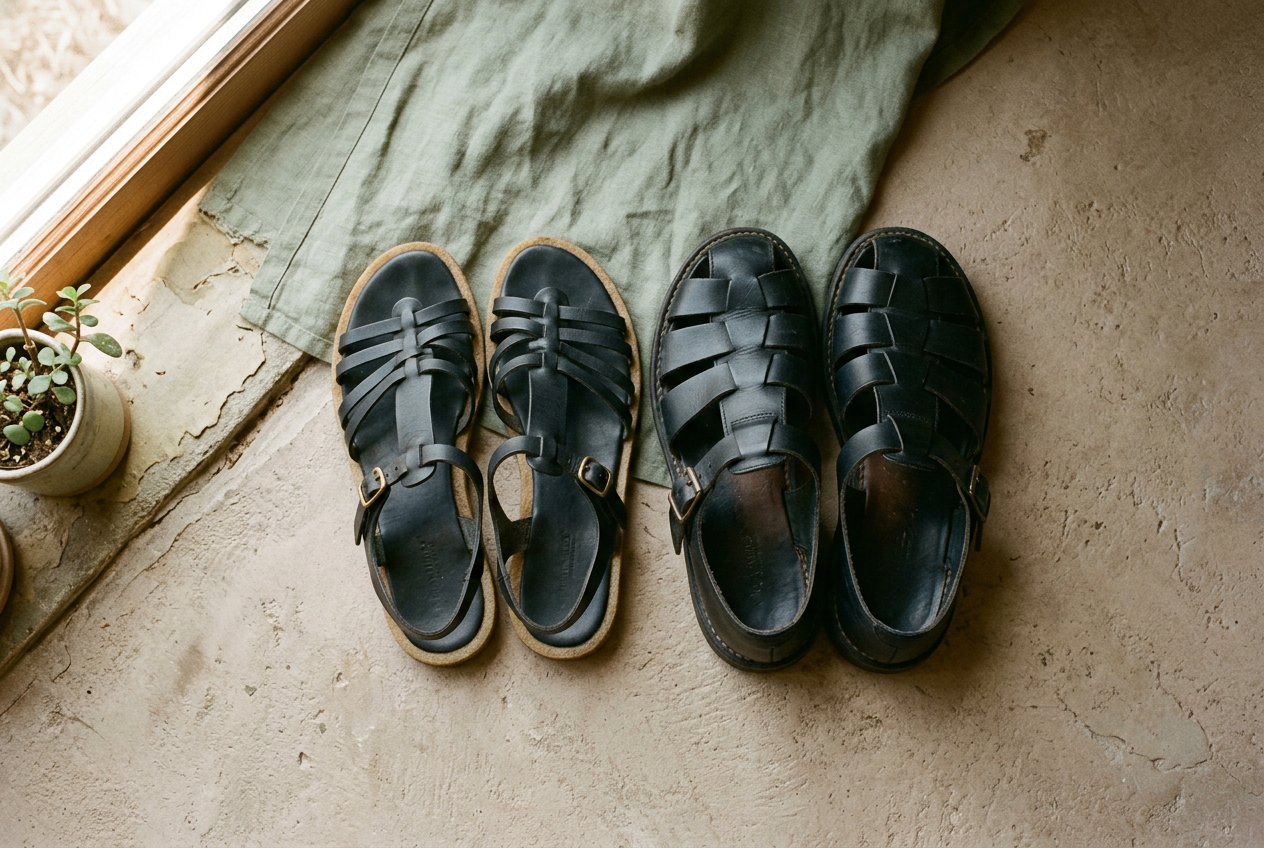
Fisherman sandals used to occupy a fairly narrow corner of the footwear department: part school shoe, part old European vacation, with enough woven leather over the toes to put off anyone seeking an uncomplicated pedicure sandal. Their wider adoption has changed the offer. The same closed cage now appears in polished leather, soft suede and single-piece molded material, at prices ranging from low-cost summer purchase to serious shoe money.
That visual similarity is misleading. Two pairs can share the rounded toe, interlaced straps and ankle buckle while having little else in common once the sole wears thin or one strap pulls away.
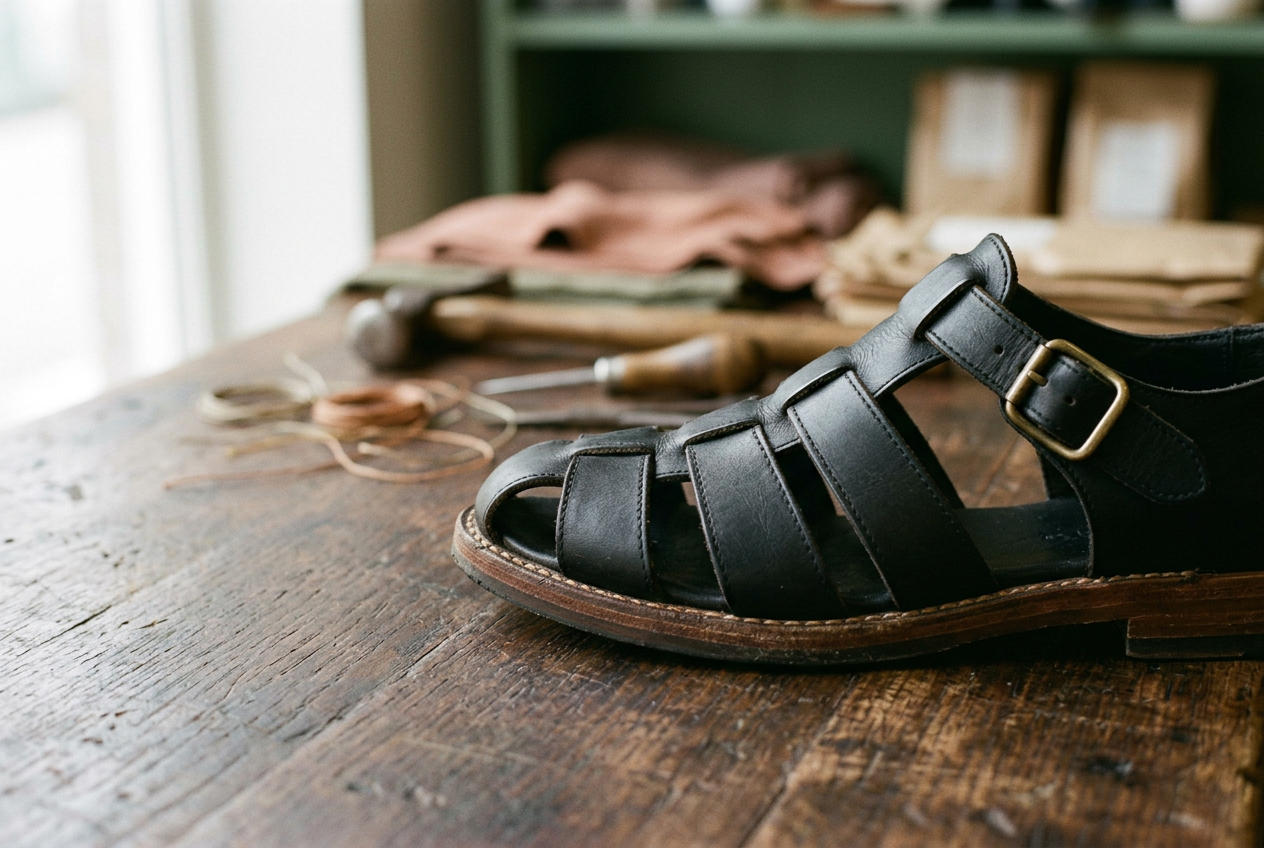
The concrete pair I keep returning to is Grenson’s Quincy, a leather fisherman sandal with a closed toe, conventional buckle, wide G fitting and Goodyear-welted leather sole. A Goodyear welt is a strip stitched around the shoe that allows the outsole to be removed and replaced without dismantling the upper. Quincy sits toward the investment end of this trend, but its construction makes a useful comparison point even for shoppers spending roughly the price of a decent pair of sneakers.
This is unisex coverage. The construction advice applies across wardrobes, although individual brands may place identical-looking sandals in gendered departments and use different size scales or widths.
The silhouette has crossed into ordinary retail
The important shift is not that fisherman sandals have resurfaced for one summer. Fashion reporting and retailer assortments have tracked the shape across luxury collections, contemporary labels and mass-market stores for several warm seasons, while the styling around it has become quieter. The sandal no longer needs a deliberately nostalgic outfit to make sense.
It is now sold as an alternative to a loafer, ballet flat or plain two-strap sandal. With relaxed trousers, the covered toe keeps the line closer to a shoe. Under a cotton skirt, the cage gives more visual weight than a thin strappy sandal without requiring a platform. Socks are optional rather than the whole styling premise.
That normalization is why construction matters more now. A niche purchase can survive as an occasional styling device; a basic gets walked to work, packed for trips and worn on days that turn out wetter or hotter than expected. The upper has to flex repeatedly at the forefoot, while the buckle takes tension every time the foot swells during the day.
Quincy makes that workload easy to read. Its individual leather straps cross the foot and disappear into a structured base, rather than being stamped as a cage pattern into one sheet. The leather sole can be serviced, though it also creates a practical tradeoff: fresh leather soles can feel slick on smooth or wet surfaces, and regular pavement wear may justify having a cobbler add a thin rubber protector before the original sole becomes too worn.
Look at where the cage joins the shoe
The durable version of this silhouette begins with separate straps that are stitched into the upper or secured beneath another leather panel. Follow each strip with your finger. It should end in a seam you can see, or pass beneath a section of the upper that holds it across a meaningful area.
A strap that is attached only by a small dab of adhesive has less material carrying the load. Once heat, moisture and repeated flexing weaken that bond, the repairer has to clean the joint and find enough sound material for a new attachment. The repair may be possible, but it can look bulky on an exposed cage.
Leather quality also changes the calculation. Supple leather should bend rather than form a sharp white crease, and the cut edges should feel reasonably smooth against bare skin. A lining is useful where straps cross the toes or sit over the instep, although even a well-lined fisherman sandal can rub during its first few outings because the cage offers more contact points than an open slide.
The molded version behaves differently. When the upper and sole form one continuous piece of EVA, a lightweight foamed plastic, there are no stitched strap joints to loosen and water is less threatening. That can be excellent for a pool, a campground shower or a wet commute. Yet if the cage splits near the ankle or tears at a flex point, there is usually no discreet repair that restores its original strength.
Molded does not automatically mean flimsy. A substantial one-piece sandal may outlast a poorly glued imitation-leather pair. Its limitation is a shorter repair path, not necessarily instant failure.
A visible buckle is not always a serviceable buckle
Fisherman sandals concentrate stress around the ankle fastening. On a traditional leather pair, the buckle usually sits on a short leather tab, with stitching or a small rivet holding it in place. A cobbler can often remove that attachment, fit compatible hardware and close the tab again. The replacement might not match the original finish exactly, but the shoe remains wearable.
Quincy’s conventional buckle layout illustrates the format to seek: exposed hardware, a real pin and enough leather around the attachment for a repairer to work with. The product specification does not promise that every local shop will stock a matching buckle, so inspect the attachment rather than treating the brand name as a repair guarantee.
Some fashion versions use a buckle-shaped closure over a hidden snap, while others cast the buckle and strap as part of a plastic upper. Those systems make dressing quicker and help preserve a clean line, but failure becomes specific to the original component. A proprietary snap that pulls out of thin material can cost more to reconstruct than the sandal merits.
Before buying, open and close the fastening several times. The pin should enter the hole without forcing the strap sideways, and the holes should sit far enough from the strap edge that the leather does not look ready to split. If the correct setting is already the first or final hole, there is little room for warm-weather swelling or a different sock thickness.
Sole stitching only helps when the rest deserves repair
Visible thread around a sole can indicate a stitched construction, but decorative stitching is common enough that the line alone proves little. Look for product language that identifies the method, then check whether the stitch line continues consistently around the shoe. Ask the retailer if the outsole can be replaced. A vague answer is useful information.
Goodyear-welted construction, as used on Quincy, offers a clear route to resoling, though it adds structure and cost. The sandal may feel firmer than a soft cemented pair, meaning one whose sole is fixed primarily with adhesive, and the leather footbed will take time to settle under the toes. This is a reasonable trade if the upper fits well enough to keep for years. It is wasted money if the cage pinches from the first fitting.
Cemented construction occupies the broad middle. A skilled repairer can sometimes replace or reinforce a glued sole, particularly when the upper is leather and there is a clean edge to work with, but feasibility depends on the materials and how the original shoe comes apart. Do not assume that a mid-priced leather pair is disposable. Do not assume it is resoleable either.
At the least expensive end, a molded outsole bonded to a thin synthetic cage often makes sense only as a short-term trend purchase. That is defensible if the sandal will be worn occasionally and the price reflects its limits. Paying a premium for the same inaccessible buckle and nonrepairable sole is harder to justify.
Fit the cage before judging the size
Fisherman sandals can feel short even when the sole length is correct because the closed front stops the toes visually and physically. The widest part of the foot should sit under the widest part of the cage, with no toe pressing into the front straps. Heel placement matters less than forefoot alignment.
The Grenson Quincy’s G fitting signals a roomier width within that brand’s system. A last is the foot-shaped form around which a shoe is built, and width labels only make sense relative to the maker’s lasts; a G fitting is not a universal measurement that transfers neatly to another label. People with low-volume feet may need to tighten the ankle strap while still finding excess space over the toes.
Try the sandal late enough in the day for normal swelling to appear. Walk on an incline if the store permits it. Forward sliding means the cage is not holding the instep, while pressure across one strap usually becomes more noticeable after an hour rather than disappearing through optimism.
Bare feet reveal edge friction. Thin socks reveal excess volume. Test both if both are part of the intended wardrobe, because a pair that works with a ribbed sock may shift against skin.
The useful buying line
Spend more when the leather cage fits without a pressure point, the straps disappear into secure seams, the buckle can be reached for replacement and the sole has a credible repair route. In that case, the cost buys options later rather than a more luxurious version of the same disposable structure.
The middle price band can be the sensible choice. A cemented leather sandal with substantial straps and ordinary metal hardware may give years of use even if a full resole is uncertain, especially when a repairer can add a sole protector or renew the heel before wear reaches the upper.
Choose molded versions for water, low maintenance and an easy way into the silhouette. Their shortcoming arrives after damage: the integrated cage and fastening leave little to replace. I remain undecided on paying designer-level money for that construction, however convincing the color or proportion looks this season.
Quincy is not the automatic answer. Its wide fit will not suit every foot, a leather sole asks for more care than a rubber one, and welted construction adds weight that some summer dressers will resent. It does show what an investment fisherman sandal should make visible: real seams, workable hardware and a sole built with the expectation that walking will eventually wear it down.
Questions people ask
Are leather fisherman sandals supposed to feel tight at first?
They may feel firm where the straps cross, but the toes should not press against the front and no single edge should bite into the instep. Leather can soften with wear; a cage that is too short, badly aligned or tight enough to leave a deep mark is a fit problem rather than normal break-in.
Can a cobbler replace a fisherman sandal buckle?
Often, if the buckle sits on an accessible leather tab secured by stitching or a removable rivet. Replacement becomes harder when the closure is molded into the upper, fixed with proprietary hardware or attached to material too thin to restitch. Ask before purchase if an unusual buckle is central to the design.
Are molded fisherman sandals less durable than leather ones?
Not in every setting. A one-piece molded sandal can handle water and neglect better than poorly finished leather, with no glued strap ends to lift. Its practical life becomes shorter once the cage tears, because the damaged section cannot usually be replaced without creating a visible weak point.
Can
Goodyear-welted fisherman sandals be resoled?
That construction is designed to make outsole replacement possible, provided the upper and welt remain sound. Resoling still depends on the repairer, available materials and the condition of the shoe, so protect a leather sole before wear reaches the welt and take the pair in when the heel begins to thin unevenly.
One update a day
Today's fashion update, in your inbox
One fashion update each morning — no hype, no filler, just pieces worth wearing.