Pendant Cord Necklaces Are Back. Choose the Cord First.
Waxed cotton, leather, and polyester may look interchangeable under a pendant. Sweat, friction, and sliding knots expose their differences within days.
November 9, 2026 · 8 min read
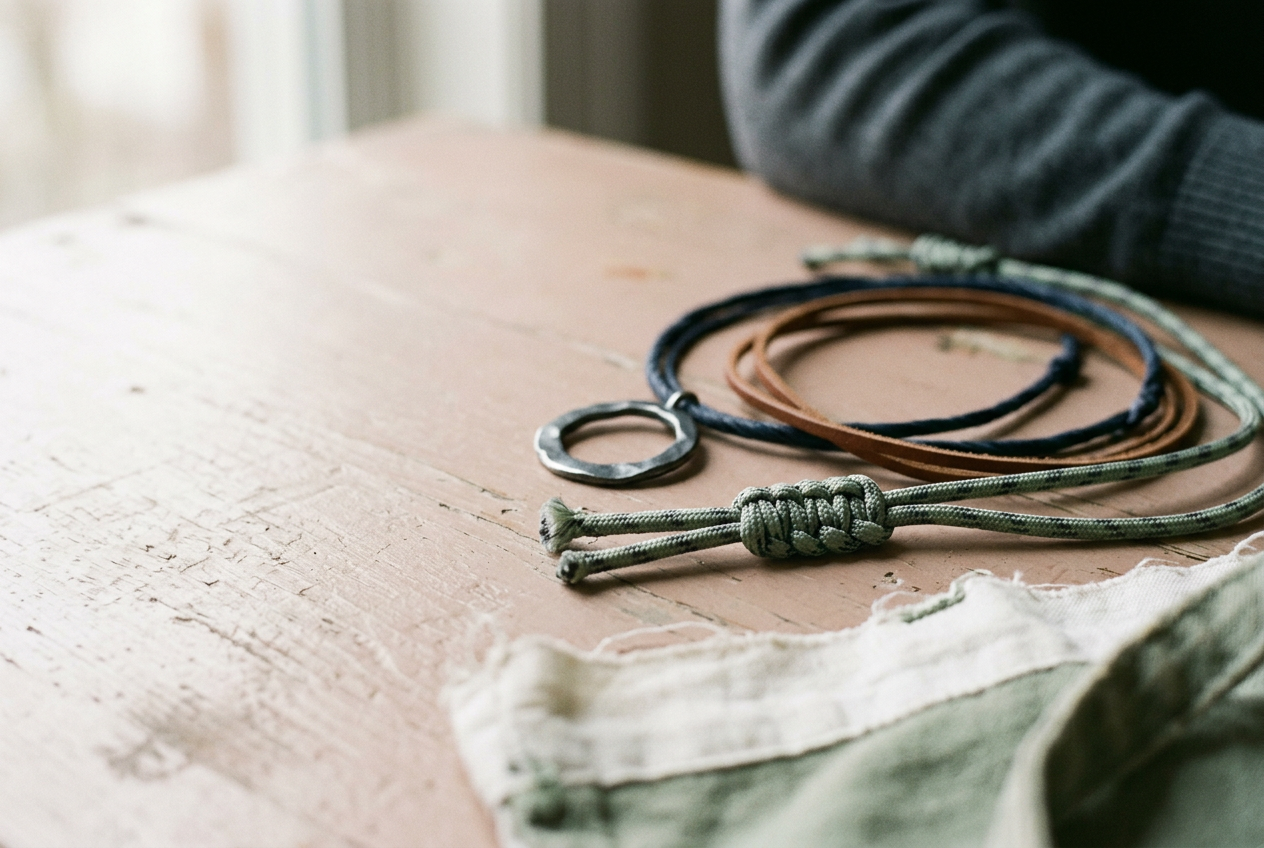
The useful object here is a dark brown, 2 mm waxed-cotton cord carrying a small metal pendant at the upper sternum. Two sliding barrel knots, compact knots wrapped around the opposing cord, extend it from a short necklace to a lower drop. It is the sort of unfussy construction now appearing across fashion assortments, often with polished metal, ceramic, stone, or shell-like pendants.
During a week of ordinary warm-weather wear against bare skin and cotton T-shirts, that cord became the reference point for the comparison. It stayed tied and held its chosen length, yet the section behind the neck softened first, while the path through the sliding knots grew flatter and showed pale surface fuzz. Neither change ruined it. Both made clear that the revival is easier to judge by cord construction than by the charm hanging from it.
The pendant has moved off the fine chain
The current cord-necklace look replaces the delicate chain with something thicker, darker, and more visible. Pendants tend to sit on a black or brown line with enough weight to register as part of the design, rather than disappearing against the skin. Adjustable knots support the look because they let one necklace move between collarbone height and a longer placement without an extension chain.
This is unisex coverage because the wear questions do not change across wardrobes. The same cord may sit inside an open shirt, over a crewneck T-shirt, or against a bare collarbone; neck circumference and pendant weight matter more than the department in which the necklace was sold. A heavier pendant also pulls a cord into a sharper V, while a light pendant can drift sideways unless the cord has some grip.
The trend is convincing at the level of silhouette. It gives a plain tank, knit polo, or unbuttoned shirt a focal point without the shine of layered chains. Construction is less settled. Product descriptions sometimes say only cord or textile, although waxed cotton and polyester behave differently once body heat, sweat, and repeated adjustment enter the picture.
Waxed cotton grips well, then shows its use
Waxed cotton starts with an advantage: the wax smooths the fibers, deepens the color, and helps a knot hold without requiring much bulk. On the reference necklace, the barrel knots stayed where they were placed, and the cord did not slowly lengthen under the metal pendant. The surface also had enough drag to keep the pendant centered more reliably than a slick synthetic cord.
Cotton itself is absorbent. The wax delays wetting, but it is a coating rather than a permanent seal, and friction gradually removes it from the areas that touch skin or pass through a knot. Sweat can then enter the exposed fibers through wicking, meaning moisture travels along the small spaces within the yarn. The cord may feel damp longer than polyester, and repeated wet-and-dry cycles can leave it less supple.
After the test week, the reference cord had not become rigid, but the neck section bent differently from the unworn ends. The pale fuzz beside one sliding knot mattered more than the softened feel because loose cotton fibers create additional friction; adjustment becomes rougher, which raises more fuzz, and the loop can eventually look tired before the pendant does.
Waxed cotton suits a reader who wants secure sliding knots and does not mind visible aging. Let it dry flat after a hot day, wipe the surface with a barely damp cloth rather than soaking it, and avoid pulling the knots while the cord is wet. Rewaxing is possible with a product intended for cord or thread, though too much wax can transfer onto a pale collar and collect lint.
In price terms, waxed-cotton necklaces often belong in the budget or lower midpriced fashion-jewelry tier unless the pendant or hardware adds material value. A large premium for the words waxed cotton alone is difficult to justify. The cord is useful, not rare.
Leather changes character rather than staying neat
A round leather cord can look richer beside stone or brushed metal because its surface has natural variation and takes on patina, the color and sheen produced by handling and wear. It is also quiet against hard pendants. That makes leather the appealing choice when a necklace is meant to look better slightly worn rather than remain graphically black.
Sweat is the complication. Leather absorbs moisture and skin oils unevenly, especially if its finish is light or the cut edges are exposed. It can darken at the back of the neck, then stiffen as it dries with salt still present. A thin cord repeatedly bent at the same point may develop a flat section or small surface cracks, while inexpensive coated leather can peel instead of aging gradually.
Sliding knots need scrutiny. Friction can burnish leather, meaning repeated rubbing compresses and polishes its surface, but the same action may create a groove and make the knot bind after moisture exposure. A leather cord that adjusts smoothly in the store may become harder to move once the fibers have swollen and dried. For daily length changes, a clasp and extension chain are often the cleaner alternative.
Look closely at the cut end near the knot. A fibrous interior with an even outer surface is more reassuring than a plastic-looking coating already separating at the edge, though appearance alone cannot confirm the leather grade. Full-grain leather, which retains the hide’s outer surface, is not automatically ideal in necklace-scale cord; uniform cutting, flexible finishing, and a knot that does not crush the strand matter more here.
Leather usually carries a small price premium over a basic textile cord, but the label should not do all the work. If the cord feels dry, shows coating damage, or has a knot that must be forced, paying more will not correct the construction.
Polyester handles moisture, but slickness changes the knot
Polyester absorbs little water into the fiber, so a polyester cord generally dries faster than cotton and is less likely to stiffen merely because it was damp. That makes it the practical candidate for frequent summer wear, travel, or a necklace that will sit against the neck all day. Sweat can still dry on the surface, however, and sunscreen or skin oil may collect within a braid, so low absorption does not mean maintenance-free.
The tradeoff appears at the adjustment. Smooth braided polyester can slide cleanly through a knot and tolerate repeated movement without producing cotton-like fuzz, but a loosely tied or poorly designed knot may creep under pendant weight. The reference waxed-cotton construction held with two compact wraps; an equivalent slick polyester cord needed more knot contact to feel equally secure. Thick knots can then become the visual weak point.
Polyester also varies by structure. A tightly braided cord resists snagging and keeps a round profile better than a soft, loosely woven one, while a satin-finish version may catch on rough pendant holes because its surface filaments are fine. Frayed synthetic ends sometimes feel sharp where they have been heat-sealed. Run a finger over the end finishing before buying, especially if the knots rest near the side of the neck.
For readers who sweat heavily or dislike a cord that stays damp, polyester is the easiest decision of the three. Choose a matte, tightly braided version with stopper knots or enough wraps to prevent creeping. It will look less organic than leather and may not hold a centered pendant as well as waxed cotton, but daily care is lighter.
The hole, knot, and pendant still decide the lifespan
Cord material cannot rescue a badly finished pendant. The hole or bail, the loop that connects a pendant to its necklace, should have smooth edges and enough room for the doubled thickness created during movement. A sharp-edged metal hole can saw through cotton fibers, scrape leather’s finish, or pull filaments from polyester.
The reference pendant moved freely without pinching its 2 mm cord, which kept wear concentrated at the adjustable knots rather than beneath the pendant. That is preferable. If the opening barely clears the cord, every step makes the same small area flex and rub; the necklace may fail there even when the rest still looks new.
Check the adjustment before paying. Extend the necklace, shorten it, and hold the pendant’s weight for a moment. The knots should move with deliberate pressure, remain in place when released, and leave the cord round rather than crushed flat. If adjustment requires a hard tug in the store, sweat will not improve it.
If the cord lengthens while held, the knot design is already inadequate.
The revival suits daily wear, but no single cord wins cleanly. The dark brown reference necklace was pleasant precisely because its waxed cotton gripped, softened, and began to look handled. A reader seeking the same appearance without that visible wear should choose tightly braided polyester; someone who wants patina can accept leather, provided changing the length is an occasional act rather than a daily habit.
Questions people ask
Can a pendant cord necklace be worn every day?
Yes, if the pendant opening is smooth and the cord can dry between wears. Polyester asks for the least moisture management, while waxed cotton benefits from rotation after hot days. Leather is better kept away from showers and workouts because repeated saturation can darken, stiffen, or deform a narrow cord.
Which cord is best for sliding knots?
Waxed cotton usually gives the most dependable balance of movement and grip. Tightly braided polyester tolerates repeated adjustment but needs a well-designed knot that will not creep. Leather can work when adjusted occasionally, though moisture and friction may make the knot bind or flatten the cord.
How can
I tell whether a cord necklace is well made?
Move each knot through its practical range, then hold the necklace by the cord with the pendant hanging. Reject knots that slip, cord sections that flatten sharply, and pendant holes with rough edges. Also inspect heat-sealed synthetic ends and coated leather edges, since either can scratch the neck when finishing is careless.
Can a fraying necklace cord be repaired?
A jeweler or competent repair service can often transfer the pendant to a replacement cord if its opening is accessible. Do not trim structural fuzz beside a knot and continue wearing it indefinitely. Once the cord has narrowed, replacement is safer than relying on the remaining fibers to hold the pendant.
One update a day
Today's fashion update, in your inbox
One fashion update each morning — no hype, no filler, just pieces worth wearing.