Oversized Shield Sunglasses Cover More. The Curve Is the Catch.
The wraparound shield has moved beyond cycling kit. Its coverage can be useful, but curvature, cheek contact, airflow, and prescription limits decide whether it survives past the photo.
November 22, 2026 · 8 min read
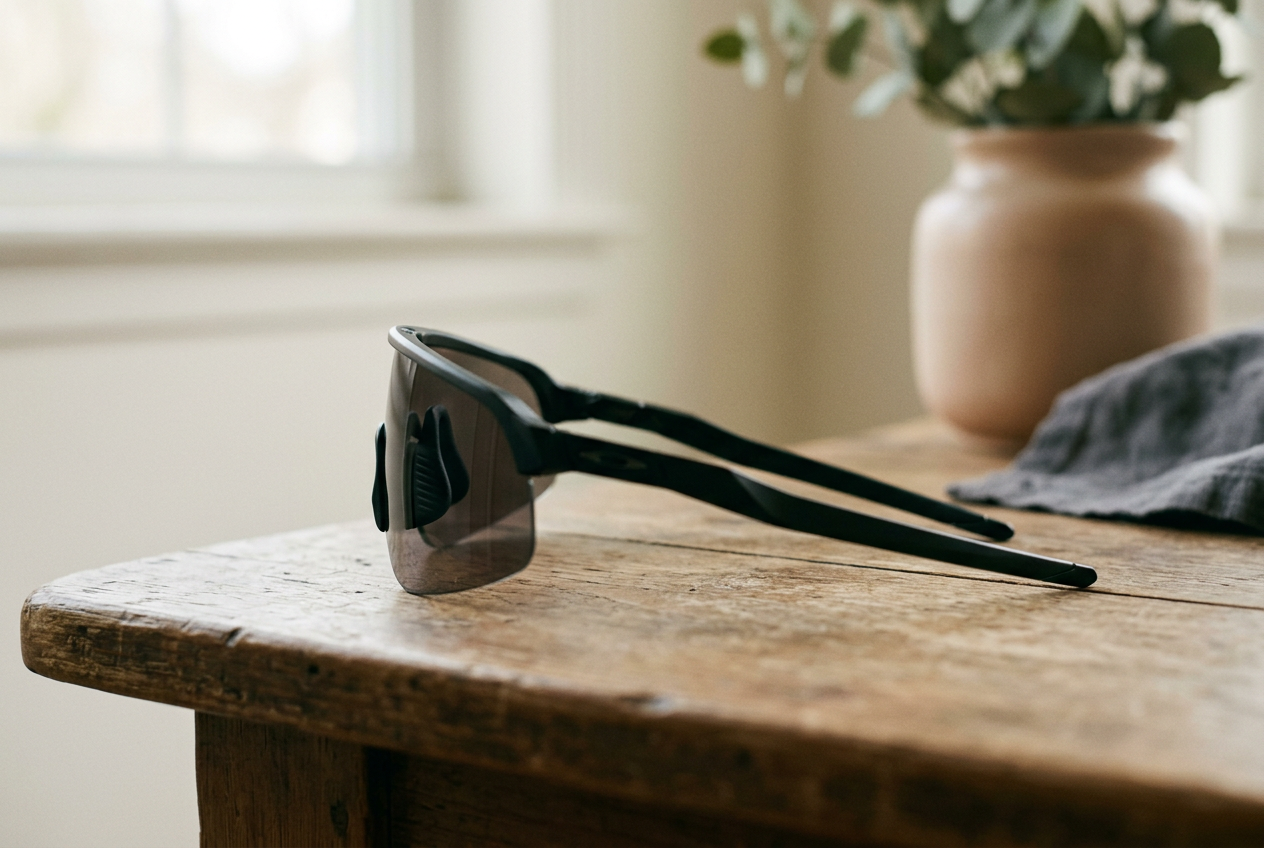
The oversized shield is rising as the narrow, barely protective sunglass loses some of its grip. The new shape borrows from cycling eyewear: one broad lens, a pronounced curve around the temples, and enough vertical depth to cover the eyebrows and upper cheeks. That can block light arriving from the side, but it also creates more opportunities for visual distortion, skin contact, trapped heat, and prescription trouble.
Oakley’s Kato is a useful case because it pushes the silhouette close to its technical limit. The frameless lens bends around the face, while an adjustable rake system changes its angle and Unobtainium nosepads, a grippy synthetic material intended to hold better with moisture, support the lens without a conventional bridge. Oakley documents O Matter material at the temples and offers the Kato with its contrast-focused Prizm lens technology.
The Kato does not represent every fashion shield. It exposes the questions a less technical version may avoid.
This is unisex coverage. The useful fit distinctions come from bridge shape, cheek height, temple width, eyelashes, and prescription rather than the department where a retailer places the frame.
The Kato test
A shield earns its size when the lens blocks light that would otherwise enter above or beside a smaller frame. That is particularly noticeable around water, pale pavement, open roads, and other bright settings where reflected light reaches the eye from several directions. A close wrap also reduces the gap at the temple, which can make a shield feel calmer than a flat fashion frame even when both lenses carry adequate ultraviolet protection.
Coverage and UV filtering remain separate specifications. A very dark lens can still be a poor choice if the manufacturer does not state its ultraviolet protection, while a lighter lens from a documented optical range may provide proper filtering. Look for UV400 or an equivalent statement from the manufacturer, then judge the physical coverage on your face.
The Kato’s adjustable rake, meaning the angle at which the lens sits relative to the face, makes this distinction visible. Tilt the lens inward and the upper gap may shrink, but the lower edge moves closer to the cheeks. Tilt it outward and cheek clearance can improve, though more light may enter from above. A fixed fashion shield gives you no such negotiation.
Its sculpted pose either matches your facial geometry or it does not.
During a fitting, look straight ahead before assessing the mirror. The lens should remain clear of the cheeks when your face is relaxed and when you smile, and your eyelashes should not brush the inner surface during a normal blink. Move your jaw as if speaking. If the frame lifts from its nose position, the cheeks are carrying part of its weight.
That contact rarely improves with wear. Makeup and sunscreen transfer to the lower lens, repeated movement smears the inside surface, and pressure becomes more noticeable once heat or humidity arrives. A frame that looks precise while motionless can become irritating during a walk.
Curvature is where the optics live
A shield’s base curve, the amount a lens arcs from its center toward the temples, determines much of its wrap. Higher curves follow the head more closely, but the wearer views the outer areas of the lens at increasingly oblique angles. Without optical compensation, straight lines can seem to bend, the ground may feel subtly displaced, or peripheral objects may shift as the head turns.
That does not mean every curved shield distorts. Established performance-eyewear makers design the lens form, thickness, and optical center together, then manufacture the surface to manage the effects of wrap. A fashion frame can use competent lenses too. The problem is that silhouette alone reveals very little about optical quality, and a sweeping product photo cannot show whether the wearer’s vision will remain stable.
Use a doorframe or tiled floor during the try-on. Hold the head still, look through the center, then move only the eyes toward each side. Some peripheral change is expected through a highly wrapped lens, but a straight edge should not jump sharply or buckle as your gaze crosses the shield. Next, turn the head while walking several steps.
Remove the frame if the floor seems to rise, depth feels uncertain, or the eyes strain to settle.
The test matters more than the first impression. Eyes can adapt to modest optical differences, yet adaptation is not proof of good construction, and sunglasses that cause a headache after half an hour are difficult to rescue through styling. Online buyers should favor a usable return window and keep every protective film in place until they have checked the lens indoors without scratches.
The Kato returns here as a benchmark rather than an automatic recommendation. Its appeal depends on the lens engineering and adjustable fit working together. A cheaper copy may reproduce the pointed lower edge and dramatic side profile while omitting the costly part: a controlled optical surface that remains comfortable as the gaze moves.
Cheek clearance and ventilation are linked
The closer a shield sits, the more it blocks stray light and wind. The same close fit can restrict airflow behind the lens, especially when its lower edge follows the cheek and the top edge sits near the brow. Warm, damp air from the skin then has fewer routes out.
Ventilation may come from cutouts in the lens, gaps around the brow, channels near the nose, or a frame shape that stands slightly away from the face. Openings near the top can release rising air, although their effect depends on movement and fit. A stationary wearer in humid weather may still fog a lens designed for airflow at cycling speed.
Check ventilation without waiting for midsummer. Wear the frame indoors for several minutes, then step into cooler air, or put it on while the skin is warm after walking. Watch the area around the nose first. Fog that clears quickly in motion may be manageable; a film that sits across the central viewing area makes the frame unreliable for commuting and outdoor exercise.
Skin contact creates another practical problem. Sunscreen can attack or mark some coatings over time, while salt, dust, and cosmetics make fine scratches more likely if the lens is wiped dry. Rinse loose grit away with lukewarm water when the manufacturer permits it, use mild soap if directed, and dry with a clean microfiber cloth. The broad shield has more exposed surface than an ordinary pair, so storing it loose in a bag is a short route to visible damage.
Prescription compatibility narrows the field
A single curved shield is one of the hardest sunglass shapes to translate into a prescription. Corrective lenses must place optical power accurately in front of each eye, while a highly wrapped form changes the angle through which the wearer looks. Stronger prescriptions, substantial astigmatism, and large differences between the eyes can make the job more difficult.
Some manufacturers offer a direct prescription version of a wrapped style. Others use an optical insert, a smaller corrective carrier that clips behind the main shield. An insert preserves the exterior shape and allows the outer lens to remain interchangeable, but it adds another set of surfaces that can reflect light, collect sweat, and fog. It can also bring the corrective lenses closer to the eyelashes.
Do not assume that prescription availability for one model extends to every color, lens treatment, or market. With the Kato or any similar shield, ask the authorized seller or dispensing optician to confirm the exact model, your prescription range, pupillary distance, and whether the result uses a direct lens or an insert. “Prescription-friendly” is too imprecise for a purchase at this price level.
A lower-wrap alternative often works better for everyday corrective wear. Look for a two-lens frame with a shield-like brow line and wide temples, but enough separation between the lenses for conventional optical centering. It gives up some side coverage. It may also deliver steadier vision, easier adjustments, and more laboratories willing to make the lenses.
Where the trend earns its place
Technical shields commonly sit around the cost of a decent pair of sneakers, while luxury interpretations can move far above that without adding adjustable geometry or better optical documentation. The useful distinction is not sport versus fashion. It is whether the frame maker explains the lens material, UV protection, fit adjustment, and prescription route before asking the buyer to pay for the silhouette.
The Kato works best as a demanding reference point. Its frameless edge makes cheek clearance easy to inspect, its rake adjustment shows how a few degrees alter coverage, and its performance origins give the exaggerated shape a purpose. It will still look assertive with ordinary clothes. A plain tank, loose button-down, or compact jacket gives the shield enough visual space without turning the rest of the outfit into equipment.
Less engineered versions may be worthwhile for occasional wear if the central vision stays stable and the frame clears the face. That is the micro-trend decision: accept a shorter shelf life at a lower price, or pay more only when the object also works as serious sun protection. I remain undecided on the shield as an all-day fashion default. On the right face, with controlled optics, it solves a real coverage problem.
On the wrong bridge, it is an expensive lens resting on the cheeks.
Questions people ask
Do oversized shield sunglasses give better sun protection?
They can provide better physical coverage than small or flat sunglasses because the lens extends above, below, and around the eyes. That advantage counts only when the manufacturer also documents ultraviolet protection. Check for UV400 or an equivalent claim, then make sure gaps at the brow and temples are reasonably small without forcing the lens against your skin.
How can
I tell if a curved shield lens is distorting my vision?
Look at a doorframe or tiled floor through the center and outer areas of the lens, moving your eyes before turning your head. Stop if straight edges jump, buckle, or shift sharply, or if walking makes the floor feel displaced. Mild peripheral change can occur with deep wraps, but strain, nausea, or uncertain depth are reasons to return the frame.
Can oversized shield sunglasses take prescription lenses?
Some can, either through a purpose-made prescription lens or a corrective insert clipped behind the shield. Compatibility depends on the exact frame and prescription, particularly with stronger powers or astigmatism. Get written confirmation for the specific model rather than relying on a general retailer filter, and ask whether the finished glasses will preserve the original wrap.
Should a shield lens touch my cheeks when I smile?
Occasional contact during an exaggerated expression is less concerning than contact during normal speech or a relaxed smile. If the frame lifts on the nose, gathers sunscreen along its lower edge, or smears whenever your jaw moves, try another nosepad position, reduce the rake where possible, or choose a shallower lens. Wear will not create extra clearance.
One update a day
Today's fashion update, in your inbox
One fashion update each morning — no hype, no filler, just pieces worth wearing.