Ribbon Sneaker Laces Look Fresh Until the Eyelets Rub
Decorative laces have moved from customization kits into everyday styling. Satin gives the clearest fashion signal, but ribbed tape and flat cotton are more dependable.
November 20, 2026 · 7 min read
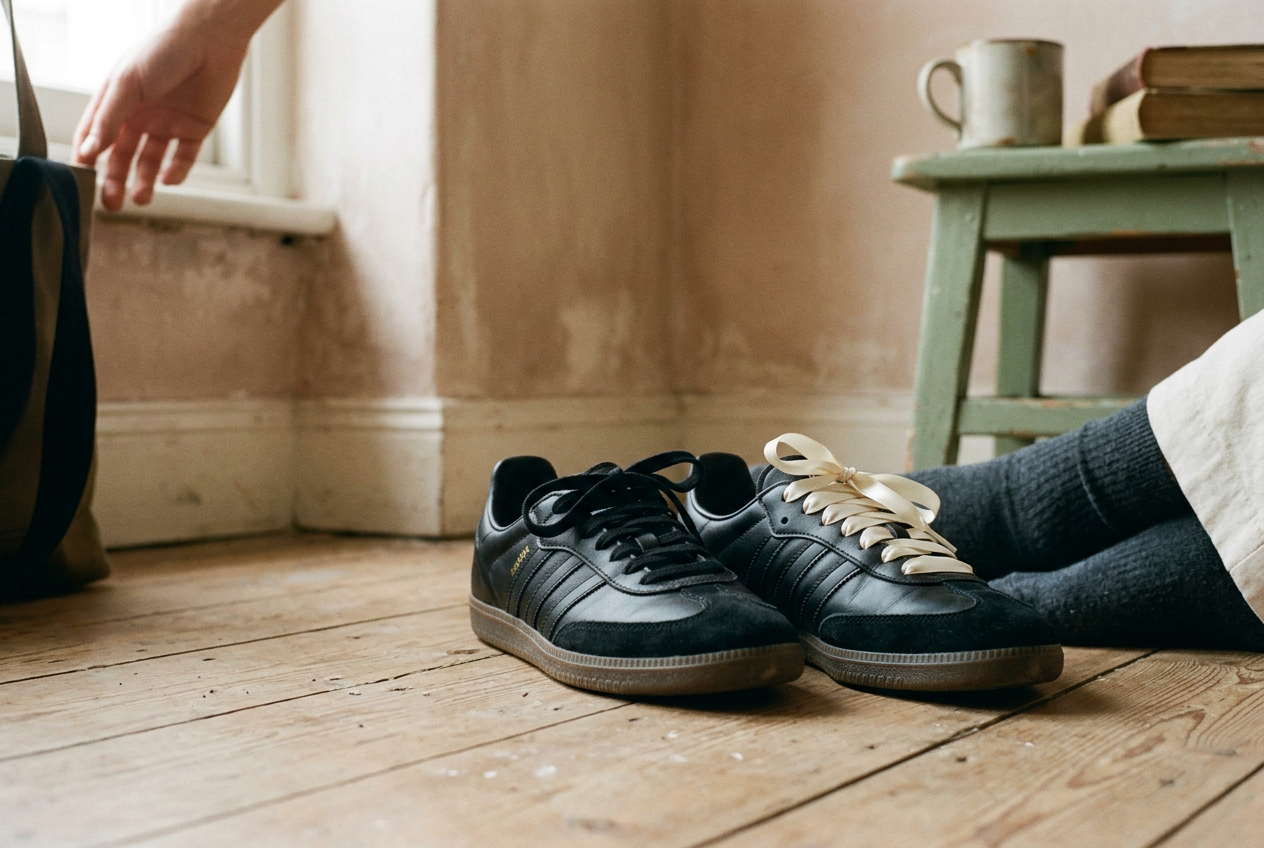
The useful test is a black Adidas Samba OG relaced with ivory polyester satin ribbon, worn with straight dark trousers so that the bow sits visibly over the tongue. It is an easy, unisex styling move: familiar sneaker, inexpensive material, no permanent alteration. It also exposes nearly every weakness in the idea.
The Samba’s punched leather eyelets are sized for a conventional flat shoelace, which compresses as it passes through each opening and springs back once it is tied. Satin ribbon behaves differently. Its smooth face slides, its cut edges can fray, and a width that looks generous in a photograph may bunch where the eyelets narrow, leaving gray rub marks on the ivory surface.
That tension explains why decorative laces are moving beyond boxed customization kits without becoming a straightforward footwear upgrade. Ribbon, contrast cord and patterned tape now work as small styling signals, especially on low-profile sneakers where the upper leaves the lacing exposed. Yet the original shoelace still wins at the dull work of staying tied through a commute.
The material matters more than the color
Polyester satin makes the strongest visual change. It reflects light, holds saturated color and forms a soft, full bow, which is why the ivory ribbon on the black Samba looks intentional rather than like a replacement bought in a hurry. Polyester also absorbs less water than cotton, though surface dirt still shows quickly on pale shades.
Its weakness is friction. Satin has little texture for one layer of the knot to grip against another, so the bow can lengthen unevenly or work loose as the shoe flexes. A double knot improves security, but it compresses the decorative loops into a dense lump and makes the sneaker slower to remove. That may be acceptable for dinner.
It becomes tiresome when the shoes come on and off several times a day.
Grosgrain ribbon, meaning ribbon woven with fine raised ribs across its width, is the more practical decorative option. Those ribs help the knot hold, and the material keeps a crisp bow rather than collapsing against the tongue. The tradeoff appears at the eyelets: a stiff grosgrain edge repeatedly dragged through an unfinished opening can abrade both the ribbon and a delicate leather finish.
Cotton twill tape sits closer to an ordinary lace. It has a diagonal woven texture, takes a knot well and gives a softer, less gift-wrapped effect than satin. It also absorbs rain, street dirt and cleaning products readily, so white or cream tape can look tired before the sneaker itself does. A cotton-polyester blend usually dries faster and holds its shape better while retaining enough surface texture to stay tied.
Flat woven shoelaces remain the dependable answer. Contrast color, checkerboard weaving or an oversized width can deliver most of the trend without asking the shoe to accommodate an unfamiliar material. If the pair will be walked in rather than photographed and removed, this is the least frustrating choice.
Round cord creates a different problem. Waxed cotton cord grips reasonably well and suits leather sneakers with sturdy metal eyelets, but a narrow cord concentrates pressure across the top of the foot and can pull hard against punched leather openings. Slick nylon or polyester utility cord is tougher, yet it may loosen unless the knot is doubled, and its dense surface can act like a small saw when dirt becomes trapped between cord and eyelet.
Velvet ribbon looks rich and holds better than satin because its pile creates friction. The pile also crushes inside tight eyelets, collects lint and can leave dark transfer on pale leather if the dye is unstable. It is a styling material, not the obvious choice for a shoe expected to survive wet sidewalks.
Check the eyelets before buying ribbon
Return to the black Samba. Its relatively small punched openings suit a flat lace that can turn neatly at each crossing; a wide ribbon has to fold or twist, and every forced fold creates a pressure point where the surface will eventually become shiny, fuzzy or discolored.
The safest width is not a universal number. Remove one original lace, fold the proposed ribbon in half and pass the folded section through the tightest eyelet. It should move without scraping or requiring a hard pull. If the ribbon jams while dry and clean, normal walking will not improve the situation.
Metal grommets, the small rings that reinforce some eyelets, reduce contact with raw fabric or leather edges but are not automatically gentle. A rough seam, burr or patch of corrosion can snag satin immediately. Run a cotton swab around the inside of each opening; loose fibers reveal an edge likely to catch ribbon.
Also inspect the tongue. Decorative laces spread load differently, and a thin tongue may wrinkle beneath a wide ribbon rather than lying flat. On the Samba test case, the ribbon looks best when it remains close to the width of the original lace path and is tied with moderate tension. Pulling it hard enough to secure a loose heel defeats the point and can crease the ribbon before the first outing.
Readers who rely on lacing to adjust a wide forefoot, narrow heel or high instep should treat the decorative swap as cosmetic. This unisex advice applies across wardrobes because the mechanical issue is the shoe’s volume, not the department label: a ribbon that does not hold tension consistently cannot replace careful fit adjustment.
A secure bow starts before the knot
Measure the removed lace from end to end rather than relying on a generic chart. Ribbon needs extra length if the intended bow has broad loops, but too much leaves tails that brush the ground and pick up grime. Cut a practice length first. Craft-store ribbon is usually the lowest-cost route, while finished specialty laces cost more because they arrive in matched lengths with sealed ends.
Those sealed ends matter. An aglet, meaning the firm tip at the end of a shoelace, prevents fraying and makes threading easier. Raw ribbon can be finished with a narrow sewn hem or a purpose-made anti-fray treatment; bulky glue creates a hard edge that may scratch the shoe, and exposing synthetic ribbon to an open flame risks melting, fumes and an uneven sharp tip.
Tie the bow so that it sits horizontally. If it rotates vertically, the starting knot may be a granny knot, an unbalanced form made by crossing the same direction twice. Reverse the first crossing, then form the bow as usual. This will not turn satin into a performance lace, but it gives the knot a more stable base without adding another knot on top.
For the ivory ribbon and black Samba, the practical compromise is to keep the crossing tension even, tie a correctly balanced bow, and reserve the pair for days without long walks or repeated removal. The original black or white laces should remain in the shoe box. Swapping back takes only a few minutes and restores the fit adjustment the shoe was designed to provide.
Pale ribbon needs a transfer test
Light ribbon shows dirt from fingers, eyelets and the shoe itself. Black leather polish, loose suede pigment and old grime inside the openings can mark ivory satin during threading, before the sneakers reach the street. Clean the eyelets with a dry cloth first, then lace from the toe upward with clean hands.
Dark ribbon on a pale sneaker carries the opposite risk. Crocking, meaning dye rubbing from one surface onto another, can leave color around the eyelets or across the tongue. Press a damp white cloth against an inconspicuous section of ribbon and rub it several times. Visible color on the cloth is a reason to skip that ribbon on white leather, canvas or mesh.
Do not wash ribbon in place. Water can pull dirt from the eyelets into the material, while detergent residue may mark the upper. Remove the ribbon, hand-wash it according to its fiber type and let it dry flat. Satin may retain creases where it was knotted, which makes replacement more realistic than restoration once the surface has abraded.
This is where the trend’s low price can mislead. A length of ribbon may cost little, but frequent replacement, careful threading and stain checks add time, while damage to a pale tongue or finished leather upper costs more than the accessory. Flat contrast laces offer a quieter result with fewer consequences.
The styling signal may outlast the literal ribbon
The shift worth watching is not that sneakers can be customized; that has been true for years. The newer signal is softer and more integrated, with laces chosen to echo a sock, trouser or bag rather than arriving as part of a maximal kit of charms and attachments.
On the black Samba, ivory satin works because the rest of the shoe remains familiar and the trousers leave only the bow and first crossings visible. Adding lace charms, contrasting socks and embellished pants would make the idea harder to read. One altered component is enough.
Whether satin ribbon becomes an everyday sneaker fixture is less certain. The material asks a functional closure to behave like trim, and daily walking keeps exposing that mismatch. Grosgrain, cotton twill tape and wider flat laces have a better chance of staying because they preserve the textural effect without giving up as much knot security.
Questions people ask
Which decorative sneaker laces stay tied best?
Flat woven cotton or cotton-polyester laces are the most dependable, followed by cotton twill tape and moderately soft grosgrain ribbon. Polyester satin and slick synthetic cord loosen more readily, especially when the shoe flexes heavily, while velvet grips well but wears poorly in tight or rough eyelets.
Can satin ribbon damage leather sneakers?
The ribbon itself is soft, but dirt trapped at the eyelets, hardened finishing glue or repeated pulling through a tight opening can mark finished leather. Wide ribbon may also rub color onto the tongue. Test the fit through the smallest eyelet and check dark ribbon for dye transfer before fully relacing a pale shoe.
How long should replacement ribbon be?
Measure the original lace and begin with that length, then add only enough for the larger bow you want. Eyelet count alone is unreliable because shoe width and lacing pattern change the distance. A practice cut prevents long tails from dragging, and keeping the original laces makes it easy to reverse the swap.
Are decorative laces worth buying?
They are worthwhile when one pair of low-profile sneakers needs a reversible update and the material matches the eyelets. Choose finished flat laces for frequent wear. Craft ribbon is cheaper and more expressive, but on the black Samba example, satin makes the most sense for short, dry outings rather than an everyday commute.
One update a day
Today's fashion update, in your inbox
One fashion update each morning — no hype, no filler, just pieces worth wearing.