Dark Brown Summer Shoes Work Harder With Faded Denim
Espresso and chocolate have moved beyond sandals into sneakers and flats. They soften white, sit comfortably beside navy, and may expose how little work a black summer shoe does.
November 23, 2026 · 7 min read
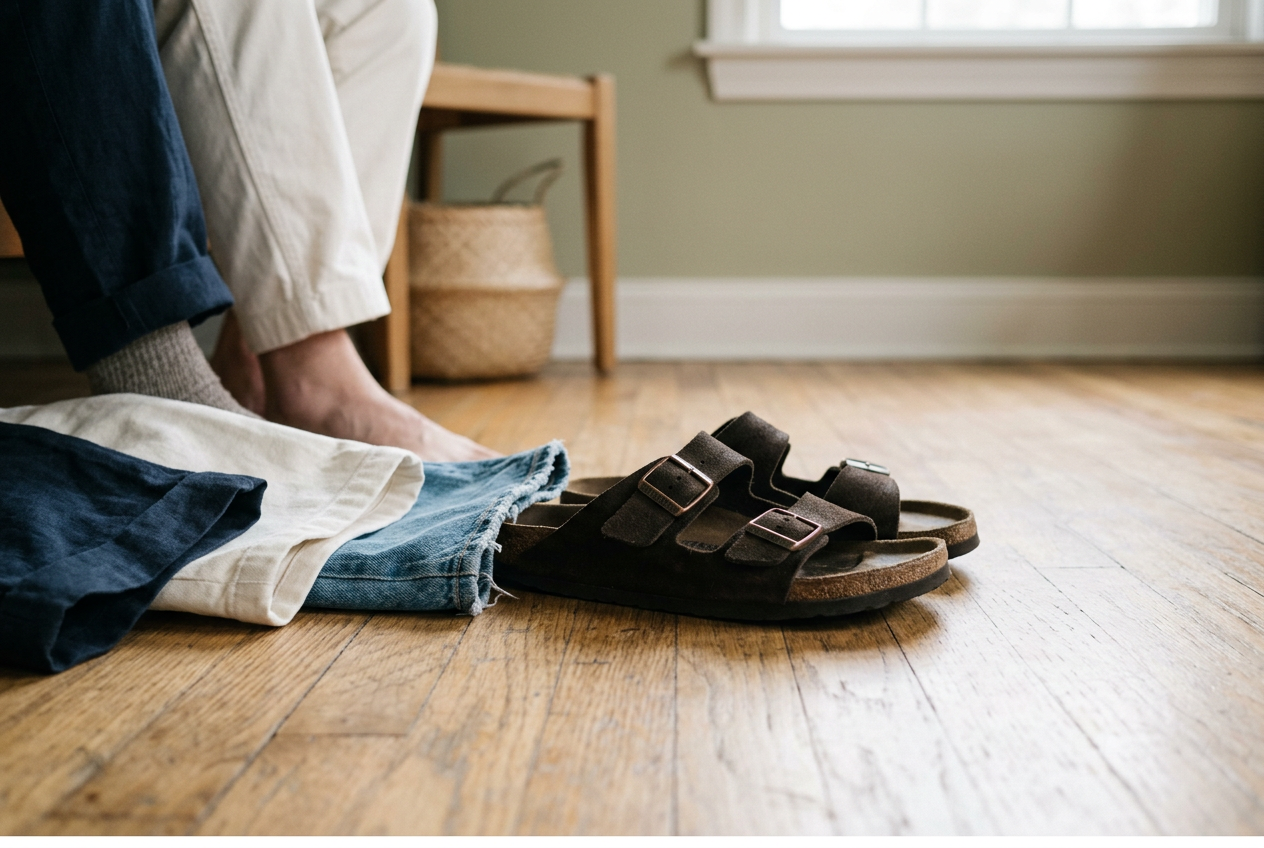
The useful test case is Birkenstock’s Arizona sandal in Habana, a deep brown that is dark enough to perform some of black’s work without looking black from a few feet away. The documented construction matters here: an oiled nubuck leather upper, meaning leather buffed on the outer surface for a soft grain, sits over a cork-latex footbed with suede lining and an EVA sole.
That combination shows both the appeal and the inconvenience of the brown shift. Habana develops lighter creases and variations as the leather flexes, so the sandal gains visible character rather than holding a flat, graphic color. A black leather Arizona looks more definite and tends to disappear under a black trouser hem; the brown pair stays present, especially beside white cotton or pale denim.
This is unisex coverage. The color advice travels across wardrobes, although shoppers should still check whether a shoe is sold in regular/wide or medium/narrow sizing rather than assuming the same labeled size means the same platform width.
Brown has spread beyond the obvious sandal
A dark brown leather sandal is hardly new. What has changed is the breadth of the assortment around it. Espresso, chocolate, tobacco, cacao, umber, and brand-specific shades now appear on retro sneakers, minimal leather trainers, ballet flats, mesh flats, loafers, and thin-soled sandals at the same time.
Color names are unreliable evidence on their own. One brand’s espresso is nearly black, while another uses the word for a warm reddish brown that behaves more like cognac. Product photographs shot against white backgrounds can also lift the color, particularly on suede, so the useful details are the upper material, edge finish, sole color, and photographs showing the shoe on a foot.
The spread across categories is more persuasive. Brown is not confined to a woven vacation sandal that a retailer can drop after August. Adidas and other sneaker brands have continued to use earth shades across terrace-style shoes, the low-profile designs associated with indoor soccer and stadium culture, often pairing brown suede with a gum rubber sole. Ballet flats and loafers have taken up the same palette in leather, suede, and mesh, while sandal assortments extend it from substantial cork footbeds to narrow straps.
Still, this is not a wholesale replacement for black. It is an expansion of the useful-neutral shelf, and some brown shoes duplicate an existing black pair so closely that the purchase only makes sense if the rest of the wardrobe favors softened color.
The material decides whether brown looks rich or tired
Dark brown exposes surface behavior. On the Habana Arizona, the oiled nubuck can show lighter marks where the straps bend or brush against something, and Birkenstock’s care guidance for its materials is worth following rather than treating the pair like washable beach shoes. The cork should not be left to dry out, while soaking the suede-lined footbed or putting the sandals near direct heat risks damaging materials that respond differently to water.
That maintenance is part of the look. If the appeal is a perfectly even espresso block, smooth leather or a coated upper will hold the idea more cleanly than oiled nubuck. Suede gives brown depth but collects pale dust around the toe and along the edge, which is noticeable with white trousers. Mesh flats avoid much of the creasing, although a brown mesh upper can reveal the toes and lining in a way black mesh disguises.
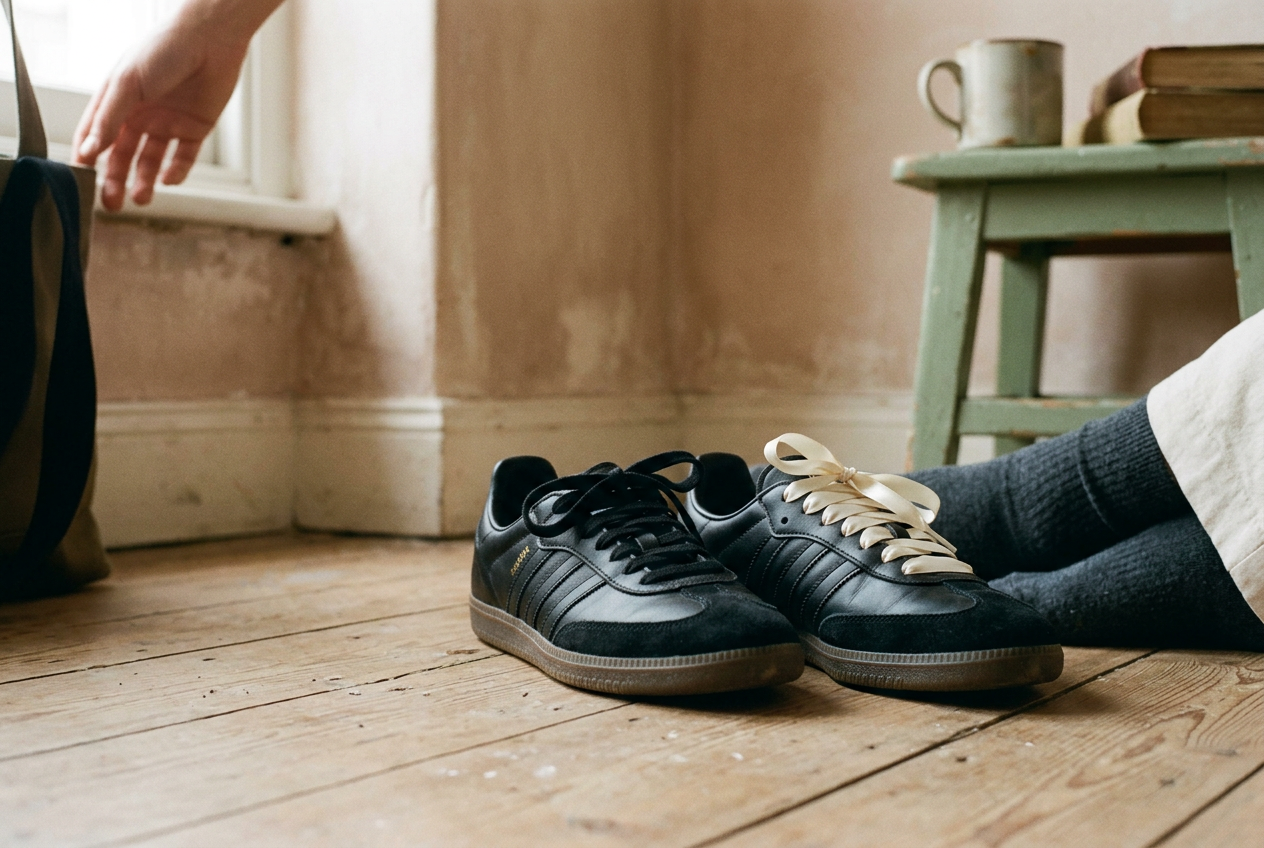
Sneakers present another tradeoff. A chocolate suede upper with a gum sole usually reads warm and retro, while the equivalent shoe in black leather can look cleaner, more urban, and easier to wipe down. The brown version also tends to have less visual distance between upper and outsole, which makes a low-profile sneaker look flatter and more casual. That is useful with loose jeans.
It may feel too subdued under tailored navy trousers.
At the lower end of the market, brown synthetic material can reveal its limitations at cut edges and flex points, where a lighter base may show through. Black usually hides that wear better. A shopper comparing two otherwise similar flats should bend the forefoot gently, inspect the edge paint around the opening, and look at the heel seam; dark brown earns its place when the finish remains deep rather than flashing orange or gray.
Navy is the strongest argument for buying brown
The Habana Arizona beside navy cotton trousers gives the trend a practical reason to exist. Black sandals can work with navy, but the combination creates a hard interruption at the foot, particularly when the trouser is washed, matte, or relaxed rather than sharply tailored. Deep brown lowers that contrast while keeping enough weight to anchor the hem.
Undertone matters. An espresso that leans neutral or slightly cool sits easily with inky navy, whereas a reddish chocolate introduces more color and can pull attention downward. That warmer version is better with navy linen, chambray, or visibly faded cloth than with a formal suit fabric.
Shape matters too. A broad cork sandal in brown supports casual navy trousers because both pieces have visual substance. A fine chocolate ballet flat under a wide navy trouser can disappear, especially when the hem nearly touches the ground, so a square or almond toe gives the color a clearer outline. With shorts, brown leather reads less sporty than a black technical sandal but more grounded than tan.
For someone whose summer wardrobe contains several navy bottoms and almost no black clothing, dark brown fills a real gap. It connects the clothes without requiring a matching brown belt or bag. Exact matching can make the outfit look overmanaged; repeating the warmth once, through tortoiseshell sunglasses or a woven bag, is enough.
White reveals the difference between soft and sharp
White clothing makes the black-versus-brown decision immediate. Black footwear draws a firm line, which can be useful when the outfit includes another black element or relies on graphic contrast. Dark brown keeps the outfit defined but removes some severity.
The Arizona in Habana works under white jeans because the open design leaves skin between trouser and sandal, preventing the broad brown straps from becoming a solid block. Under a long white skirt, the same sandal can look heavy if the hem hides most of the foot. A slimmer strap, lower-profile sole, or dark brown ballet flat handles that proportion more quietly.
Care becomes less theoretical around white. Oiled leather and suede can transfer residue when new or damp, and dark footbeds may mark pale hems that drag across them. A cautious first wear with cropped clothing costs little time and shows whether the material sheds color. Black can transfer too, but brown marks on white are often interpreted as dirt rather than dye.
A brown sneaker with white socks creates a deliberate break between shoe and leg, while black can make the same sock look more athletic or uniform-like. Off-white socks reduce the contrast further. The move succeeds when the sneaker has some light detail in its sole, stitching, or stripes; an entirely chocolate shoe below bright optical white can look visually dense.
Faded denim makes brown easiest to justify
Faded denim is where espresso and chocolate outperform black most consistently. Blue jeans lose saturation through wear and washing, and a dark brown shoe meets that softened surface without forcing the denim to look darker or cleaner than it is.
The effect is clearest with retro sneakers. Brown suede, cream detailing, and gum rubber belong to the same muted register as stonewashed blue, so the shoe looks integrated even when the jeans pool slightly over it. A black sneaker remains useful, though it creates a firmer endpoint and often looks better when the denim is dark, rigid, or cut close to the ankle.
Brown flats also solve a familiar transition problem. A black ballet flat with pale jeans can feel prim unless the rest of the outfit repeats black; chocolate leather is less formal and does not require that repetition. Toe shape then becomes the deciding detail. A very round brown flat may drift toward vintage sweetness, while an almond or softly squared toe keeps the shoe current without depending on the color trend alone.
The Habana Arizona returns as the most instructive version because its visible grain echoes worn denim rather than competing with it. That does not make it the universal answer. The cork sole adds casual bulk, the footbed needs time to mold to the wearer, and the two straps require adjustment so the foot stays centered rather than gripping with the toes. Anyone seeking a shoe for long polished trousers, restaurant floors, and occasional rain may get more use from a closed leather flat or sneaker.
The wardrobe-gap test takes ten minutes
Pull out the black summer shoe that the brown pair would replace, then set it beneath the navy, white, or faded-denim bottoms worn most often. Photograph each combination in daylight. If black repeatedly looks too abrupt, brown has a defined job; if black already relates to a bag, belt, print, or sunglasses in most outfits, the new pair is probably duplication.
Next, compare materials rather than color swatches. An espresso suede sneaker does not substitute for a black leather flat in rain, at work, or in cleaning effort. A brown smooth-leather loafer may. The closer the construction, coverage, and sole thickness are to the existing shoe, the stricter the color test should be.
Price should follow frequency. Dark brown is now available from mass-market synthetic flats through welted leather loafers and designer suede sneakers, so there is no need to pay an investment-level price merely to access the shade. Spend more when the upper can be maintained, the sole suits the distances walked, and the shape still works if black returns to prominence.
For the Habana Arizona specifically, the purchase makes sense for a wardrobe built around washed blue denim, navy casual trousers, and warm whites, provided visible leather variation is welcome. Someone who wears crisp black-and-white clothing, needs easy wet-weather care, or dislikes a footbed that records wear has not found a gap. They have found a second neutral.
Questions people ask
Is dark brown more versatile than black for summer shoes?
It can be for wardrobes centered on navy, warm white, and faded denim because brown lowers contrast without becoming pale. Black remains more useful with graphic prints, black tailoring, cool white, and evening clothes. Versatility depends less on the trend than on which dark color already repeats through the closet.
Which dark brown shoe should I buy first?
Start with the category already worn most: a sandal for open-toe daily dressing, a sneaker for walking, or a flat for covered-foot outfits. Choose smooth leather for easier cleaning, suede for depth and softness, or oiled nubuck if visible creasing and color variation are part of the appeal.
Does dark brown work with navy without a matching bag?
Yes. A neutral espresso or deep chocolate can sit beside navy without another brown accessory, especially when the clothing is matte or washed. If the shoe is reddish, one small warm element such as tortoiseshell frames can make the shift feel intentional, but an exact match is unnecessary.
Will dark brown shoes look dated when black returns?
A restrained shape in leather, suede, or canvas is unlikely to depend entirely on one season’s color direction. Highly specific combinations, such as a very thin retro sole with contrasting cream trim, may date faster. The safer purchase is a shape already proven in your wardrobe, recolored in brown.
One update a day
Today's fashion update, in your inbox
One fashion update each morning — no hype, no filler, just pieces worth wearing.