Fisherman Sandals Are Getting Slimmer, but the Soles Give Up Support
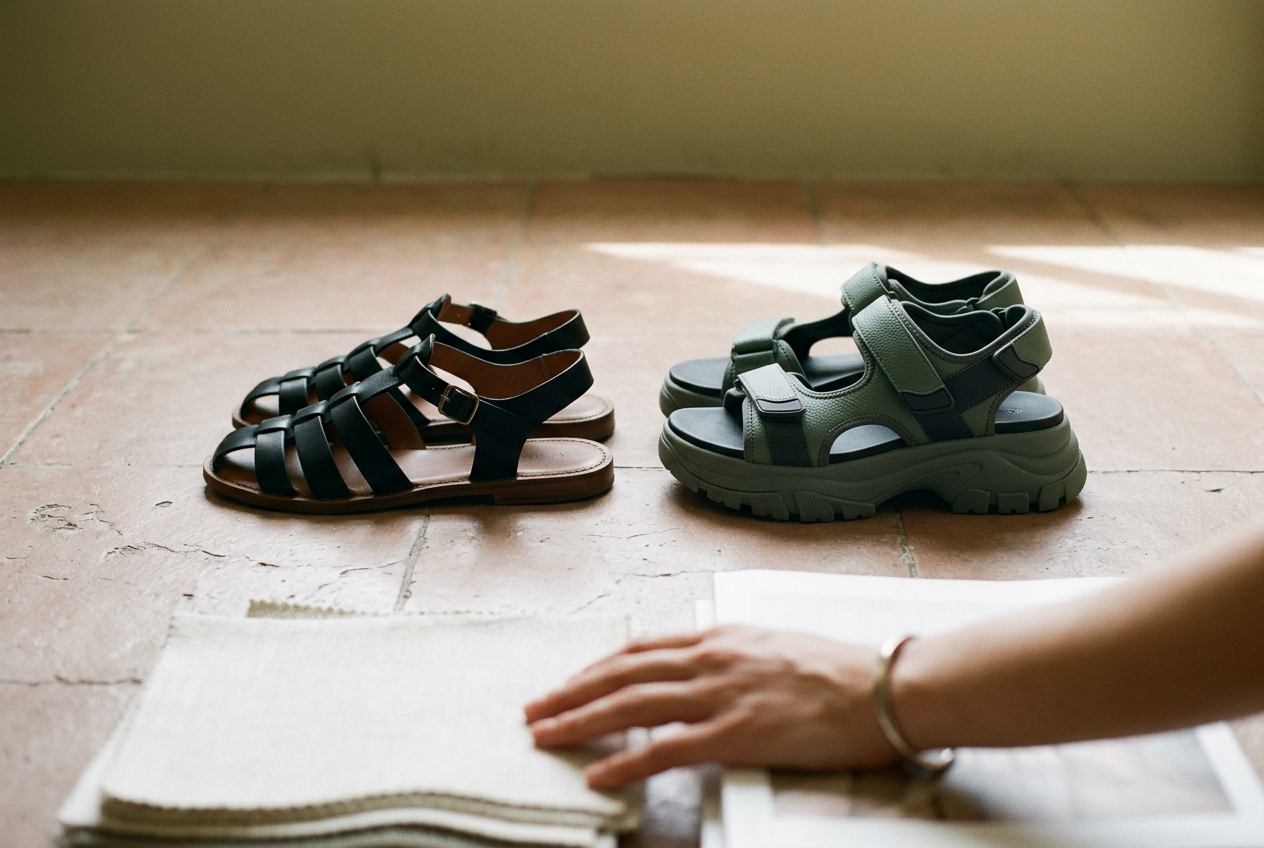
Low-profile cages now sit beside the lugged fisherman sandals that dominated recent summers. The slimmer shape works under wider trousers, though the flattest versions can feel unforgiving on a long walk.
Women's · September 7, 2026 · 7 min read
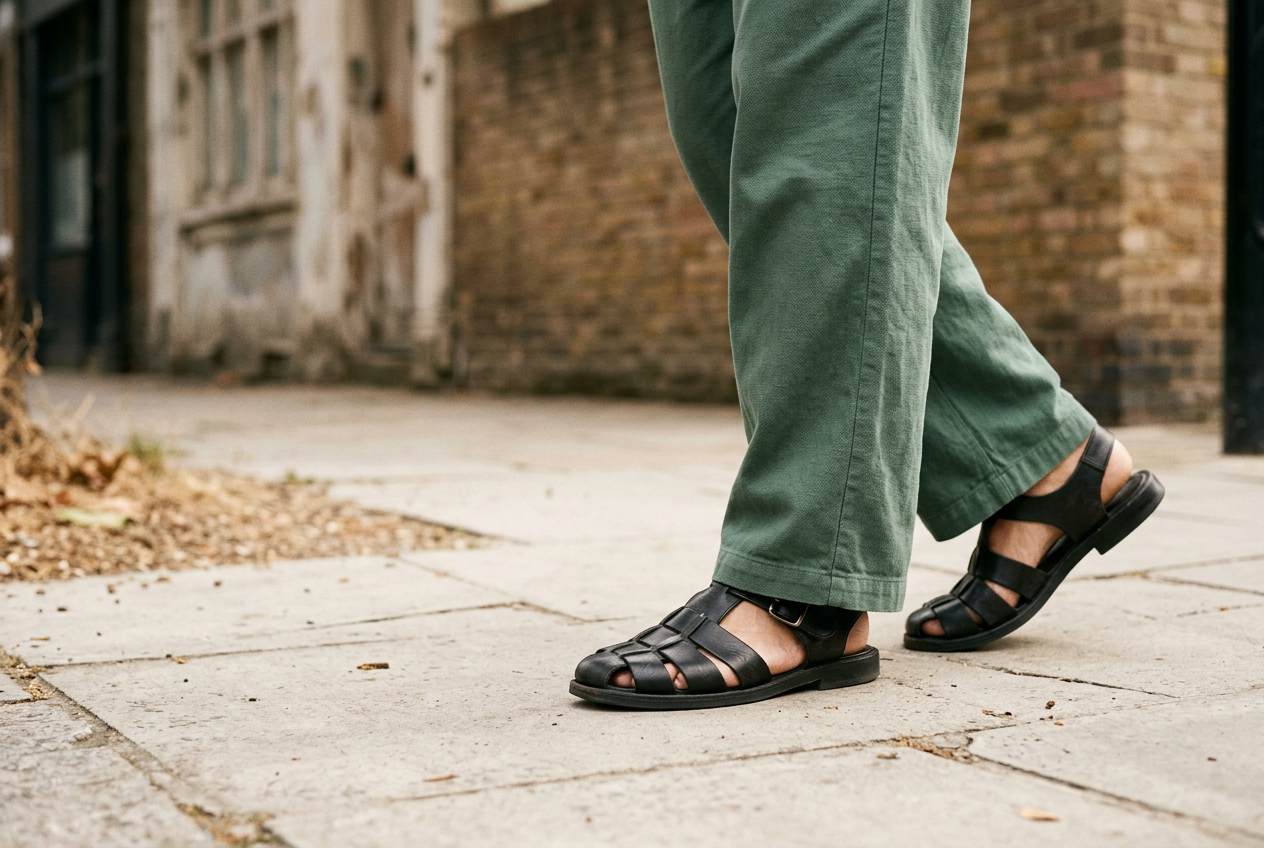
The useful comparison is J.Crew’s Winona fisherman sandal in leather, a low-profile women’s style with a closed cage, ankle strap and rubber outsole. It retains the familiar fisherman structure while removing most of the visual weight that defined the lugged versions seen across the high street over recent summers.
That one change matters more than it sounds. A heavy fisherman sandal sits outside an outfit, visibly bracketing the foot with thick straps and a deep tread. The Winona type sits closer to the line of a plain leather flat, which lets a wide trouser fall past it without bunching on a projecting sole or appearing abruptly narrow at the ankle.
Mainstream retail is not conducting a clean replacement. Slimmer leather cages have become easier to find alongside substantial versions at J.Crew, Madewell, Mango, Zara and COS, while Dr. Martens and comfort-led shoe brands continue to make a case for thicker soles.
The direction is visible, but the old sandal has not disappeared. The category has split according to what the sole is expected to do.
What changed below the straps
A fisherman sandal is defined by its cage, the interlaced or parallel leather straps that enclose much of the forefoot while leaving openings for air. On the chunkier version, that cage usually meets a broad welt and lug sole, meaning an outsole molded with deep projections for grip. The straps may be wide enough to match the scale of the base.
The slimmer version edits all three elements. Its straps are narrower, the edge around the foot is less pronounced, and the outsole has a shallower tread. Viewed from the side, the difference is immediate: the sandal no longer adds a dark horizontal platform beneath the foot.
The Winona is a useful anchor because its leather upper and rubber outsole avoid two shortcuts common at the cheapest end of this trend. A synthetic upper can look neat in a product image but may resist softening where the cage crosses the little toe, while a hard, smooth plastic outsole can reduce both flexibility and grip. Leather is not automatically comfortable, yet it has a better chance of easing around pressure points if the lining and strap edges are finished cleanly.
Rubber also allows a thin sole to bend without becoming quite as exposed as a leather dress-shoe sole. It cannot create cushioning from nothing. If the footbed has little foam and no shaped support, the wearer still feels pavement through the sandal after the initial softness of the upper has settled.
Wide trousers explain the shift
Trouser volume has moved the styling problem. Full-length wide-leg pants, relaxed tailoring and jeans with a generous hem can overwhelm a delicate open sandal, but they do not always cooperate with a lugged fisherman either. A deep sole catches the inside of a low hem, particularly when the trouser is cut to skim the floor in the shoes used at fitting.
A Winona-scale sandal solves that mechanical issue. Its closed toe gives the hem a visible endpoint, unlike a narrow flip-flop that can disappear under fabric, while the low sidewall lets cloth pass over the shoe with less resistance. Black leather is the easiest pairing because the cage reads as one shape from a standing distance; tan or cream exposes every gap between the straps and appears busier below a patterned trouser.
The slim fisherman works best with a wide hem that nearly covers the ankle strap. It also suits a straight trouser cropped just above the ankle, where the smaller sole keeps the leg line continuous rather than placing a platform at the bottom. With a barrel-leg pant, the answer is less settled. A curved trouser that narrows sharply at the ankle often needs the ballast of a chunkier shoe, and a very thin fisherman can make the fabric above it look more inflated.
That is the buying distinction for women’s wardrobes: full and long favors slim; cropped and sculptural can still favor lugged. Skirt styling follows a similar logic. A fluid midi usually benefits from the quieter sole, while a short, rigid skirt can take the heavier base without losing proportion.
The cage can be slim without being narrow
The visual trend carries a fit trap. Narrower straps do not guarantee a narrower footbed, but retailers sometimes reduce both, producing a tidy cage that pinches across the forefoot. The pressure tends to appear where the outermost strap crosses the little-toe joint and where the central straps meet the vamp, the upper section covering the top of the foot.
Product photographs from above are more useful than angled campaign images here. The footbed should remain visible outside the cage at its widest point, and the front straps should not converge so aggressively that they form a pointed channel. A person with a high instep should also look for adjustability beyond the ankle buckle. That buckle secures the heel; it does not loosen a fixed leather cage over the midfoot.
The Winona construction illustrates the compromise. Its ankle strap can control heel movement, but the enclosed forefoot still has to fit before any softening begins. Going up a size may add length without placing the straps correctly over the toe joints. If the cage looks taut while standing, waiting for leather to stretch turns a sizing problem into a break-in project.
Bare feet add another variable. Narrow strap edges concentrate friction into smaller areas than broad straps do, especially during the first few wears or once the foot swells in heat. Check the underside for raised seams and exposed edge paint. A clean lining matters more than decorative polish on top.
Thin is not the same as flexible
The comfort loss arrives when brands treat low profile as a reason to remove the working parts of a sandal. A thin rubber outsole can walk well if it bends at the ball of the foot, has a little heel cushioning and sits under a footbed that is not entirely flat. A thin but rigid sole forces the foot to lever against it. A soft sole with no structure may feel pleasant indoors, then transmit every uneven paving edge.
Chunky fisherman sandals have their own failures. Deep soles can be heavy, and a stiff platform may slap at the heel if the ankle strap is loose. Their advantage is space: a thicker construction gives a maker room for cushioning, a supportive footbed and deeper tread, even though not every brand uses that room well.
This is where the slimmer trend is least convincing. The most reduced versions can sacrifice walking comfort to achieve the profile of a ballet flat, despite enclosing the foot like a more substantial shoe. After several days, leather straps may soften; the sole will not develop arch support it did not have at purchase.
For a commute followed by mostly seated hours, the trade can make sense. For a city break or a day spent crossing hard floors and pavement, look for a modest rubber sole with visible tread and a footbed that rises slightly under the arch rather than the thinnest edge available. That middle construction keeps most of the new silhouette without asking the foot to absorb the whole route.
The price check belongs inside the shoe
Slim fisherman sandals now cover the span from high-street impulse purchase to leather footwear priced above a decent pair of sneakers. The clean silhouette does not reveal much about value, because fewer visible components can still conceal a lined upper, stitched edges and a properly attached rubber outsole, or disguise a flat synthetic unit that is difficult to repair.
At the lower end, inspect the point where the cage enters the sole. Straps merely trapped between glued layers can be hard to fix once they pull free. A stitched or securely channeled upper is a better sign, though stitching around the perimeter does not prove the entire shoe is sewn together. Brand documentation should identify the upper, lining and outsole separately; “leather sandal” may refer only to the most visible layer.
The J.Crew Winona makes sense as a silhouette reference rather than an automatic verdict. Its leather-and-rubber specification clears the basic material test, and its restrained sole fits the trousers currently occupying more closet space. The remaining decision is personal and physical: whether that fixed cage matches the width and height of the foot.
I would not discard a comfortable lugged pair to buy the slimmer outline. Its larger sole is fading as the default fashion signal, yet it remains the practical alternative for a wearer who needs cushioning or repeatedly pairs sandals with ankle-baring, structured pants. For a new purchase intended to sit under long, wide trousers, the slimmer leather cage is now the more useful direction. Avoid taking “slim” all the way to paper-thin.
Questions people ask
Are slim fisherman sandals comfortable for all-day walking?
They can be, but the narrow profile is not evidence of comfort. Look for a flexible rubber outsole, some cushioning under the heel and a footbed with light shaping. A completely flat, rigid sole may work for short trips, while a modestly thicker version is a safer choice for hours on pavement.
Do fisherman sandals work with wide-leg pants?
A slim fisherman sandal works particularly well under full-length wide-leg pants because its closed cage remains visible while its shallow sole is less likely to catch the hem. Keep a chunkier pair for cropped barrel trousers, where a heavier shoe can balance the volume above the ankle.
Should fisherman sandals fit tightly at first?
No. Leather may relax across the toes, but the cage should not press hard into the little-toe joint or top of the foot while standing. The ankle buckle can stop heel slip; it cannot correct a forefoot that is too narrow, and sizing up may only add unwanted length.
Are lugged fisherman sandals already dated?
They no longer look like the only current option, but they are not obsolete. A lugged sole still earns its place when it supplies useful tread, cushioning or balance beneath a cropped trouser. The versions that look most tied to the earlier cycle are those combining an oversized platform with an equally bulky cage.
One update a day
Today's fashion update, in your inbox
One fashion update each morning — no hype, no filler, just pieces worth wearing.